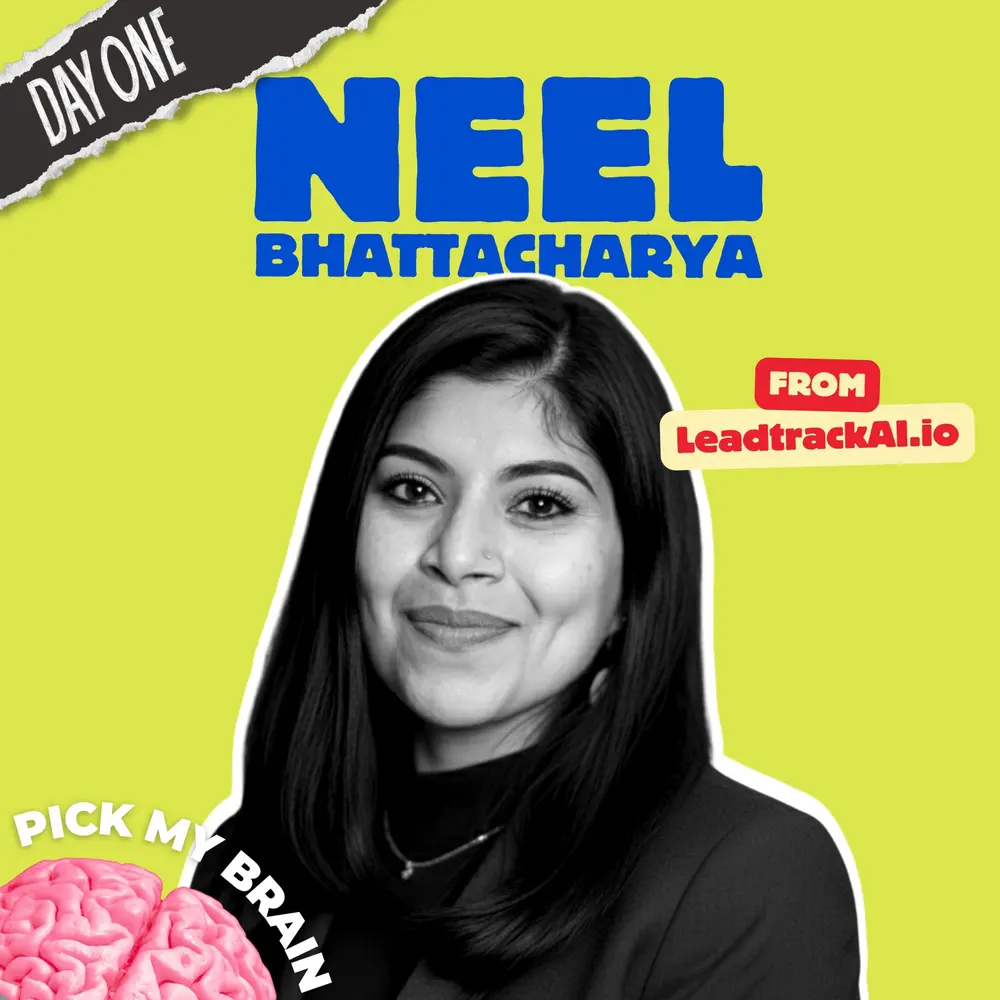
Neel Bhattacharya is the founder of LeadTrackAI, a platform built to solve one of the most common and costly problems in sales: leads that go cold because nobody followed up fast enough. After more than a decade in product management across the energy sector, Neel built an AI voice agent that calls a new lead the moment they submit a form, speaks just like a real person, and qualifies them before handing them off to a human salesperson.
Neel started with solar and battery installers, an industry she knows intimately, and has since expanded into automotive. In this episode, Neel joins Alan to talk about the very real challenge of being a solo founder spread too thin, why documenting your own sales process is just as important as building the product, and how to decide whether to go deeper into one industry or wider into new ones.
Alan also shares a genuinely useful productivity framework and a tool recommendation that any solo founder drowning in admin will want to steal.
Pitch Alan. Book your spot. Bring your founder pitch to Pick My Brain. Alan will pull it apart — kindly — and help rebuild it into something investors can’t ignore.
Apply to pitch Alan
Chapters 1:27 Neel's origin story: from wanting to be an architect to a decade in energy product management ▶ 3:01 Why Neel left corporate to become a founder ▶ 3:44 Who LeadTrackAI is for and the problem it solves for solar and battery resellers ▶ 5:06 How the AI voice agent works: calling leads the moment they come in ▶ 6:32 Why a fresh, qualified lead is worth more than ten cold ones ▶ 7:01 Where LeadTrackAI is today: three large customers and expanding to Sydney ▶ 8:55 Why every call is transcribed and how that builds an audit trail for regulated industries ▶ 9:57 The founder's trap: chasing shiny objects instead of documenting what works ▶ 11:27 Alan's four-quadrant framework for prioritising urgent vs important tasks ▶ 14:28 Why SOPs and financial admin always end up in the "important but not urgent" pile ▶ 16:01 Using AI to observe your own work as a founder, not just to build product ▶ 17:39 Neel's big question: go deeper into solar and automotive, or go wider into new industries ▶ 18:17 Alan's advice: run a cheap landing page experiment before committing to a new vertical ▶ 22:31 Why charitable and nonprofit donation pipelines could be the next great use case for LeadTrackAI ▶ Transcript Search or select a timestamp to jump ▾ 0:00 Neel Bhattacharya: They follow up with these leads about like 2 to 3 days later down the line when the leads have already, you know, sort of forgotten that they ever submitted a form. 0:08 Alan Jones: Yeah. 0:08 Neel Bhattacharya: So I built this agent which talks just like you and me, picks up the phone as soon as the lead comes in and calls the customer. 0:15 Alan Jones: I saw the demo on your landing page. 0:17 Neel Bhattacharya: Oh, awesome. 0:18 Alan Jones: It sounds just like, you know, a regular male Australian person calling up the customer and asking the questions that the business would need to price up a quote on some panels. on a battery, right? 0:32 Neel Bhattacharya: As founder, you're pulled in so many different directions, you don't know where to focus on, and you always chase the shiny new object or you chase the dollars, right? 0:41 Alan Jones: And you hide from the things that you don't like or that you're not very good at. Be careful of the things which are urgent but not important because we feel like we're making progress, and often those things are really quick to tick off. My name's Alan Jones, and we're here today at the beautifully green offices of the Cremorne Digital Hub right here in Richmond. the heart of Melbourne's startup scene, for this and a few other episodes of the show. Thank you for Cremorne Digital Hub for hosting us and for doing all the equipmenty things. 1:15 Ad: You're listening to a dayone.fm show. 1:18 Ad: Founders scale faster on Deel. Set up payroll for any country in minutes, hire anyone anywhere, get visas handled fast, and get back to building. Visit deel.com/dayone. That's D-E-E-L.com/dayone. 1:43 Ad: Wondering how your AppSec program really stacks up? Golar Cyber's Application Security Assessment gives you a quick 10-minute pulse check built around the 5 core principles of AppSec: inform, integrate, influence, innovate, and iterate. In just 10 minutes, you'll get a clear snapshot of your maturity across each of these principles, along with practical insights you can put to work straight away. Head to glasscyber.com.au/assess and take the assessment today. That is glasscyber.com.au/assess. 2:14 Alan Jones: I'm joined today by Neel Bhattacharya. Neel, you are the founder of leadtrackai.io, aren't you? 2:26 Neel Bhattacharya: Yeah, absolutely. 2:27 Alan Jones: Cool. Well, thanks for coming on the show. When you were, you know, young, when you were 8, 10 years old, what did you think you wanted to be when you grew up? 2:37 Neel Bhattacharya: When I was 8 or 10 years old, all I wanted to be was an architect because I was growing up in a colony of engineers and architects was the only profession I thought, unless people fell sick and went to doctors. 2:49 Alan Jones: So 2:50 Neel Bhattacharya: I really wanted to be that. 2:52 Alan Jones: What did your parents want you to be? Did they want you to be an architect too? 2:55 Neel Bhattacharya: They were okay with it, but because my dad wasn't from the stream, he was very apprehensive about the profession. He thought it's like dirty sites you have to go and to do all of these things, not the fancy looking buildings that I imagined. 3:10 Alan Jones: Not a nice air-conditioned office. 3:11 Neel Bhattacharya: Yeah, absolutely. So yeah, I was sort of dissuaded from pursuing and they were more pushing towards like a nice clean MBA degree and a desk job sort of thing. Yeah. 3:23 Alan Jones: You're such a disappointment to your parents. And what were you doing immediately before you became a startup founder? 3:29 Neel Bhattacharya: I spent about like more than a decade in corporate environment, mostly with energy organizations in the product management capacity. So I was basically streamlining their, you know, or designing the product roadmap for these enterprise clients, understanding the bottlenecks, understanding their roadblocks, how to scale, where to, you know, push their next investments in, and, you know, how can basically they make more money. 3:57 Alan Jones: So why quit that and become a startup founder? 4:00 Neel Bhattacharya: It's basically, you know, I'm not tied to the chair anymore. Okay. I can do my own thing because as a part of working with a lot of these enterprise clients, what I understood that there is the same bottleneck which happens with most businesses. Now startups really have deep pockets. They can, you know, engage with a lot of, you know, think tanks to, you know, elevate their problems. But then small businesses are the ones which need support. And if I can use any of my acumen and my experience to be able to help them, there's nothing like it. All right, great. You know, I feel gratified. 4:34 Alan Jones: Great. Who's the ideal customer for LeadTrackAI.io, and what are they using your product to solve? 4:43 Neel Bhattacharya: Yeah, so the ideal customers for LeadTrackAI.io essentially is, you know, any businesses which is sustainably minded. I started off with solar companies just because of my background with energy. I knew them, you know, like the back of my hand. Solar energy companies. Yeah, solar energy companies. 4:57 Alan Jones: Panels and batteries and things. 4:59 Neel Bhattacharya: Yep, solar energy battery. Also, it allows me to sort of support the sustainability, you know, goals for Melbourne. So that 2030 is one of my targets. And 5:13 Alan Jones: what problems are you solving somebody selling panels and batteries? 5:17 Neel Bhattacharya: Yeah, absolutely. So what we solve is at scale, we help them convert the leads better, which means most of these businesses I've seen, they spend a lot of budget in basically to do their, run their ads, the Facebook ads, the marketing engine basically costs a lot of money for them. But at the same time, the teams are very lean. So they face a problem in terms of converting them at scale when teams are deployed across the city and they don't have the bandwidth to be able to do that. They follow up with these leads about like 2 to 3 days later down the line when the leads have already, you know, sort of forgotten that they ever submitted a form. So, so then I started working with one of my clients basically to convert these leads better. So I built this agent which talks just like you and me, picks up the phone as soon as the lead comes in and calls the customer. 6:05 Alan Jones: I saw the demo on your, on your landing page. 6:07 Neel Bhattacharya: Awesome. 6:08 Alan Jones: Sounds just like a regular male Australian person calling up the customer and asking the questions that the business would need to price up a quote on some panels and a battery, right? 6:22 Neel Bhattacharya: Yeah, absolutely. 6:23 Alan Jones: Okay, cool. So does that solve a problem for the reseller because they're getting leads in from, say, Metsoff on Facebook and they can't staff up that, that role sufficiently to handle the demand that they have coming in. 6:41 Neel Bhattacharya: Yeah, absolutely. Because they don't spend as much budget which would allow them to have a full-time employee just to sit there and convert the leads. And also the sales agent need to be trained up, right? So it is very difficult for them to always employ somebody who's experienced, who has, you know, that kind of experience to be able to talk with the customers, know the product, you know, back and front and also be able to write, you know, fantastic emails, SMS the customers and so on. So what we do is to, we have automated a part of that dirty job, which nobody likes to do. And then we book appointments. Now that their trained agent can come in and just speak to the customer because the customer is really interested. So they don't waste their time chasing like 10 different leads. They spend their time only on one lead, which is ready to buy. 7:31 Alan Jones: Okay. So a fresh lead is a good lead. Absolutely. Okay. So we're setting people up for an in-person appointment, for somebody to come out with a tape measure and visit you on site and take a look at your roof and so on and so forth. So we're not trying to take people all the way through the sales cycle, just that tricky bit where leads come in and they need to be qualified and information needs to be provided so somebody can come out and visit. Okay, I get that. I get that. Great. So how's it going so far? 8:00 Neel Bhattacharya: It's going great. Like the customers we've been working with, we have— 8:03 Alan Jones: How many? 8:04 Neel Bhattacharya: We have about 3 large customers and we are working our way through. We are doing a couple of POCs all across town and we're working our way through a couple 8:15 Alan Jones: of people. 8:15 Neel Bhattacharya: Yes, yes. And that's exactly where we are. And for the customers we're working, we have got about 2 solar customers and 1 enterprise automobile customer, which is spread across Melbourne at this stage, and they are looking to scale to Sydney as well. 8:32 Alan Jones: Okay. And are you using your AI to go out and reach out to potential customers and get that appointment for you? Or are you just picking up the phone and ringing people? 8:41 Neel Bhattacharya: I'm picking up the phone and ringing people. I'm 8:43 Alan Jones: disappointed. I think you need another AI. I've got an AI for you. 8:47 Neel Bhattacharya: And the only reason is because I know their customer problems. And we have like a, you know, I think a 50-page wiki for our customers, but I still have to go and make that for my own business. 9:03 Alan Jones: Yep. Yep. So founder-led sales is always really good to make sure that you are understanding the customer and their problems and make sure that you've got a good solution that matches, you know, exactly what they're looking for better than your competitors do. But yeah, you're right. Like at some point you need to document those parts of the sales process that are working when you do them and then study them and see if those processes can be handed off, those scripts or those common answers to common objections, and to make sure that they can all be handed off to the next salesperson you hire and the next salesperson so that one day there's 30 salespeople working for you and they're all working from the same set of sales training materials that you've created. Do you get to spend any time documenting some of that yet? 9:54 Neel Bhattacharya: Yeah, absolutely. So we have like an interesting part of the tool or the process that we have built. It auto-documents everything, which means every call that the customer has or AI speaks to, whether or not it converted or not, we transcribe every single call. So not only that helps with the SOPs or the process documentation, it also helps with the audit process, which is very important for regulatory industries like say solar and automobile and EVs because everything needs to, they need to have a trail Yep. 10:28 Alan Jones: So I understand like that's for our, for your customers, the customers of, um, sales-track.ai, no, ai.io. LeadTrack. Right, LeadTrack, that's right. But, um, we need that for, for our startup too, right? So, so how are you going with spending time studying your own transcripts of your sales conversations and making sure that you're building a playbook for your future sales team? 10:56 Neel Bhattacharya: Yeah, I've started the process. I've not been, you know, extremely great with it because diligent with it. And the reason is, as founder, you're pulled in so many different directions, you don't know where to focus on. And you always chase the shiny new object or you chase the dollars, right? 11:13 Alan Jones: And you hide from the things that you don't like or that you're not very good at. 11:17 Neel Bhattacharya: Yeah, yeah. And it falls into that admin bucket. But definitely this is a great reminder for me to, you know, start pulling up my socks in that direction. 11:25 Alan Jones: So we all have an unlimited to-do list. in the startup world, don't we? I have an unlimited to-do list as well. If my venture partner Emily is watching or listening, I know that she knows, and I know I've got that list and you've got your list and I'll get to them, Emily. I promise I will. 11:40 Ad: Founders scale faster on Deel. Set up payroll for any country in minutes, hire anyone anywhere, and get visas handled fast so you stay focused on scaling. Deel takes care of onboarding, HR, IT, EOR, benefits, and compliance so your team can grow without borders. It's why more than 40,000 fast-growing companies trust Deel to move fast. Visit deel.com/dayone. That's deel.com/dayone. 12:16 Alan Jones: Have you seen the, like, the 4-quadrant model for dealing with tasks before? The one where you have Like if we imagine a box and put a cross in it, and we've got four quadrants, and we can say, okay, on one side, so two of those squares are things that are urgent, and two of those squares are things that are important. So we end up with four quadrants: there's urgent and important, there's important but not urgent, there's not urgent and not important, and then there's What are we left with? Important but not urgent. No, I think we've done that one. That's amazing. 13:02 Neel Bhattacharya: That's actually, I can actually, you know, picture. Yeah. As a product manager, all I have done is like frameworks, frameworks, frameworks for everything. So this is fantastic. 13:09 Alan Jones: So just get a whiteboard or a piece of paper and just, and every day look at the tasks that you have before you and put them all into one of those 4 buckets and spend most of your day on the things that are both important and urgent. Set aside 25 to 30% of your day on the things which aren't urgent but are important. So the things that go into that bucket might be, what's the marketing plan that I need to support my own sales effort to get new customers from my startup? That's a thing which is usually for most of us unfamiliar and slightly scary. And we have a general sense that it's going to cost us money that we don't have. So that's the thing for most of us that we typically try and hide from. But it sits in that not urgent, but important bucket. Another place where we tend to spend way too much of our time is on things which are not important, but are urgent, right? So somebody texts us out of the blue. 14:03 Neel Bhattacharya: Oh yes, that's where I think my 100% time goes. 14:06 Alan Jones: You're working from a coworking space and the founder that you sit next to that you really get along with says, hey, let's go and get a coffee. I've got some questions to ask you that might help me with my startup. And you think, well, you know, don't really need another coffee, but this is my friend and if I can help them with their questions, right? So that's an example of something which for your business is not important, but it's urgent, right? You're being asked to make a decision right now on that, you know? So be careful of the things which are urgent but not important because we feel like we're making progress. And often those things are really quick to tick off, you know? So we want to get to the end of the day and look back at the set of tasks that we've completed. And if there's 20 of them, we feel better about ourselves than if there's only 3. 14:45 Neel Bhattacharya: Yeah. 14:46 Alan Jones: You know, it's a— we feel like we're making greater progress, but those things are still sitting in the not important bucket. it, you know. 14:51 Neel Bhattacharya: How? 14:52 Alan Jones: Right, so try and spend most of your day in the bucket of tasks which are both urgent and important, and about a third of your day in the things which are important but not urgent, because they're probably things, well, they're important first of all, and there may well be things that you're avoiding. So for me, that would be my expenses. Again, I'm sorry, Emily. And the financial operations of Made Ventures. And for many of us, it might be sales. Most of us. Don't love sales. Yeah. And most of us don't love marketing. And many of us, once we have a team, avoid HR, you know? 15:27 Neel Bhattacharya: Yeah. 15:27 Alan Jones: So relationship issues between team members and, you know, performance issues with people, we tend to hide from those. So look every day at about 25, 30% of the time, what is something in my not urgent but important bucket? Make sure I get that done. My R&D tax filing, blah, blah, blah, blah. There are too many things. 15:46 Neel Bhattacharya: That's so amazing. That's gold, actually. It's like you can hear me think. 15:51 Alan Jones: Thank you. Thank you. So do you have something in that not urgent but important part of your task list that, you know, now I mention it, comes to the surface? 16:02 Neel Bhattacharya: Oh, yes. Yeah, like SOPs is one of those things. 16:05 Alan Jones: Okay, standard operating procedures. 16:07 Neel Bhattacharya: Yeah, and, you know, building my, you know, The finances is a bit messy. As founders, we tend to max out the credit card and the expenses go everywhere and we don't know how best to bucket it into right direction or hire an expert in that field or a bookkeeper who can probably basically organize it because we try to do everything ourselves. So that's really messy. 16:33 Alan Jones: So it's one thing to complete a task and it's another thing to document a task. Often we'll find ourselves completing a task that we hadn't yet added to our Trello or however we manage the list of tasks we have. have to get through. So we've completed it and then we think, oh, I'm not going to be able to give myself a little dopamine rush by saying I completed that task. I better add it to my task list now. That's usually a sign that it's something that's neither not important, but urgent. And along the way, like we're so busy doing and in the moment and worrying about the future that we're not taking much time out to do things like document our SOPs. 17:07 Neel Bhattacharya: Yeah. 17:08 Alan Jones: So we might be able to use AI these days to help us with a bit of that. Have you ever had set up an AI that is just observing your work during the day and then helping you document it? 17:22 Neel Bhattacharya: I haven't set it up as of now, but because I've been using different models of AI, it needs to be like one tool across all the different models to be able to extract what I've been asking and what what I've been doing as well. 17:35 Alan Jones: May I make a recommendation? 17:37 Neel Bhattacharya: Yeah, absolutely. Cool. 17:39 Alan Jones: So this is an unpaid endorsement, but there's an AI, an app called Little Bird. 17:45 Neel Bhattacharya: Ah, fantastic. 17:46 Alan Jones: Little Bird, check it out. So it's kind of a journaling, sort of coming from a journaling part of the world, but it's studying and observing all of your interactions with all of your browser tabs, the apps on your laptop. what you do on your phone. So there is a little bit of privacy invasion necessary to capture that information. But it can do a really good job at the end of each day. You just turn to Little Bird at the end of the day and go, what did I do today? And it will have a detailed list and it will have insight. And then you can look back at it and you can say, what did I really achieve this month? So what did I achieve by the end of this week? What did I tell Little Bird that I wanted to achieve by the end of the week? And how does that differ from what I actually achieved. Let me reflect on that. So you're using AI to help your clients deal with the problem of there's a big influx at the top of funnel. How do we turn those into the next part of the funnel? Yeah. As startup founders, we can also use AI tools to help us be better startup founders. Don't forget to do that as well. It's not just about using AI to code a platform or to create a marketing strategy or something. It can also be about like, help me be a better founder by studying how I behave as a founder. 19:03 Neel Bhattacharya: Yeah, absolutely. No, this is fantastic. This is, that's great recommendation. I'll definitely, you know, log back in and check this one out. 19:10 Alan Jones: Thank you. So, so what's your next big goal you're working towards right now? 19:13 Neel Bhattacharya: So look, I have been able to do this with, you know, 2 specific verticals, which is solar and automobile, and sustainability is something that makes my heart sing. I'm just, you know, contemplating whether I should go after the 3rd vertical or should I, you know, go wider or go deeper. That's one of my big questions so that I concentrate all my energies to get more and more solar businesses, batteries, VPPs, and so on? Or should I go wider in terms of cast my net around? Because this is the same product that can help almost anybody who's struggling with a lead inflow and they're not able to convert as fast. 19:51 Alan Jones: Cool. Look, I think the answer and the way forward here is probably pretty clear. So we've already talked about the time challenges involved in being a solar founder and running a business that already has some customers and all the different hats we have to wear. Probably one thing we don't want to do right now is also add additional customer segments or industries to our total mix because everything we do in the whole funnel and then the delivery of the value has to be replicated across each different sector that we decide to target, right? So the marketing strategy that we use to appeal to solar and battery installers is going to be related, but actually really quite different to the marketing strategy that we use to market to real estate agents. The functionality of the product may differ a little bit, but it's largely about how we acquire customers and what we do with them in our own conversion funnel from when they're just an unqualified lead through to a paying customer. 20:57 Neel Bhattacharya: Yeah. 20:57 Alan Jones: And we probably can't scale to more than one or maybe two of those at a time. What we might be able to do though is as product people, we know about the value of multivariate testing, right? So we're always testing this against that to see which one outperforms the other. So we might be able to do that with market segments as well. But don't go into, okay, I'm going to try and run effectively two different parallel businesses on the front half of my startup for a while, because as a solo founder, I probably won't be able to execute well. across all of that. So what we might do instead is define a hypothesis and design an experiment to test that hypothesis. So what's the quickest, cheapest way that we might be able to continue to run the customer segment that we focus on now while at the same time establishing whether there's any difference if we choose another industry? So solar and the renewable installation business over here, let's go, I don't know, commercial real estate over here. It can be any industry. But what are we testing? So we're probably testing how much it costs us to put somebody in the top of the funnel. Yep. You know, so what kind of creative spend do we have to make and what kind of, how many leads does that translate to? And then what's the price point that we're going to test here as well? So, you know, revenue is customers over time, right? And also the price that they're charging. So if we possibly can, let's design multivariate tests to establish whether or not there's a higher price point that a particular particular customer segment might be on a test. Now we don't have to build the whole business again or the whole marketing funnel to do that. You can use a startup landing page A/B testing platform to just run a landing page against an advertising campaign that you might run on Google Search or Meta or something and just study how likely people are to click on the tell me more button. So that may or may not lead into your software platform. It may just lead into, you know what, we're launching really soon and you can be one of our first 500 customers if you just leave us your contact details and we'll give you your first year for 50% off if you do. Study what sort of incentive makes people leave you their contact details. And so that landing page can tell you everything you might need to know about whether commercial real estate is more valuable a market segment. And then you may decide to actually go, well, I will just move. I love the renewable installation industry, but I'm going to go chase commercial property until that is a big enough profit engine for my business that I can go back to the industries that I love and care about. So I would love to see you using this product in charitable donation industry, for instance. So helping organizations like Oxfam and UNICEF and charities of all sizes and shapes because they get leads coming in. I imagine that would be a very fulfilling and rewarding thing to have those organizations get more donations, get more charitable donations to their organizations without adding any further people to their phone teams. 24:05 Neel Bhattacharya: That's amazing. Yeah, that's a fantastic use case. And yeah, funny that I did not even think about it. So thank you so much. 24:13 Alan Jones: No worries. No worries. I don't know how much money they have to pay for software, mind you. So let's design an experiment with a hypothesis and see how little money and time we can spend to see whether that works better or worse. 24:25 Neel Bhattacharya: Yeah, fantastic. No, this is great. Yeah, I take this challenge head on. 24:30 Alan Jones: Neil, thank you so much for coming on the Pick My Brain show today, the special Melbourne Picks My Brain edition on a cold and rainy day. I really appreciate you coming out to Cremorne to see me. I hope you've enjoyed the show. If listeners want to check in if they've got a top-of-funnel problem, or if they've got a friend who has a business that has a top-of-funnel problem that you might be able to solve, where should they go? 24:55 Neel Bhattacharya: They can connect me, hit me up on, on LinkedIn, um, the website, and I can drop my email as well. And, uh, yeah, 25:03 Alan Jones: and that website is leadtrackai.io. Got it right. LeadTrackAI.io. 25:14 Neel Bhattacharya: Yep. 25:14 Alan Jones: Thanks very much, Neil. 25:16 Neel Bhattacharya: Thank you so much, Alan. Thanks for having me. 25:20 Alan Jones: Thanks for joining me for this and every episode of Pick My Brains, the advice podcast for every startup founder. Never mind the don't forget to like and subscribe bullshit that every podcast host goes on about. Instead, please take a moment to think about someone you know who could use some of the advice I've shared and tell them that they should listen listen to it. I don't know, maybe they'll choose to like and subscribe. Anyway, I'm not a lawyer or an accountant, and what you've heard today is not intended as financial or legal advice. You should always seek that from a qualified professional before making the big decisions. And I'm not a superhero either, so don't forget that sometimes I'm fallible, and very occasionally I might even be wrong. Please let me know when you think I might be so I can get better at this too. Just reach out to me on any of our social channels or email the show at pickmybrain@ at startupfoundercoach.com. Speaking of startupfoundercoach.com, that's where you might sometimes find show notes, transcripts, and bonus bloopers if I have the time. The Pick My Brain podcast is produced, edited, and beamed directly to your ears by the hardworking and understaffed team at Day One, the podcast network for founders, operators, and investors. Find out more at dayone.fm. Thanks for listening. No transcript lines match that phrase. Try fewer words.

 ▶
 ▶
 ▶
 ▶
 ▶
 ▶
 ▶
 ▶
 ▶