
How Do You Grow a Marketplace When Both Sides Are Slow? Ishan Dan on RegenX
Nothing is going to be better for making you an industry expert than trying to be one.
Pitch Alan. Book your spot.
Bring your founder pitch to Pick My Brain. Alan will pull it apart — kindly — and help rebuild it into something investors can’t ignore.
Chapters
Resources
- RegenX –
- Ishan Dan on LinkedIn –
- Ask Alan a Question –
- More from Alan Jones –
- Pick My Brain is a Day One show hosted by startup founder coach and investor Alan Jones.
Transcript
# Ishan Dan — Transcript _Auto-transcribed via AssemblyAI (PMB-3X7Q). Duration ~33 min. Speaker labels are AssemblyAI's; map to real names on review._
## Chapters
- [0:00] Why Regenics Is Changing the Way Investors See Alternative Investments - [1:25] Picking My Brain - [2:14] Day 1 Business Interview - [2:54] Startup Founder: What Did I Want To Do As A Kid - [4:40] What is an Alternative Investment? - [5:33] How Regenix is changing the way clean energy projects are marketed - [11:36] How Regenx is growing: Clean Energy Projects - [13:13] What's the HardEST part of raising capital in the Wealth Management - [17:43] Two-sided Marketplaces: Challenges - [24:25] The importance of a personal relationship with clients - [29:06] The Importance of Being an Expert - [29:43] Two-sided Marketplace Capital Raising - [31:34] Pick My Brain
## Transcript
**Speaker A** [0:00]: I've always wanted to be a stockbroker. I love the pressure. But most of all, I love the idea of being able to help investors build wealth. During COVID you probably remember share markets fell, bond markets fell, but one asset class didn't and that really stood out. Alternative investments. And all the smart investors seem to be in alternative investments. It's a hard area to get access to.
**Speaker B** [0:26]: Why is it hard to get into these alternative investments, infrastructure projects?
**Speaker A** [0:33]: Everything is opaque. You need to send in a team of analysts to actually understand the way that traditional markets were built. These projects are hard to structure. They're fragmented. Minimum entry sometimes is a million dollars. So what Regenics does is it solves this problem by structuring and digitizing alternative investment projects. The minimum check size would be 50,000, sometimes maybe 20,000, which is very standard for a wholesale investor.
**Speaker B** [1:09]: The biggest mistake that I see most startup founders make when they're in the two sided marketplace model is that they tend to favor the side which is easier to grow because it feels like you're making progress and it's just easier and more fun to do. Welcome to Pick My Brain, the podcast where we help startup founders improve their pitches to better connect with customers, co founders and investors. My name's Alan Jones and I'm an ex startup founder myself. But that was a very long time ago and for the last 15, 20 years I've been an angel investor. So I have a bunch of experience helping startups find their footing and achieve their goals. I'd like to acknowledge that this podcast is being recorded on Gadigal Land, land that was never ceded. I pay my respects to the innovators and leaders past, present and emerging on Pick My Brain. You'll hear the real story straight from the founders as they pitch their startups, tackle the challenges we all face and turn their ideas into a successful business. Each episode we'll see if I can help these founders take their startups another step forward with advice, ideas and maybe a little constructive criticism. Thanks for joining me. Let's get started.
**Speaker A** [2:15]: You're listening to a Day 1 FM show.
**Speaker B** [2:19]: Today we're joined by Ishan Dan, who is the founder and CEO of Regenx IO that's R E G E N X IO. Thanks for joining the show. Ishaan, how are you going?
**Speaker A** [2:30]: I'm well, thank you Alan. And yourself?
**Speaker B** [2:32]: I'm good mate, I'm good. Calling in from Melbourne, I think from Doncaster in Melbourne. I happen to be in Surry Hills today. The last few episodes I recorded Cromwell Digital Hub down In Melbourne, mate. I started off each show with a couple of standard questions just to warm up and let the audience know a little bit more about you. So standard question number one. When you were a kid, what did you think you wanted to be when you grew up?
**Speaker A** [2:59]: Thanks. That's an easy one. I've always wanted to be a stockbroker. And especially after watching Pursuit of Happiness with Will Smith, it was embedded in me. I love share markets, I love the pressure. But most of all, I love the idea of being able to help investors build wealth. And so, yeah, I became a stockbroker for 15 odd years.
**Speaker B** [3:23]: Okay. That's an unusual thing for a kid to want to be one day. Do you have family in that industry or just that one movie? Will Smith?
**Speaker A** [3:33]: Well, I started off actually as a banker after my banking finance degree at nab and I found myself share trading while I was working. So it's something that I've always loved. The share market is just. Yeah, it's been something that I've always wanted to be part of and. Yeah, right from the get go.
**Speaker B** [3:54]: And what were you doing immediately before starting a startup founder journey? Like, what was the moment when you decided, I'm going to build a startup rather than just continue being a finance professional?
**Speaker A** [4:03]: Yeah, definitely. It was actually during COVID the burning sensation had been there for a while. During COVID you probably remember, share markets fell, bond markets fell, but one asset class didn't. And that really stood out. Alternative investments. And all the smart investors seem to be in alternative investments. It's a hard area to get access to. So that's when I decided, you know what, I'm going to launch a platform that solves this problem. And so it was just after Covid that I decided to quit and start Region X.
**Speaker B** [4:40]: What is an alternative investment?
**Speaker A** [4:42]: Yeah, so it's a funny term, actually. Alternative investments are asset class for investments that are not correlated. They are correlated to the equity markets or bond markets. So we're talking about infrastructure, we're talking about private equity, we're talking about clean energy correlated to.
**Speaker B** [5:01]: What does that mean?
**Speaker A** [5:02]: Infrastructure projects, they don't move when the share market moves. So if the share market tumbles and the bond market tumbles, the value of an infrastructure project remains resilient and doesn't move any of the other markets.
**Speaker B** [5:19]: Well, if it collapses, it'll be for its own reasons, not because the stock market has collapsed.
**Speaker A** [5:24]: Right, yeah. Correct.
**Speaker B** [5:25]: Correct. Okay, so an alternative investment is not the share market and the bond market that we all know at height.
**Speaker A** [5:31]: No.
**Speaker B** [5:32]: Cool. Okay. All Right, mate. What's Regenx? What does Regenx do?
**Speaker A** [5:37]: Yeah, so what regenx does. Well, obviously, the problem that I saw here is access. Investors were struggling to get access to alternative investments, clean energy projects. So what regenics does is it solves this problem by structuring and digitizing alternative investment projects.
**Speaker B** [6:04]: Why is it hard to get into these alternative investments, infrastructure projects?
**Speaker A** [6:11]: It's difficult because the way that traditional markets were built, these projects are hard to structure. They're fragmented. They often require a team of analysts just to administer and structure a big solar project into an investment vehicle. So for that reason, these asset class of projects, I mean, alternative assets, were actually offered only to institutional investors and family officers, large super funds that have the ability and have a team of analysts that can actually go out and look at the project. So because of that reason, that whole sector, clean energy projects, is largely out of reach for your wholesale investor. The minimum entry sometimes is a million dollars.
**Speaker B** [7:09]: Okay. So the check size is really big. And to really understand what you're investing in, do you have needed a team of people to do a lot of specialist research to understand the investment?
**Speaker A** [7:21]: Yeah, 100%. It's not like the share market, where you've got a research report like Morningstar that actually releases it and you can see, you know, all the data that's coming from, you know, the company that has to release results for a clean energy project. Everything is opaque. You need to send in a team of analysts to actually understand. So we solve all of these problems through our platform. We're able to so data that comes off the project to investors, and we are able to interpret that data so investors can understand so that they don't have to. They don't need a team of analysts to go and analyze. To go to the actual project and analyze it. Yeah.
**Speaker B** [8:07]: All right. So you build a platform that allows you to do the research on behalf of not just one investor, but all the investors on the platform.
**Speaker A** [8:15]: Great. Yes.
**Speaker B** [8:16]: Okay, cool. And then you presumably are able to bring the minimum check size down from, say, a million dollars to something lower. How much lower are you able to go?
**Speaker A** [8:27]: Yeah, so because it's still. This is a wholesale and sophisticated investor platform, the minimum check size would be 50,000, sometimes maybe 20,000, which is very standard for a whole sale investor. So that's a big drop from your half a million to a million dollars required for a managed fund or a, you know, syndicate.
**Speaker B** [8:49]: Okay, cool. So how's it going?
**Speaker A** [8:54]: Yeah, it's going well. We've started well. The company started 2024 and since then we've built a MVP and that's live. We've completed a proof of concept just to validate platform. We onboarded a live battery project and now our next milestone is to on board. We're working with a clean energy developer and he's got a big battery project that's our pilot and we will have proper investors that will fund the project end to end. We decided not to raise capital because of markets, also because of the traction. Now that we've sort of managed to get a bit of traction, we may look to raise capital soon. So that is up to date.
**Speaker B** [9:37]: Cool. So with that first project, the battery project that had already been built and people were investing to buy a piece of that battery project, do you ask for an allocation in that project that you say, I'm going to try and fill this many hundreds of thousands or millions from my customer base? Is that how that works?
**Speaker A** [9:58]: Yeah. Well, the proof of concept that we did that didn't have any investors in it. It was just done internally just to prove that the platform, you know, the ability. The pilot project that we'll be doing next, it's only A. It's $150,000 battery. We may have maybe three or four investors. That's the first one. Now, after that's complete, then our next project will be a $5 million solar and battery project. Now where we'll go from there is we'll actually. It's a direct sales. This is my bread and butter. It's a direct sales approach where we'll approach wealth managers and the wealth manager network and we'll approach family offices and individual high net worth, ultra high net worths that are interested in investing.
**Speaker B** [10:47]: Cool. Got it. What's your revenue model?
**Speaker A** [10:51]: Yeah, so our revenue, it's a bit like a fund manager. We charge a capital raising success fee of around 3%. That's. So if a project raises a million dollars, we charge 3%. We also charge 1.5% from the investor side when they transact on a buy or a sell. As the platform builds and we start to onboard wealth management firms or family offices, we'll charge a platform administration fee because wealth managers require reporting, they require administration and they require, you know, customer service and relationship management. So we'll charge added platform fee, but that's more of a stage too.
**Speaker B** [11:36]: All right, cool. You've mentioned we a few times. Is that the royal we or do you have a team around you?
**Speaker A** [11:43]: I do have a team, Yep. At the moment, team is five of us. I'm the sole founder of Regenx. We have a CTO and he looks after all the tech stack, the coding. Now we do have contractors that full stack engineer, a UXUI coder. We have an EXASX bdm, she works contract and she helps us out with onboarding wealth managers and investors. Now we have signed MOUs with about four clean energy developers. What I found out is that instead of trying to find projects on their own there are clean energy developers all over Australia that have a massive pipeline of projects like data centers, you know, warehouses and basically they need those, they're ready to fund these projects and they basically need the quickest, you know, easiest person that can fund it because project finance can take a year and it, and it's a lengthy process whereas you know what I do is quite efficient and quite quick. So yeah, I've signed a few MOUs with clean energy velvers and they'll be placing their projects. So we've got a pipeline of roughly about 60mil of projects that are ready to fund and that's. Yes, the projects are there. There's a lot of them. Yeah, great.
**Speaker B** [13:13]: So what next?
**Speaker A** [13:15]: Yeah, what next? So it's a delicate as you know a marketplace, two sided marketplace isn't a easy thing to do. And at the same time I'm a regulated financial product so I can't just go out there and offer, offer financial security. You know, I'm covered by AFSL licensing regulations so it has to be a step process where the next product will be the first project I on board and that will be bringing in a few wealth manager investors and, and getting their confidence. Then after that the clean energy at the same time the clean edge developer I'm working with, I've got a small one, a medium scale and a large one. They all want to see me first hit a few home runs with small projects and then they'll start to, you know, onboard bigger projects and at the same time then I'll start to take those investment. It'll be like an information memorandum. I'll take them to wealth managers and then I'll get wealth managers on board. And that's how it scales. It's not an instant scale where you get a thousand investors straight away but once you get one wealth manager on board or one wealth management firm or a family office that could be in the tens of millions and it's repeat business.
**Speaker B** [14:34]: But I assume you've got on a CRM full of these people as it leads to go chase right from your background in this Industry.
**Speaker A** [14:42]: Yeah, I actually worked, I was Victorian sales for, I won't name the name, but one of the big wealth management platforms in Australia. And so that gave me exposure to every wealth management firm, every financial advisor, every fund manager, family office. So I do still have those networks. Yeah.
**Speaker B** [15:05]: You took those names and email addresses with you when you left. Good thinking. So mate, how can I help you? What seems to be harder than you expected? What's not going according to plan?
**Speaker A** [15:18]: What's been interesting is the whole capital raising process. If we go back about three years ago, 2024, I had a friend of mine who raised, I think it was 1.6 million on the back of a napkin. I don't even think, you know, they built the platform and capital raising those days, all you needed for a VC was basically a good pitch deck, you know, a flashy pitch deck that solved the problem and the solution and you get, you had a bit of, a bit of a story. Then that went to traction, then that went to mvp. Now that vibe coding has come out and AI has come out, an MVP is just, it's the standard, it's, you know, so the goal posts are ever moving and that's why I've, I've had to sort of push away capital raising for the moment and I decided build the platform, I've built it and it works and I've decided jump into capital raising. So it, it's a lot of effort and, and it takes a lot of time to go through the whole capital raising process. I've decided let's onboard pilot first and then after that let's onboard the first project. Now what help I need is I will need to capital raise. I don't know whether that's the right way to do things. The hardest part is not just getting one project, it's scaling quick and scaling effectively on both sides of the marketplace as well and doing it when you're having capital raised. So it's a real juggling act. And the hardest part is I see a lot of startups, but the majority of startups, their customers are retail based and they're in the thousands or they're on a SaaS type model. So it's hard to sort of get that sort of VC traction with thousands and thousands of investors and doing it via, as you'll know, you can't send an email to a wealth manager and try and sell an investment. You gotta, you gotta visit them, you gotta visit a wealth manager, you know, you gotta gain their confidence and they have to trust you and that's just the way it is in Australia. And once you've done that, then you've got them. But that's a long, it's a long process.
**Speaker B** [17:43]: All right, so there's a couple of challenges you have there. Let's, let's pull apart and think about some of those individually. So first let's talk about two sided marketplaces because I think they're very interesting and some startup founders that I meet are not quite as far along as you and they don't actually realize that they're operating a two sided marketplace. But you do understand that. And so that's a really important thing to get your head around. Right? We make a market, to use a financial term, right. So we find a buyer and we find a seller and we find a thing that could in theory be sold by the seller to the buyer that's making a market. So we have supply and we have demand. So supply is these alternative energy assets and the demand is wealth managers and family officers investing in them. So in all two sided marketplaces, either the supply or the demand grow, right? And conversely, the supply or the demand, the other side of it is always much higher, harder to grow. And the biggest mistake that I see most startup founders make when they're in the two sided marketplace model is that they tend to favor the side which is easier to grow because it feels like you're making progress and it's just easier and more fun to do. So sometimes it's easier to grow, for instance, the supply side, because you used to be on the supply side and you understand their mentality and what they're looking for and you have lots of personal connections. There's other times it's because the supply side is just so easy to acquire because it takes a second of their time and there's no cost to them. Right? So an example, there might be a booking platform for undiscovered music talent. So somebody's trying to make it big as an artist, but they're just getting going in their bedroom at the beginning. They get offered a chance to put a profile up on a two sided marketplace and they're hoping that one day a record label will find them, while a music label will find them if they get promoted to the front or if they're really good music talent. So it's going to be much easier to recruit music talent than it is going to be to recruit music labels. So it's easy to fill the supply side in that example. In your example, it feels a bit more like supply and demand side are both Kind of approximately challenging to grow, right? Because energy infrastructure projects are big and they're slow and they're unwieldy and complicated. But then wealth managers and family officers are also slow and as you say, require lots of in person time. And it's difficult to scale when there's one person or two people growing that side of the business. So investors are always looking at all two sided marketplace opportunities. They sit across a sector or across a market, they would probably put RegenX in the fintech area of their sector analysis and they would look at it and say, okay, of the fintech two sided marketplaces that are raising capital right now that we know about which ones are the most interesting. So some of that interest might be in, well, this looks like a real rockstar team because they've built and commercialized and sold something similar to this before and it went really well. So they're going again with something slightly different, but they're using all that skill and experience that they had before. So that might take make one startup more interesting. Another startup might already have unusually fast traction, you know, so although you're in a sector where it's difficult to grow quickly, one of the other startups the VC is looking at might be growing unusually quickly. Another startup may be unusually profitable even at a low number of transactions. And then another startup might have something really unique in their intellectual property that might be patentable or difficult to copy, or maybe they've done some really interesting work in how they're using AI so they're capturing much more user and customer context that might be valuable in the future. So investors looking at all of those things and when they come across Regenx right now, they might be thinking, well, this is challenging, right, because we've got a two sided marketplace and it seems like both sides of the market are going to be slow to grow. So in a way, although we always want to make a market, if we were able to focus all of our energy on growing the side of the market which was hard and slow to grow, we might be able to count on the other side of the market to grow itself. You know, if we're getting music artists on board, music artists will tell other music artists the supply side can grow all on its own. But we're talking here about two sides that are both kind of challenging to grow. So maybe one way forward here is to find a way to make growing the other side of the market somebody else's problem. We might be able to do this by exploring whether wealth managers and family officers are across infrastructure projects that they're not yet able to invest in because they don't have a platform like Regenx to solve the problem for them. So we might be able to use them, you know, so we, we want them on the, on the, on the demand side. We might also be able to use them on the supply side. If we can come up with a business model that means that they get compensated in a way that's meaningful to them for, for helping us grow the side of the marketplace one side while we focus on the other. Another way forward might be to look at perhaps finding a way to make this worth the infrastructure project providers to find a way to make them motivated to grow their side of the marketplace for us. So is there some financial or reputational or regulatory effort that we can help them with that is worthwhile to them that might help them build that side of the marketplace for us? So that might be a way forward. In the meantime, we're kind of sitting in a place where I can perhaps understand to a degree the reluctance that a VC might have. They're looking for things that might grow fast in a world of AI. And fast in terms of a world, in an AI world is a two sided marketplace that perhaps is doubling month on month or perhaps is doubling every quarter or perhaps doubling every six months in size. That's the kind of crazy growth metrics that we're starting to see out of many, many startups out there in the market. We talked before about the importance of a personal relationship with wealth managers and family officers. And you know, I feel your pain when I've got my main ventures hat on. You know, when I'm not being a podcaster, I'm out there trying to talk to some of the same wealth managers and family officers about whether or not they might be able to allocate a little bit of their capital to MaidVentures Next Fund. And that is a slow and expensive process. Right. Not all those people are in the same city as us. They have cluttered calendars, might take a lot of negotiating back and forth because they might need to have two or three people available for that meeting. So sometimes we can spend weeks just trying to find a day and a time that they're available to meet. And then we find that that's a day that we're in Brisbane instead of in Adelaide where they are. And then when they meet, it's typically at least for an hour and we may go all the way to Brisbane to go meet somebody and spend an hour with them and find that we're spending most of our day in transit between those two different places. So I get it. The sales cost is super high here, but there's no real replacement for the in person relationship unless. So sometimes we can find ways to take what is traditionally a one to one relationship that needs to be invested in in person and turn it into either a one to many relationship or a one to one relationship, which feels more in person than just a zoom or a teams call what we're participating right now. You are part of my one to many relationship strategy. Right. So the reason why my show is called Pick My Brain is that a few times a week a founder will reach out to me on one of a number of channels and say, hey Alan, somebody told me that you'd be the ideal person to speak about this. Could I buy you a coffee or buy your lunch and pick your brain about this problem that I have in my startup. And so that's great, like word of mouth spreads and that one person goes and tells another two or three people, but it doesn't, it's not really viral. Right. So the podcast for me is an opportunity for me to sit down with someone like you, do that same sort of advisory thing. But then more people listen to my podcast than come along to that lunch or coffee with you and I. And so that's part of my one to many relationship to reach more people. So I've seen founders like you and markets like you explore one to many communication media to try and have a kind of personal or at least insightful and in depth relationship with more than one potential customer at a time. So a podcast is a way to do that. I've seen a few brokers over the years start their own podcast and start giving their financial advice. And now, you know, TikTok is going crazy in that area as well. Another way to go though is if we need to have in personal relationships. To be fair, this has been part of the finance industry for a long time. You bring multiple people together into a restaurant, in a private room, in a restaurant, and you have 10 of your potential customers sit down and you try in the course of that two, three hours you spend with them, to spend a little bit of one to one time with each and then a bit of one to many time talking to that audience as a whole about how you see this market changing at the moment and what you forecast might happen next in the next few years to come. Sometimes we can bring in another industry expert who might be a particular kind of specialist researcher or a scientist or Somebody who's studying the market in more depth than we are, and we may get one, two or three of those people to join everything. So suddenly we've got a panel where hopefully some of these people are going to agree to disagree at the end of it. So those opportunities work with us because we get to have a small partial relationship with each one of those individual potential customers in the room, but also they get to start to form potentially a relationship with each other. Now, maybe they're a little bit adversarial at first, but if they have a chance to talk to each other on a regular basis, perhaps those barriers come down just a little bit so that they find that they've actually got problems in common. So if we can be the broker of the solutions around our customer's business, so if we, we're the person who brings them together so they can talk about the challenges they face in common and how best to solve them, that might become an opportunity for us to be front of mind for them.
**Speaker A** [29:01]: Yeah, definitely. All those suggestions are really good.
**Speaker B** [29:06]: Thanks, Ben. Now, we all suffer from imposter syndrome when we go to do this, right? So we all think, well, hang on, I don't have a PhD and maybe you do, but I don't have a a PhD in renewable energy infrastructure. And so sometimes it can be scary for us to step forward and be the expert, to be the podcaster, to be the blogger, to be the substack email writer, or to be the convener of a lunch or a dinner with our market. We've got to fight through that though. So nothing is going to be better for making you an industry expert than trying to be one.
**Speaker A** [29:42]: Yep.
**Speaker B** [29:42]: Great. Matt, is there anything else I could help you with today?
**Speaker A** [29:46]: You've touched pretty much on all of the points that I raised and the main one's the two sided marketplace capital raising. Building a two sided marketplace is probably the most difficult thing I will come across. And you touched on that well, and you've given me a few ideas that I can definitely work on. And the podcasting, one newsletter, all that kind of stuff is something that I think I need to start straight away. So, yeah, cool.
**Speaker B** [30:11]: So, mate, this seems like in general a relatively illiquid two sided marketplace to build, right? So it's not like it's going to be like Gumtree marketplace where there's 100 transactions a day. It might be necessary because venture capital is probably not going to be a good fit until there's quite a lot of deal flow across the platform. So it might be a good idea in the meantime to consider whether or not there is a way to get some of those family offices and wholesale investors on on board as investors in the business along the way. Maybe not immediately at first, but that might be a useful source of capital. You know, most of the money going into venture capital in Australia has come from superannuation funds, ultra high net worths and family offices. So, you know, one way or another, that's the same kind of capital. You don't really need a VC manager to introduce you to their LPs. You may find that they're a better source of capital. They understand what you do because they're a customer of yours.
**Speaker A** [31:11]: I think you're right. Yeah. And I think that's Bren Butter. They understand what I'm doing. And then on after the VC type traction, which is for the longer game. So I think yeah, more like the angel sort of wholesale investor is probably the way to go. So I think I might start to look there.
**Speaker B** [31:34]: Great. Okay, look. Thanks Ishan for telling us about Regenex and for joining me today. Thanks for viewers and listeners for tuning in for every episode of Pick My Brain, the advice podcast for all startup founders. Thanks for being part of this and if you enjoyed this episode, never mind. Don't forget to like and subscribe malarkey that every podcast hosts goes on about. Instead, please take a minute to think about another startup founder that you know that might benefit from some of the advice we discussed today and share with him. I don't know, maybe they'll like and subscribe. I don't really care. But it's important to say that I'm not a lawyer or an accountant or a financial advisor. And what you've heard today is not intended as financial or legal advice in any way, and you should always seek that from a qualified professional before making the big decisions. Not a single superhero either. So sometimes I'm fallible and very occasionally I might even be wrong. And if you think I have been, I would really appreciate it if you'd let me know because I want to be better at this as well. So reach out to us at any of our social channels or email the show direct at [email protected] that's [email protected] the PickMyBrain podcast is produced, edited and been directly to your ears and eyes by the Hustle, hardworking and greatly appreciated team at Day One, the podcast network for founders, operators and investors. Find out more about them at Day One fm. That's Day One fm. See you next time.
**Speaker A** [33:03]: Thank you.
More brains to pick
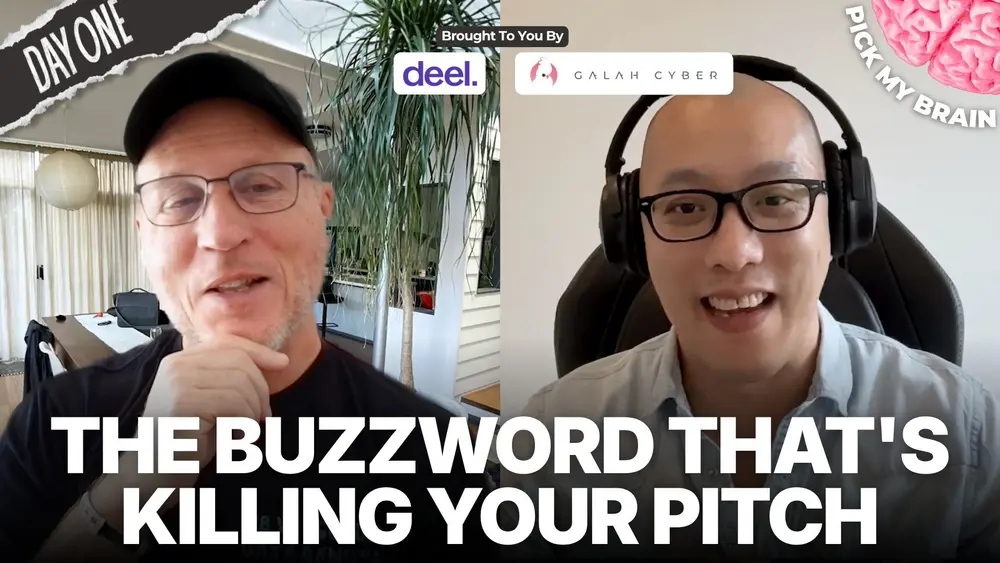 ▶
▶ The Buzzword That's Killing Your Pitch: Billy Chan on Alfred Travel
 ▶
▶ Why You Should Think Global From Day One: Ilana Elbaz on Deel
 ▶
▶ How Do You Sell Software to an Industry That Won't Change? Mitchell Baker on Claimstack
 ▶
▶ What's Your Moat When AI Can Copy Your Product in 48 Hours?
 ▶
▶ The Four-Quadrant Framework Every Solo Founder Needs
 ▶
▶ The App Built to Stop Image-Based Abuse
Pick My Brain is a Day One® show — the podcast network for founders, operators and investors. Want a show like this for your company?
Other shows worth a listen
Episodes from across the network exploring similar themes — part of the same Day One conversation.
 ▶
▶Investment Thesis with Kali Norman
Mick Liubinskas' Investment Thesis
18 September 2026
 ▶
▶First Cheque with Cheryl Mack & Maxine Minter
What Makes a Founder Worth Backing at Pre-Seed? With Ilana Elbaz | GTM at Deel
20 July 2026
 ▶
▶Founders in Motion with Thea Ngo
Battery Storage Founder: 8 Months of Rejection, One Term Sheet He Refused | Rakhesh Martyn, Hachiko Energy
25 June 2026
Turn podcasting into pipeline
We're the team behind the Day One Network, and we helped build Blackbird Ventures' Wild Hearts. We help founders, funds and operators build trust, authority and deal flow with a show tailored to their market.