Transcript Synced · select any line to jump ▾ 0:00 Dan Westgarth: I would say that if you're an inexperienced coder, using Flood is actually very inefficient and time consuming. Flood was burning a ton of tokens. My laptop fans were buzzing and we were red hot. In addition to this, we've built something called DCA, which stands for Deel Code Agent. And the idea of DCA is you can feed it the ticket and it will actually analyze, understand the ticket. It will then find the relevant areas of the code base and it will write code. It will create a pr. 0:30 Georgie Healy: Dan, that is your AI. Ha. Heck of the week, I tell you. DCA is so strong. That is incredible. That's awesome. 0:38 Dan Westgarth: Navigator finds a bug, pass through the DCA, DCA solves it and repeat. The platform's self improving and getting better over time. 0:50 Georgie Healy: Hello, welcome back to In the Blink of AI. I'm Georgie Healy and we have an exciting guest. We have Deal. If you don't know who Deal are, frankly, what are you doing? Go back and listen to our previous episodes because they are our incredible sponsor this season. They have made this show possible. Dan, their COO who joins us today was a really great sport. I absolutely loved it. So, okay, a bit of context about Deal. They are one of Y Combinator's success stories. They were actually there just before Sam Altman left to go all in on open AI. Fun fact. They're doing over a billion in annualized revenue and so they've not only navigated AI, they've fully like nailed this time in AI. And Dan as COO helps us peek behind the scenes of their operations and where you still need human beings. Remember human beings. Yeah. In sales there is a specific part of the process that AI cannot emulate. And he break down how Deel actually runs customer support. They have three tiers. It's based on confidence and context. Can't wait for you to hear that. Like every other episode, we spoke about things that are a bit off piste in the headlines that we just want a really smart person that's in the weeds and delivering day after day to give their insight on. Thank you, Dan. Thank you Deal. And let's dive in. 2:08 Speaker: You're listening to a Day One FM show. 2:14 Georgie Healy: Founderscale faster on Deal. Set up payroll for any country in minutes. Hire anyone anywhere, get visas handled fast and get back to building. Visit deal.com day one. That's-double.com/day one. Dan Westgarth, you are the CEO of Deal and I feel like household name amongst you know the tech Industry, the startup industry. But just in case people haven't heard of deal, tell us what you guys do. 2:48 Dan Westgarth: Essentially, Deel is a HR and payroll platform. Our clients are able to hire, manage and pay anyone anywhere. We started out as a contractor invoicing platform. We now do all different types of HR services. Everything from a HR information system through to immigration and mobility work to IT leasing to global payroll processing. We aim to meet all of our customers HR and payroll needs. 3:18 Georgie Healy: Incredible. Huge platform, huge deal, huge role. Before we dive into that though, I'm going to hit you straight up with some kind of AI hot takes. Are you ready for those? Sure. What role in companies in general do you think has really fundamentally changed since AI has become proliferated? 3:45 Dan Westgarth: I mean, I'm seeing a lot of change in finance, particularly accounts receivable. A deal we do more than a billion dollars in revenue on an annualized recurring basis. And reconciling all of those invoices used to take a lot of time. Clients will send us the wrong amount or in the wrong currency or they won't put the right invoice reference in the payment field. And reconciling them was taking a long time. Since developing our own AI workflow, we were able to do that much, much, much faster. So I think the role of account receivable specialist has changed significantly. And I think that's just kind of a general trend that we're seeing across their finance and operations. 4:31 Georgie Healy: For me, this is brilliant news. I did one accounting subject at university. I did a master's in commerce, and I was like, I'm going to be across all of this stuff. And for whatever reason, that topic was so boring I could not get it to retain in my brain. Like I just could find myself excited about things like balancing invoices. I can't even remember what it was called, but the like. So I see this as great news. Is there any roles where you're like, oh, kind of wish AI didn't disrupt that? Or are you a purist in any sense in terms of AI disruption? 5:13 Dan Westgarth: I don't think it's roll by role. I think that AI is able to help just about every role in our business. I think it's more the application of it. The majority of use cases are still human in the loop use cases, for example, when people are using AI to draft emails. Great for drafting them. But I don't think that AI always has something that's ready to send. Usually you need human in the loop. You need to put your own spin on it, make sure it's in your tone, in your voice. And at the end of the day, that's a communication coming from your address. As a human going to another human, it should have human in the loop, it should have human oversight, and a human should be finishing the communication. 5:51 Georgie Healy: Human in the loop with AI doing the boring, repeatable stuff I love. Okay, here's a headline for you. There have been a lot of hardware releases recently from big tech companies that they're not letting these AI glasses die. Dan, like, every company seems to have their iteration, but Meta, Google, Snap. Can you see yourself purchasing AI hardware in the form of glasses? Is this on your horizon? 6:25 Dan Westgarth: You know, I was with a friend recently and he was showing me the latest Oakley glasses. And yes, they were really cool. We were actually wakeboarding and we were using the glasses to make videos and I thought it was really cool. Would I be a customer? Would I buy them? Probably not. It's not really for me. I'm not really a content creator. I don't like to film or photograph everything. However, I am really interested in ergonomic working. I really love to lock into deep work, no distractions. I like to be really comfortable. I've spent a lot of time setting up my home office, so I think if glasses are to move closer to tools for work, I would be interested in. I was a customer of the Apple Vision Pro, and while that product isn't doing so well, I do think there are some really cool learnings that will probably be applied to the glasses market on that. 7:22 Georgie Healy: We have the Meta Oculus gathering dust at a very tall shelf in our house. Really cool for sports use cases perhaps. Like my husband said that for a specific cricket shot and I'm definitely showing our nationality here. It was really hard to practice that shot because if you missed it, you'd basically get hit in the balls or something. Like, it was a real. I can't remember what the shot was, but it was a really difficult one to practice. But with hardware, you can practice the angles of the movement to get to a good enough point that once a ball is coming at you, that is you've got the runs on the board. Do you see sports as a use case for AI hardware? Like, I'm not sure if this is outside of wakeboarding. 8:11 Dan Westgarth: Yeah, for sure. I mean, there'll be a ton of real world, real life utilizations. 8:17 Georgie Healy: So, yeah, amazing. Not helpful for me, who's terrible at sport and has no interest. But it hypothetically could be great. Okay, last hot take for you before we dive into the media part. Of the episode. You're a COO of a series E company. You're probably quite busy. But. But have you been following the World cup and if so, any hot takes? Who's going to win? 8:40 Dan Westgarth: Well, yes, of course I'm following the World Cup. I would love for England to win. The time zone is not ideal, being based in Europe to watch all of the games, but I would say that the highlights coverage is really good. And I've been watching a few of the games the day after. I would love for England to win, but I think they got some tough competition. 8:59 Georgie Healy: England's doing so well. It's very hard not to get pumped about certain players. Right? 9:05 Dan Westgarth: Yeah. 9:06 Georgie Healy: Yeah. Been loving it. Okay, thank you for humoring me with the hot takes. Let's dive into what people probably have decided to listen to this episode for. Number one, there are a lot of HR platforms. So why is Deal so successful? Why are you guys so good at what you do and have navigated like this AI landscape and have continued to be so successful year after year? In one minute. 9:34 Dan Westgarth: Yeah, I mean, the common denominator is people. We hire really good people in all of our functions and in all of our locations. But if I tell the story a little bit. We started Deal seven years ago. We made a bet on remote and international working pre Covid. When the pandemic came along, every company wanted to hire people internationally remotely, and we were able to support them. We built a lot of momentum, secured a lot of funding, brought a lot of smart, hardworking people together, and then the businesses snowballed from that point. 10:04 Georgie Healy: I've heard a lot of people say, these businesses that built just before COVID or around Covid, where we assumed that we would all stay remote, like, haven't been able to navigate past that. You guys obviously have. Why do you think that is? 10:21 Dan Westgarth: Well, we quickly diversified. Like I said, the start of the podcast, our initial product was a contractor invoicing product. So let's say an employee in their home country wanted to move home to be with family during the pandemic. Companies weren't able to pay them because they didn't have a legal entity in that country to run payroll. So we offered them a temporary solution whereby that individual would become a contractor, they would raise invoices for their work, and those invoices would be paid. We quickly realized that that model was probably not sustainable for most of our customers and their particular use case. So we diversified into employer of record, where we establish the entity, we employ the person directly. And then again, we realized, you Know, once a company has a large number of employees in a country on this model, they're probably going to set up their own entity. So then we went to global payroll and then after global payroll we had clients that said, well, actually can you help us get a laptop in the country? Can you help us do the person's visa? Can you help us provide benefits to their, to the employees? And we decided to do all of that. So I would say that it's customer led. I think the thing that makes us different, different from a lot of other companies in the space is the people we hire top talent and we're quite aggressive in our way of working. 11:33 Georgie Healy: To you, what is great top talent? You know, I recently interviewed 11 labs and they basically said we don't really coach. Like if you, if you don't have that like internal drive and ability to, to level up, like we, we can't teach it. What do you look for when you're looking to hire? 11:53 Dan Westgarth: Yeah, I don't think the fundamentals can really be taught. I think there are three buckets that I look for. I think curiosity and willingness to learn is number one. If someone is curious and constantly learning and constantly trying to figure out things they're likely to do well, they need to be good working. 12:13 Georgie Healy: If I came in with my, I refuse to read income statements, you'd be like, good to know. 12:19 Dan Westgarth: Yeah, yeah. I, I don't think it's, it's, I don't think it's about kind of certain topics or refusing to look at certain topics. It's more being able to pull yourself into things. So I love working with self taught people. Maybe they're self taught coders or their self taught finance professionals or whatever and they're kind of being led into this area and then they've done the qualifications, they've done the deep training, they've done the education. But to be self led into it, I think is a big part of it. 12:56 Georgie Healy: And in this time where the technology is moving so quickly, you have to continuously have that drive and curiosity. Right. To continue to navigate like you guys have. Before you joined Deal as coo, you were an early member at Revolut, another household name, a company that I'm sure many of the listeners are familiar with. But what we might not be familiar with is what it takes to leave one rocket ship for another rocket ship. How did you make that decision? What, what inspired you to do that? 13:33 Dan Westgarth: I think it was opportunity really. And I could be really, I could try and sound really smart about this and say opportunity cost or difference in opportunity. But really the truth of the matter is I knew the founders of Deal. I really liked them. I thought they were really smart, hard working people. They were curious, they were eager to learn, eager to build. They had the grit and mentality. I also got on really well with them. They gave me the opportunity to come aboard as COO a deal. Sorry. revolut I was a general manager working on international expansion. So this opportunity was a step up and I really liked the founding team and I really liked what they were building. It really resonated with me and I could see parallels between other very large companies and what Deal was building. 14:28 Georgie Healy: Founderscale faster. On Deal, set up payroll for any country in minutes, hire anyone anywhere and get visas handled fast so you stay focused on scaling. Deal takes care of onboarding, hr, IT EOR benefits and compliance so your team can grow without borders. It's why more than 40,000 fast growing companies trust Deal to move fast. Visit deal.comday1 that's-double.com dayone. And just to give a little sneaky behind the scenes about those co founders of Deal, they were part of the YC Winch 2019 batch just before Sam Altman announced he was going all in on OpenAI AI. I have to ask you, Dan, did they ever talk to you about that over a beer? Did they meet Sam Altman? Do you use any of the wisdom from that cohort to this day, any of that carried through? 15:31 Dan Westgarth: I have no idea on the Sam Altman point, but I would say that the cohort companies tend to stick together and, and the friendship circles are formed and they also tend to stick together. While I wasn't a founder in the batch, I joined shortly after and a lot of those other founders and founding employees, we're all friends. 15:53 Georgie Healy: I want to be on that WhatsApp group chat. Okay, let's talk about hitting your targets for seven years. Apart from people, what do you attribute that to? Like, how do you set targets that you can stretch yourselves as a company but also achieve? Like, what are the mechanics that go behind that? 16:15 Dan Westgarth: I mean, at this stage it's a lot of mathematics in it. The targets are not quickly or easily set. There's a lot, a lot of thinking and working that goes into those. But I think the important thing is momentum. It could be hard to measure momentum. It could be easy to talk about it and describe it. And I think it's really important. Once you have people working towards targets and hitting those targets, the culture of the company falls into place and you can keep growing and keep compounding. 16:48 Georgie Healy: Tell me about your sales team. This is something that I find fascinating as someone with no sales background. Are your sales team using AI in a way that you find is beneficial and what needs to remain human? Do you believe? 17:09 Dan Westgarth: I think that AI is helping a lot in understanding the customer. Prospecting, building materials, proposals, comparison slides, things like that. The bit that AI can't touch, which is especially fundamental to our business, given we're in payroll and hr, is building relationships, building trust, and going the last mile on understanding the customer. AI can do so much of it. It can provide a great foundation, but you really need to understand what the customer wants. And in our business, it's not just about selling, it's about implementing. Implementation is a really important part of what we do, especially as we talk about enterprise customers. Some of those implementations can take years. For example, I was speaking with a, a major bank recently. They had over 200,000 employees. Just imagine how long that implementation will take and how many stakeholders will involve. So you know, actually, actually selling, selling the deal is one thing, but implementing it is a whole other part that is really important. 18:12 Georgie Healy: You made this clear earlier. The customers said, oh, can you do this as well? What about visas? What about this? And I'm sure the sales team want to just be like, yup, sure. And then like hand it off to someone else. Is there any tricks to knowing what they can say yes to or how do you message throughout the company? Yes, we want to do what the customer asks, but can we achieve it? I'm curious what happens as an overall logistics perspective? 18:42 Dan Westgarth: Yeah, I mean, it depends on the size of the customer. If it's a smaller customer, then we offer them what's off the shelf. And it's prepackaged, it's mostly automated. The customer can set up on their own. If it's a large customer, and I'm talking about big international companies, banks, airlines, etc. Then we'll do custom builds. Maybe they want immigration processing done in a way that's not off the shelf. Maybe they want the implementation in a way that's not off the shelf. Maybe they want to completely white label the platform. Maybe they don't even want the CDL's logo on it. All of this stuff is possible and that's what is required when you're dealing with companies of more than 100,000 people. 19:24 Georgie Healy: Bringing it back to AI for a second, hot take for you. I've heard both sides for this. Do you let AI do your email triaging? Answering customer emails, answering internal Emails or is that the most important touch point? Your emails with your customers should be human led, should be hands on, don't remove that friction. 19:51 Dan Westgarth: Yeah, I think the first point that I hope the listeners will like is we don't really have internal email at Deal. Everything is done in real time on Slack. There's some volume of internal email, but it's really small. When it comes to customer email, it really depends on the topic. So when we're dealing with our customers, especially the medium and large sized ones, we're dealing with many different stakeholders. So if the nature of the communication is to do with customer support or operational change, that I think AI can play a really good, really good part, especially if it's a very easy transactional topic. If it's a deeper change related topic, then you can lead with AI, but a human tends to be in the loop. So what we found really helpful on our customer support program is we have an AI copilot which alongside the communication, their copilot will build the context layer that will help the person respond to the customer. That's really helpful. The other thing that we've done is we've had AI generate a draft response. So that's there in the tool and they can use it if they want. And then for the really transactional basic things where we're pretty certain that we're going to be able to resolve it to a high standard and the customer is going to be happy, we'll actually just respond to the customer directly. 21:07 Georgie Healy: This brings me to email AI meeting assistance. Not email, just AI meeting assistants in general. Again, such a contentious topic at a business at your scale. Pros and cons for using a meeting assistant. When would you? When wouldn't you? 21:28 Dan Westgarth: Yeah, I think in general you want to have AI having access to as many touch points and as much data as possible because that helps it make smart decisions, it helps increase context. So a deal. We use Gemini because we're a G suite customer, so we can have Gemini build a transcript, post the transcript, we can do summaries, we can do action points, all this stuff. But I think for AI to be able to build these self reinforcing loops, it needs as much context as possible. And meetings are a really good context point. 22:11 Georgie Healy: I heard a hot take yesterday which was you need these meeting assistants to be in all your meetings. You can't just turn them on and off because if you do that you're adding bias in. Oh, this is an important meeting. So I'll have the meeting assistant. This is just a quick meeting I won't have the meeting. Assistant. Assistant. Do you agree with that? 22:33 Dan Westgarth: Yeah, I do. I don't think it should have access to everything. I think there are certain confidential topics, like, for example, HR and people topics. You don't really want an assistant there and you don't really want all of that information adding into the internal wiki. However, if it's a product decision, if it's a customer issue, you do want that information transcribing and storing, because that's going to help the AI next time it's solving a similar issue. 22:57 Georgie Healy: Okay, and last one in that section is what makes an a engineer in 2026. Dan? 23:08 Dan Westgarth: Curiosity again. They need to be curious. I don't think we're ever going to spoon feed the best people, the best technologies. We have had quite a bit of success with AI and engineering. Around just over two thirds of all code that is committed is actually coming from AI. So you can imagine the productivity gains we're having in engineering at the moment. 23:35 Georgie Healy: Yeah, incredible. Do you code with AI now, even if you're not a coder? 23:41 Dan Westgarth: Yeah, yeah. I use pull code. I've got access to the different repos I've made pull requests. There's nothing quite like the feeling of your PR being approved by an engineer and getting a little message, being like, okay, good job, that's really fun. But this isn't my core work. These are things I'm doing at weekends. In addition to this, we've built something called DCA, which stands for Deel Code Agent. And the idea of DCA is you can feed it the ticket and it will actually analyze, understand the ticket. It will then find the relevant areas of the code base and it will write code, it will create a pr and an engineer will review that pr and then if it's accepted, it will be pushed. So you can kind of imagine if you find something on the platform, you find something on the internal tools that's wrong or broken, you can write the ticket yourself, you can send it to DCA, and within a couple of hours, DCA is finished writing the code and an engineer will be reviewing it. 24:49 Georgie Healy: Dan, that is your AI hack of the week. I tell you, DCA is so strong. That is incredible. That's awesome. 24:57 Dan Westgarth: I can take it a layer further. So imagine the DCA process that I've just described. On the flip side, we have another tool which proactively navigates the application as if it was a user, as if it was a customer. And during those navigation sessions, it will find bugs and it will find issues and Then it will create tickets for those bugs and issues. So then if you stack that above DCA and you can imagine then you have this self reinforcing, self improving process. Navigator finds a bug, pass it to DCA, DCA solves it and repeat the platform's self improving and getting better over time. 25:37 Georgie Healy: It's magic. Sometimes AI feels like magic, right? 25:41 Dan Westgarth: Yeah. Look, I would say that it's not a perfect process. Do we have any bugs on the platform? Yes, we do. I'm sure there are some somewhere is what I just described. Solving the majority of the easy, easy ones. Yeah, for sure. So it's freeing up our engineers to work on more complex and interesting problems. 25:59 Georgie Healy: I had such a chip on my shoulder not picking like software engineering as an undergrad. I picked chemical engineering which super not really helpful day to day but increasingly that should be on my shoulder is getting smaller based on what we're able to do. Even as like I guess non technical people, even though I hate that term. 26:21 Dan Westgarth: Yeah. 26:21 Georgie Healy: Tell me a bit about, you know, you have customers that are trying to break into new markets. You've obviously broken into new markets. Where is the sweet spot where they're not scaling too quickly but also like is it true that you'll never be ready? Like, like will you ever feel ready to sc into other markets? 26:45 Dan Westgarth: Yeah. I'm going to talk about B2B businesses because I think B2C is very different. I think with B2B businesses, adopting a global approach from the get go can be really beneficial. We did that at Deal, so we were able to pay anyone anywhere, but also have clients, customers, businesses from anywhere use Deal and you know, a lot of naysayers would say this isn't going to work. How can these companies pay you? How can they pay in dollars from Brazil? You don't have Spanish language. Why are you asking for this Social Security number or equivalent when someone is from this country? There's a lot of different reasons why going global is difficult. But I found in the B2B space the really good customers, the customers you want, the fast growing, the fast moving, they will see the value in your solution and they will figure out a way to navigate it. They'll figure out a way to fund you in dollars. They'll figure out a way to complete the onboarding. And we did that a Deal. And while it didn't necessarily contribute to so much of our growth in the early days because most of our growth came from Europe and the US and that's where we were localized, we did see some international customers and it created momentum. I remember our first country manager we hired. Her name is Nati in Colombia. Your first country manager was in Colombia. Can you imagine? It's such a strange country to hire the first country manager from. She'd heard about us, maybe she'd even been paid through a deal. And she commented and said, we want to represent you, I want to represent you in Colombia. Okay, sure, let's do it. And Colombia started to build momentum. We localized the Colombian onboarding flow and we supported pesos on the platform and Colombia is now flying. So I think, I think going international from the get go and opening it up does have its merits for a lot of B2B platforms. 28:39 Georgie Healy: And B2C, what's the strategy there? 28:42 Dan Westgarth: I think B2C is very, very, very different. I think the infrastructure that's required to offer consumer services is generally has a much higher barrier to entry. Particularly when I think about businesses and financial services or I think about businesses in the ride hailing space, delivery space. The infrastructure requirement is way higher. And even after you've navigated all of that infrastructure, you then need a really compelling go to market motion to make it worth your while. So I think on retail businesses the country by country approach is better. I do think there are some cases where passporting works across regions especially. Yeah, yeah. Well, there's a few different types. Let's talk about passporting within the eu. This is quite easy. One EU country can typically sell into another EU country. They're not required to have another consumer license because the consumer license in their home country can be passported in. Yeah, yeah. You've seen, you know, you've seen some, some really good cases of this and then some really bad cases of this. I think about the fintech space, I think about number 26 German fintech bank, quite a lot of German customers, but they didn't really figure out passporting into other countries. So in their case, not all of the infrastructure, but a lot of the infrastructure could be passported into different countries. I'm not sure why that didn't work out. I'm not sure if it was the rest of the infrastructure they needed to make a really good proposition or it was the go to market motion that wasn't ready. 30:21 Georgie Healy: I want to know what the horror stories are when you don't use a platform like Deal that have seen everything. They've seen every case. They've seen what happens when compliance goes wrong or local payroll goes wrong and they're like, no, we can just do it ourselves. Maybe they think, oh well, with Claude I can just ask it and maybe I don't need Deal. What happens then? 30:47 Dan Westgarth: Maybe I can answer in two different perspectives. I think for large companies, they don't do it themselves. What happens is there's a lot of duplication and fragmentation of tools and there's a lot of inefficiencies. So I think of a global business, let's say they employ a few thousand people across multiple different countries. They've probably got different payroll systems and different HR systems in every single country. Then they've hired people to manage those. They're built in different currencies, different amounts. Nothing really talks to each other. There's very little interoperability and it just becomes really inefficient and painful. And when you speak to those businesses and they're trying to increase bottom line margins, it's an area that they really care about because they can see how inefficient it is, how much duplication is happening and how much money they're spending. And Deal solves that with one platform for all countries and all different services. If we go to the other end of the spectrum, which is really kind of small companies, maybe they've got less than 10 employees and doing it yourself, I think from a HR data perspective, you can probably manage that pretty well off of a spreadsheet. Sounds crazy, but I truly think you can. When it comes to calculating payroll and paying people and filing taxes with the government and filing with the government and paying Social Security, child benefit and all of this type of stuff, in most cases it's not possible. In some cases it will be possible. It will become a huge time suck even for 10 people. There's a lot of fiddly things, government portals that need to be navigated and it's really not worth the time. You can onboard the deal and for tiny company the fees are very low. You can get set up in five minutes and just run payroll immediately. 32:37 Georgie Healy: It's like penny wise, pound foolish type stuff. And if you get sued, I guess it's you saved not a lot of money for that. 32:49 Dan Westgarth: Yeah, and it goes deeper than that. I mean, you know, maybe an employee will sue you because you messed up their payroll. But imagine if you have the authorities coming after you and your business is a success. You have the Social Security administration auditing you for the next five years and that's not a fun experience and it just sucks. More time. 33:05 Georgie Healy: There's some good horror stories. Dan, thank you, I appreciate that. AI agents. I went on a full rant about AI agents because I think people Misuse the term like really autonomous. No human in the loop like that. Original definition of an AI agent. Let's call it workflows, let's call it AI agents. But for you, what keeps you up at night with the idea of AI agents running the business? 33:33 Dan Westgarth: Well, Akai keeps me up at night because I'm working 24 7. Akai is our internal tool to manage agents and build workflows. So I think we quickly realized at the start of this year that yes, you can build powerful agents, you can get the proof of concept pretty quickly, but actually deploying and scaling them is a huge pain. Handling things like two factor authentication, dashboarding, being notified when the agent isn't working, things like that were a huge pain. So we decided to invest into an internal tool, Akai. We use it internally. It saved over 200,000 hours of manual operations time and we're now opening it up for our customers. The interesting stat that I can give you and Akai is a contributor to this, we have best in class revenue growth at Deal. I can't say what the number is, but if you look at our annualized revenue growth, it's really strong. We haven't grown the operations team since March of 2025. So revenue's grown by a large amount, huge amount. But the operations team hasn't grown since March 2025. So I'm really proud of that. AI is a contributing factor alongside internal tooling and efficiencies of scale. 34:55 Georgie Healy: And so what would you say to people that aren't seeing that as well? This is incredible for the employees that are there, like they are obviously, you know, doing incredibly well and the AI is doing the boring stuff, they get to do the more interesting strategic stuff. But to some listeners, they're listening and being like, oh my gosh, what does that mean for the workforce? Stan, what's your advice if people are like, I want to be one of those employees that is loving life? 35:26 Dan Westgarth: Yeah, I think the foundational roles are always required. I mean, a deal with just over 7,000 people, and I think that number is made up of foundational roles. We have a certain number of payroll professionals we need, we have a certain number of finance professionals we need, et cetera, et cetera. What I would say to those people is the bar is going up. So to be an amazing product manager or an amazing finance person, the bar has gotten higher. And its emphasis on the curiosity and self learning and being aware of all of these tools and being actually able to use them and apply them, that's the reality. I Don't think the number of jobs is necessarily going down, it's just that the bar is going up. 36:19 Georgie Healy: You said you were coding on the weekend. Clearly even COOs are navigating, being more effective in their role. Did you expect to see yourself coding? 36:32 Dan Westgarth: Yeah, I mean, I think at the time that I was exploring that, it was a very hot, trendy topic and I just wanted to dive in. So I got set up and changed some of our internal tooling. I think in the end the engineers rewrote it anyway because what I built was very inefficient. But just being able to feel and understand how everything works and how quick and easy it is. I wouldn't say it's actually that quick and easy. I would say that if you're an inexperienced coder, using Claude is actually very inefficient and time consuming. Claude was burning a ton of tokens. My laptop fans were buzzing and we were red hot and I was giving a prompt and I was having to return in five minutes, go downstairs, get a cup of tea, come back upstairs, and the laptop's still burning away. So I don't think it's necessarily super quick or efficient for someone that's not experienced, but it proved to me the capabilities and that certainly had a positive impact on the business. 37:30 Georgie Healy: And I'm sure the engineers and you had a mutual respect for each other after that experience, right? 37:36 Dan Westgarth: Absolutely. 37:37 Georgie Healy: Okay, so we have made it to the rapid fire. At the end of the episode, I want one minute answers, but if you're like, you know what, I've got more juice in the tank, I'll allow a little bit extra. How about that? The saaspocalypse, it is still an ongoing topic. Some people say it's a myth, some people say it's just starting. What's your take, Dan? 38:01 Dan Westgarth: I again think it's bar raising. I think that AI makes migrations easier. So customers that were tied to a certain SaaS platform are no longer tied as tightly and that is going to increase competition. It's also going to create some consolidation. So I don't think a SaaS apocalypse is going to happen. I think if anything, the leading SaaS companies are going to get better, they're going to gain more market share and they're going to be better off as a result. And so are we as customers. 38:35 Georgie Healy: And what would you hope that those companies that are navigating this, as you guys have clearly done over seven years of navigating different market cycles, what's the most important thing for them to be focusing on right now, do you think? 38:48 Dan Westgarth: I think customer experience. I think there are so many SaaS platforms which are actually really bad and they can be way better. 38:55 Georgie Healy: I don't know about you, I have seen some platforms and I'm like, how do you have even one customer? It's going to be really interesting to see people will have more autonomy to say no to bad experiences. Maybe. 39:11 Dan Westgarth: Yeah, yeah, I think so. I think again, doubling down on that switching point and implementing switching cost and implementation has been a huge time suck on focus, suck on companies and on people. And if it's easier, quicker to switch and re implement, then it's going to make the market a lot more competitive. 39:33 Georgie Healy: We've seen it with LLMs, like even with all the context that people put into ChatGPT, for example, and years of training, the voice and all the rest of it, it's like if they want to switch to Claude, they will put up with those switching costs and they will figure out a way to make it work. Right? 39:51 Dan Westgarth: Yeah, agreed. 39:52 Georgie Healy: Okay, so you guys created a physical deal card, right? Like a physical one? Be honest. Did you use it? Do you use it? Would you ever use it? 40:04 Dan Westgarth: Yeah, yeah, I was heavily involved in building it and back in the, back in the day, it's quite an old product now. It's a few years old. It's designed for people in emerging markets that don't have access to really great fintech solutions like Robinhood or Revolut or whatever else it might be. Yeah, amazing product. If you're in an emerging market, I would use it. 40:31 Georgie Healy: I want to see what it looks like now. Did you create it like a Neobank like portrait mode? Seeing you were behind the scenes, like, I want to hear about how you designed it. 40:42 Dan Westgarth: I mean, the initial objective was to give workers in emerging markets quicker access to their money. So if you're living in the Caribbean, receiving your salary can take a long time and there can be hidden fees your bank might actually charge you to get paid, which seems insane, but it's the truth of the matter. And sometimes it can take three to five days for that money to arrive. So we said, okay, how can we get money to people quicker? And this was kind of before the rise of stablecoins. There were crypto solutions available, but they weren't stable. They were to pick the volatility. So we said, okay, let's do two things. Let's build the deal card and workers can get access to their earnings as soon as they're paid like the same second, and then they can spend that money. And what we saw is we saw most people getting a portion of their salary paid onto the card and then the rest paid to the bank. So then that moves me on to my second solution which is crypto. And we have Stablecoin offering, a stablecoin offering and then also the kind of traditional big crypto. So you can get paid in bitcoin, you can get paid in Ethereum or usdc. And now we have both of those solutions on the table. We actually see like multiple things happening. We kind of have some, some customers that are bitcoin believers who get a portion of their PayCheck deposited in BTC and assumably they hold on to that and then some of the money goes on the card, some of the money goes on stablecoin and no money is going through the banking rail. So I think that's the real value that it delivers. 42:27 Georgie Healy: Oof, they're living in 2035. That's cool. Listeners of the show will maybe be familiar with stablecoin. We have touched upon it before. But just a quick one minute summary for the listeners. What is a stablecoin as opposed to like a volatile. 42:44 Dan Westgarth: Yeah, yeah. Stable coins are backed by something. So if you think of USDC which is a US dollar backed stable coin, for every $1 of a stable coin there is a dollar sat in a safeguarded custody account and there's no volatility, the price remains the same. 43:06 Georgie Healy: Beautifully said. Would you switch LLMs based on performance or are you a clawed pilled user? Like many of the people that I surround myself with, I'm kind of guilty with my laptop stickers myself. You a purist? Are you loyal? How do you read the room? 43:29 Dan Westgarth: I think I've built up habits and I use different tools for different things, but anything that's integrated into the G suite I use Gemini. So for all meetings it's Gemini. For Google sheets, Google Docs, it's Gemini. For emails and text based things, it's ChatGPT. For personal, it's ChatGPT. I love to use chat to read menus in foreign languages or wine lists or help with construction of personal projects and then Claude for anything which requires kind of more than one run and we'll just kind of get on with it. There'll be some prompts for authorization or prompts to to continue with with its plan. But yeah, if something is deeper and requires multiple runs then Claude. 44:19 Georgie Healy: I am the same about ChatGPT. I feel like the voice is more personable, more easy to to communicate with. I have my Mission this weekend, Dan, to add some skills into Claude to train it again with my voice. I've got a weekly substack. Like, I keep being like, why do you sound so formal? Like, it still doesn't sound like me, but watch this space. I'm going to try. I'm going to try again. And, you know, if you had to, you know, build one project over the weekend, is there anything. Is there any big project that you just need a lot of time with and an AI tool that you would build? 45:07 Dan Westgarth: Yeah. I'm going to get, like, a very abstract answer that you probably wouldn't expect. I think farming is a really interesting case for AI. I think that if I think of all industries in the world, farming is probably at the end of the back of the innovation curve and it's so important. We all need farming to eat and survive as humans, and that's the area that I would look into. No idea what I would do, but I'm sure AI has some cool application in farming. 45:45 Georgie Healy: And when you say farming everything, like, have we got cattle? Have we got produce? Is it a hobby farm? Like, what are we talking? My husband in the background has been chuckling along to the Top Gear guy's farm show. I forget what it's called. He loves that show. Like, what kind of farm are you having, Dan? 46:07 Dan Westgarth: I think all of the above. I mean, I don't personally have a farm, but, yeah, I think. I think Clarkson's Farm on Amazon prime is a great show. It just shows you some of the struggles that farmers go through. And if you. If you. If you track the. The price points of these different food types, whether it's beef or corn or barley, they're typically all trending up. There's a lot of energy production. Sorry, a lot of energy that goes into producing these foods and fertilizers and there's a ton of inefficiency. So, yeah, I don't know where I would start, but farming is definitely interesting in Yorkshire. 46:42 Georgie Healy: Is there good farmland there or. 46:44 Dan Westgarth: Exactly. Yeah, yeah, yeah, Very good farmland. 46:49 Georgie Healy: All right, that's the next career pivot. Dan, this has been an absolute pleasure. I feel like you are just a mine of incredible insights through what you've been able to scale and build at Deal and in your previous roles. How can people follow you? What would you like to shout out about Deal and. Yeah, take it away for us. 47:12 Dan Westgarth: Yeah, I mean, follow me on LinkedIn. That's probably my biggest, biggest platform. Putting out a little bit of content there on AI, scaling operations and Deal itself deals recently signed a sponsorship deal with Arsenal Football Club. So you'll see us on the sleeve from next season, which is. 47:33 Georgie Healy: Oh, my gosh. 47:35 Dan Westgarth: Which is really cool. Yeah, yeah. It's always interesting seeing some of the Arsenal players on the England squad and other country squads, by the way, but, yeah, follow along and, yeah, we're here for any of your payroll and HR needs. 47:48 Georgie Healy: Okay. You cannot go Arsenal. Like, is that your team? Like, how did that happen? 47:55 Dan Westgarth: Yeah, yeah. I mean, Arsenal was on my team growing up, but I think I'm converted to an Arsenal support by now. Yeah, I think Deal has an objective to increase brand recognition globally and I think Arsenal was a really, really good partner for us. They have so much global following and different people from different backgrounds working in different industries, doing different things. So I'm really glad we got the. Got the Deal done and the Arsenal team have been fantastic to work with. 48:29 Georgie Healy: Strong, mate. Very strong. Loved this episode. Thank you so much for joining and yeah, I'm looking forward to the next Arsenal game where I see Deal on their jerseys. That's awesome. 48:43 Dan Westgarth: Thanks so much. 48:46 Georgie Healy: Thank you so much for listening to in the Blink of a AI if you want to go deeper on anything we've spoken about today, I write a weekly substack called Attention Is All I Need. Yes, it's hilarious. It's a pun and essentially I go into AI rants, tech news, events I'm going to and more. It's bite sized and I hear it's awesome. The link is in the show notes below.

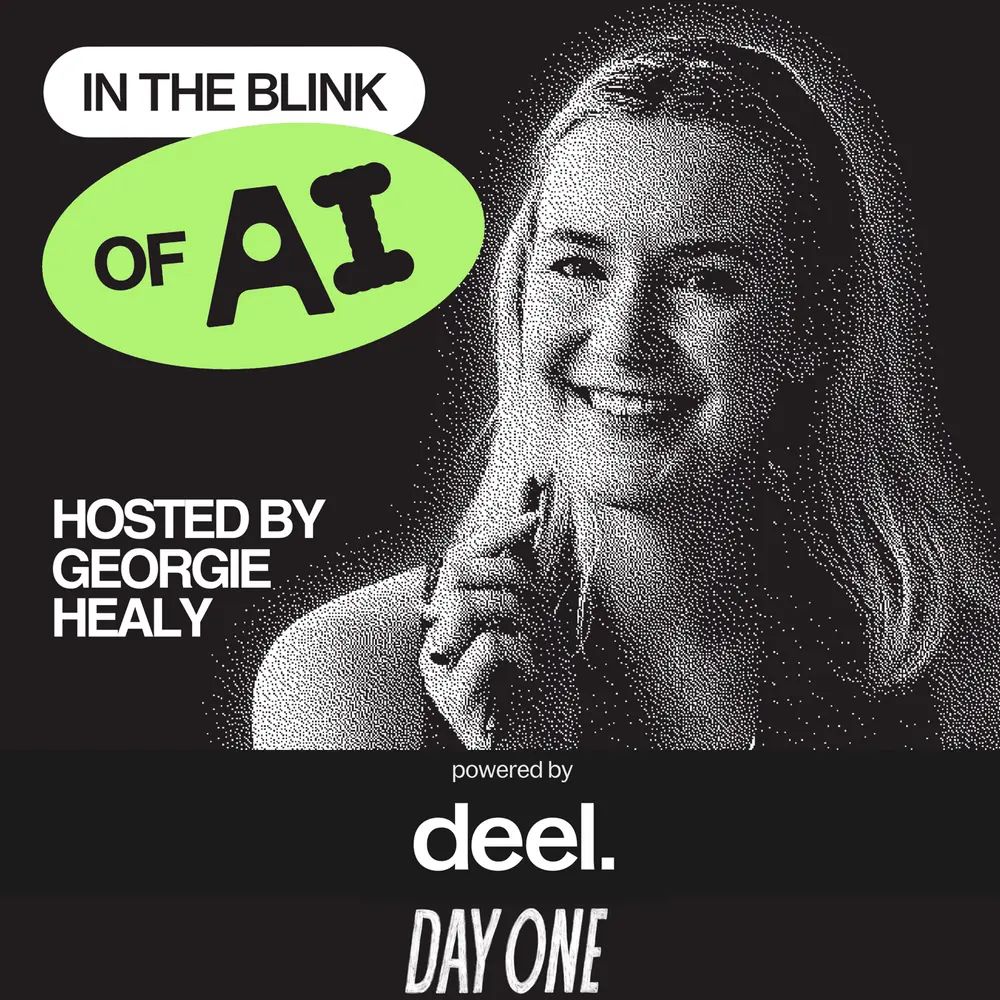 In The Blink Of AI with Georgie Healy
Presented by Deel & Stripe
In The Blink Of AI with Georgie Healy
Presented by Deel & Stripe 

 ▶
▶  ▶
▶  ▶
▶  ▶
▶  ▶
▶ ▶
▶ ▶
▶