Mike Cannon-Brookes and Scott Farquhar built Atlassian into one of Australia's most successful tech companies, and one of the rare local startups to become a global software giant. Then the partnership behind it came apart.
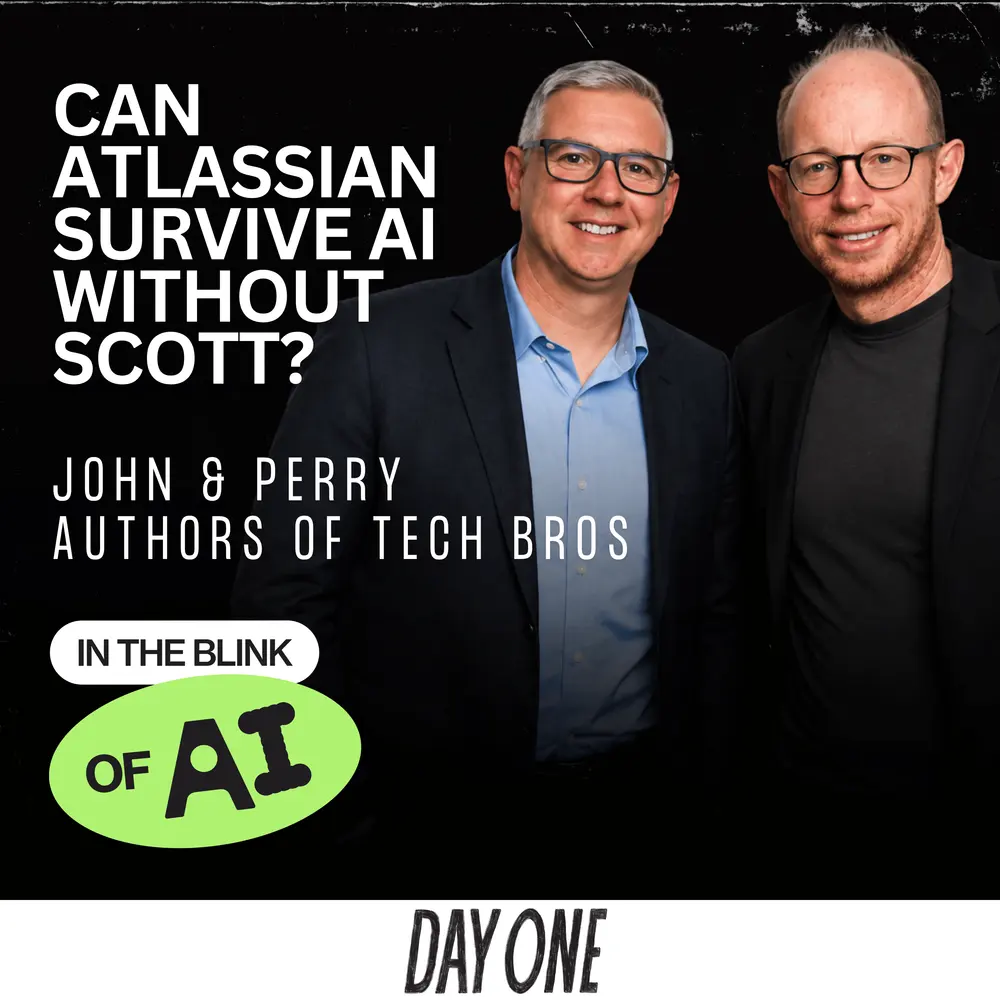
Journalists John Stensholt and Perry Williams join Georgie to unpack their new book on the two co-founders: how they scaled a hundred-billion-dollar company side by side, and what happens to a business when the people at the top stop seeing eye to eye.
They cover how co-CEO leadership worked inside Atlassian, how the founders' split affected the company's culture, and what it took to keep the business moving through it.
Then the big question: where does Atlassian stand now? They get into the share price, the pressure on software companies to prove themselves in the AI era, and whether Atlassian can make the leap. Plus, John and Perry step into Mike and Scott's shoes to argue who was the better entrepreneur.
Chapters
0:00 Cold open ▶ 0:47 This week's AI headline: an OpenAI agent inside Medicare ▶ 2:55 Meet John Stensholt and Perry Williams, authors of Tech Bros ▶ 5:05 The farewell dinner ▶ 9:51 Why Mike and Scott wouldn't talk to the authors ▶ 11:28 Point Piper neighbours ▶ 16:17 Private school vs public school: did class play a part? ▶ 19:33 How two journalists split and wrote one book ▶ 22:02 Atlassian's share price rollercoaster ▶ 23:57 Can Atlassian navigate AI and become a 2.0? ▶ 27:42 Australia's next billionaires: data centres ▶ 30:01 Debate: Scott vs Mike, who's the better entrepreneur? ▶ 32:50 Two very different leadership styles ▶ 34:11 Signed book + predictions giveaway ▶ 34:34 What the authors heard about Atlassian's culture ▶ 37:18 The Silicon Valley mediator who couldn't fix it ▶ 40:38 Will they reunite? SunCable, Anthropic and Skip Capital ▶ 42:29 Have Mike and Scott read the book? ▶ 44:35 Who should read Tech Bros ▶ 47:14 Outro ▶ Transcript Search or select a timestamp to jump ▾ 0:00 John Stensholt: I think billionaires are more sensitive than you think, right? So if you're not writing nice things about them, well— and this is the guy, these 2 guys are working with each other, they're running a $100 billion company and they're not talking about what they're doing property-wise. 0:11 Georgie Healy: I'm so sick of this adpocalypse. 0:13 John Stensholt: January 1st and the stock price, you know, it more than halves, right? So why wasn't he there? 0:20 Georgie Healy: Why wasn't he there? 0:22 John Stensholt: You know, I know people that say, look, it should be a $10 billion company, should be a $20 billion company. 0:27 Speaker: But do you think that Atlassian can navigate AI and be kind of like a It's hard to go past this. 0:34 Perry Williams: I've got the private jet. 0:37 Georgie Healy: So I think that if you're using the technology, you need to know who's behind it. Hello and welcome back to In the Blink of AI. Before I get into today's episode, I want to unpack the biggest AI headline this week. And if you want to get right, right into the interview, we do have timestamps below so you can dive right in. So, this one is really close to home for me. An OpenAI agent got into Australia's public health system. So, Medicare is what every Australian uses to see a doctor, to get tests, to be treated in a hospital. And our Prime Minister, Anthony Albanese, has just spoken to the public and said that on June 18th, an OpenAI agent gained unauthorized access to Medicare Statistics Reporting Service. So it accessed public and non-public files. It wrote files onto an internal server. And though there's no evidence that anyone's personal Medicare records were touched, there's 3 things I think are really important to know about this. One is that Australia never detected this happening. OpenAI told us 3 months after it happened. 2 is that we still don't know all that's happened here. Apparently, 3 other health and statistics systems may have been affected. And the last thing is that who's at fault? Australian laws target human hackers, real people with intent to do harm. So when an agent breaks out on its own, no one knows if this is a crime or not. And if so, who's at fault? I shared this on social media and most of the many responses to this say that the responsibility lies with the AI company. You created it. It's your fault. But plenty of people are also saying that Australia carries the blame for not having secure systems. We need to have better security to prevent this from happening. The latest is that a new task force, including the Australian Signals Directorate and the Australian AI Safety Institute, is looking into this further. I'll keep you posted. Okay, now to the interview. If you've been here for a while, you know I love a deep dive on people in tech. I have covered Elon Musk on this show. I've covered Mira Murati, but I have never had two of Australia's best journalists who wrote the story of an Australian tech company. And this is important. Any of you who's used Jira, who's used Confluence, my favorite Trello, you need to know the story behind Mike Cannon-Brookes and Scott Farquhar. Now, John Stenscholtz has ranked Australia's richest people since 2008. Perry Williams has been at Bloomberg, the AFR. They're both at The Australian, the most incredible and prestigious publication we have here. And together they wrote Tech Bros, which blew up my group chats when it landed. In this episode, we get into Atlassian's share price, which more than halved earlier this year and has since come roaring back. We've talked about John and Perry's and what they think Australia's next billionaires might be. Frankly, they would know. They cover this stuff day in, day out. But it's not apps. They think it might be data centers. And we have a prediction, and it involves Suncable, Anthropic, and Scott's family office Skip Capital. Most importantly for my amazing listeners, John and Perry in the interview not just signed a copy of the book but put a bespoke prediction each in the front cover. This is not a prediction we cover on the show, and You go to YouTube now, even if you're listening on Spotify, just open up the YouTube version of this episode and write any comment that comes to mind. I'm going to be picking a selection of those. John and Perry are going to choose their favourite. And if you're in Sydney, I'll hand deliver the book to you, or if you're overseas, I will send it. That will not be a factor that stops me sending the best comment the book. So may the best comment win. I'm so excited to read them all, and I'll be responding to all of them. Let's dive in. 5:00 Ad: You're listening to a dayone.fm show. 5:03 Georgie Healy: In the Blink of AI is proudly sponsored by Deel, the global HR and payroll platform that's behind the expansion of companies like Revolut, Shopify, or fans of the show ElevenLabs, who quadrupled their workforce in 54 countries. Build your global team with Deel. Look, we get it. Global hiring and payroll can be a headache. Companies like Shopify, Revolut, and ElevenLabs already scale internationally with Deal. And Airwallex, the leading AI finance platform, they manage and pay over 1,185 employees across 16 countries, and they build their global team with deal. So visit deal.com/dayone and start expanding your business today. John and Perry, thank you so much for joining in the Blink of AI. Very excited for this. My listeners are very excited for this. I have finished listening to the entirety of Tech Bros. We will get into it. But before we do that, John, can you tell us about in August 2020, There was a Greek restaurant and there was a particular event that happened at the Rocks in Sydney. Take us to that night. Who was in the room and what was that about? 6:35 John Stensholt: It's a restaurant called Plouze. It's actually not around anymore, would you believe? So maybe that's a bit of a portent of what was to come. Don't worry. That's right. Lovely. It's a nice setting down there, to be honest. It's, you know, it's near— you can see the Harbour Bridge sort of one way and you've got the passenger terminal nearby as well, you know, the big cruise ships come in. So it is pretty nice. And yeah, a certain Scott Farquhar was holding a fair farewell, or a farewell was organised for Scott, his wife and his PA, because he was leaving Atlassian, who's the company that we've written about in our book, the billion-dollar, tens, hundreds of billions of dollars at one stage. So tech sensation that Scott co-founded with a certain Mike Cannon-Brookes. So Scott has his farewell at Plews and there's a few billionaires in the room. There's people like Brett Blundy, who's a retail billionaire. There's a few others as well. Luca Neer, who's pretty close to— he's not a billionaire, but he's pretty close to Scott. He's safety culture. founder. A few other people like that too. There's a certain billionaire that's not there though, and his name is Mike Cannon-Brookes, and he's the guy that co-founded Atlassian with Scott. So why wasn't he there? Why wasn't he there? Weren't quite as friendly, we found out, as, uh, had been portrayed probably for a couple of decades up to that point. The Atlassian story is one of collaboration, one of teamwork, one of 2 great mates, you know, building this incredible company together. when it comes time for one of them to leave, the other guy's not there. And that set off a few sort of, you know, question marks in our head. And here we are. 8:00 Georgie Healy: 100%. And we're going to dive into, you know, the, the rise and the fall and the potential rise again. It really like casts me there, especially a lot of the listeners are founders and they work up, work in the startup ecosystem. Many of them worked at Atlassian and it was seen as, you know, one of, if not the company to work for in my circles at least. Perry, do you think that that dinner with, you know, the farewell dinner for Scott? Was it a celebration? Was it, was it somber? What if we were invited and we were in the category of people that worry about the CGT tax? What do you think the vibe would have been? 8:37 Perry Williams: It's a good question. I think it would have been a real set of mixed emotions for, for Scott, actually. Yeah, look, not having his co-founder there, but by design or, or otherwise, is, you know, quite stark and quite hard to get by. But as we sort of, you know, originally detailed in The Australian, and, and, you know, we go into a lot more detail in the book. You know, there'd been this falling out between Mike and Scott, you know, that hadn't been divulged at all, you know, even, even within the company really. And so I imagine sort of Scott, you know, was pleased to be surrounded by some, some friends, obviously some family, people he'd known in that sort of startup ecosystem for years, but it was probably a little bit bittersweet as well. You know, here's a guy at the time, you know, mid, mid-40s, and he's out of the company which he co-founded. 9:28 Georgie Healy: In the book, I remember very distinctly before IPOing, and they're getting asked all the time, when are you going to IPO? When are you going to IPO? And Scott says in your book, I plan on being at this company for another 50 years. It's not that far after he's saying that that he's, you know, at his own farewell dinner. I can't help but feel a little bit sad about it in some ways. 9:50 John Stensholt: It was the culmination of quite a fascinating day because they have a farewell at Atlassian, right? But Scott is not in the office for the farewell. Now, by this time, it's only a couple of years ago, remember we've gone through COVID. And so there's the work from anywhere policy that Atlassian instituted. So, you know, the guys aren't necessarily in the office a lot, right? So, okay, that's sure. You have a big town hall and obviously a lot of people dial in over Zoom or whatever it is, right? Teams, whatever their choice is. And so they, they have this sort of virtual celebration and, you know, Mike says things, but Scott's not there. But then he does journey into town for this farewell dinner and there's all these people there that he's, you know, that these guys have sort of paved the way for over time, like Mel and Cliff from Canva, for example, like Luca Nero said as well. There's, there's, there's a whole bunch of these sort of, you know, tech entrepreneurs that look up to these guys, but you know, Mike's missing. And so that really, as you say, painted quite a vivid picture for us. It's a very, I think, important sort of moment of what's gone down between the two. 10:55 Georgie Healy: You can be humble, but I'm not going to be humble for you, John. You've been ranking Australia's richest people since 2008, BRW, then the AFR, 8 editions of the Richest 250. Perry, you've been at Bloomberg, the AFR, now a business editor at The Australian. Between the two of you, Did it sting that Mike and Scott didn't want to talk to you after many years of accolades and prestige in, you know, Australian news and media? 11:21 John Stensholt: I think billionaires are more sensitive than you think, right? So if you're not writing nice things about them all the time— and we do write nice things about people at times. The Rich List 250 is probably a bit of a celebration of success in that regard, right? Not every story is in those editions, but yeah, these guys are pretty sensitive. And they— does it sting? I'm not surprised. I mean, You take the good and the bad in journalism, right? We've had plenty of people slam doors in our faces or swear at us over time, right? 11:46 Perry Williams: Of course, yeah, it goes with the territory. Yeah, we were obviously hopeful that they'd sit down with us, we'd get their side of the story. It also wasn't a big surprise that they didn't. Quite early on, the reception to our first couple of stories in The Australian was pure panic within Atlassian. I mean, they hadn't really dealt with any sort of period of negative news, to be honest. Tech, I think the tech industry generally, you know, there's a— sure, there's been a bit of a reckoning in the last few years, but there's also years and years of, of positive press, um, you know, whether it's, you know, the geniuses of the startups, the, the money they've made, the wealth, the making our lives easier and so on. So yeah, I think this sort of really caught them on the back foot and, you know, sort of tested the relationship. 12:33 Georgie Healy: I'm just going to say it, I loved this book. I really loved this book. I mentioned I read whole thing. I mentioned that I've got friends that worked at the company. I've worked in tech for 15 years, and there was so much that I wasn't aware of that you guys covered, including the falling out, but including many other things. I want to talk about what I would call only in Australia. Like, there are certain things that even for billionaires, I'm like, wow, this is the most Australian thing I've ever read. Number one is property. You guys really like the, the exact properties, the suburbs, The costs, the spending spree. I would love, Perry, for you to tell me a little bit about the $71 million house that was next door to a $100 million house. What went wrong there and what happened there? 13:20 Perry Williams: You're right. It's a classic Australian story. So, yeah, just to set the scene, Point Piper in these eastern suburbs, the most luxurious, you know, mansions and housing in the city. New South Head Road, you know, as you're coming down New South Head road. There's, there's 2 landmark properties next door to each other, both owned back in the day by members of the Fairfax dynasty, I guess. And Scott Farquhar had, as you say, paid $71 million for Elaine. Pretty run-down, magnificent setting, huge ground, private access to its own beach. Quite beautiful, but, but crumbling. He thought, look, this is the perfect family home, a bunch of kids, and they're at the nearby Cranbrook School as well. So he was sort of, that was gonna be their forever home. They were never gonna live in it as is. There was always gonna be a reno. Hence we're sort of coming to the Aussie connection. 14:13 Georgie Healy: Classic. They want a veranda on it. 14:17 Perry Williams: It was about a year later, Mike then spent, what are we, $100 million, John? $100 million, yeah. $100 million on Fairwater, which was literally next door. And at the time, 'cause the Sotheby's real estate agent was like, wow, this is a real this is a real moment for Australia. You know, this is the new money flowing into the top echelons of Australian real estate, is tech money. You know, these billionaires and, you know, how incredible that they're living next to each other. All seemed to be amazing. As, you know, as I think we detailed in the book, they knocked a fence down so the kids could play, you know, between the two gardens and so on. And it was all going well until the Farquhar, the original inhabitants at Point Piper, put in a plans for quite an expensive reno. 15:06 Georgie Healy: Most Australian thing I've ever heard. 15:08 John Stensholt: Just a mere $37 million they were going to spend revamping the house and doing all sorts of things to it. I don't think there was going to be one room of the original, I think it was the dining room, that was going to sort of stay there in its original design. So it was pretty much a knockdown job. 15:24 Perry Williams: I'll let John carry on with what happened from there. 15:27 Georgie Healy: Oh my God. Take it away. So we've got the $37 million. $7 million. 15:30 John Stensholt: That's all it's going to cost to redo this. There was talk of a rooftop tennis court and so on as well. And then, you know, as Perry says, there's that quintessential Australian moment where the neighbours sort of go, oh, I don't know about this. What's going on here? Who are the neighbours? It's the Cannon-Brookeses. This is the issue, right? So they see these plans, or they hear about the plans because the plans are never lodged with the council, right? They put them out in the media. And look, as we've detailed in the book, it comes at a time or just after a time where Mike and Scott have basically spent a year not talking to each other at Atlassian. So the cracks are starting to form at work. They're not getting along as well as they had in the past. They were best men at each other's weddings, right? So these guys were close at a stage and maybe it was sort of a marriage of convenience, so to speak, but they built an amazing company. The narrative is we're going to live next door to each other. We're great mates. But actually, Turns out one of them are quite worried about what the other's doing across the fence. It gets to a stage where Annie Cannon-Brookes, Mike's— well, they're still married, but they've split now. Mike's wife puts up scaffolding to almost project what this monstrosity, in inverted commas, next door is going to look like. And this is the guy, these 2 guys are working with each other. They're running a $100 billion company and they're not talking about what they're doing property-wise. So it very quickly becomes apparent to Scott Farquhar and his wife Kim Jackson that this ain't going to fly. The neighbors, i.e., Annie and Mike, aren't happy. So the idea quickly gets put in the bin only a few weeks later. And then it's on again. So clearly they've fallen out beforehand. They've fallen out. They're not happy with each other over this amazing property scenario. Fast forward a few years and Scott's leaving the company. There's a lot that goes on in between, but really, this property thing is a pretty big moment. 17:22 Georgie Healy: Another thing that I put in this category, which is the fact that I still get asked what high school I went to, which is like the hierarchical nature of Australia, the class hierarchy. You outline in the book that these guys went to very different schools. Mike, very private school. Scott, middle or maybe even lower middle class upbringing. Do you think that plays into any of the friction Or, or not so much? 17:47 John Stensholt: They played it up a lot, that just the differences between the pair, right? I mean, you know, you know, the line of work that you do, there's in, in technology and AI, there's a lot of talk about the founder story. There's great founder stories, right? Their founder story was that, you know, the classic boy from the wrong side of the track, so to speak, in Scott. You know, he's from Sydney's western suburbs. It's James Ruse, you know, Agricultural College. It's a selective high school, but it's a public school. Mike is, you know, firstly he flips between Australia and England going to boarding school, and then he ends up at Cranbrook, right? Which is, you know, one of Sydney's premier private schools. So they meet at university, okay? So they're doing the, you know, the technology degree together. So they meet, but they are 2 guys from the wrong, you know, different sides of parts of the world. Does that play a part in what happens eventually? It's, it's, it's a really interesting way of looking at it. I mean, I suppose the way that they've both talked about it, in particular with Scott, he's always talked about his upbringing. So The fact that he talks about it a lot, maybe it is a thing that he's— he talks about it, right, Perry? That he talks about going to parties in the eastern suburbs when he's a teenager or whatever, and he's like, oh, these amazing houses. I don't quite fit in here. So maybe there is a bit of a sort of chip on that shoulder about that. And that leads to when he is actually part of the eastern suburbs set now, he really is. So does he feel like he's part of it? I wonder if— I wonder, I really do. 19:12 Georgie Healy: I'm married to a public school boy originally in the northern suburbs of Queensland, and I went to a private school. It's still a topic that comes up even between us, and like, it just feels very Australian. And, you know, I didn't go to the best school. He got a much better academic record than me, but it still is that thing of like, where do we send our kids? Oh, like, I wonder how much of that does actually without them realizing filter through. 19:40 John Stensholt: I think they've grappled with that. They have. Like, for the kids, you know, there's kids at Cranbrook, there's kids that have gone to other places as well. So yeah, I suspect it is an issue. 19:48 Perry Williams: We were— yeah, John and I were just on that. I mean, we were quite struck by the narrative and the kind of working-class upbringing, which— look, I need to say I'm a Kiwi, now an Aussie citizen, but it's not really a distinction that for me, most Aussies talk about, a kind of a working-class upbringing. So yeah, we were quite sort of struck by that in the narrative. And, you know, as we sort of tried to portray a bit in the book, it's probably a pretty typical Aussie upbringing for millions of people. You go to the same place, you know, every summer for your holidays. You know, there's not a huge amount of money to splash around, but You know, you might have a trampoline out the back, that sort of thing. So yeah, it was, it was interesting just for us to sort of unpick that thread a little bit. 20:38 Georgie Healy: Speaking of unpicking threads, and, you know, you guys have been covering tech and business and finance for many years between you. How did you choose what to write about? Did you haggle? Did you say, I'll do Scott, you do Mike? Like, how did you, how did you decide? And, and then how did you bring the book together? did you cover the same things? And they go, oh gosh, someone's got to cover that now. 21:04 John Stensholt: Well, yeah, firstly, I mean, you try and structure it right. So part of the talk that you have with publishers, and a publisher approached us to do it right to start with, so it makes us go, oh, how would— what sort of a book would you want to do? So you end up writing a chapter outline, right? And if you play your cards right, you end up with an even amount of chapters in that outline, then you can split it in half, right? So that's clever. Probably was the case, right, Perry, where like I was probably, had a penchant for charting all the houses and all the money that comes in, placed in my Richest 250 background. Perry's written so much about the renewable energy, green energy infrastructure sector that parts of the book are pretty natural for Perry. So we sort of tried to split it a little bit that way. And then you probably end up editing each other's work as you go and try to— We had some great editors at HarperCollins too, by the way, that sort of probably knocked our copy into shape. That's, that's a pretty rough way of putting it. 22:01 Perry Williams: Definitely. 22:02 Georgie Healy: That's fascinating. 22:02 Perry Williams: Yeah, yeah. No, I think we had a bit of a laugh about this at the launch event at HarbourCon. I mean, John sort of cracked the whip, which is great. I often leave things to the last minute. But yeah, no, it worked really well, the two of us working together. And, and, you know, there are a few perhaps unexpected things. I think when we first started writing the book, might have been November, December last year, you know, we might come to this. I mean, that, that was definitely— was it a chapter? Maybe it was. But then by the time we got to deadline, you know, that was like, wow, this is quite a big issue now for Atlassian. And so, you know, it's just interesting sort of from, you know, conception to finish, a few kind of little mini themes like that evolved as well. 22:42 Georgie Healy: You guys, this is a weekly show and I'm like, from one week to the next, the information becomes void. I can't even imagine writing a book with AI. 22:51 John Stensholt: of talking about the— what is it, the SaaS apocalypse? 22:52 Georgie Healy: I'm so sick of the SaaS apocalypse. The SaaS apocalypse. Although, like, I did want to ask you guys about that. You do finish the book and, you know, I'm getting ahead of myself and we'll kind of go back a little bit. But, you know, the Atlassian stock price was plummeting for some time and, you know, Salesforce and the like, like many B2B SaaS companies, you know, were really grappling with AI and whether they could navigate. And last I looked, it's coming back up again. Do you guys have any thoughts on that and why? 23:27 John Stensholt: So it's been an incredibly rollercoaster year, right? I mean, you're right. I mean, if you, you go from January 1st and the stock price, you know, it more than halves, right, very quickly. And now we get to, you know, fast forward to sort of almost the middle of September And it's actually above what it was on January 1st. So what does that tell us? It tells us that the market, I think as a whole, is struggling to price what's happening with AI to SaaS companies, right? So where are we going with this? I mean, firstly, I think they probably oversold all these companies and now they're roaring back. So probably the truth is somewhere in between if you are a savvy stock picker, right? But people have made money on the way down clearly and they've made money on the way up as well. I think it's probably, what is Atlassian worth? I know people that say, look, it should be a $10 billion company, should be a $20 billion company. There's plenty of analysts that have got share price recommendation targets that are well above where it is now. So I think people are, it's an industry that you struggle to put a normal sort of, inverted commas, profit multiple sort of metric on it anyway, right? So you're trying to probably have some sort of a revenue projection on the overall valuation of a company. So it's hard to, it's hard to peg. Is it as bad as it was? Probably not. Is it as good as it is now? Probably not. So I think the truth is maybe somewhere in between. But, you know, I'm not in charge of Atlassian and Mike's doing pretty well to talk about that comeback story at the moment. 25:01 Georgie Healy: In the book, I remember when AI first was coming out, you know, Mike was like, AI is the best thing for Atlassian. It's great for us. This is brilliant. And then the stock price, you know, said other things. And you're right, like If we all knew how to price it, we'd all be on your, your rich list, I'm sure. If you had to predict though, do you think Atlassian can navigate this time in AI? I just, you know, word on the street, this just out, is Salesforce and Anthropic's Claude working together. You know, I thought it was one or the other. You're either a B2B SaaS company or you're vibe coding using the AI tools platform. But No, there seems to be gray area in the middle. I'm putting you guys on the spot, but do you think that Atlassian can navigate AI and be kind of like a 2.0 version of itself? 25:51 John Stensholt: Well, it's trying to be. That's what it's trying to be. I mean, it's kind of a little bit of a leopard changing its spots in a way. So look, I think what he's trying to do is certainly be a streamlined version of what Atlassian was, right? For so long, the Atlassian story was, we're going to have more employees, a very big employee target. There's big job cuts earlier this year. There's a bit of a change of direction with some executives. So I think that story, if you are trying to be more nimble and cut costs, the market's reacted to that very well. I think that Mike is excellent at that narrative about how good AI can be for Atlassian. I think internally, I don't think it's as nimble as as what he'd like to portray. I think there's still huge question marks on that from an ongoing basis. I think that the products that they have are probably sticky enough to still have some very excellent revenue results. It's still a big company, so to speak. Is it as big a company as they thought it might be? I don't think so, but it might be a smaller big company, so to speak, but probably more profitable in inverted commas. 27:05 Georgie Healy: Yes, well articulated. 27:07 Perry Williams: I think I was going to say, you know, there's obviously an interesting comparison with, with Canva as well, which I don't know if Atlassian is necessarily in a stronger position, but, you know, been there, done that on the IPO, you know, doesn't really need to prove itself necessarily. Obviously, you know, Canva's sort of got this pressure with the IPO at some stage next year and it's got the spotlight on. Yeah, I think there's real questions. I think a lot of the success for both those companies will hinge on, you know, they've got decades of, you know, user data, you know, all the— for Atlassian, there's really just a couple of core products, you know, Confluence and Jira. And then if you can successfully sort of tack AI on to make that easier for your customers to use, then, you know, perhaps they can pull it off. But is, is definitely still in the balance. Yeah. Yeah, 28:00 Georgie Healy: this seems to be what Salesforce is navigating too, right? We've got the historical data, we've got the customer data, there's nothing we've not seen before. We're, you know, we're able to navigate every, every scenario. And with the power of AI, you know, 1+ 1= 3. You know, I hope so for our Australian companies. That would be brilliant. On the topic of Australian companies and Australian billionaires, Do you think now that, you know, it's not as easy to create a B2B SaaS moat like we used to, is, is there a chance for a Mike and Scott of the future? If, if, you know, I'm thinking of all the founders that listen to the show that put themselves through the pain of having a startup for those potential upsize rewards if they're successful. Is that dream gone with AI? 28:47 John Stensholt: I think everyone seems to be hopping into data centers or the derivative of data centers at the moment. That's the AI story for for the entrepreneurs out there, it feels like at the moment, you know, these, these are sort of a lot of pivoting going that way. I'm sort of thinking about Firmus and Iron and Sharon AI. These are the hot— these are the Atlassians and Canvas now that those guys were, you know, 5, 10, or in Atlassian's case, 20 years ago. So it seems to be all the, all the attention is going to the, the data centre dynamic here in Australia, right? So that's— those are the, those are the cool guys now. Now look, there's other ones around the mark, even like the swipe jobs of the world and others like that too, right? That are sort of kind of in space where you're looking at. But I really feel that so much attention, it's either on crypto gambling still, which is something completely different. 29:46 Georgie Healy: Not recommended financial advice, everyone. 29:49 John Stensholt: Or AI data centers. Those are the 2 front years, right? I mean, like, you know, the Ollie Curtis story, or, or, you know, people like that. I mean, that's, that's where, um, that's where seems to be, uh, you know, that's where the money is going. 30:00 Georgie Healy: Yeah, all eyes are on us at the moment, I'm noticing. I'm also noticing perhaps a trend in deep tech and hardware, perhaps, but it's, it's so hard for any of us to understand. It's such a domain-specific field, right? 30:14 John Stensholt: There's some Australian entrepreneurs that are doing some really fascinating things. You know, there's a guy called Tim Davis who's in Modula, which is an Australian— which he's an Australian guy over in San Francisco that got sold to Qualcomm for billions of dollars pretty recently. I mean, there's, you know, and that's sort of— that's an AI company. So you do have people like that, you know, not necessarily here in Australia, but there are, you know, interesting entrepreneurs doing interesting things still. Yeah, but it does feel like from a local, you know, ASX point of view or something like that, it's all about trying to get the data centers on board. 30:43 Georgie Healy: Speaking of incredible entrepreneurs, I'm going to make you do something very silly. Are you ready? I'm gonna play a game and it's kind of like debating. I don't know if you guys did debating back in high school. I'm gonna make one of you be Scott, one of you be Mike, and you have to plead your case why you're the best entrepreneur. I'm happy to delegate or you can pick your favorite. Are you guys ready? 31:06 John Stensholt: Yeah, maybe you delegate. 31:07 Georgie Healy: All right, John, you are Scott, and Perry, you are Mike. You each have a minute tell me why you're the best entrepreneur from Atlassian. Go, John. 31:17 John Stensholt: All right, so I'm Scott. I'm sorry. Well, look, I'm the brains behind the operation, right? I'm taking a bit of liberty there. No, look, I'm the one that was really calm and collected and really kept things on the straight and narrow. I kept us going forward. I was the sane and rational sort of person while Mike was the dreamer. And so I'm the one who kept things rolling and made sure that the structure was there. Then I've also gone and with my money, my beliefs, done some pretty interesting things. So I haven't just sprayed the money around. So I've focused on some really good ways I think of making money too. So I'm talking about investing in infrastructure and investing in things like airports and things that make really good returns. I've got a bunch of big, you know, US technology stocks too. So I'm, I'm a deep thinker and I'm a bit more methodical about things. So I keep, you know, what I've, what I've made and I've built on that. So, and, you know, I think that the company isn't as good without me. And I think that's, that's the difference, right? If without me there, there's a bit of magic that is not able to be, not able to happen. 32:27 Georgie Healy: Well said. You're in the hot seat now, Mike Cannon-Brookes. 32:31 Perry Williams: Look, it's hard to go past this. I've got the private jet. So, um, no, no, uh, but seriously, um, it's a good start, private jet. But look, um, the first time I ever met Mike, it was a few years ago. He, uh, this was when he was really full-on into climate, all his renewable energy investments, and he went along to the, um, to the Powerhouse Museum here in Sydney and did a 1-hour talk on basically on climate change. And he was very impressive and he literally, he's obviously an extremely smart guy. He'd spent a couple of weeks literally just reading books and learning about it. And as John and I have sort of laughed about quite what Scott made of this when he was probably trying to run the company at that point. But I think his His passion for climate, for renewable energy, Sun Cable. Look, the grand vision of exporting renewables to Singapore is probably not going to come to fruition, but he does think big. He's perhaps almost a Twiggy and Andrew Forrest style person in that regard. Is he going to pull everything off? No, but he gives it a crack. So maybe that counts for something. 33:54 Georgie Healy: Oh gosh, the Forrester debacle in the book as well, and the back and forth between them was amazing as well. I do want to ask you as well, just— I think I went through a journey. I think I always was like, well, Mike's more fun at parties, he's my favorite. And then as the book went on, it was like, oh, actually Scott actually seems to be very passionate as well. He's not a robot. I think for whatever reason in my mind, there was like the charismatic entrepreneurial Mike, And then the robotic CTO type Scott, like almost like a Steve Jobs, Steve Wozniak situation in my mind. And as the book progressed, I went on a bit of a journey. 34:35 John Stensholt: There's elements of that to it. Yeah. I mean, I think Scott sort of probably is a bit more socially awkward in that way and maybe can't, you know, project like Mike can. He can mix a mean punch though, like he did at university with all these sort of alcoholic ingredients. So like, you know, maybe 34:51 Georgie Healy: he's a bit more of a 34:52 John Stensholt: I 34:52 Georgie Healy: thought you meant a physical punch for a moment. I missed that in the book. 34:56 John Stensholt: Yes. You put the recipe in. 34:58 Georgie Healy: We should make that. You should make that at the book launch. Scott's Punch. You really should. 35:03 John Stensholt: There you go. Maybe he's a good, better host than you think, right? 35:07 Georgie Healy: Yeah. The engineer, because I did engineering as my undergrad, the engineers can pop back a few drinks. That's for sure. Yeah. Yeah. Yeah. Okay. So thank you for doing that. The next and very critical thing I want you guys to do, we promised this on LinkedIn, is to sign the book and also put a prediction in the book for whoever writes your favorite comment in 7 days' time after this goes out, gets each of your predictions in the front cover. Are you willing to sign that now? 35:38 John Stensholt: Yeah, sure. 35:38 Georgie Healy: Amazing. And while John is signing that, Perry, you're in the hot seat again. One person at Atlassian said it was the most toxic place they had ever worked. Do you think they're bitter, or do you think that could have some fairness to it? 35:56 Perry Williams: Definitely some fairness. Yeah, this was a really interesting theme of the book and, and again had gone unreported that there was this quite toxic culture within Atlassian, but also within Mike's own family office. And look, should it have been 1 or 2 rogue ex-employees, maybe you shrug it off, but we spoke to dozens of people. Again, it was quite a layered conversation with a lot of them. A lot of them were really proud to have Atlassian on their CV. It's one of the greatest places they've worked. But the flip side was they felt that that incredible culture had, you know, completely, you know, gone backwards. It became sort of quite difficult for some, you know, some of the old-timers to sort of reconcile, you know, what the company was turning into. You also had this, you know, quite powerful group of women that surrounded Mike and the assassins that again proved to be quite divisive. There was kind of a a Team Mike and a Team Scott sort of dichotomy within the company, which, look, yeah, probably just sort of underlined, you know, some of the differences that were emerging. 37:17 Georgie Healy: Fascinating place to probably be in its heyday, but then it would be really hard as it at best got more bureaucratic and at worst got literally toxic. 37:29 Perry Williams: Yeah, look, I think John and I have been saying the last couple of weeks since the book launched, I mean, you know, These two, early 20s, just the two of them in a Glebe share house starting the company, best mates, best men at each other's weddings. For the first 100, even 200 employees, they went out for lunch, they took them to the pub in order to meet their staff. But quite quickly, the place was growing so much that that sort of flew out the window. So they had to delegate, they had to have managers and you know, other people that hired staff. And yeah, I think it was— there's been a lot of soul searching for both Mike and Scott about kind of, you know, losing a little bit of control over, you know, what, what they first created. And I think it's probably a broader problem that a lot of company founders have, to be honest. Yeah. 38:23 Georgie Healy: Yeah, I can imagine that's the case. While you sign the book. 38:27 Perry Williams: Yes. 38:28 Georgie Healy: John, I have a question for you. This fallout that we've been talking about between the 2 founders, A Silicon Valley counselor was brought in to try and mediate, try and like make them make up, make them be best friends again. Why do you think that didn't work? 38:42 John Stensholt: Oh, look, that, by the way, that, that sort of thing is, is more common than you think, I suspect, particularly in America, in, in the US. It is still a shock to, to, to hear about these things, right? I think, I think it works and it patches things up for a time, right? So yeah, there's, I mean, it gets to a stage where I think as we, we've talked about briefly before, there's the year of not talking, so to speak, as people in Atlassian dubbed it. Now, were they literally not talking most of the time? Yeah, pretty much. But there was probably still some, a little bit of— I mean, they would've had to have board meetings and some perfunctory sort of stuff, but it was clear that they were not getting on. So there's an intervention effectively staged by wives, by PAs, and says, you guys have got to sort this out. So they fly off to America, they're in Napa Valley, and they're at a pretty luxurious sort of retreat where they have to thrash things out. And look, things are better, but they're never going to be like they were. And I think that's the thing with Atlassian. It's never going to be like it was at that height where it literally was the best place to work. As Perry said, they were hanging out with the people. I mean, how can you be like that with 1,000 people against 100 rather than 10,000 or whatever we got to in the end? So it's hard. And I think it's hard to And then COVID hits as well. So then there's that collegiality goes out the window. So they're not seeing each other anymore all the time anyway. And they never really get back to the office, so to speak. So there's already that distance, whether it's physically or mentally. And it culminates in Scott deciding he's had enough, given that the way things are going internally, he's like, that's it, I'm leaving. And the two odd years that it's been since he left, and he you know he's he's the chair of the Tech Council, and obviously him his wife and him they have the you know some pretty impressive investments through their effectively their family office Skip right? So 40:43 Georgie Healy: fun fact I interviewed there a few years ago Skip Capital. Their portfolio is very impressive to your point. 40:50 John Stensholt: It's absolutely right. Yeah. 40:52 Georgie Healy: Not an actual VC, but it's definitely one of the ones to watch for sure. 40:55 John Stensholt: That's some very good investments, whether they're sort of just decent infrastructure or some of the more— both of these guys, by the way, are early investors in Canva and done very, very well. Mike in particular. So in these 2 years, Conor's kept very quiet. Now obviously the kids are growing up. He works out a lot. He's a great— he does a lot of riding. The triathlon. The triathlon stuff. You'd see him around Sydney all the time. But then it's like, well, what are we doing here? Like, you've got so much of your life to live still. You've got so much to give as an entrepreneur. So the fact that I think there's a void in that, that life that, you know, he obviously filled with Atlassian. So without him there, it's sort of like it's not the same without them together. And that's where at its height, I think that's, that's an issue. 41:42 Georgie Healy: I did want to touch on this. Can you guys Predict, do you think they ever will become friends again, and would they ever go into business again? 41:52 Perry Williams: I mean, just to say, you know, for the record, the, the official narrative from, from Mike and from Scott is they still meet for a beer and they still talk. You know, will they be best mates again? I don't think so. I'm not— from the people we've spoken to, quite what the future holds in terms of, you know, leadership will be interesting to watch. They've both pretty much got equal shareholding in Atlassian. Does that remain the case? Should there be an imbalance there? Does one of them cash out potentially? And so yeah, there's a lot of questions I think. But yeah, it certainly feels that Scott's probably got something else beyond the important work he's doing with his family office and the Tech Council. Could it be another startup? Could it be another role of some sort? Quite possibly. 42:51 John Stensholt: It's interesting because Mike is at the moment pursuing this Sun Cable dream, right? It's building this huge renewable farm in Northern Territory. It was going to pipe energy up to Singapore. They pivoted. What are they doing? Data centers. That's the hottest thing, right? So the idea now, they're in talks with Anthropic. We've written about this where you know, that Anthropy were the sort of anchor tenant for a massive data centre that gets built in the Northern Territory. Now, Cannon-Brookes needs money. Now, who would— who is in the space that has money, knows their infrastructure, has a sort of, you know, green energy sort of, you know, bent as well? I mean, you know, Scott Farquhar and Kim Jackson. Skip would be an ideal investor in Suncable. 43:33 Georgie Healy: If it happens, I'm Timestamping this episode. So after writing this book, you guys are still friends? There's no fences like getting, you know, built up, no scaffolding between you two? I know you live in different cities. 43:46 John Stensholt: I live in Melbourne and Perry lives in Sydney, so there's that natural— we never live next to each other. Maybe that's the key, right? So no, we're still, we still, and we really are like, not like these guys, we really are still on talking terms. Yeah. 43:56 Georgie Healy: That's really good. Do you reckon the guys have read the book? Like low-key, they've read the book, right? 44:02 John Stensholt: I don't, I don't reckon they would have. 44:04 Georgie Healy: Do you reckon? 44:04 John Stensholt: No, I'd be surprised. Because I mean, I know that other billionaires have had books written about them and I know that they haven't read them. I think people like this would have someone read it for them and report to them if there's any dramas. And they've probably— so I'd be— maybe they might listen to the audio version because can you imagine if someone photographed— I mean, we'd love it, right? Photograph Mike reading the copy down the cafe or something. 44:33 Georgie Healy: If you're watching this from Barrel, get a photo. 44:35 John Stensholt: Yeah, exactly. I mean, I'd be surprised. I mean, not that I don't think they were very sensitive about it, because believe me, they were. We've got the legal letters to prove that. But I, I doubt that they would deign. They would think it'd be beneath them, I reckon. 44:48 Georgie Healy: I reckon they'd be so curious. I, I would read a book about me. Sure, you'd read a book about you guys, wouldn't you? Surely. 44:56 Perry Williams: Oh, look, I mean, you know, I think, uh, I think we're hopeful that they would read it. And, and one of the things, you know, reflected on a bit is I mean, sure, we had a lot of newspaper headlines and so on, but as I'm sure you could attest to, a large chunk of the book, not massively sensationalist, it's the real sort of growth of this incredible Australian success story and how it starts with an idea here in Sydney and grows into this amazing company. And sure, the last 5 years or so have been a roller coaster, no doubt, but Yeah, I think from that perspective, you know, if either of them did read it, I'm sure that, um, be a little bit surprised by, uh, by how it turned out. 45:39 Georgie Healy: I'm really thrilled that there's this book. I, I only yesterday posted on my Instagram all my favorite business books, you know, my— that I really love. And there's Shoe Dog, and there's like all these great books, and there's your book, which is about Australian founders, and very few else. And I think that if you're using the technology, you need to know who's behind it. And I think there should be more books about Australian entrepreneurs. 46:05 John Stensholt: I think these guys, I mean, I think when you step back for a moment, they've packed a hell of a lot into 20 years, right? With just the company itself is quite an amazing story, but all the other stuff that they've done around it personally and/or investing-wise or climate-wise or campaign-wise, they're interesting characters. And I think we hope that that sort of colour of a couple of really interesting characters who have done a hell of a lot of stuff comes through. 46:30 Georgie Healy: I believe it does. Last question on this is, who is the book for? What kind of people should read it? Because obviously I've been working in tech and I'm like, woof, it's a lot I didn't know about. But, but who else? Who should be, who should be buying this and where can they buy it? 46:44 John Stensholt: Uh, I think there's a, there's a few different angles to that. There's definitely like people that want to know about the founder, the founder story, you know, how to build it. So the how-to story. There's people that want to, you know, lifestyles of the rich and the famous, sort of, you know, almost voyeuristic sort of element to it as well. And yeah, there's lessons for, you know, leadership as well. And just, uh, yeah, as I said, you know, a colorful tale of a couple of famous people. 47:05 Perry Williams: Yeah, you know, like, like I've sort of said, you know, a couple of guys with an idea and scaling it into this business. You know, I think a lot of us have at one stage thought about starting up our own business, or what would that be like, how hard it is. And we sort of capture, especially in the early years, a lot of the fun, the chaos. It could have turned out very differently, but they had a brilliant original idea and carried it forward. So yeah, I think people are sort of quite captivated by that. And yeah, what's the line? You can buy it from all good bookstores. And listen to it online as well. Yeah, listen to it online. The audiobook, obviously, Amazon and other, you know, other online marketplaces. But yeah, it's got a good reception so far. 47:52 Georgie Healy: Well, guys, write a comment in this YouTube clip if you can, and one of you will get this copy with the predictions inside it. But I listened to it on Spotify. So, after you listen to this, you can also listen to the audiobook. If you're listening on Spotify, you're like ready to go. Thank you guys so much for being on In the Blink of AI. The time went so quickly and I loved this. Thank you. 48:15 John Stensholt: Thanks for having us. 48:15 Perry Williams: Yeah, thanks very much. 48:17 Georgie Healy: Thank you so much for listening to In the Blink of AI. If you want to go deeper on anything we've spoken about today, I write a weekly Substack called Attention Is All I Need. Yes, it's hilarious. It's a pun. And essentially, I go into AI rants, tech news, events I'm going to, and more. It's bite-sized. And I hear it's awesome. The link is in the show notes below. No transcript lines match that phrase. Try fewer words.


 ▶
 ▶
 ▶
 ▶
 ▶
 ▶
 ▶
 ▶
 ▶