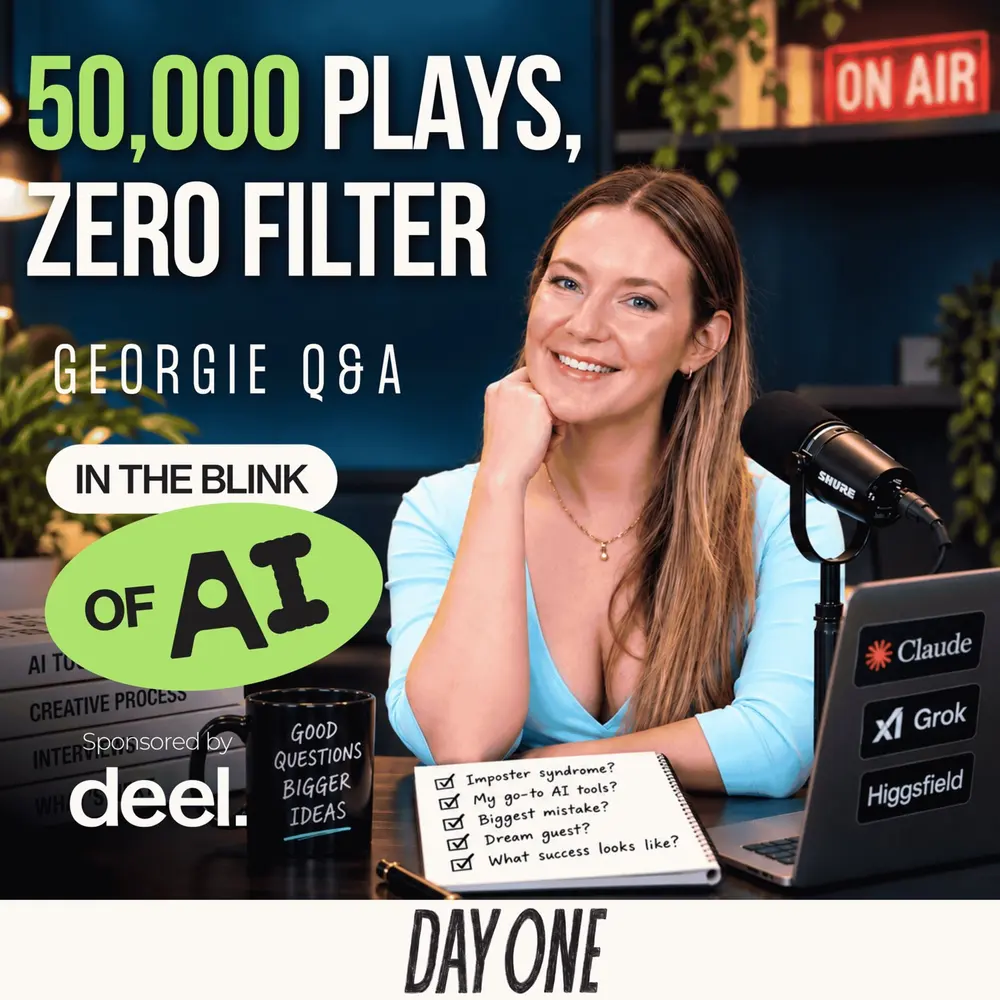
For the first time in 80 episodes, host Georgie Healy flips the format and answers your questions. This Ask Me Anything covers the questions listeners have been sending in since the early days of the show: the early imposter-syndrome years, the two lines she still repeats to herself every week, and how she prepares guests before they ever hit record.
There's a rapid-fire round covering her most-used AI tools (Claude is the one she can't make a decision without), the AI products everyone can't stop talking about right now (Higgsfield and Grok Bot both get a mention), and the guest she's still chasing. Georgie also goes behind the scenes on the interview mistake that still makes her wince years later, told in full for the first time, along with the moment a live Sydney audience quietly revealed just how many of them had Claude running while they sat there.
It closes on where the show goes next: Georgie's honest, ambitious answer to what success looks like, and why she wants In the Blink of AI to be your weekly AI Superbowl.
Transcript Search or select a timestamp to jump ▾ 0:00 Speaker A: I asked her how it felt or what she thought her review of an article. It was so inappropriate. I don't even use that terminology. It would've been very easy to tell my editor, just delete that. It had to stay in the show. You've gotta give yourself permission to suck. You have to do it scared. And we are celebrating 50,000 Spotify plays. I will be celebrating by answering those questions, including the anonymous ones, including the ones I probably shouldn't air. People that aren't using AI or don't like AI are ignorant. Delightful about AI. This is what you could be using. This is how you can improve your life. Hello everyone, welcome to In the Blink of AI. I'm Georgie Healey, and today it's just me. I get so many DMs around this podcast, and they're often around how I do the podcast, where I record, how I interview guests. And we are celebrating 50,000 Spotify plays, and so I will be celebrating by answering those questions, including the anonymous ones, including the ones I probably shouldn't air. And I've broken it down into 3 key themes. And I've got a rapid fire in the middle. 1:12 Speaker B: You're listening to a dayone.fm show. 1:19 Speaker A: In the Blink of AI is proudly sponsored by Deel, the global HR and payroll platform that's behind the expansion of companies like Revolut, Shopify, Or fans of the show ElevenLabs, who quadrupled their workforce in 54 countries. Build your global team with Deel. Okay, so this section is the first block, and it's really about backing myself when no one else does. So it's kind of around imposter syndrome, and I had a lot of questions around this, especially in the early days of the podcast. And the truth is that It was actually a year when even my friends and family didn't really listen to the podcast. It's asking a lot, you know, an hour-long AI podcast, especially in the early days when AI— people weren't necessarily sure it would stick around. And I had to kind of back myself and believe in myself before the numbers ever represented that. And it's hard in those early days. 2:18 Speaker A: So I'm gonna answer the questions that come around this imposter syndrome. And the first one is from Gemma Clancy. And we kind of heard it at the beginning of the show. As someone that's not a software engineer and who doesn't fit the typical tech bro mold, how did you become comfortable interviewing and being in rooms full of technical people talking about AI? And yeah, the truth is that I wasn't, I wasn't comfortable with it. And I've learned over time that it's, it's not cute to pretend to be more technical just for credibility. I don't do that anymore. And after recording 80 episodes, I see the data and the data says that you guys do like my personality and my opinions, even if I'm not the most technical in the room. I was under the assumption that I was only as good as the guests I have, and the guests I have are incredible. But I want you to click those episodes even if you aren't familiar with the guest anymore. 3:18 Speaker A: And then that onus comes on me being an entertaining host that will ask the right questions regardless who the guest is. Also, 2 quotes that I have been using Since the beginning of the show. Number one is you've got to give yourself permission to suck. I give myself a lot of permission. And then you have to do it scared. I do everything scared. I'm doing this Ask Me Anything very scared. You do develop a muscle to kind of get through those awkward stages. From Fiona Pettigrew, I love this question. What self-learning discipline Have you applied to build your AI literacy? So I had the horrible sensation of having a guest after I asked them a question to then ask me what I thought afterwards. Now my entire focus was always around researching the guest, asking the right questions, and making that my number one focus. 4:18 Speaker A: Answers to those questions themselves, I never ever thought about. And so, when the VP of Dropbox or the COO of Notion would then say, what do you think? Saxophones would very loudly play in my head. It was alarming because I didn't have an answer, and I'd come up with something that was as honest as I could on the spot. And at the beginning of this year, I started a Substack, not even for growth necessarily, but to force myself to have a weekly opinion on the top AI news. So, politics, new technical tools, founders, anything that was the most important topic in AI, I would start with my AI rant of the week. And to have a rant, you really need to deeply understand that topic. And I've been doing that every week this year without fail. This week's AI rant of the week was on GrokBot. And I published that this morning. 5:13 Speaker A: It's a fantastic way to keep yourself accountable, even if no one's reading it, but thank you for reading it. Okay, the next question. I get this question a lot, and it is, how do you be motivated in the early days when the numbers suck? The truth is that I didn't look at my data a lot in the early days, like in the first 9 months. I know you should be looking at your podcast metrics and things, but podcasts are a very long game, and I found that if I would look at those, I probably would have got very discouraged. At the quantity of listens, and what I instead focused on was the comments I received. So, I got some really lovely and thoughtful comments. A shout-out to Tristan Cameron, who was going for runs in San Francisco and listening to the show in the very early, terrible audio days where I was still figuring out myself as a host, and he went to the trouble to say that he liked an episode or what he thought about a certain guest. 6:13 Speaker A: And that stuff really kept me motivated in the early days when numbers weren't great. Who is my biggest competition? I am going to answer this, and I don't want it to come across competitive in a negative sense. Of course, in the podcast space, it's a very competitive space, and of course there's overlapping hosts that have overlapping guests. I see my biggest competition as Sachin and Adam. Since the early days, they have really carved out an incredible community in the tech founder VC space. They're really good at what they do. They're several steps ahead of me in terms of production, in terms of, you know, they've been doing it for a long time. They're also really generous, and I've been able to ask them questions and they've been really specific and really open about their process. 7:08 Speaker A: And I feel really grateful to have them them in my network, and they deserve every success they get. They're kind of more in the tech documentary space now than the podcasting space. But yeah, like, we, we often do work with similar people and similar guests. So I see competition more as like, where would I like to go? What would I like to achieve? And in the Australian space, they're, they're an obvious example. Oh, and by the way, on that note, I do get people say, oh, this person's starting a podcast that's very similar to yours, or I see they're doing this the same As you, and it's really hard to be a podcast host. Anyone that's tried it knows that it looks easy, but to do it really well is really hard. And my way that I approach it is that I out-care the competition. And that's not specific to do with anyone in particular in the industry. 8:01 Speaker A: I think everyone cares, but I will care the most and I will not stop and I will listen to every single episode. Back and I will scrutinize myself every single time, every single week, and I will continue to do so until it's what I think is a world-class show. So welcome, and I'm looking forward to more competition. Rob Edgar asks, you spend a lot of time talking to people at the leading edge of AI. What do you think those of us who are enthusiastic about AI sometimes forget about the people who are just starting to use it? It's a great question. I am on other social media platforms like Instagram where AI is not so well received like it is on LinkedIn and maybe X. I think what we get wrong a lot is that us in the tech space that love AI or we're very AI-pilled, we assume that people that aren't using AI or don't like AI are ignorant. 8:59 Speaker A: And I don't necessarily think that they're ignorant. I think they do know what AI is. I do think they know how to use AI and they choose not to. And it's not because they're They're dumb, and it's not because we just need to show them how it works. They are making a considered choice. It's maybe an ethical choice. It's maybe a, you know, they don't like the fakery of AI, and I completely understand them, and I don't think they're wrong. What my approach is and what I recommend to anyone that would like to show the benefits of AI to a wider community, I think you just have to say that you get them. You understand their concerns and you don't need to force them. And you just say, I am here if you ever do want to see my AI workflows or you do want to see how I use it. But I completely understand where you're coming from and I understand why you feel uncomfortable about it. Frankly, I feel uncomfortable about a lot of AI-related concepts as well. 9:57 Speaker A: But for me, the pros outweigh the cons. Yeah, consider that approach. What makes a perfect guest? There's 3 things. Number one is someone that trusts me. If a guest trusts me that I'm not going to get them cancelled, I'm not a gotcha journalist, they're usually a lot more open and it's a lot more of an easy-flowing conversation that's easy for listeners to listen to. Quick answers is something that I really appreciate because when a guest speaks for a very long period of time, it's hard for the listener and it's hard for me as a host because I I hate cutting guests off. It's a lot easier if they answer quickly and then I can ask a follow-up question if I think it needs it. I like an unfiltered guest. I like a guest that can speak off the cuff. I've never had someone cancelled on my show before. I don't plan on that changing anytime soon. One difference with the quick answers part is there's always an exception to the rule. 10:54 Speaker A: And my exception is Dr. Simon Longstaff, who came on the show. At the end of it, he said, Oh, sorry, did I ramble? He is the only guest that I've ever had that has gone completely viral on my Instagram. A clip from him has— and counting, by the way, I get more likes and more follows every day because of him— 1,300,000 views on a clip where he talks about working in the Gulf of Carpentaria and speaking to an Aboriginal mob and the patterns that they notice. I encourage you to check that out. He is a world-class storyteller, but don't try that at home. I'm definitely not a world-class storyteller. I think a quick answer is better than a long answer unless you are at that level. What do new hosts get wrong? This is the last question in this, this part of the episode. New hosts over-engineer in the early days. 11:49 Speaker A: They get amazing cameras, amazing lighting and videos before they've really Settled into themselves as a host, before they've really scrutinised themselves as a host. So, they've got this incredible production value, incredible guests and equipment, and they'll do things that I did in the early days. They'll have a lot of filler, they'll talk too long. I hate things like my vocal fry, which I'm sure I'm doing like crazy in this episode. I used to make noises when the guests were talking, like the aha, mm-hmm. Yeah. Wow. And we all do that because that's how we speak to people. You should be like 15 episodes in and removing the easy things to remove before you get to that level of production, is my opinion. Okay. We are at the rapid-fire section. I make my guests do a rapid-fire and now I'm putting myself through this. It's really not easy and I'm going to try my best, but now I feel very deeply for how hard this is and what I put guests through. 12:49 Speaker A: Shilpa Mohan asks, if you could only ever ask one question of one person in the world about AI, who would it be and what would you ask? Of course you ask such a hard question. I know who it would be. It would be Demis Hassabis, the recent CEO of DeepMind. But the hard thing is what question I would ask him. I think what I would ask him, and I would make him do a shot of truth elixir before he can answer this, I would ask him, do you wish you could put the genie back in the bottle when it comes to AI? Aka, would you take AI away if you had the power to do so? And the reason I would give him truth elixir is that all the tech leaders, all the AI leaders always say that AI is a net positive. You know, you can advance, you can advance drug discovery, you can advance the implications of healthcare. It's just going to be a net positive on the world. But I think they know a lot more about the security risks. 13:49 Speaker A: Risks of AI. I think they know a lot more about the potential downside of a few powerful people that seem to have a lot of the control when it comes to AI and the implications of what that means. And so I would ask him honestly, is it a net positive or a net negative to have AI in the world? Most used tool right now is Claude. Still to this day, it's like I can't make a decision without running it by my business partner Claude. Look, we get it. Global hiring and payroll can be a headache. Companies like Shopify, Revolut, and ElevenLabs already scale internationally with Deal. And Airwallex, the leading AI finance platform, they manage and pay over 1,185 employees across 16 countries, and they build their global team with Deal. Deal. 14:46 Speaker A: So visit deal.com/dayone and start expanding your business today. Hottest AI company. There's 2 at the moment that people can't stop talking about. One is Higgsfield AI, and I don't know what it is or what it does. Everyone won't stop talking about it. That's my research for this week. And also GrokBot. It's so hot right now, and I started using it literally yesterday, and I get, I get it. It's incredible. It's the first time that this will be your AI chief of staff bot for you actually is working for me and is very user-friendly. Grokbot is crazy. Dream guest that I haven't landed? I have my heart set on Kara Swisher. If you know her, get her to call me. Tool that I use every day is Whisperflow. I love voice AI, and that one works well. Best book I've read this year? 15:46 Speaker A: Too hard. I've got a book club where we read exclusively fiction, and my favourite book from this year is called Malaluka. It's written by an Indigenous Australian. It's like a whodunit. Fantastic book, very entertaining. I'm reading Tech Bros at the moment. I'm really loving it. It's about the Atlassian co-founders Mike Cannon-Brookes and Scott Farquhar. Brilliant. And I reread Brave New World this year. It's written like 100 years ago, and I think it's very— there are a lot of parallels between what that book showcased and the way people act when they're kind of slowly being boiled like a frog and this time in AI. I do recommend you reading that. Who is my worst guest? This is really— I nearly was going to answer this. I really recommend to anyone that has difficult question like this posed to them to really know what their values are. 16:40 Speaker A: And 2 of my biggest values don't often play nicely with each other, one of which is honesty. I really value honesty, and my lizard brain, my thinking fast, would go straight with honesty, and I would say who that guest was, and I would say why, and there's a reason why, and it's very fair that I would say this person. But then my other even more important value is kindness, and it would be incredibly unkind for me to say their name. On this podcast and share that with thousands of people. Warren Buffett said you can insult by category and not by person. And so that's what I'm going to do today. This person wasted a lot of my time and money and recording and editing and then asked me to remove the episode. And I think they knew better. I think they knew what they had done in terms of work and what that meant. And it wasn't cool. 17:31 Speaker A: But if that's the worst thing that ever happens on this show, I'm very, very lucky and I'm very, very grateful because 99.999% of my experiences with guests have been so positive and I'm absolutely honored to be able to interview the people that I do. The app I hate is Granola. The people that come for me for promoting Meta Ray-Bans or thinking that the Meta glasses are cool and actually their surveillance, when meanwhile you're recording people without them even being aware and having any knowledge. You know who you are. Like everyone is using Granola and seems to be okay with it. I find it really icky. I hate it. I think that there should be an ability for people to know when they're being recorded and Granola is bad news. I don't like it. One prediction for the next 12 months. I told you that I use WhisperFlow. I'm obsessed with WhisperFlow. 18:29 Speaker A: And the reason is typing, and typing is a modality we've gotten used to because we had to. That was our only way of departing that information into the computers and the phones that we needed to. And with voice AI, it is so brilliant. And the more I use it, the more I use it. My prediction is that in 12 months, in September 2027, we are going to be using voice 50% of the time. At the moment, maybe it's 10%. I reckon that number is going to increase significantly. One thing I've changed my mind about— I guess in general, I changed my mind about the tech bros a lot. The AI overlords, the Sam Altmans, the Mark Zuckerbergs, Demis Hassabis, Dario Amodei, Elon Musk. I find it really hard to know how I feel about any of them at any given time. They'll release an incredible product. They'll do something politically dodgy. 19:26 Speaker A: They'll seem like they're pro-humanity and then The way they interact with their customers or their users or the way they build their products will make me second-guess that. So I change my mind about how I feel about any of those people often. Oscillates wildly from they're completely evil and I don't trust them to I think they're doing their best. I actually think they are pro-humanity. I think they're trying to help, which are two very different ways to feel about any one person. And finally, my favorite question I've ever asked a guest. So when I prepare for an interview with a guest, I write out all the questions in advance, and there's always ones that I circle as my favorite questions. So there's easily 5 per episode that are my favorite questions every single week. But to try and answer this question, one that comes to mind that I was particularly proud of is when Anthropic launched here in in Australia. 20:24 Speaker A: There was a Sydney exclusive event. I think it was called a Deep Tech Saloon. And I had the privilege of interviewing Zac Hatfield Dodds, who is Anthropic's 21st employee. He's Aussie. He worked in the University of Canberra and yeah, very early employee at the company. And to kick off the, the moderation or the interview that I did for him live in front of an audience, I asked the audience to show a sign of hands who's used Claude in the last week, and then who's used it in the last day, who's used it in the last few hours. And so everyone was showing their hands for each of these, and it was kind of everyone. And then I got Zach to ask them who has used Claude, who is using Claude right now. And it was fascinating to see who was showing their hands that had Claude running in the background while they were sitting in the audience. 21:22 Speaker A: And it was really special and really delightful to see his reaction because he is As the builder of this product, coming back to Australia— he's based in San Francisco— seeing those hands of people that love a tool that he is fundamentally behind and, and building, I loved that. Okay, so this is the last section. This is what I would classify as behind the scenes. This is where the sausage gets made. These are things I don't normally say or tell people about how I build the show, how I prep guests and the like. Hi. What was the biggest occasion when a guest properly surprised me with their answer to a serious question and not just banter? Actually, I've got quite a serious answer to this and it still haunts me to this day. I had Michelle Gilmore, who is an incredible founder, VC-backed. She is the CEO and co-founder of Juno. I had her quite early on the show. 22:22 Speaker A: I'm really not proud of this moment. It's when I told you about when a guest asks a question back at me. This is an example of that. And I don't know if my brain short-circuited or what happened there. I asked her how it felt or what she thought, her review of an article with herself in the paper and her takeaways from that article and what it made her feel. And then she asked me back, what do you think when you see this article of me and of Juno? What I said to her was, You look like a real ball basher. I mean, what— oh, what even is that? Like, why would I say that? It was so gendered. It was so inappropriate. I don't even use that terminology. I think it was the first time I've ever said that. I, I just— I'm so embarrassed. It's so cringy. After the interview, Michelle very kindly said to me, if you want to remove that, you can. 23:16 Speaker A: But what she had done in the interview is she had said very politely, very clearly, ah, would you ask like a male founder that question, or would you say that about a male founder? And the way she handled it was so exceptional, it was so world-class, it was so exactly how a woman should answer a question like that or, or a statement like that, that even though every part of me wanted to remove it from the interview— I was so repelled by it, I was— and it would have been very easy to tell my editor, just delete that— it had to stay in the show. She had done such a beautiful job. I do not get a medal for keeping it in the show, but you know, it's still available to listen to. It's still as cringe as it was the day I recorded it, but that is how you answer a question like that, and that is exactly why I kept it in. Fiona Pedigree asks, how do you prep guest speakers for the show? Very much the same way as I always did. 24:12 Speaker A: It starts with either PR reaching out to me with an incredible guest, or me cold reaching out to a guest to ask them to come on the show. These days, if they're a pretty spectacular guest, I also send my media kit to show them my audience and analytics. And then from there, we do a briefing call, which is about 20 minutes. And this is really important because I know what I think audiences would like to hear from them. I know what I would like to hear from them, but I really want them passionate about what they're talking about. And so I want to know what they want to talk about as well. After that, I write up all the questions one by one and I send it to the guest. And sometimes they go through fine-tooth comb Sometimes they don't even read it. There's no right answer. Guests kind of know what they're most comfortable with. We record either on Riverside virtually if they're out of Sydney, or at Wisecast in person, and from there it goes live. 25:06 Speaker A: We used to have an additional chance for a guest to edit the episode then or provide feedback. With a weekly show that comes out every single Friday, we just simply can't do that anymore. So if they have a specific concern after we record, I ask them like, is there anything you want to change or remove? You know, 90% of the time they don't, and we just go live from there. So now you know exactly how the sausage is made. Kelly Norman asks, is what you thought would be the most interesting elements of AI when you started still what excites you today? And if it's changed, how? Great question, Kelly. When I first started the show, AI was still kind of seen as, I wonder if this technology will stick around. Like, will it be like the metaverse, or will it be like Web3, or anything like that? And I fundamentally thought AI was incredible. It was a different way I would search. 26:01 Speaker A: So instead of going into Google search and scrolling and going through all the articles and trying to decipher information through the sea of Google, It was a much better way of getting information quickly, and that's how I saw AI. I thought it was brilliant. I thought it was genius. It's actually fundamentally changed how I live and work. Like, I use AI constantly. I told you earlier that Claude is like a business partner for all my decision making, any kind of research. It understands me really well. It understands my goals really well. It challenges me, and even the modality of how I. Work and live now. I told you about how much I'm using voice AI. That was so not on my radar before. And yes, yesterday I used Grokbot, and for the first time ever, agents actually feel quite delightful and fun, and the interface is incredible. 26:58 Speaker A: Like, early days on that, but that might be another thing that I didn't even expect to change the way I interact with the world. It's crazy. So we have Tara Awamoto. Thank you so much for this question. She's asked, would you ever consider doing a live podcast show? Asking for a friend. You are a friend. Here's what I would need to do this, because I am a perfectionist freak that wants it to be perfect and wants it to be amazing. If I'm doing a live show, I want people to be talking about it a year later. I would want it to be a fantastic venue. I would want sponsors to cover drinks and food, have a merch stall and make it feel delightful. And that would make it such that anyone could come. I don't want it to be like too exclusive that it could only be catered to the people that could afford it. I'd want it really inclusive. 27:53 Speaker A: I would want a world-class panel of people that are speaking, people that have flown in, people that you never see at events, people that are in the Times 100 in AI list. That's the kind of level I would want it. And I would want new In the Blink of AI merch there that would only be dropped on that night for that day. Had to be there to get it kind of thing. And I would want like the VIP listeners that have been listening since the early days, that are the kinds of people that find an Ask Me Anything fascinating, to get the best seating at the front. Yeah, that's what it would take. Message me if you've got any ideas of how to make that happen. We have one final question. I've saved it deliberately. This is the future of the show. This is from James McDonald. What does success look like for you? Is it being a world-class podcaster? Is it being able to podcast and write while also being there for your family? Is it something else? 28:51 Speaker A: Do you have an end goal in mind? Brilliant question, James. Of course, a fellow podcaster asked such a brilliant question. Success for me is a world-class podcast. Not just a world-class AI podcast, not just the best AI podcast in Australia. I'm talking Diary of a CEO level, Call Her Daddy, Dwarkesh Pod, Acquired. They're, they're my favorite podcast of all time. Shameless Media. You know, I am such a huge podcast fan, as you can tell. I started listening to them 12 to 15 years ago, and I distinctly remember I was working in Detroit at Ford headquarters. It was snowing, and I'm a girl from Brisbane, and I would walk to the factory and freezing my ass off. And as I was walking, I would listen to podcasts. And maybe don't try that at home in Detroit, guys, if you're listening. But I would listen on the way to work and on the way home, and it just felt delightful every day. 29:50 Speaker A: And It's what got me into podcasts in the first place. So yes, I'm a huge fan and I want to be at that level. I mentioned before that I take it so seriously. I out-care anyone and my plan is to get there. And every single episode that I record, every single guest that I get, it's very high conviction and with a lot of intent behind it. So please give me feedback. Please tell me what I can do to improve. Please like the episodes. Please subscribe to them so that I can continue to improve and get more feedback and exposure into circles that I might not be in otherwise. In terms of being there for my family, a really lovely side effect of going all in on the show this year is that I do drop my kids at school every day. I never used to be able to do that when I worked at Google launching the AI Accelerator. I just didn't have the capacity to be a 10 out of 10 mum and a 10 out of 10 employee and a 10 out of 10 podcast host. 30:48 Speaker A: And I definitely think I'm 10 out of 10 at both with like social and family life and what I care about most, which is the show. So that's been brilliant to have that flexibility. And what's my end goal? I would love In the Blink of AI show to be like the Super Bowl. Like people get so excited to tune in and they talk about it the next day at work. AI is a really hard and scary place to be in right now. People are feeling scared and disrupted and for good reason. And the great thing about not working for a specific tech company anymore or having any agenda that I'm trying to promote means that I can play with both sides of it's really hard and it's really scary and the pace is way too fast, as well as delightful about AI. This is what you could be using, this is how you can improve your life. And I hope that this show is something that people can tune into week after week and feel educated but also not judged. 31:45 Speaker A: I would like the show to become a safe space and a community that people feel really welcome and happy in. So that wraps the first ever Ask Me Anything for In the Blink of AI. Thank you so much for listening. This has been very scary to talk to camera face to face like this. What didn't I answer? What do you wish that I answered? Please put a comment in below or send me a message. I'm more than happy to do this again if there's enough of those. In the meantime, make sure Make sure you like this episode if you enjoyed it, and I will see you next week. Thank you so much for listening to In the Blink of AI. If you want to go deeper on anything we've spoken about today, I write a weekly Substack called Attention Is All I Need. Yes, it's hilarious. It's a pun. And essentially, I go into AI rants, tech news, events I'm going to, and more. 32:42 Speaker A: It's bite-sized, and I hear it's awesome. Uh, the link is in the show notes below. No transcript lines match that phrase. Try fewer words.

 ▶
 ▶
 ▶
 ▶
 ▶
 ▶
 ▶
 ▶
 ▶