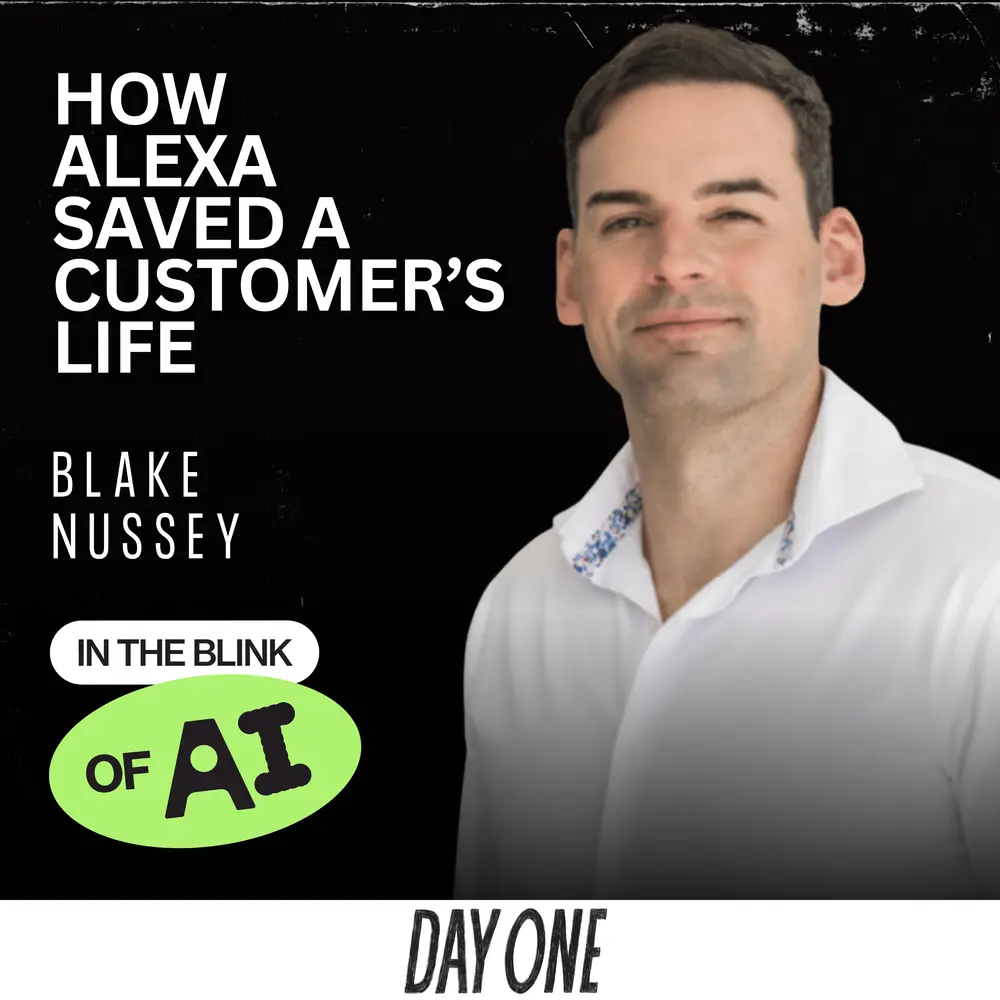
Blake Nussey leads at Amazon on Alexa, and he joins Georgie for a deep dive into Alexa Plus, now live in Australia. They cover the shift from rigid voice commands to a true personal assistant powered by over 70 models, and why Amazon built a model agnostic architecture to trade off speed against reasoning depth.
The conversation gets personal fast: a customer who broke her leg and called for help through Alexa, Blake's Alexa run wind down routine, and why "don't lead the witness" has become his and Georgie's go to line for settling arguments with a neutral AI referee. They dig into what it actually took to make Alexa understand Australian English (avo, servo and all), the far field listening tech that lets Alexa hear you across a noisy room, and how privacy and trust are engineered in, down to a hardware mute button.
They also talk accessibility (Alexa's role for vision impaired and elderly users), kids and voice AI, and Blake's prediction for when voice hits 50% of how we interact with tech. Plus a rapid fire round covering Tesla FSD, Brazilian Jiu-Jitsu, flat whites, and Jimmethy the raccoon.
Chapters
0:00 Cold open: FSD and "don't lead the witness" ▶ 1:18 Intro: Georgie's honest take on Alexa Plus ▶ 4:04 Sponsor: Deel ▶ 4:22 Welcome + Blake's favorite AI hack (voice routines + Tesla FSD) ▶ 6:27 Most non-AI thing: Brazilian Jiu-Jitsu ▶ 8:30 Evolution of Alexa to Alexa Plus ▶ 9:59 Behind the scenes: how Alexa picks the right model ▶ 12:51 Smart home routines and the "corporate athlete" habit ▶ 15:29 Alexa recommends a book (the Kindle story) ▶ 16:25 Sponsor: Deel ▶ 17:12 Building Australian Alexa: colloquialisms and local speech ▶ 20:58 What made the Aussie rollout hard ▶ 22:36 2 billion interactions and Australian usage patterns ▶ 24:32 Kids and Alexa: safety, kids mode, and development ▶ 26:44 Presence, phones, and family dinner table use ▶ 27:44 Privacy, trust, and the hardware mute button ▶ 30:52 Accessibility: vision impairment, aging, and emergency use ▶ 34:21 Near field vs far field: how Alexa actually hears you ▶ 39:19 Voice AI hype, predictions, and wearable mic concepts ▶ 46:17 Privacy culture, recording etiquette, and Meta glasses ▶ 48:44 Rapid fire round ▶ 55:16 Outro ▶ Transcript Search or select a timestamp to jump ▾ 0:00 Blake Nussey: I've got 97% FSD of all my driving miles, which I think is pretty awesome. The coolest thing about living over here is you have access to the full self-driving with Tesla. And I grew up driving on the wrong side of the road, right? So any help I can get on the road is very, very welcome. 0:17 Georgie Healy: No, no, no, you're goading. The way that you're asking the question is going to make you right, but no. And so we argue over that. So it's really nice to have a third party that is like, You can't lead the witness. 0:28 Blake Nussey: This is digital. 0:30 Georgie Healy: Exactly. 0:30 Blake Nussey: No, don't lead the witness. Yeah. She'd probably be really good at setting timers and alarms, but it's gonna stop there. So we need to adapt to customers, and a big part of that is how they speak. We have literally anecdotes from customers saying, this saved my life. Like, I broke my leg, I was able to call for help with Alexa. I'm really focused on being productive and effective at work, and I think a big part of that is getting restorative sleep. And one of my rules as part of that is no phones in the bedroom. I also have a goodnight routine, so as soon as I say goodnight, all the lights turn off in my house. Alexa starts playing pink noise, which is really important for sleep. Alexa Plus is available now in Australia. So we've been rolling out early access since about early August, and so thousands of customers have already been invited to use Alexa Plus for free. 1:18 Georgie Healy: Hello guys, welcome back to In the Blink of AI. Quick story, I went to the Alexa Plus launch event here in Sydney and it was fabulous, but frankly, I have never identified myself with a smart home type. You know, when I sent a photo on LinkedIn, I had all these comments about people that are obsessed with their smart homes. They're really proud of their setups and you know, behind the scenes, I was like, that ain't me. That ain't me. That seems like a lot of work. I just don't know if it's worth it. And, you know, full disclosure, I kindly got gifted an Echo device, which meant that I got early access to try Alexa Plus. And, you know, I was going to try it. I was going to give it a shot so that I could make this interview engaging. But it's not sponsored. I don't really need to promote the product for any reason. And since having it in my home, I can tell you honestly, it has been really interesting and game-changing in the ways I did not expect, in— not in the ways that Claude told me to use it. I'm going to give you one example. Put your sandwich down if you're mid-lunch. Today, I have a senior bunny. She unfortunately has some bladder issues. It's the bane of my existence, and I was performing some kind of Brazilian wax on this rabbit. Anyway, quite revolting, quite disgusting, but she's getting distressed, right, because I'm, I'm cleaning her fur. And from the other side of the kitchen, I realize she's, she's probably not enjoying this. She's probably very stressed out. And I call out, Alexa, can you please play some soft classical music? I need to take the, take the vibes to a different direction. And it's That kind of stuff that I do all the time without thinking about it, with my hands tied, which I can't use my mobile phone for. I need voice AI that can do far field, which we'll get into on the show. And this stuff I have been doing genuinely daily, all the time, without realizing I needed it. And it's for that reason I do think you should listen to this episode. If you think you're not an Alexa Plus kind of a person, or if you are, this is a really deep dive and some honest takes. Around what the future of voice looks like. I really can't wait for you to have a listen. Let's dive in. 3:53 Ad: You're listening to a dayone.fm show. 3:59 Georgie Healy: In the Blink of AI is proudly sponsored by Deel, the global HR and payroll platform that's behind the expansion of companies like Revolut, Shopify, or fans of the show ElevenLabs, who quadrupled their workforce in 54 countries. Build your global team with Deel. Blake, thank you so much for joining In the Blink of AI. I have been looking forward to this for some time. I literally just told you that behind the scenes. I want you to kick us off with the most important part of the show, which is your favorite AI hack. 4:37 Blake Nussey: Yeah, well, my favorite AI hack, of course, it has to do with Alexa. So with Alexa Plus, we have now the ability to create and edit routines with your voice. So in the past, you had to actually use the Alexa app to do that. There was a lot a lot of friction. So now you can create them very easily, edit them very easily, as I mentioned. And so some of my favorite routines, every day at sunset, all my lights turn on, which is awesome, you know. So when I get home, it feels like I'm coming home to somebody, but unfortunately I live alone. Yeah. And then the other really cool thing is at 9 PM every day, uh, wind-down music begins. Uh, so it's kind of my cue that I need to sort of like get ready to, you know, calm down, get ready for bed. And so yeah, it really allows me to optimize and automate my household, which is super important for me. Very focused on work, so help at home is much needed. Now, can I cheat and just add one more that's non-Amazon, if that's okay? 5:27 Georgie Healy: You know what? I love a hack. 5:29 Blake Nussey: This— I don't know if it's really a hack, but the coolest thing about living over here is you have access to the Full Self-Driving with Tesla. And I grew up driving on the wrong side of the road, right? So any help I can get on the road is very, very welcome. And so I checked my metrics before starting this. I've got 97% FSD Of all my driving miles, which I think is pretty awesome. 5:52 Georgie Healy: Wait, what's FSD? 5:53 Blake Nussey: Full Self-Driving. 5:53 Georgie Healy: Oh, we are in the dark ages over here back in Australia. That is incredible. That's so cool. Like, to each their own too with these routines. It wasn't quite LinkedIn appropriate, but with my Alexa Plus, when I say, Alexa, I'm home, what happens is my red light turns on and some hardcore screamo starts playing. So like kind of same same but different routines, right? 6:18 Blake Nussey: Yeah, I love it. Yeah, every customer, uses them differently, but the customers absolutely love them, especially Aussie customers. So it's huge. Yeah. 6:27 Georgie Healy: Okay, but what's the most non-AI thing you still do? 6:30 Blake Nussey: So I actually am really big into Brazilian jiu-jitsu. So if your listeners don't know what that is, it's a form of martial art. It's grappling. So it's sort of think of it like wrestling, but with submissions. And so if you ever watched the UFC before, when it goes to the ground, they're mostly doing Brazilian jiu-jitsu. So I'm a brown belt. I've done it for about 10 years, but it's a huge stress relief. Like, you know, working here all day, long hours over in the US, you know, very, very stressful. And going into jiu-jitsu afterwards, it allows me just to, you know, get into my body, which I think is really, really important. I always think physical health is mental health, and that's a really important release for me. One thing I would say though, you know, at the beginning of the class, you've got to learn new techniques, and my cognitive abilities are pretty bad at that time of day after working all day. So some of these guys are like, are you really a brown belt? But when it comes to sparring, you know, then they go, okay, yeah, yeah, yeah, you're a brown belt. Once the memory kicks in. Yeah, exactly. So it's a lot of 7:27 Georgie Healy: fun. It's like that short-term memory too. It's like that's a different muscle altogether. I feel like being able to pick up new steps. Crazy. 7:34 Blake Nussey: Definitely. And the other thing is you get to meet people outside of the tech bubble. Like in Seattle, it's very, very tech. So you get to meet all kinds of different people. One guy has a business that makes doors, you know, like, so you just meet these really interesting people you'd never come across in my day-to-day. So I love that part of it as well. 7:50 Georgie Healy: That's so cool. My son actually does Brazilian jiu-jitsu and he's 6. Yeah. Yeah. And it's good for him because he's naturally a really lanky kid. He's not very sporty, but he loves Brazilian jiu-jitsu. It's really interesting that it kind of seems to not be just for if you're sporty, you would like it. It kind of seems to have all different sorts. 8:10 Blake Nussey: Well, I have a confession. I'm not athletic at all and I'm kind of lanky. So, me and your son sound like the same body type. 8:16 Georgie Healy: So, yeah. Brilliant. Okay, well, yeah, I'm like, mate, I wasn't sporty either. But there's still stuff you could do that's very full on. Okay, that's a brilliant non-AI hack. But let's start talking about— I mean, the elephant in the room is the fact that Alexa Plus is in my household now. And I'm speaking to someone who very much made this possible and Australian. So first of all, maybe tell me a little bit and the listeners about the evolution of Alexa to now that the kind of elevator pitch version? 8:51 Blake Nussey: Yeah, definitely. So Alexa was launched, you know, over 10 years ago, the original version, and now we've recently launched Alexa Plus. And so this is possible with the power of generative AI. And probably the major thing to think about with Alexa Plus is now it can truly adapt to you and what you need. So you don't— in the past, in the previous versions, you had to use Alexa Speak. So very specific commands. With the new version of Alexa, Alexa Plus, you can talk to it just like you would talk to a friend. And yeah, we've just recently launched it in Australia and really excited about that. 9:23 Georgie Healy: I used it this morning because the weather has been crazy here in Sydney. On the weekend it was 27 degrees and sunny and I was literally at Bondi Icebergs. Today, raining, freezing, wearing a long sleeve shirt like crazy. And so before I left the house, I was like, when will it rain? And I got a clear answer about timing and all the rest of it and didn't get caught in the rain, which was really good. 9:46 Blake Nussey: The cool thing about that is you can kind of do that on the way out. You don't have to like grab your phone and look it up. You're just like, Alexa, what's the go with the rain? Just tell me, you know, and it's like boom, boom, boom, done, you know. So you can sort of stay present, stay focused on what you're trying to do. That's one of my favorite things about it. 9:59 Georgie Healy: And you mentioned generative AI, but you made that sound very general. What kind of models does it use? Is it specific based on behind the scenes? Like, how did you choose? 10:10 Blake Nussey: Yeah, so actually Alexa doesn't just use one model. It's not Alexa Plus as in a chatbot. It's, it's not that. It's, it's a you know, personal assistant. In fact, it uses over 70 models. And so these include models that we've created from, you know, Amazon Nova and also a bunch of models available on Amazon Bedrock. And so what we do is we choose the right model for the job. And so with something like, you know, turning on the light, that's quite a small model. But for something more advanced that requires more computation, we choose one of our, you know, bigger models. And that enables us to do more complex tasks, more reasoning and things like that. So What it really is, is we've built an incredible harness that utilizes all these models effectively to ensure we trade off between, you know, latency, so doing something really fast or something more complex, you know, getting something more precise, if you know what I mean. 10:59 Georgie Healy: I do know what you mean. Like, for someone very new to this ecosystem in general, you know, I'll admit when I first posted that I was trying Alexa Plus, I had so many people in my comments, Blake, talk about their smart homes and screenshots of their energy usage and all of this stuff. Whoa, there is a world out there of people that are really, really, really passionate. And sometimes it feels kind of overwhelming. When I think of Alexa, I kind of think of, there's a pause there. Why is there a pause there? When do we need a pause? When can she answer quickly? Tell me a little bit behind the scenes of that as someone like me who's really quite new to this whole space. 11:44 Blake Nussey: So as soon as you say something to Alexa, Now, we need to find the right model for the job. And I sort of touched on it before. With something very, very simple, we can use a small model which is optimized to be faster. So, you know, turning on the lights, and that's like quite a use case that we know everyone does. We have a lot of training data on it, so we can build a very like specific model just for that job. But, you know, if you're trying to organize a trip, you know, you're asking key information, maybe you're setting up like a really complex routine that includes locking your front door, we need to take a little bit more time to get that answer correct for customers. And so that enables us to use a bigger model, but the trade-off is a little bit of latency. So we do, you know, our best to mask that as much as possible and ensure we're delivering it as efficiently as possible to a customer. And we do have what we call like a model agnostic architecture. What I mean by that is if we identify a new model that we think better serves our customers, we can add that in. And so we're constantly improving it behind the scenes for customers. And that's something I'm really passionate about. 12:51 Georgie Healy: I mean, I have to talk a little bit more about smart homes just because I know so many listeners have like respect for having a smart home. One person in my comments said that they have this tip, which is get more than one device, because he was screaming from his bed to his living room, turn the lights off, Alexa, until she— he got a, an extra piece of hardware in his room as well. Tell me about your smart home routine. You mentioned when come home and sunset and the lights are turning on, which is lovely. I remember you mentioned another use case about your corporate, uh, what's it called? You're a corporate athlete. Tell me, tell me about that. 13:32 Blake Nussey: Yeah, I mentioned I'm a corporate athlete, and, uh, what I mean by that— it's a, it's a term gets thrown around these days, and I don't mean I run triathlons on the weekend and don't keep my medal on like people did at the, uh, Sydney Marathon, or as I heard. 13:44 Georgie Healy: Don't get me started. 13:45 Blake Nussey: Yeah. But what I mean is I'm really focused on being productive and effective at work, and I think a big part of that is getting restorative sleep. And one of my rules as part of that is no phones in the bedroom. So I have to have my Alexa device, you know, in my bedroom, and that enables me to, you know, set an alarm. I also have a good night routine. So as soon as I say good night, all the lights turn off in my house. Alexa starts playing pink noise, which is really important for sleep. And I actually sleep really hot. So what Alexa also does is turns the aircon way down. So the bedroom's like super cool. And then she says a nice little goodnight phrase to me, which kind of makes me feel like I'm connected to her, which is kind of cool. 14:28 Georgie Healy: Oh my gosh, that's so cool. 14:30 Blake Nussey: Yeah, yeah. And then in the morning when I dismiss my alarm, that's actually also a trigger for Alexa. And I mentioned, you know, it turns the aircon way down. Now that's way too cold once you get out of bed. So when I dismiss the alarm, it turns the AC way up and heats the whole apartment back up. up. So it's pretty cool. But with Alexa Plus, you know, there's so many things now I can do from my bedroom. You know, if I forgot to do something— one, you know, anecdote was I'd finished a super long day at work, I got home, just wanted to go straight to bed. I picked up my Kindle and I'd finished my book and I had no idea what to read next. And so I thought, let's give this a crack. I don't want to get up and get my phone because I don't know about you, as soon as I pick up my phone, there's like I get distracted. It's not what I want trying to do before I go to sleep. So I thought, let's give this a crack. Alexa, you know, recommend me a book. And so Alexa said, well, Blake, I know you love historical fiction books, and there's this new book that's just come out that I think you'll like called Last Rose of Shanghai. I was like, okay, tell me a little bit more about it. It sort of gave me a bit of a spiel. I liked what I heard, but I was like, are these recommendations legit? You know, the way I sort of fact-check that is, what are the reviews and how many reviews are there? So, I asked those questions and she came back with— it's pretty high ranking, above 4.5, I believe, on Goodreads with thousands, tens of thousands of reviews. And she's like, look, it's only $4.99. Do you want to give it a crack? And I said, yeah, let's do it. And I started reading it. It was delivered right there to my Kindle. And I'm pleased to say it's one of my favorite books. Now, I have a new favorite author totally outside the authors I'd already read. For me, that's a pretty magical moment. And that's when I really got quite excited about the product that we'd built. And you know how it's going to help people with being a corporate athlete. 16:25 Georgie Healy: Look, we get it. Global hiring and payroll can be a headache. Companies like Shopify, Revolut, and ElevenLabs already scale internationally with Deal. And Airwallex, the leading AI finance platform, they manage and pay over 1,185 employees across 16 countries, and they build their global team with Deel. So visit deel.com/dayone and start expanding your business today. Oh my goodness, I am obsessed with that. I do not see myself as a corporate athlete, but I am a big Kindle girly, big Goodreads— like, I'm obsessed, right? Uh, BookTok has become a big thing amongst, amongst women and millennials and Gen Z, and I hate when that happens. Like, I finish a full series and I'm completely like, I don't even know, I've saved all these books, I don't know which one, and I don't want to get out of bed and I want to get my phone out. No. And I don't want to be researching it 11 PM at night. That is genius. We freaking love hacks on the show. But I do want to ask you a very specific question. I had the 21st employee from Anthropic at a live— what was it called? Like a live salon when Anthropic arrived in Sydney and their head office started here. Then— not their head office, their Sydney office started. It was a fantastic chat with him. But one of the things he mentioned was he tried to get some Aussie colloquialisms into Claude and was outruled. Very sad for us. But you didn't get outruled. Tell me why having Australian Alexa Insights is important. Why, why and how that came about. 18:22 Blake Nussey: So when we launched Alexa Plus, we really wanted to make sure that it worked for Australian customers. And, you know, one approach is, hey, let's just throw on an Australian voice to this product and be done with it. But that's not going to work. And I sort of know that firsthand, you know, living as an Australian in the US, people don't really understand me. From like the very first principle of like speech recognition, we wanted to make sure that, you know, Alexa understood how people spoke. For example, over here, if I say water like an Australian, they've got no idea. We really wanted to make sure that Alexa not only, you know, spoke like an Aussie, but she also could hear you, but also understand what you're saying. You know, what we believe is that if a product feels locally authentic, then customers are actually going to use it more. And if you think about it, if you had a personal assistant, as in like a real human, and that's often how we sort of use to make decisions around our product, like if you had a personal assistant in Australia, it would understand how you speak. It wouldn't just understand how you know, the American English is or the British English is. And so a lot of these models, just because of the way they're trained, like most texts out there is American English. And so it doesn't really understand, you know, how we speak. The other example I always use over here is like, yeah, I'll catch you the salvo. Americans have no clue. They're like, you're talking about avocado? And I'm like, no, no, that's avo. They're like, what? Like, and so I think, you know, As part of building that relationship with customers, if you can't understand them and you have to— the customer has to adapt to your technology, you're already on the back foot. And I think the promise of generative AI and also the promise of voice AI is that we adapt to our customers. And I think that's really, really exciting. It's also— there's a lot of people out there, my mom, for example, who's a big Alexa user. She is going to struggle to sort of change how she speaks to make sure she can control Alexa, right? Like, she's probably really good at setting timers and alarms, but it's going to stop there. So we need to adapt to customers, and a big part of that is how they speak. 20:30 Georgie Healy: I love that. I'm in a group chat with 2 Americans and a Canadian, and the number of times I'm like, no, no, no, guys, I meant this— it's hilarious. And they live here in Australia. I'm like, come on. What was hard about it? I can You mentioned, you know, not that easy of like flicking a switch. Like, what was difficult about not only launching Alexa, but also getting that genuine Australian voice and colloquialisms baked into the model? 20:59 Blake Nussey: Yeah, I mean, it's sort of what I touched on before, where a lot of these models are trained on like 99% American English. What we actually had to do is build out huge evaluation framework for this. And we wanted to understand, you know, if we build out sort of datasets of Australian customers and using the language they speak, we wanted to measure this and understand how these different models performed. And, you know, then we had to also build out based on those results a strategy of how to increase how it would perceive and understand an Australian. And one other thing is, I sort of touched on this before, we have what we call a model agnostic architecture that also enables us to use very specific models for different countries. So, in fact, when we say launch in somewhere like Japan or India, some of those models are different to what we use in the US or Australia. So, yeah, it's about evaluating what's going on, then building a strategy to bridge those gaps. And this could be things like supervised fine-tuning, it could be prompt engineering, you know, all types of different techniques we have. Yeah, just the funny stuff I'd already touched on. Like, avo, arvo, like these types of things, going to the servo, you know, like you've got to understand that stuff. 22:14 Georgie Healy: That means something very different. 22:15 Blake Nussey: I wasn't going to mention that one because it's a bit spicy over here. But yeah, that's one I also have fun with as an Aussie. You know, I'm like, do you know what these flip-flop things are called back home? They're like, what? I'm like, you— oh my God. 22:29 Georgie Healy: Olympics here, we had like Kylie Minogue riding on a giant thong. Like, it's just very Aussie, right? Like, you had to be there, guys. Okay, talk to me about this 2 billion interactions here in Australia last year. Is that surprising to you or not surprising? To me, that is crazy. That's crazy. I didn't know we were that advanced, to be honest. 22:50 Blake Nussey: I think probably what stood out to us is the routine usage, and that's something I've touched on before, how important it is for me day in and day out. But what we found was Australians perform more than 40 routine actions per month on average. And that's actually more than customers in the US, UK, and Germany. So they've really embraced automating their home in ways that I guess feel practical and no-nonsense. What it kind of makes me realise is that, you know, a couple of things. First of all, Australians, like, we kind of love our homes. Like, we love our houses. You know, you sort of see how, like, big real estate is, you know, for Australians. It's all about, you know, you invest in it, you've got to build your home. And I think that's like a natural extension of their Alexa usage. And I think it sort of fits in with a bit more like our culture. Like, we're here in Seattle, it's super, you know, in the bubble, like everyone works in tech, they're real frothy, right? They're always talking about the latest and greatest stuff. But Aussies, we're a bit more pragmatic and practical. Like, tell me how it actually works today and if it's useful. Yeah, I think that's how we think about things. It's pretty cool. You know, it tells us Australians aren't just using Alexa, you know, to set alarms or timers. They've actually woven it into their homes. 24:06 Georgie Healy: I mentioned I saw it in my comments. I was like, oh my goodness, there's like a whole ecosystem out there. And it's so funny you mention about Aussies and their homes. I just finished reading a book about the Atlassian co-founders and there was an entire chapter about their homes and their properties, like an entire chapter which went into full detail. It's what Australians want to hear, right? Like, we want to know what homes are like. Okay, but tell me about— in my home, I've got 2 little kids. I've got a 4 and a 6-year-old. I mentioned the 6-year-old that does jiu-jitsu. The one AI use they have, because they're still too young, we've decided for computers and screens and that kind of thing. But we're very happy for them to use voice AI. And what they say is, they say, can you ask the machine? Anytime, like, I don't know the answer to something, Ask the machine. Do you see, do you see that happening in homes as well, that children are able to engage? And if so, is there any difference in the way that the model can be, or the, like, the Echo can be set up for kids versus adults and things like that? 25:16 Blake Nussey: Yeah, I think, you know, I don't have kids personally, but I've got a lot of nieces and nephews, and they all love Alexa. And I think it's probably better for their development in some ways where they're able just to talk to Alexa. It sort of practices their social skills, how to articulate their thoughts. And I think it's, you know, personally, my viewpoint is, you know, tablets have a time and a place, but it feels a much more natural way for Alexa to sort of form part of their lives. So in terms of like how kids interact with our devices, so we do have a specific kids mode that you can enable, and that creates a kids profile, and it gives parents control over that experience. And of course, it protects those kids from, you know, sort of requesting songs that maybe have like sensitive lyrics and things like that. In terms of like what kids do, they love music, you know? So it was really funny. For the longest time, I think worldwide, the top music request on Alexa was Baby Shark. And so kids would just play it and play it and play it and play it. Like they are the undefeated power users of Alexa in some ways. And then, of course, you know, I love the info side of things, general knowledge. I actually find myself day in, day out asking Alexa questions that I have no idea about, especially when you're with a friend, you know, like, let's just find out the answer. Let's not assume. Let's not go on our phones and get into like a rabbit hole. And now I've got a notification. And I don't know, like, for me, when I use my phone for an extended period of time, I don't feel good. You know, and I could only imagine how kids feel, you know, as well after using tablet sometimes for hours. Yeah. And so, if we can help kids also stay more present, stay engaged with their families so they can just quickly ask a question and move on, if we can facilitate better family discussions at the dinner table by enabling people to ask questions and get the right answer, I think that's pretty good overall for the family unit. So, of course, with all that said, I still have a mobile phone. I love mobile phones. They serve huge part of our lives, but I don't think they should serve everything. 27:27 Georgie Healy: 2 thoughts. Number one is I get really mad at the way my husband will type in the question when we're trying to fact-check. I'll be like, no, no, you're, you're goading. The way that you're asking the question is going to make you right, but no. And so we argue over that. So it's really nice to have a third party that is like— 27:43 Blake Nussey: You can't lead the witness. 27:46 Georgie Healy: Exactly. 27:47 Blake Nussey: No, don't lead the witness. Yeah, I agree. 27:50 Georgie Healy: You know, like Like with AI and with everything, there's, there's a spectrum of the way people feel about it. And I know that some people, the idea of having a device in the house that can listen gives them some kind of feelings that are uncomfortable. How do you guys approach privacy? Is it always listening? Like, tell me, tell me the way you guys approach that. 28:15 Blake Nussey: So I think the first thing to mention is that we've had Alexa and Echo devices in people's households for over 10 years. So we've built a huge amount of trust with our customers. And the way we think about that, trust is hard-earned but easily lost. And so privacy is a huge part of that. And of course, you know, you've got a device in your household that has a microphone in it. And how do we make customers feel comfortable with that? You know, what we try and always do is build our products with the customers in mind. And a big part of that is giving them control. And so that means many different things with Alexa. First of all, with the Echo speakers, you have a hardware-based mute button. So if you actually hit that mute button, it's not software, it's hardware. Like, it's an actual, you know, turns it off. There's nothing we can do, nothing anyone could do to actually turn that back on without hitting that button. So that's the very first part to give people that confidence. And then from there, you know, we give them control around how their data is used right throughout the product. So they can opt out of us using any of their voice recordings to improve the product. We give them full control over their voice history and their interaction history, so they can see what they've said to Alexa, and they can also delete it. And we also think about this pretty deeply on the tech side as well. So as a quick example, you know, what we listen for is the wake word, and the wake word is Alexa. So if you think about it, we've just got a little system on device that's going, did I hear Alexa? Did I hear Alexa? Did I hear Alexa? That's the only thing it can hear. It can't hear anything else. If it does hear Alexa, then it will start streaming that to the cloud. But it doesn't stop there. We actually also have cloud-side verification. So the you know with this stuff, like the model on the device, it's very good. It's very targeted at that very specific wake word detection. But with the power of the cloud, we can be like really, really sure that they actually did speak to the device. So those are some controls that we talk about, but it's all about giving customers how they manage their data. It's up to them. You know, we enable them to opt in, opt out of some of these features. And we think that's like super important for them to have their say in how they use the product. 30:28 Georgie Healy: Yeah, it's interesting you say that because like even the way I use Claude is different to the way my husband does. I want to save all my history and all my context because I'm like, I don't want to have to re-explain myself. I find it absolutely mad that my husband turns off that setting, I'm like, don't you want the context? Don't you want to not start from scratch? But for whatever reason, he feels very like, don't remember anything I ever say. But yeah, it's nice to have options and people are allowed to, you know, choose what makes them feel the most comfortable. I want to ask you something that is not currently on my radar, but, you know, could be really important to some people, which is what if they have parents that are visually impaired or elderly and might need extra assistance, maybe some mobility limitations. Is this something that is on your radar, on the playbook, on the product roadmap for the future? Something you think about now? 31:27 Blake Nussey: Absolutely. I mean, it's a huge part of Alexa. And, you know, if you think about some of these customers with vision impairment, Alexa can really, really help them day to day. You know, these use cases, they're genuinely humbling. If you can't easily use a touchscreen and navigate an app, Voice becomes you know not just convenient but also essential. So in Australia, we've had long-standing partnerships with Vision Australia and Guide Dogs Australia, and their members with vision impairment use Alexa as their primary way to access information, control their smart home, make calls, and manage their day. It's pretty brilliant. Like in the some of the internal meetings for Amazon, they create these montages of these customers telling us how. they use that product. And, you know, I'm not a super emotional guy, you know, but this stuff is pretty touching. And to know that we're able to help those people, you know, actually function and, you know, be part of their household and not feel like, hey, I can't use these phones that everyone uses— like, for me, that, that's pretty cool. You know, as we have more of an aging population, we see more early-stage dementia and things like that. And so for these customers, Alexa can do things like reminders for medication, prompts for daily tasks. Also, with our devices, we also enable voice and video calling as well. So for someone that can't, you know, use their phone very well, they can just say, hey, call mom or call Jimmy, and they can have an easy conversation, don't have to worry about picking up their phone. So I think, you know, to be honest, we, when we first built Alexa, this wasn't necessarily top of mind. But as customers have started using it, this is something we now prioritize much more. We didn't realize how helpful some of this stuff could be for these people. So, and so I guess that reinforces the message around, you know, what we always talk about is ambient AI. So what we mean by that is it's there when you need it or it fades into the background when you don't need it. And a big part of that is voice. And so I think voice is probably going to be the dominant platform for how we interact with AI. If not today, but certainly in the future. 33:34 Georgie Healy: Oh my gosh, I'm dying to talk about this. But first of all, so, so I, I just want listeners to think about that for a second. If someone has a fall in the home and their phone is in a different room and they're by themselves, they could just speak and call someone and get help that way. That is pretty powerful. That's incredible. I really love that. 33:57 Blake Nussey: Yeah. And not only is it super powerful, as I mentioned, we have literally anecdotes from customers saying, this saved my life. Like, I broke my leg, I was able to call for help with Alexa. And yeah, it's— we try and, as I said, mention those and share those in our, like, internal meetings just to show everyone, hey, like, what we were working on is pretty, pretty cool, pretty helpful, makes a big difference to people's lives. So it certainly helps with that extra motivation, you know. 34:22 Georgie Healy: But Blake, what if I say to you, oh, well, I've got Whisper Flow on my phone, you know, maybe if I did have access to my phone, I've got voice AI. Voice AI is all the same kind of voice AI, right? Right or wrong? 34:33 Blake Nussey: I mean, not fundamentally wrong, I suppose. You could, you could say that, but I think people probably oversimplify what that actually means. And so typically when you're using, say, your phone or any kind of like microphone that you hold up to your face, that's called near field. And what Alexa uses is something called far field. And so what I mean by that is in most situations with Alexa, you're at least 1 to maybe 3 meters away from the device. And, you know, there could be a lot of chaos going on in your household. You could have music playing, people are yelling, washing machine's on, like there's a lot of background noise. And so you can imagine when you use a mobile phone, you bring it right up to your face like this, that model has a pretty easy time interpreting what you're saying. But if you're across the room, like in our use case, it's much, much more complex. And so I'll do maybe a quick breakdown on how that technology works. I already touched on, you know, what we have is the wake word model, and that determines if you're talking to our device. So as I mentioned, we've got on-device and also cloud-side verification. And then from there, you know, what we have is a bunch of auxiliary models working in unison to deliver that. And so the very first thing is what we do is when we detect that you're speaking to us, we then use this technique where it's almost like we have like a virtual microphone, pumps up what you're saying and does its best to sort of remove background noise. And we also have— every device has a slightly different microphone array. So we need to actually have that be very, very specific to the device itself. So what that enables us is to get a much cleaner audio signal, but of course, it doesn't actually remove all the background noise. So these speech models need to be trained on that as well. So then the next step is we have something called non-device directed. And so we need to determine what you said, was that for us or was it for someone else? And the other sort of use case where this makes a lot more sense is let's say you're talking to Alexa. But someone else is also talking in your household. So how do we make sure that we pick up the right context from you and not like, you know, your son or someone in your household talking? What's really interesting about that is that's different depending on what language you're speaking. So that model is actually trained to be very, very specific to like the language you're speaking and the country. So what I mean is there's like a different model for Dutch, There's a different model for Japanese, different model for Hindi, etc. So already it's starting to feel pretty complex, right? I've got multiple models working in unison. And the very next point is, of course, the speech model itself. And we've already touched on that, right? Like Americans, Australians, we both speak English, but we talk very, very differently. The classic example, of course, I just want to say it again, arvo, avo. Like, you know, the model needs to be trained to detect that. And then the next step is we also need to determine when you stop speaking to us, and we call that endpointing. That enables us to really optimize for latency, but we have to be super careful here. Like, if we stop and start, you know, acting on what you've asked us to do too quickly, we can actually cut you off. However, if we take too long, then it also adds to the user-perceived latency. 38:03 Georgie Healy: We think you're pausing, but you're not. You're just like, are you finished talking or not? Interesting. Yeah. 38:09 Blake Nussey: Because you're talking to someone, it's— your expectations are like a live conversation. So customers have awesomely unreasonable, but I think fair, you know, expectations when it comes to latency. And so it's really important to get this endpointing model right. So, you know, just to sort of recap, you know, there's many models working in unison to deliver that experience. And I think, you know, when I look at some of the leaderboards out there of other companies doing this, and, you know, we're like way ahead of everyone. Like Amazon are really the leaders in this space. We've been doing it for over 10 years. And I mean, I could even keep going on, right? There's also what happens when you have multiple devices in the household. We have to then do device arbitration. Not only that, like every room is different. The acoustics are different. You sound different. There's also with the wake word, what if they said Alex? Like, you know, what if it's, what if it's in a movie? Like, it's endless. And so I think people are very reductive when it comes to this. And they think it's easy. When you start to peel back the onion, many layers, super complex. And, you know, we also need to keep improving that because it's not perfect today. 39:19 Georgie Healy: Oh my gosh, like voice and voice AI is It is so hot right now, everyone's using it. I wanna get your predictions in a second, but just for the listener, just to tell you my experience this morning. I mentioned the weather's changing, I asked Alexa, you know, when's it gonna rain, all this stuff. Meanwhile, my 2 children are literally like screaming while they're eating Weet-Bix, and as I get the answer from Alexa, I'm yelling at them, guys, careful, like don't, you know, whatever I was saying, and Alexa had written down on screen what I'd said and didn't respond to it because she could tell that I wasn't actually asking her a question anymore. I was just talking to her and yelling at children at the same time. It's crazy. It's crazy how it can do that. 40:07 Blake Nussey: Pretty crazy. And then also, like, that's another part, like, we have to format the text appropriately on the screen. We're dealing with all these different languages, like Hindi and Japanese take up way more real estate than English. And the screen has to look the same. It's just endless challenges, but keeps us— yeah. 40:25 Georgie Healy: No wonder you need the wind-down routine, Blake. Like, wow. 40:28 Blake Nussey: I mean, over in the US, they don't mess around. You know, people here, especially in Seattle, everyone's here to work. So everyone's like super focused on work. And, you know, it's high expectations here. 40:40 Georgie Healy: I want to visit. I'm going to San Francisco next week. And I want to review the two Because you both have like— both cities have such a reputation for this like lock-in 996 energy. No wonder you need like no more screen time. 40:56 Blake Nussey: It's crazy. I was at like a poker game the other night, and around the table you've got like a SpaceX, uh, SpaceX engineer, Meta engineer, Google engineer, one guy with a startup, one guy that's like a day trader, another guy that makes all his money from prediction markets, you know. And then next Next to us while playing poker, there's actually a startup that's building some basketball computer vision app that are working at 7:00 PM at night. It's pretty crazy. 41:24 Georgie Healy: Wild. We have a golf simulator in our home. It's got the vision detection and your swing and all of that. And I'm like, it doesn't make logical sense. I have an engineering degree and make it make sense. Like that you just see the ball get hit and you know exactly how far and how hard and what angle. Crazy. Crazy. Crazy. 41:45 Blake Nussey: Computer vision, no joke. 41:46 Georgie Healy: No joke. Okay, last question for you before we get to the rapid fire. When, when is voice AI and voice in general going to be— I'm going to give a number— 50% of our questions that we ask? When is it going to reach the point of 50% instead of getting my phone out and typing it out Or typing it on my computer screen. When do you reckon we're using voice 50% of the time? 42:13 Blake Nussey: Probably the analogy that comes to mind, and just go with me on this one, is, you know, they always talk about like when radio came out, radio was like, okay, people aren't going to read anymore. And then when TV came out, people were like, okay, radio is no longer needed. I think what we will see is like a shift of course, to maybe the majority of AI interactions being voice, but there's still gonna be like many scenarios where it doesn't make sense. And so if you're on a train or public transport, I hope you're not gonna use voice. I hope you still type. I don't know, those people that like watch videos without AirPods, I mean, come on. 42:52 Georgie Healy: It's my biggest like anger-inducing thing to ever happen. 42:57 Blake Nussey: Yeah. Yeah, it's not great. 42:59 Georgie Healy: The games, like Candy Crush, like super loudly. 43:01 Blake Nussey: It's not good. I noticed on planes now they're actually saying, hey, people, don't do this. It's crazy they have to tell people. But anyway, I digressed a little bit for you, Georgie. But I think the point is like, you know, the technology is all converging where voice will be the dominant platform. I think probably within 3 to 5 years we'll see that shift. You know, probably the only thing is when it comes to more like asynchronous tasks or long-running tasks, sometimes text is going to be the better modality. Just like, you know, for me, I use a lot of our internal tools that leverage like Anthropic's models and OpenAI's models. And these are like really complex information I need to share. But I actually now have the habit of going into like one of our little pods or a meeting room and just talking at it. You know, it's so much easier just to get all that massive brain dump of information. And the AI is pretty good at like filtering. So, I don't know, I've seen some like interesting gadgets coming out of San Francisco. They call them like cones, where they're kind of like got these like almost face marks things so they can actually do that. But I think that's like a genuine challenge that is gonna— I don't know how you solve for that. You know, I don't want— I mean, maybe one thing is like sometimes people are on the phone around you So maybe it becomes quite accepted, but I don't know exactly how that's going to play out. But yeah, I think within 3 to 5 years, we'll see probably at least half, I would say, transactions or interactions on voice. 44:35 Georgie Healy: Fascinating. It's so funny, like the plague mask kind of idea coming back. But it's also, I mean, to your point, yes, if I just get off an hour-long meeting, and there's all these ideas percolating in my head. For me to try and force that into a few sentences to feed the AI without the context, without the vibes, without the talking— very hard, I think. Very, very hard. I wonder if we'll need more far-field and near-field technology when you're in an office space so that it knows, don't listen to that guy's convo, listen to me. 45:14 Blake Nussey: You know, I think we're probably already seeing some companies come out with that. We also acquired a company Amazon acquired a company called Bee, and they have this sort of personal hearing device where it is listening to a lot of different scenarios and will transcribe that for you. But of course, you know, we need to make sure that privacy is privacy forward, you know. And so I think what we're seeing right now is a lot of experimentation on these. And I suspect we'll have some pretty clear ways of operating like these devices in the not too distant future where people are comfortable with them. there's still gonna be people that don't feel comfortable with it. And so I think trying to balance those when you're in like a communal setting is super important. And I don't think it's gonna be something that happens overnight. I think it's gonna take some time. And I guess maybe the cultural shift will also be a factor. I think, you know, imagine if I, you know, you took someone from like 100 years ago and they went and brought them onto a train today and you see everyone like glued to their phones, like they'd be pretty freaked out. Yeah, I don't know what the future looks like, but I think voice will be a big part of it, that's for sure. 46:18 Georgie Healy: I think, uh, your privacy is very clear with the, the way that you approach technology. My biggest pet peeve and rant is the, the Granolas of the world that are recording with no one knowing, and then it's like, oh, don't worry, I recorded this whole interview, and you're like, what? Uh, okay, I hope I didn't say anything incriminating. It's weird. It's weird, right? I don't like it. 46:41 Blake Nussey: Conversations are naturally ephemeral, right? Like, uh, Um, so that's a massive shift. I don't know, I think, uh, the funny sort of thing there is like people talk about how nightclubs were before people had mobile phones and recorded everything. And so something gets a little bit lost, right? Of course it's cool you can capture these moments, but now people are a little bit more self-conscious. How does that impact like how we develop socially? Like there's a lot of cool or interesting second-order effects, second and third-order effects we can talk about. Yeah. 47:10 Georgie Healy: All these Gen Zs that are home at like 9 And wearing sneakers at the club and then going home and they don't drink. And I'm like, I'm not surprised. I'm not surprised. 47:19 Blake Nussey: Turns out drinking's kind of bad for you. Who would have thought, huh? 47:23 Georgie Healy: Surprise. Yeah. And you're worried it'll end up on LinkedIn the next day, I guess. 47:27 Blake Nussey: Especially around here because everyone works at— well, almost everyone works at Amazon or Microsoft. And so, when you walk around the street, everyone's got like their badge on still. So, don't drink. I don't really drink myself, but I could imagine if you had a few too many, you dropped some note about someone, could get back to you. 47:48 Georgie Healy: Blake works at Amazon. Get him. 47:51 Blake Nussey: Yeah. Hopefully not. 47:53 Georgie Healy: No, I— my last side anecdote on this one is I got absolutely torn to shreds about saying I thought the Meta glasses were quite cool. Like I could see a lot of use cases. for them, you know, not getting your phone out at a concert, but being able to like record your favorite parts at a music concert. You're not getting in the way of everyone else's view. I thought there were use cases that are cool, but I was told that they're surveillance devices, etc., etc. But then these same people use Gridholla, is all I'm gonna say. You do not need to comment. I'm just saying. 48:26 Blake Nussey: I actually think they're pretty cool devices myself. So I agree, like, uh, it's They're kind of the— it's really hard to like stay present and also capture the moment. And I think they do a pretty good job of balancing that. But of course, I think, yeah, the data handling side of things is super important. 48:46 Georgie Healy: That's the thing. Yeah. It's like you could be okay with certain parts of the product and then not others. So, Gulbey, we have gotten to rapid-fire part of the interview. You have been been such a brilliant sport. This is kind of like a This or That spicy version. I've got a, what, 10 questions, 8 questions? We're gonna find out. Are you ready to go? 49:08 Blake Nussey: Let's go! 49:08 Georgie Healy: Okay, voice or screen? 49:10 Blake Nussey: Voice every time. That's why I work here. I work on Alexa, so that's an easy one. 49:14 Georgie Healy: Alexa or human assistant? 49:17 Blake Nussey: Alexa, you know, because everyone can have one, not everyone can have a human assistant. 49:21 Georgie Healy: All right, here we go. Seattle coffee or Sydney coffee? 49:24 Blake Nussey: Sydney coffee, not even close. In Seattle, you can find good coffee, but in Sydney, it's hard to have a bad coffee. And when we were down in Australia and we launched Alexa Plus, I brought a bunch of American colleagues and now they agree. They're like, okay, yeah, yeah, yeah. 49:38 Georgie Healy: What's your order? 49:40 Blake Nussey: A flat white. I love a flat white. And also the best moment for me when I got back to Australia, ordered a flat white and the guy said, I'll bring it to you. I was like, cool. I sat down, a couple minutes later, here's your flatty, mate. Oh, it felt so good being back. 49:52 Georgie Healy: Oh, you're like, oh, the motherland. 49:54 Blake Nussey: Yeah. 49:56 Georgie Healy: Smart home or dumb home? 49:57 Blake Nussey: Smart home, obviously, but a smart home that's invisible. Shouldn't have to think about it, shouldn't be hard to set up. 50:02 Georgie Healy: Do you want to talk to your house or do you want to talk to your phone more these days? Be honest. 50:08 Blake Nussey: For me, it's about the house. Ambient AI, I think, is really important. If I have someone over, I want to stay engaged in that conversation, and talking to the house enables me to do that, but also make sure that no one is telling fibs. 50:20 Georgie Healy: What about If you could give Alexa 10 more IQ points, she's genius, she's AGI, or 1 second faster in responding, which would it be? 50:32 Blake Nussey: Right now, 1 second faster, because that's actually a harder problem to solve. I think smart is pretty much table stakes, but doing it in the speed that customers need in a live conversation is actually a harder problem to solve right now. 50:46 Georgie Healy: What's the feature you use most? 50:48 Blake Nussey: Routines, hand down, hands down. 50:49 Georgie Healy: And say Australia catches up to the US on AI adoption. Like, I don't know what the numbers are. Don't quote me. The numbers change every day. But is it in the next 2 years, 5 years, never? 51:02 Blake Nussey: Oh, that's a tough one. I think we're a lot closer than probably what people realize. But I think the whole world is going to catch up to America at some point. Australia is going to do it way faster because of how much we use technology. So long answer, but I'm gonna say 2 years. 51:19 Georgie Healy: 2 years, it's the, the closest shortest one. I like it. Second last question, what's something you'd never let AI do for you? 51:27 Blake Nussey: I don't think I would let AI, uh, set up or do dating for me. I think that's like a really personal thing, so that's something I think, uh, should, should be human. 51:40 Georgie Healy: I had a friend ask me to do— to create a vibe-coded app that basically was her entire personality and just does the first like conversations with everyone on whatever app and then like could filter down into who she should actually meet in person after they've had those conversations. Would you use that though? 52:00 Blake Nussey: I think I would still wanna— I mean, maybe, uh, you could still have like a human in the loop, that, that's okay. But I think like rocking up to a date that you don't know anything about, AI's just given you like a little summary of that person And I don't think I'm ready for that. 52:15 Georgie Healy: That's why we do a briefing interview for the podcast, Blake. That's why. 52:18 Blake Nussey: Right, right. 52:19 Georgie Healy: A final question. I gave you a— I gave you homework, and I'm going to see if you did your homework. Did you, on the weekend, go looking for Jimothy the raccoon? 52:33 Blake Nussey: So I took this task very seriously. And so you may know Jimothy the raccoon is typically in Ballard. So I went to Ballard as instructed. I spent about 2 hours there. Oh my God. I used the Lime scooter, covered a lot of territory, did not find our friend Timothy. Ah! But I will send you some of the stickers one of our colleagues made. So at least that's a nice second place, I think. 52:56 Georgie Healy: Yes! And you will, you will email me instantly if you ever see him, okay? 53:01 Blake Nussey: I've let the entire team know. We've got a couple people that live in Ballard, so we've got our best people on it. 53:07 Georgie Healy: Got eyes on the ground. I love it. Blake, this has been an absolute joy and pleasure. Genuinely, you know, this is not an— this is not something that is anything other than a tool that I am using for the joy of my heart, and my home is getting smarter by the day. I really appreciate talking to you about it. Where can people find you, and when can Aussies start using Alexa Plus? I know people listening will be like, wait, wait, I don't, I don't know anything about this. Where is it? 53:37 Blake Nussey: Yeah, so for me, my name is Blake Nassi. You can find me on LinkedIn. And Alexa Plus is available now in Australia. So we've been rolling out early access since about early August, and so thousands of customers have already been invited to use Alexa Plus for free. If you don't want to wait for your invitation, you can fast-track access by purchasing a new Echo device online or at your favorite retailer like JB Hi-Fi. And when the early So when the early access period ends, Alexa Plus will be available at no additional cost to Prime members. So that's $9.99 a month for free fast delivery on Amazon, Prime Video, great deals, and now the all-new Alexa Plus. 54:14 Georgie Healy: Everyone has Prime, Blake. Everyone has Prime. Like, let's be honest, anyone listening to this show already has Prime. 54:21 Blake Nussey: Yeah, I love it. It's absolutely awesome. Jeff Bezos' idea with Prime was like, it should be unrivaled. Reasonable for a customer not to have Prime. So I think that's, uh, where we've positioned it. However, we're all about selection and choice, and so it's also available as a standalone subscription for $29.99 a month. And one thing worth mentioning is— I get this question a lot— is, you know, does my device support Alexa Plus? I'm pleased to say that about 98% of the existing customers in Australia have a compatible device. And the other cool thing is we've also redesigned the Alexa app so you can take Alexa Plus with you on the go. But yeah, can't wait to hear what Aussies think. Feel free to shoot me a message on LinkedIn, let me know any feedback. If you got any cool anecdotes or product roadmap suggestions— 55:12 Georgie Healy: I want more hacks! Yes, 55:14 Blake Nussey: hacks, all hacks all day, send them my way. 55:17 Georgie Healy: Thank you, mate. Have a great rest Appreciate 55:21 Blake Nussey: it. Thank you so much. 55:22 Georgie Healy: Thank you so much for listening to In the Blink of AI. If you want to go deeper on anything we've spoken about today, I write a weekly Substack called Attention Is All I Need. Yes, it's hilarious. It's a pun. And essentially, I go into AI rants, tech news, events I'm going to, and more. more. It's bite-sized, and I hear it's awesome. Uh, the link is in the show notes below. No transcript lines match that phrase. Try fewer words.

 ▶
 ▶
 ▶
 ▶
 ▶
 ▶
 ▶
 ▶
 ▶