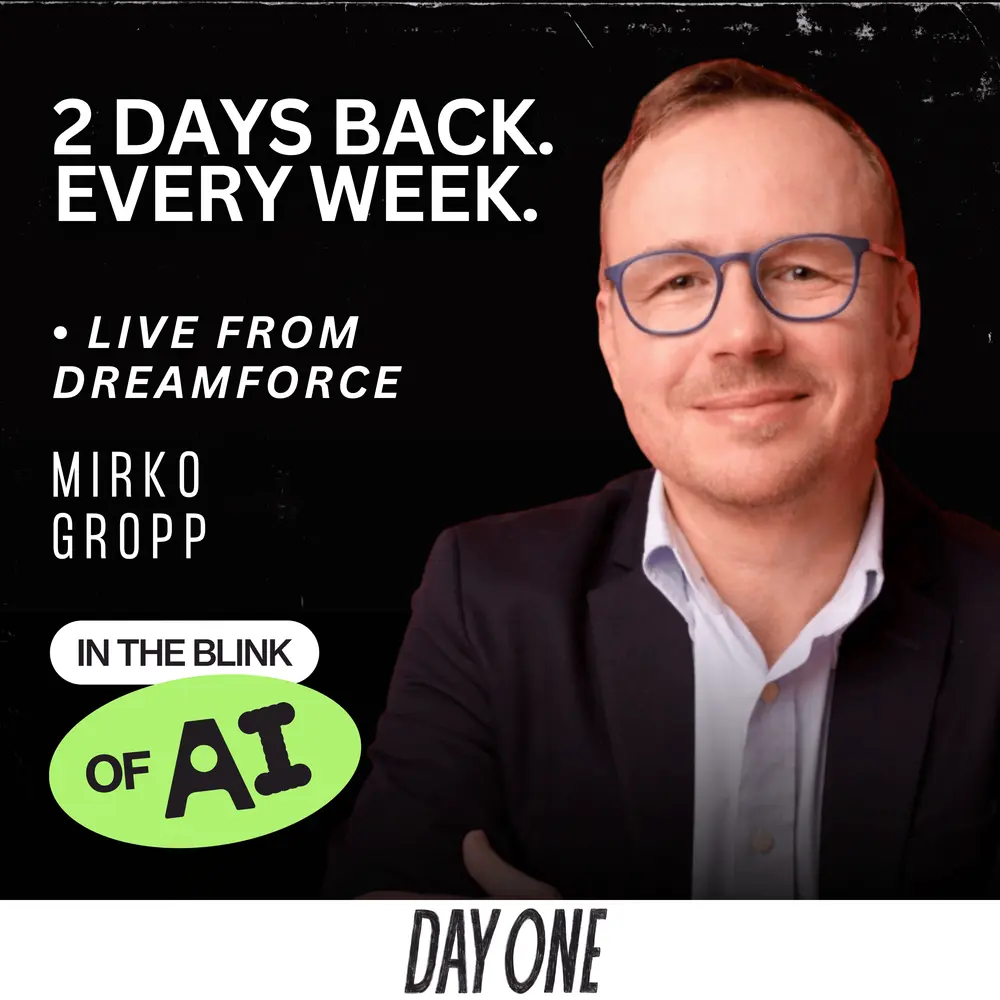
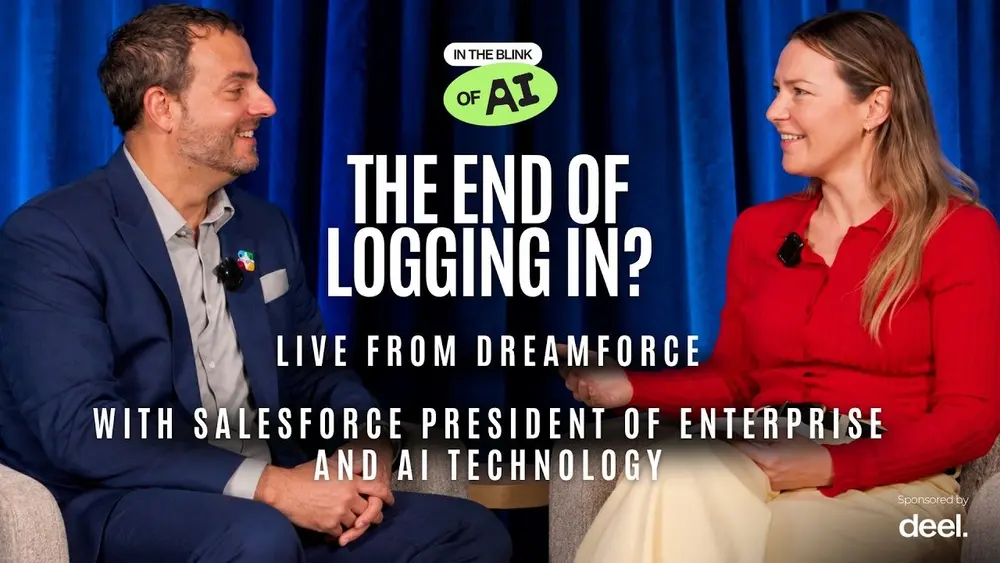
Georgie Healy talks to Mirko Gropp, General Manager of Digital, Data and Technology at The Living Company, live from Dreamforce day three. The Living Company owns, develops and operates student housing, build-to-rent apartments and senior living across Australia, with around 2,000 people and about $17 billion in assets by Mirko's count.
Mirko's take on the week: Salesforce going headless means the UI, long the moat for software companies, is no longer the point, and Claude arriving inside Salesforce lets his team ask plain-language questions of their cases. He says agentic coding lets him build in 3 months what used to take a year, with 2 people who never touch the code.
They get into how a company rolls AI out when a small group of super users does most of the heavy lifting, and the HR question nobody has answered yet: how do you reward someone who is 10x more productive? Mirko explains why students hate email and voice, how The Living Company will build its first agent for senior living, and why most customer chat doesn't need a top-tier model.
If you have a custom tool you assumed was too hard to build, this one is the push. Mirko's advice is to describe the outcome you want, let the tool walk you there, and be a critical, proactive builder.
Chapters
0:00 Cold open ▶ 1:30 Welcome back: the final Dreamforce interview ▶ 1:39 Headline: AI agents don't need screens ▶ 3:29 Headline: Headless 360 and the 5% AI value gap ▶ 5:27 Headline: How AI ends email and password fatigue ▶ 8:59 Mirko joins live from Dreamforce ▶ 10:22 The Living Company and the headless shift ▶ 11:49 Building in 3 months with 2 people who never touch code ▶ 12:51 Onboarding 10,000 students with 80% old school automation ▶ 13:53 What chatbot questions reveal, plus Cowork inside Salesforce ▶ 15:14 Rolling AI out to staff and the super users ▶ 16:56 The HR question: employees who are 10x more productive ▶ 17:20 Students trying to jailbreak the agent ▶ 18:13 Senior living: building the first agent ▶ 19:44 Designing for Gen Z and seniors ▶ 23:11 Tone of voice and rebuilding the bot with Salesforce ▶ 24:18 Shipping 5x to 10x faster than 10 years ago ▶ 25:47 Rapid fire: will AI disrupt property? ▶ 27:52 Predicting who's leaving and filling rooms early ▶ 28:40 You don't need Fable for everything ▶ 30:04 Where The Living Company goes next ▶ 32:16 Mirko's advice for builders ▶ 34:28 Outro: Attention is All I Need ▶ Transcript Search or select a timestamp to jump ▾ 0:00 Mirko Gropp: Thursdays are always like 3 AM in the COP when the lights go on. Everybody is just kind of on the last meters and wants to go home. AI is now everywhere. Started with Agent Force, now Headless that was announced at TDX. And that's a massive shift, right? So I mean, that's big for software companies. So that was normally your moat, right? Like UI. And I still have vendors in the stack that would not even give us an API, right? To call and see where things are at. I can build stuff more easily, right? Like with Claude Code and all the agentic coding, I can build something in 3 months that would've taken me in a year, right? And I do it with 2 people and they never touch the code. So that's very exciting. You use 5 to 10%. We don't have to kind of push the frontier models more. 0:40 Georgie Healy: Everyone needs to catch up. Yes. 0:43 Mirko Gropp: So it's very exciting. 0:44 Georgie Healy: It is exciting. 0:45 Mirko Gropp: And I'm very German, so you can't see it. 0:47 Georgie Healy: This is the most excited you've ever been right here on the pod. 0:51 Mirko Gropp: But you will have employees that are 2x, 10x more productive. We have people that build their whole workflow like that. There's a lot of mundane tasks. They build everything in cowork, right? That saves them a day, 2 days a week. Students don't want to interact via email, right? They hate email. They like chats. They hate voice, as we don't have a voicebot, for example, although we could, because they don't want to talk. It's an amazing time to be a builder, right? So you have to be a critical thinker, be proactive, right? That's the profile that's required. 1:20 Georgie Healy: Hello, welcome back to In the Blink of AI. I'm Georgie Healey, and this is the second and sadly final interview from Dreamforce 2027. If you haven't been following, this has been the most incredible coverage of Salesforce's flagship event in San Francisco during the AI gold rush. Dario, Sam Altman, Jensen Huang, Marc Benioff, the All-In Pod. The list continues, and it was incredible to be able to cover what feels Feels like is an incredible time in history. So thank you for following on LinkedIn and Instagram and listening to last week's episode. We had Joe Inzerillo last week, an executive at Salesforce, and this week we have a real customer explaining what it's like to be adopting AI agents in this very fast-moving time—the good, the bad, the ugly. Like how are the employees reacting to AI agents? What it looks like when it's being done well? What it feels like in the process? The companies I spoke to this week—the L'Oreal's, the Formula Ones, the Zeros. the golden goose. They're all just doing it at a pace that I've only ever seen startups do it in the past, and it's incredible to see. But before we dive into the episode, I'm going to do some news headlines that you need to know about this week. So for 25 years, software companies have been successful by getting you to use their interface to get you on their platform. You log in, you find the menus, you click around, and you do everything inside software companies' own interfaces. But AI agents don't need screens. And increasingly, AI agents, not humans, are going to be the ones moving through the internet. They're going to be finding information, taking actions on our behalf. That's something you need to know about AI agents. And something else you need to be knowing about AI agents, especially if you're working at one of these companies that are adopting AI agents, is that they're using tools like Salesforce Headless 360. Sounds very metal, which I like, but actually it just means that they are using the quality data in the background and you don't actually need to log in anywhere. They're using the data, the workflows, the actions, the context of your company, and doing all of that for you under the hood while you use, like, say, a Claude interface or an AI interface instead. Can you imagine never logging in again? It genuinely seems wild. And it's been so successful, this marrying of Salesforce and Claude, for example, that my prediction is you're going to see way more software companies going headless into 2027. Okay, this next one's a bit of a rant, but I am on your side, I swear. 10%. That's how much value your business gets from AI right now. And honestly, that's probably generous. It's more like 5%. And you can't cancel me. This is Dario Armadale, CEO of Anthropic, saying you aren't using AI to nearly the potential of its capabilities. I witnessed him saying this in a room of 10,000 other people at Dreamforce, that even if AI completely stopped development, businesses are still only capturing 5 to 10% of the value already sitting there. We're so obsessed with the latest model. When's the next Claude model coming? This Haiku's just been released. Oh, you're only using Sonnet? I'm using Fable, who cares? Because when I spoke to the GM of The Living Company this week, they serve thousands of customers, he said that the huge amount of opportunity is still just in boring old automation. This agentic AI, he admits, is incredible, but it's cream on the top, guys. There is so much capability already available. In his view, we could spend the next 3 years catching up. With the models we already have. So I think this is good news. I think if you're feeling overwhelmed by all the models and all the chat and are you using the right one and that was the old one, we got a new one. Don't worry about it. Focus on automating forms, automating emails, streamlining the stuff that you do every single week and that you hate. And you can tell your company, we do not need AGI. We need to start using the AI we're already paying for. Okay. Finally, a topic that people are not talking about, and I think they should. This sounds small, but I think it changes the entire way we're going to be thinking about software. Studies show that Gen Zs get really stressed out by email. Meanwhile, boomers get really frustrated and overwhelmed by password management. For decades, software has made us adapt and learn around it. Where is the website? Where is the menu? Where is the checkout? Where do I click that? Why isn't it here? What's my dog's maiden name? You had to know all of this stuff based on the website you were on, and that changed for every single website. One benefit to AI is that it'll solve both. This is a true story. I was at book club last night with my friends. We're using this book club app. It helps you poll for your favorite book. It helps you schedule future catch-ups. It helps you find recommended books. Great. But I couldn't find where to schedule the next book club meeting. And my friend laughed at me. She was like, don't you work in tech? And I was like, yeah, bitch, I shouldn't have to do this now. With AI, I should be able to write the words, book club is Thursday the 22nd, invite the same people, and it should just work. It should just do that automatically. And when this happens, this is going to be brilliant for younger users. They're going to feel like this is much closer to the instant message-based interface they already live in. And for our parents, it's going to remove that friction digital layer around password management. You'll already be logged in. We talked about Headless, no more logging in. I predict the companies that win in AI are not using the smartest models. They're not the ones that are like, "Oh, we're all on Fable." It's the companies that don't make humans adapt to their software. Okay, that's the headlines for this week. Now it is time for Mirko Gropp. He is the general manager for technology at The Living Company. This is Australia's leading living platform for student accommodation and senior living. It's an incredible chat. Like Mirko has this dry German sense of humor that was delightful. He gives real use cases of what it is like to be a company that is engaging and automating and using AI and agents, but what it feels like when some employees are adapting it really fast and others aren't, and what that looks like. I know you're going to learn a lot from this chat. I loved having this discussion live at Dreamforce, and I hope you love it as much as I did. 8:11 Ad: You're listening to a dayone.fm show. 8:17 Georgie Healy: In the Blink of AI is proudly sponsored by Deel, the global HR and payroll platform that's behind the expansion of companies like Revolut, Shopify, or fans of the show ElevenLabs, who quadrupled their workforce in 54 countries. Build your global team with Deel. Neelko, thank you for joining us on In the Blink of AI. We're live from Dreamforce, day 3. What do you think of the energy today? What are you feeling being here? 8:51 Mirko Gropp: First days are always like 3 AM in the club when the lights go on. Everybody is just kind of on the last meters and wants to go home. Yeah, yeah, there's been a big Dreamforce. I think Mark rolled every tech giant in that he could find. I was just at the All-In. 9:08 Georgie Healy: I was just at that too. Yes. 9:09 Mirko Gropp: It was quite fun, wasn't it? 9:10 Georgie Healy: That was fun. 9:12 Mirko Gropp: What else? I mean, everybody else was here as well. Yeah, it was quite a celebrity-heavy Dreamforce this year, interestingly. 9:18 Georgie Healy: Speaking of that, right, celebrity-heavy, and I normally think of the headliners like the Gwen Stefanis and the Ushers and the will.i.am and the Matthew McConaughey and all of those people. But actually, I feel like the tech people are the celebrities, perhaps surpassing them. I don't know if it's just me, or do you feel like They're becoming public lexicon, these, these big AI companies. I 9:42 Mirko Gropp: mean, they were quite in the news, right, this week. So everybody was watching them. Like Sam was here, Dario was here. They were all talking. So it was quite a big news week as well. Yes. 9:50 Georgie Healy: Yeah. And tell us before we go any further where you work, what you do, and, you know, tell us your experience as a Salesforce customer before versus perhaps now. 10:04 Mirko Gropp: So I work for The Living Company. We are probably the biggest property owner and developer in Australia for the living sector so that we only do living. So that's everything from student to seniors. We also build apartments. So that's our, our thing. We kind of building that category in Australia and probably $17 billion in assets. So that's what we do. So we find good opportunities, build something, and then operate it later as well. And I look after technology. So everything from internal like ERP to everything customer-facing, including Salesforce. And then how it compares, a lot has changed actually. Unfortunately, Mark made all the announcements earnings call, right? So the whole Cloudforce thing he announced there with Dario. So he kind of stole a bit the thunder for the keynote, but that's basically what, what changed, right? Like AI is now everywhere. Started with Agentforce, now Headless that was announced at TDX. Uh, and it's a massive shift, right? So I mean, 10:59 Georgie Healy: no login screen. 11:00 Mirko Gropp: Like this is, I mean, that's big for software companies. So that was normally your moat, right? Like UI and I still vendors in the stack. that would not even give us an API, right, to call and see where things are at. So it's pretty bold. And now Cloudforce is again, big shift, right? Like opening up and merging it a bit more with Claude, Anthropic, and then others to come, I guess. 11:21 Georgie Healy: And as a technology leader, this seismic shift you're talking about, do you mourn the loss of a UI that's just owned by a certain company? Are you excited for headless? 11:31 Mirko Gropp: I'm always thinking it's probably the most exciting time in tech at the moment today, probably tomorrow even more, right? Like I can build stuff more easily, right? Like with Claude Code and all the agentic coding, I can build something in 3 months that would've taken me a year, right? And I do it with 2 people and they never touch the code. So that's very exciting. But also SaaS, right? Like so easy for them to add value with models, right? Summarizing cases, making recommendations, all that stuff is very, it's here now, right? We just don't use it yet. So Dario in the keynote said, look, It's all here. You use 5 to 10%. We don't have to kind of push the frontier models more because— 12:09 Georgie Healy: Everyone needs to catch up. Yes. 12:11 Mirko Gropp: So it's very exciting. 12:12 Georgie Healy: It is exciting. 12:13 Mirko Gropp: And I'm very German, so you can't see it. 12:15 Georgie Healy: This is the most excited you've ever been right here on the pod. I love that. Talk to me about what used to happen when you have, you know, thousands of students all coming into one of your buildings and what used to triage their questions versus how you would handle that now? 12:33 Mirko Gropp: Yeah, I mean, a lot of it is bread and butter, kind of preempted, right? Like we kind of nudge people before they arrive to give us all the forms and everything that we need to check them in. 80% of it is really old school automation, kind of good UX design that you nudge people and they don't show up and have done nothing. And then on Salesforce specifically, you can do a lot of automations as well to follow up, to trigger certain events. And then kind of the cream now on top is agentic, right? So we have ServiceBot, for example, you can ask questions. It's just the beginning of it. Yeah. So it's interesting about students is it's a very cyclical business, right? So they come for the semester and we have 20,000 beds now. So there's like 10,000 people that would arrive within 2 to 3 weeks. So it's a massive scale up, scale down type of scenario. Yeah, and again, 80% is just old-school automation and building journeys to preempt a lot of that kind of busy work before it happens in the 3 weeks, and then agentic helps as well. 13:35 Georgie Healy: And I would love to highlight for the listener who's listening to this thinking, oh, when I was a student, that would've been really helpful, and I didn't have to have a human. I could just ask all the questions and get all the answers whenever I needed, any time of day. But for a business, having the insight into the questions they're asking How important is that and does that help you as a business knowing the kinds of questions? 13:57 Mirko Gropp: Yeah, that's probably our journey ahead. 13:59 Georgie Healy: Really? 13:59 Mirko Gropp: But now we have a lot more codified, right? Like all the interactions with the bot we can see, right? And actually the one thing they launched and didn't really talk about is Copilot. So if you're familiar with Claude and Copilot there. 14:13 Georgie Healy: Yes. 14:14 Mirko Gropp: So that's now also in Salesforce. So you can ask questions like that as in go back last 4 weeks in cases, what are the trends, what's emerging, what should we be aware of, right? Like a natural language. And it really does, as in Claude, if you have the data attached to it, gives you an analysis what's happening. So that's really, really amazing for our business, right? And the interesting thing is we also launched Claude to all our employees. So they're very, very used to kind of how to interact with it, the UI and so on and so forth. And Claude actually did a very good job in designing it. It looks very simple, But there's a lot of things behind the scenes, right? Like the concepts they use, like the skills, the artifacts, and so on. So bringing that into Salesforce makes it very powerful. 14:56 Georgie Healy: And tell me about those employees when you said, you know, as a technology leader, you know, I've, I've been a consultant before where we just have to brute force, put a technology on people, it's happening, get with the program. Has this advent of AI and perhaps more user-friendly technology solutions in your career, has that made your job any easier? Harder? How's it felt to embed technology these days? 15:23 Mirko Gropp: Yeah, interestingly, it all started with ChatGPT, right? People playing around. So there was a lot of kind of consumer, like, user demand for it already. So that really, really helped to just give it to them and they use it, right? I don't have to do a training or, like, force them to use it. So they really jumped all in, right? We also a company that we grew from 1 property to 5 to 40, right? We grew very rapidly. So everybody is kind of really under the pump, right? We didn't grow 40 times in employees in the same time. So everybody has a lot on their plate. So every help is really appreciated. So hence they embrace it. And then as always, probably 50% of the token usage is 10% of the staff, right? That there's people that build— 16:03 Georgie Healy: Super users. 16:04 Mirko Gropp: Super users. They build their own app because they are really kind of stuck with a problem and they want to solve it. And then you have people that spend nothing, right? So you have still the whole spectrum and it'll change, right? It'll kind of make its way across the organization. 16:18 Georgie Healy: I do think listeners would find that interesting, you know, having your super users in the company that use up the credits or the tokens, and you probably wanna encourage that. They might teach your other employees or make them more delightful, but then eventually, I guess you're gonna have to like evenly spread that out. Do you expect that to evenly spread out over time? 16:38 Mirko Gropp: Yeah, it's one I'm grappling with also from an HR perspective at some point, right? You will have employees that are 2x, 10x more productive, whether we have people that build their whole workflow like that, There's a lot of mundane tasks. They build everything in co-work, right? That saves them a day, 2 days a week. That stuff also takes a lot of people. We're all grappling with that. 16:56 Georgie Healy: Yeah, yeah, we're all grappling with it. Cheeky question. You've got a lot of students that are using your chatbots, and maybe this isn't fair to say about the youths, just as a millennial, but are they trying to jailbreak it? And then how do you make sure that they don't like ask for the rent to be decreased and things like that? 17:14 Mirko Gropp: Yeah. Those type of use cases, customer-facing, they all work on Salesforce. So we use Agentforce, which has really strict guardrails, right? So you can't just ask anything. It's also neither connected to the web or anything, right? It's just our kind of authorized content, our authorized actions, what they can do. They can raise cases, they can book tours and so on and so forth. But still they try. 17:36 Georgie Healy: Oh, I bet they try. 17:37 Mirko Gropp: But it's actually more well-behaved than you would expect. It's probably below 1%, right, that try to flirt or— 17:43 Georgie Healy: Oh, really? 17:44 Mirko Gropp: Or jailbreak it, right? Like try what I read on Reddit to see whether they can get away with it. So it's a small group, hand out fines for it. So yeah, it's a small group, but some try. 17:55 Georgie Healy: And, you know, we spoke about the student end of the spectrum that you support, but there's also the aged care. Can you please tell me a little bit about that and how far on the technology evolution that end of the market is at with your company? 18:09 Mirko Gropp: Yeah. So we do senior living, which is kind of the earliest is 55, and then depends on how fit you are, 18:17 Georgie Healy: right? You know Gwen Stefani last night? 18:19 Mirko Gropp: 56. 18:19 Georgie Healy: Looked it up. 56. 18:20 Mirko Gropp: Looked it up, yes. 18:21 Georgie Healy: She'd be part of your— You see, she doesn't look it, does she? She could come. Should we invite her? She looks fantastic. 18:28 Mirko Gropp: Yeah, so that's an interesting journey ahead of us. So currently we do very, not very much in that sector with digital. So, but we are embarking actually now, we will be building our first digital platform agent for that segment. It will be a discovery journey, right? Like, yeah, my hunch is actually they will use it like chat interfaces might be a very interesting one. My mom is 72. She chats to me all the time. Does she? But she's not a big user of websites and stuff like that, right? It always becomes too complicated with the password in here and there. So we will try out bots or like a chat interface might be something to get started. So that's a discovery journey for us, kind of what works in that sector. But my hunch is, I mean, we are still talking 55 to like 70. 19:12 Georgie Healy: Yeah. 19:13 Mirko Gropp: That there will be good use cases for them, right? And interestingly, I mean, the other stakeholders in that journey are the kids, right? How they then kind of stay in the loop, what's happening and so on and so forth. So that's another interesting part to that digital journey. 19:26 Georgie Healy: I feel like the people I talk to on this show are oftentimes, myself included, quite AI-pilled and within like, you know, a very specific age bracket. You know, some of us do remember the dawn of the internet, but most of us are like in that bracket where, you know, we've seen that and we've seen AI and we're tech literate, I would say. Your customers probably are at the outer skirts of those or, or don't remember the internet coming and just are native. Do you think when you build out your tech for the senior living, you'll borrow from learnings or will you have to just kind of— Blank sheet of paper, like. 20:06 Mirko Gropp: Probably later. 20:07 Georgie Healy: Yeah. 20:08 Mirko Gropp: So we try to build platforms, right? Like for example, we build a mobile app, right? We build it in a way that we can redesign it, reskin it for senior living as well. So the backend, we want to build the same, but for example, the agent and the tone of voice and how we lead people through stuff will be probably quite different. Yeah. Whether I'm a big fan of a good UX/UI team, so we have one, Why they would help us, right? Like, technologists are normally pretty bad at understanding kind of what is really of value for end users, right? They have a hammer, everything is a nail. Totally. And so we have to guide them kind of where are the nails, right? And kind of, or there might be different tools, right, to get a screw in. Yeah, so that's our journey for the senior living. And the other side of the spectrum is also quite interesting, right? Like, as in students don't want to interact via email, right? They hate email. They like chats. They hate voice as we don't have a voice bot for example, although we could, because they don't want to talk, right? They want to send us something and they want an app basically. So that's what we are now launching, right? Like something dedicated whenever they have a question or anything related to their services with us or their stay, that they can get it done very quickly. 21:18 Georgie Healy: Look, we get it. Global hiring and payroll can be a headache. Companies like Shopify, Revolut, and ElevenLabs already scale internationally with Deal. And Airwallex, the leading AI finance platform, they manage and pay over 1,185 employees across 16 countries, and they build their global team with Deal. So visit deal.com/dayone and start expanding your business today. I find this a fascinating thing for people to be grappling with when AI is here and it's coming and it's making our lives easier. But the different groups will have different feelings and thoughts. And even as an Australian here at Dreamforce, talking about like we just saw the All In podcast and they're talking about something very American and I'm like, wow, that's such an interesting way of putting it. And then I guess that would happen when it comes to an agent and their tone of voice will make people emotionally behave differently with it and things like that. I guess my question to you is, how do you make it not unc for the Gen Zs and how do you make it not, you know, too much jargon for the, for the older groups? Is that your decision or a Salesforce decision, or do you work together? How do you create that agent together? 22:53 Mirko Gropp: In the end, Salesforce, they give us the platform where you can build whatever you want, right? That's the great thing about Salesforce. Also sometimes the bad thing because you can also build stuff that doesn't really work. So that's our journey. me as well, right? Like you learn over time, make it more granular. So yeah, the first bots sales was actually the big use case and it still is. Like a year ago we launched it. Now we rebuild it completely actually together with Salesforce to have, for example, tone of voice, right? Before you couldn't even do it technically. Also the technology itself has come a long way over the last 12 months, right? Before it was very stock standard kind of content retrieval, very little observability. You couldn't even understand what's working, what's not working. That has all changed now. like now you can really see every chat that gets rated on the quality. So you can ingrain tone of voice and then you have to research with your students what they like, what they don't like, right? And to your point, our journey, right? We have big target groups and over time personalize everything more to them, which is also great, right? It's an opportunity also for them to get better service or service aligned to their expectations. 23:52 Georgie Healy: How long would it have taken to roll something like this out in your career 10 years ago versus what it looks like now. 23:59 Mirko Gropp: Not possible 10 years ago. 24:00 Georgie Healy: Yeah. Like actually not even possible. Yeah. 24:03 Mirko Gropp: Yeah. Yeah. I mean, it's crazy, right? Like it's probably 5x, 10x already now, right? Especially if you go more and more custom, right? And that's kind of the trajectory also Salesforce and Parker are driving, like headless, what they call headless, right? You build then your surfaces, right? Might be an app, might be a bot, right? You can build a custom, build all of that then on top of Salesforce. 24:23 Georgie Healy: Does that 5 to 10 X pace also play into that? Like you can do it that much faster. Do you feel pressure to build it faster or is it really just like it's at our fingertips? Let's go. 24:37 Mirko Gropp: Oh, it's more, we always, right? Like we have a medium-sized company, so you always don't have enough budget, right? You have 100 use cases that are great. You can deliver 10. So it's actually an amazing opportunity. Now we might be able to deliver 20, right? And then in the future, we might be able to deliver 50. So it's really great, right? Like, I'm a builder. I like to build stuff, right? Like, people in tech, they like to build stuff. So it's very exciting. Back to the, it's an amazing time, right? SaaS is progressing. Custom build is progressing. So yeah. 25:05 Georgie Healy: I find that brilliant. I know we've got some rapid-fire spicy questions. Are you excited for those? Are you scared for those? 25:13 Mirko Gropp: Let's see. 25:13 Georgie Healy: Oh, you're going to find out. Where else do you see AI disrupting Property in Australia? 25:20 Mirko Gropp: Yeah, I'm not sure it's disrupting, right? Like our product is basically location, very important value, right? Like quality and cost, right? Like the core product will not be really disrupted, right? So it's a lot of money, long cycles and so on and so forth. But it, I think it will make the product a lot more attractive, right? Like hopefully we can eradicate a lot of the mundane busywork friction, right, between our residents and, and us. 25:44 Georgie Healy: Property is very hot in Australia. You've lived in Australia, did you say 15 years? Yeah, you must be very familiar with how obsessed we are with property. Do you think that, you know, with these, with what you are doing at The Living Company, that other industries might have anything to learn with how we can grapple with housing in general? 26:05 Mirko Gropp: Yeah, not sure. I haven't thought about other industries, but I think our industry will change quite a bit, right? Like currently investment thesis of our whole company, right? Like to create the living sector as something that investors can kind of invest in. So the obvious one is senior living will double, triple, people, right? Like just looking at demographics. So that will be a lot bigger. And then I would assume the big one that just started is what we call in Australia BTR. So we build to rent. So we build apartments and it's for rent. So I think that's a trend that will continue, as in people rather than buying and being locked in, they rather rent, right? So that whole sector living will become more common, right? As it is in other countries. Yeah. I think that that's a big shift in the property space. And for other Property is very old school in the sense it's around a lot of money delivering a project, right? Like it's, some of our projects are more than $1 billion or more than 1,000 apartments, right? It's massive. So I think that's the core of it, right? Delivering something like that. And AI will help again, right? Like getting rid of the mundane tasks and making better decisions. So definitely improvement. 27:09 Georgie Healy: Yeah, I really like that. And maybe democratize the process for people that wouldn't have been able to figure it out normally or— 27:15 Mirko Gropp: And for us to provide a better service, right? 27:17 Georgie Healy: Yeah. Yes. Yes. Proud renter actually. But I lived in London for years and I just, I lost the Kool-Aid of you need to own property. So that build-to-rent model is quite exciting. Sure. 27:27 Mirko Gropp: Because there is a room available. The time window is very small, right? Like it's like on a plane. So you have your 4 weeks. If you don't sell it, or it's a bit more, but like let's say 4 weeks, then there is an empty room, right? So we try to predict, are you leaving? And if, if we think it's very likely that you're leaving, we already we try to, to sell basically your room type, things like that. So that they proved to be quite different or quite valuable for the business, right? And others where we thought, oh, we know you're leaving, let's try to A/B test whether an offer could sway you to stay. 27:59 Georgie Healy: Yes. 27:59 Mirko Gropp: Proved to be quite hard to operationalize, right? To give, to do A/B testing to start with in such a big cohort, right? You need a lot of automation and sophistication. So that's probably use cases that fizzled out But the other one proved to be very valuable. 28:14 Georgie Healy: What do you predict that you can't do right now that you might be able to do at Dreamforce 2027? Is that something that you might be able to do live? 28:23 Mirko Gropp: I gave up predicting because of ChatGPT, right? Literally in the last 6 months. 28:26 Georgie Healy: I love predictions. Yeah. 28:28 Mirko Gropp: No, no. Like last 6 months were already— so I think pragmatic. There's so much already available. We can spend the next 3 years to make use of all of that, right? It's not really the models themselves, right? Like a lot of the use cases need a very sophisticated model, right? Like just interacting back and forth, kind of helping customers. You don't need a Fable for that, right? Like— 28:47 Georgie Healy: Agree. 28:48 Mirko Gropp: Yeah. So there's so much already here now. It'll not get boring. 28:52 Georgie Healy: Sam Altman yesterday, 2 days ago, said, you know, ChatGPT is now, has stronger math, best math professor on the planet now. And it's like, I just don't know why I would need that. And I just don't, I'm not really solving anything that big right now. 29:08 Mirko Gropp: Yeah. There's horses for courses, right? There's the simple stuff. Like just answering questions or taking a case and managing a case. But there's also the hard stuff and back to cowork, right? Like if you can do this type of analysis, hey, go through my cases, what are the patterns? What can we improve? I mean, that's very valuable, right? And that's driven by things like Fable, right? Like very sophisticated reasoning. I mean, the North Star is the math stuff, but like the underlying is how do you reason in multiple steps, right? And query data. So that's also quite interesting as a use case in a business, right? 29:38 Georgie Healy: Yeah, I love that. Okay, I promise 2 more. What will SKATE potentially be running in 2 years? It's another prediction. You love your predictions. Oh, I know that the fans love the predictions. What will SKATE potentially be running in 2 years that does not exist as a product today? Is there any products that you would love to release that you haven't yet? 29:57 Mirko Gropp: Yeah, I mean, what we will start to do more is to build very kind of vertical, like for just for our use case, right? There's a lot of horizontal SaaS that can do everything but not kind of very specific to students or to senior. So those type of things we will build ourselves. So that will be a lot more, right? Like back to headless or like very specific use cases that we build ourselves. Like the app, right? It will be very much for students. The other one will be very much for senior living, right? Like there is white label apps, but they all are the same. But we will have something very customized for that use case. And there's more, right? Like I mentioned, people are building stuff themselves, right? Like somebody built a whole like a CRM for development Right? It's a very complex process with a lot of steps, like literally like 1,000 steps, right? Like really specific solutions. I, that's here now, right? We just have to mature it and integrate it into ERP and so on and so forth. So that's one, like very vertical solutions. Yeah. And then it will be also on the back of it. Not everybody can do it, or if we can do it 2x better than like somebody that has 3 buildings, like BTR is super new. Senior living is very fragmented. So there will be at industry level, I think locally consolidation, potentially even globally, right? Because somebody like us can build a global platform. 31:11 Georgie Healy: Okay. What I've loved that you've said quite a few times is, you know, like we, it's essentially out-caring the competition. We will, we can't control everything. We can't control visas and the property market necessarily. But what we can control is how much we adopt AI and personalization and how we, we be better than the competition. I really love that message. I guess my last question for you is the people that are listening that might might be considering starting their own startup or in, you know, been playing with AI and been playing with Claude and been playing with ChatGPT. Is there anything you think should light a fire up our butts right now? 31:48 Mirko Gropp: Yeah. I mean, there's room for a lot of these very custom solutions, right? Like that were too hard to build, right? Like, especially if you are in a company, like the builders within a company, there's so many opportunities now, right? To build like the perfect thing. Before you had to buy something off the shelf, 80%. Now you can build a perfect thing at kind of a 10th of the cost than it was before. So there's heaps of opportunity, right? And actually back to the point, right? Like it's now business users, right? They set up, they've never done coding in their life. They actually don't do it, right? Claude does it, but they set up GitHub, they set up multifactor authentication, right? Like I've never done something like that, but Claude, right? That's the amazing thing about AI. you don't have to tell it what to do. You tell it, hey, this is the outcome I want. This is how it should look like. How do I get there? Right? Like prompting the outcome and then Claude or any other platform, we use Claude a lot, guides you on that way. So it's an amazing time to be a builder, right? So you have to be a critical thinker, be proactive, right? That's the profile that's required, right? And then if you consider to start a startup, 32:52 Georgie Healy: Yeah. 32:53 Mirko Gropp: I mean, that's your profile, right? Like otherwise you wouldn't do it. And that can be on your own outside of a company, but I think it enables as well within the company, right? And it's for the leaders to think through. It obviously comes with risk, right? Like all that stuff can go either way, right? 33:08 Georgie Healy: That's a very, very strong ending. I really love this chat, Mirko, and I really want listeners who have heard what you've said to feel empowered to build. Like even if you're not technical by background, as you said, You don't need to code now. Your limitation really is as limited as your imagination, and then you kind of work your way backwards. Amazing. It's an amazing time. 33:32 Mirko Gropp: Best time ever today, even better tomorrow. 33:35 Georgie Healy: Wow, you're good at this, mate. We'll have you on again. Thank you so much. Thank 33:40 Mirko Gropp: you. Thanks. 33:44 Georgie Healy: Thank you so much for listening to In the Blink of AI. If you want to go deeper on anything We've spoken about today. I write a weekly Substack called Attention Is All I Need. Yes, it's hilarious. It's a pun. And essentially, I go into AI rants, tech news, events I'm going to, and more. It's bite-sized, and I hear it's awesome. The link is in the show notes below. No transcript lines match that phrase. Try fewer words.


 ▶
 ▶
 ▶
 ▶
 ▶
 ▶
 ▶
 ▶
 ▶