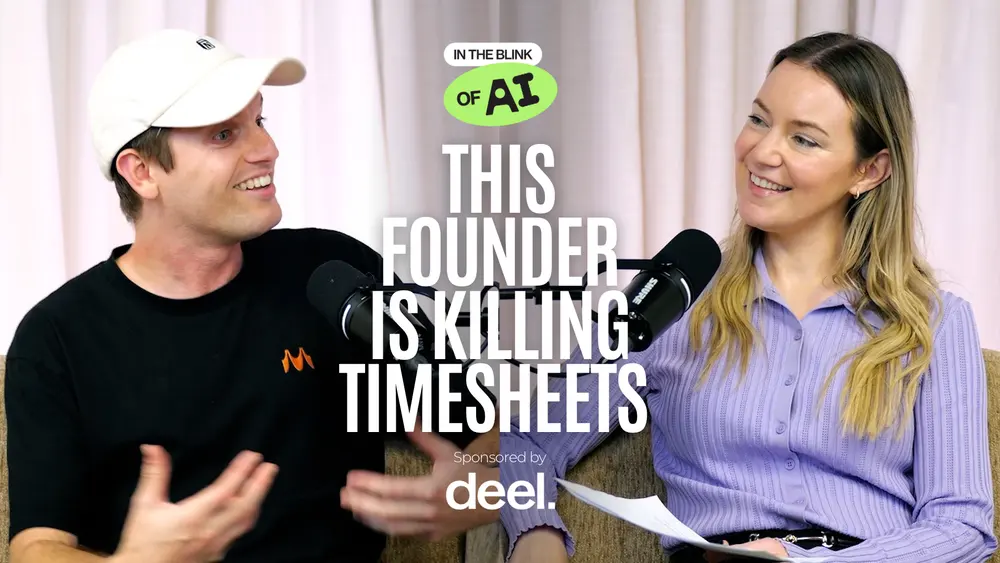
Transcript Synced · select any line to jump ▾ 0:00 Thea Ngo: Most 25-year-olds are figuring out their first job. Finlay Mercomi built Fluency, a platform that maps how work actually happens in Fortune 500 organizations. 0:08 Finnlay Morcombe: We went to market with it, and within one week we're like, okay, we're hard pivot. 0:11 Thea Ngo: And convinced investors behind Facebook to lead a $6 million seed round before he'd even unpacked in San Francisco. 0:18 Finnlay Morcombe: We would rather company die trying than be like a $50 million company. 0:22 Thea Ngo: Fluency, $15 million in pipeline, Fortune 100 partners, built by self-taught devs. From Melbourne. 0:29 Finnlay Morcombe: Agency is so powerful. What's gonna happen? I, I'm Finlay, and I'm one of the co-founders of Floency, and this is the best podcast ever made, Founders in Motion. 0:36 Thea Ngo: Quick thing before we get started. We have a huge goal this year of hitting 10,000 subscribers. Yes, it's ambitious, but it lets us help more people build really great companies. So if you enjoy the content, learn something new, The best way to support us is by subscribing. Okay, let's get back to it. So let's start at the most recent news. You just raised $6 million from Accel, but had only been in the US for a few weeks. You weren't even fully boofed in yet. So walk me through how the round happened. 1:10 Finnlay Morcombe: We weren't really sure we were going to raise at the beginning. We have enough traction to not really— like, a raise wasn't imperative for us at the time. And we're like, let's just write 2 pages, send it to some VCs, and see what happens. That was it. And then we sent like a literal 2-pager. We had no deck, no data room, didn't have a data room till right at the end for DD with Excel. Yeah, sent it to like 10 funds, had some conversations, got some intros, probably spoke to 18 funds or less total for the whole thing. And I'd met like a couple of US funds just in my travels generally when I went to the US with Ollie like 7 months ago. 1:48 Thea Ngo: Put it into context. Say if an Australian founder is looking to raise from US investors, what is your recommendation in terms of the best things that helped you guys? 1:58 Finnlay Morcombe: First of all, 2 misinterpretations from Australians raising capital in the US. 2:02 Thea Ngo: Yes. 2:03 Finnlay Morcombe: One is the fact that they think it's like really easy. You just go to the Valley and you can just raise a massive round. I don't think that's inherently true. I've met a bunch of founders, NSF, who like come from other countries, like, I'm gonna raise a round, and you see them a week later like, I have to go home, my visa's up, I didn't raise a round. So I don't think it's inherently like this magic button that gets pressed. the fact that it's possible, like, or you can at the same time. So I guess it's kind of like a cognitive dissonance sort of pace. Like, there's everyone kind of thinks that really easy, but then like, like you can just go and do it as well. They kind of both coexist together. What worked for us though is like, one, I was like, I am moving, I've moved here. 2:38 Thea Ngo: Yeah. 2:38 Finnlay Morcombe: Whilst I was in the process of literally moving there, like regardless of whether we raised or not. The second was the attitude we had politely was we have enough capital in the bank anyway. and we're gonna get it done. Thirdly, it was that we did have a good amount of traction on the new product. And then the fourth piece was for Excel specifically, what we were building perfectly hit a thesis they had internally. 3:02 Thea Ngo: Yeah. 3:02 Finnlay Morcombe: So that was some serendipity. So it was like meeting one with the partner and then like 2 hours later, maybe that's a bit of hyperbole, it felt like 2 hours later, within a 24-hour period, there was like another separate partner meeting. 3:14 Thea Ngo: Yeah. 3:15 Finnlay Morcombe: And then it was like IC the next day with like 24 partners on the call. 3:18 Thea Ngo: Yeah. 3:19 Finnlay Morcombe: And then it was like a lot of back and forth between myself and our investor, our partner. And they were awesome actually. They were so sophisticated in their relationship building, I would say. Like they were conscious that there was a deadline approaching and they were really trying hard to build a genuine relationship despite the timeline. 3:40 Thea Ngo: Yeah. 3:42 Finnlay Morcombe: And then we went to DD, which was 12 background calls pretty much just on myself. They called my brother whilst he was, so my brother's a chippy. They called him whilst he was onsite. It was like hammers and stuff going in the background. 3:53 Thea Ngo: Mm-hmm. 3:54 Finnlay Morcombe: Ex-employers, customers, friends, other founders. So like, yeah, like 6-odd hours of background calls. Data room DD, but there's not much in the data room. So that was pretty chill. And then they were like helping us find the right other partners to help to jump in. Biggest thing we wanted was like talent attractiveness because we're unknown people from relatively unknown unis, especially over in the US. So we had no network over there to attract really great talent. So yeah. 4:20 Thea Ngo: So, okay, you've already had Australian customers like AON, PVH, and Specsavers on board. Um, there is this notion going around about US investors discounting Australian revenues. So did you ever feel that US investors discounted your revenues because they were in Australia? 4:39 Finnlay Morcombe: No, not for us. 4:40 Thea Ngo: Yeah. 4:41 Finnlay Morcombe: Because I— we'd heard that a lot as well, and I was like, oh, they're gonna discount it to zero. Um, maybe if you're like vertical software, but we're like extremely horizontal. Like one of our Achilles heels is like how big the opportunity space is for what we're building can do. 4:55 Thea Ngo: Yeah. 4:56 Finnlay Morcombe: In terms of like you have to make the right product decisions, blah blah blah. But back to answering the question is no, I don't think we really had a massive amount of discounting to zero. 5:03 Thea Ngo: Yeah. 5:03 Finnlay Morcombe: To be honest. um, excelled in anyway. The revenue is maybe half and half. Yeah, at the time of the seed, but the big logos were the US side. Maybe even less than half and half. No, it's probably more predominantly Australian revenue split, but the bigger logos were on the US side. 5:19 Thea Ngo: So now that you've experienced both countries, Australia and the US, what do you think is the hardest thing about building in Australia that founders face? 5:28 Finnlay Morcombe: I've just got back from the Valley a couple weeks ago, first time back to Australia in like 5 months, is I just wanna put my feet up and kick back. Like there's like no extrinsic pressure here. Like in the Valley, it's like if you're not working, you feel like you're falling behind. And that's awesome. Like that's what you should optimise for if you are a founder and you do wanna have like a venture scale outcome. 5:48 Thea Ngo: Yeah. 5:48 Finnlay Morcombe: I think it's a positive thing. 5:49 Thea Ngo: Okay, so maybe let's zoom out for a second. What does Fluency actually do? 5:54 Finnlay Morcombe: How it works is Fluency is deployed onto, let's say everybody's laptop. Inside of an organization, and for all intents and purposes, we see everything that happens. We take screenshots, we scrape like system logs, we get ingress egress for like network logs. We get a lot of information, and we're getting this every day as time passes across the whole organization. We build what's called a work ontology. An ontology is just like a tech word for a queryable graph, where a graph is a form of data store where you have nodes and edges. A node represents some data and an edge is the relationship. So this has been built over time and it's constantly changing depending on new context we get. It's non-monotonic, which means that the, the present can affect the past because sometimes you might get an email or communication or something changes in your business which affects what we thought was the truth previously. And there's 3 levels to our ontology. The first one defines what work is. So we're like working on software or this is a process for invoicing, just making sure we know who's who in the zoo. Like, because like to a computer's perspective, you are different in emails, in Slack, in the CRM that you use. But we just want to make sure that we always know it's you. And the third layer is we understand what is being built through these processes, you know, whether it's an invoice or a PowerPoint presentation or a unit of code. What that empowers from an outcome perspective today is a couple of things. There's like 3 main use cases for Fluency. The first, cab off the rank, is businesses don't actually know what their processes are, how they get done, what are the edge cases, what are the exceptions. If, you know, this weird tiny bug happens, they have to elevate it over here. Whatever. We capture and give them that information. The next value prop is once we've found all of your workflows, processes, and tasks, we tell you how to improve them. Usually that's through automation. So we give them the map, the data, the APIs to build that automation on top of our platform in, you know, a very short amount of time accurately, whether it's agentic or otherwise, doesn't really matter. Flavor of the day is agentic though. 8:11 Thea Ngo: Yeah. 8:11 Finnlay Morcombe: The final use case we enable today is measuring the ROI on change itself. 8:16 Thea Ngo: Yeah. 8:17 Finnlay Morcombe: So this, to put it in a question, I'm a CFO at Acme Corp and I want to answer the question, for people in my team who are the biggest power users of Microsoft Copilot, how much more effectively do they get their work done? How much capacity is freed up? Do they access documentation less? We can answer any of those sort of questions and then you can attribute it to financial dollars or generic productivity tracking in aggregate because we don't allow individual employee monitoring or productivity indexing. 8:44 Thea Ngo: But in layman's terms, what Fluency does is they look at how work is done across your organization, figure out what are your processes, where are the areas that you can optimize further, and create a more intelligent workflow for all organizations. 9:01 Finnlay Morcombe: Couldn't have said it better myself. That's what I meant. 9:04 Thea Ngo: You can steal that next time. 9:06 Finnlay Morcombe: Yeah, I will. And that's just today. 9:08 Thea Ngo: And that's just today. So this is already like a really huge product and a really huge vision to understand how work is being done and how to make it better. Do you see an even further evolution of Fluency? 9:20 Finnlay Morcombe: Yes, absolutely. We kind of expand the vision every month. What it is today and what we've started working on is actually step 1.5 is we will run the automations ourselves on top of our ontology. So the ontology or the map of work is really, really good at helping you automate things without needing developers, without having to worry about agents hallucinating as much because it has all of the examples of all that ever was. But it still requires a good amount of setup and work to do that. It's not entirely accurate. What we're moving towards next is building our own foundational models, not large language models though, what are called world models. So a large language model, as I'm sure everyone's used ChatGPT, it predicts the next sentence, word, what's called a token, a small subset of text. It's effectively predicting like the future in a very discrete, discrete manner. What a world model does, it uses the same architecture to predict the next most likely event. It's still trained on text or like binary because that's what a computer is, but it's not representing text. It'll represent something like a video game or represent a manufacturing floor. For us, it represents how work gets done in a business. So it's graph-based, it's that work map-based. To rationalize that, you put work map in and it'll predict what's gonna happen next work map out. So what we think is gonna happen inside of our early R&D is you can have like effective super agents on top of your process. It can run it all like fully autonomously, almost zero-shot. workflows and orchestrated workflows, like almost like department-based work without needing to like set it all up. And the other piece is you should be able to put in like what a future state looks like into our world model and we'll predict what's gonna happen. Like how is it gonna affect the team? How's it gonna affect your revenue? How's it gonna affect your finances, productivity, all of that sort of piece? 11:16 Thea Ngo: Yeah. 11:16 Finnlay Morcombe: So that's where we're heading. And we believe the best way to do this is like a sovereign, world model per customer. So most of our customers are more larger enterprises which would be able to afford this. 11:26 Thea Ngo: Yes. So my simple understanding here is that because you are able to build such a deep context map of how work gets done and how operations are currently done, you have kind of, you have a very unique understanding of their organisation. Then you're able to predict better because it's trained all on that kind of unique dataset. 11:48 Finnlay Morcombe: Yeah. Like you send an email and we say, you know, time series graph, basically what happens next every single time. 11:54 Thea Ngo: Yeah. 11:54 Finnlay Morcombe: And that happens for anything you do on your machine. We abstract it and build it out for the whole organisation. One of our investors heads up AI at Princeton, and she's super focused on building out world models. So working closely with her to make sure we do it right. 12:08 Thea Ngo: Yeah. And when you think about this next stage of fluency, the 1.5 or the number 2 act, when do you think this can see the light of day? 12:19 Finnlay Morcombe: 1.5, 8 to 12 weeks. 2, 9 months. 12:23 Thea Ngo: Speaking of agents and your idea of super agents, I remember a while back you've said to me that agentic AI is currently just robotic process automation on the cloud, and that VCs are overhyping it and getting it wrong. So this is kind of a hot take. Do you still agree with this? And why do you think the current hype cycle is missing the mark? 12:45 Finnlay Morcombe: I don't agree with it anymore. Yeah, I don't agree with it anymore. I think the opposite's now true. 12:50 Thea Ngo: Yeah. 12:51 Finnlay Morcombe: I think pretty much everybody is quite flippant about the current capabilities. And like, like when I said that, I think it was probably true at the time. 12:58 Thea Ngo: Yeah. 12:58 Finnlay Morcombe: And now I completely disagree. I think we've gone the other way. I think we're like undervaluing, especially as like a broader people outside of tech. 13:07 Thea Ngo: Yeah. 13:08 Finnlay Morcombe: What is coming. 13:09 Thea Ngo: Yeah. 13:10 Finnlay Morcombe: What's possible. Like, assuming there's no, like, mass extinction event in our lifetimes, there's probably multiple futures where you could say, like, the only limit is really our imagination. 13:22 Thea Ngo: Yeah. 13:22 Finnlay Morcombe: It'd first start in, like, computer space where the only limit's your imagination. And then once we have these— well, actually world models, but for physical reality where they're, like, augmenting a humanoid robot or I don't know, some factory thing. 13:35 Thea Ngo: Well, what do you think the workforce will be in the next 10 years? 13:39 Finnlay Morcombe: I agree, roles will be created. But I don't think it'll match the displacement that'll happen. 13:44 Thea Ngo: Yeah. 13:44 Finnlay Morcombe: As in, like, I don't think— oh, maybe though. As I said, you know, the abstraction floor comes up. 13:50 Thea Ngo: Yeah. 13:51 Finnlay Morcombe: The abstraction ceiling comes up with it. Maybe when we get to that point, there will be sufficient roles created to supplement the displacement that'll likely occur. 14:01 Thea Ngo: Yeah. 14:02 Finnlay Morcombe: Um, I can't see it right now though, but that's probably because, like, the acceleration is faster than the floor. And there'll be like some sort of uncomfortable period, but then it'll come up to it. But maybe we'll just become like really, really productive and we'll learn to like work with this much productivity. So there'll just be like same amount of jobs. 14:20 Thea Ngo: Yeah. 14:21 Finnlay Morcombe: But everyone's just like 100x more productive. 14:23 Thea Ngo: Okay, so you've had your fair share of pivots. Before the current iteration of Fluency, you were doing standard operating procedure capturing. What broke that made you realise that the first version wasn't going to work? 14:35 Finnlay Morcombe: We had the plan of going from what we called PICM, Process Creation Module, called SOP Creation, to POM, Process Observation Module, which is kind of where we were today, to PAM, which was Process Automation Module, which is also kind of where we are today. SOP product, yeah, we've like got a decent amount of revenue, got some decent customers, but it wasn't— we didn't feel the product market fit. Didn't even feel like we really had inklings of product market fit. Everything felt like a fucking grind. 15:00 Thea Ngo: Yeah. 15:01 Finnlay Morcombe: For selling that product, it was just like Sisyphus pushing the ball up the hill. for every sale. There was a use, but the buyer— like, the user wasn't really the buyer, and the buyer didn't have that much pain associated with the user. There were some companies who were really appreciative, but they were few and far between. Um, so we're like, let's just bring Pom forward and see how that goes. 15:22 Thea Ngo: Yeah. 15:23 Finnlay Morcombe: And then we slowly worked on it for a while. Took a shit ton of time to work out how to get it to work, because like, how do you define what work is? It's subjective. 15:32 Thea Ngo: Yeah. 15:32 Finnlay Morcombe: How do you know what is a process and what isn't a process across anything anyone could possibly be doing on a computer? 15:38 Thea Ngo: Yeah. 15:38 Finnlay Morcombe: When a process is really like a human-applied definition for a pattern of action. 15:44 Thea Ngo: Yeah. 15:45 Finnlay Morcombe: So trying to work out all those problems, eventually got it to work. We went to market with it, and within one week we're like, okay, we're hard pivoting, because the reception was completely different. It was like, all right, this is definitely what we should do. So The old product still kind of exists in the new product today, but it's like, if you assume building process documentation was 100% of the old product, that's like 10 basis points, like 0.1% of the new product in terms of like capability and value creation. So we're still maintaining it. We still got a couple of deals, still got a lot of customers on it. Most of them still love it, to be honest. 16:22 Thea Ngo: Yeah. 16:23 Finnlay Morcombe: But we're very much focused on Yeah, Fluency. We just called it Fluency again. 16:27 Thea Ngo: Okay, so when you first started Fluency, you were in your early 20s trying to sell to really large enterprises in Australia. And like you said, like pushing shit up the hill. Like, did anyone ever look at you and just not take you seriously? 16:42 Finnlay Morcombe: Honestly, I never felt that, to be honest. No, not really. I never felt like I got disparaged against my age. I never felt we got disparaged against unreasonably as a startup. 16:55 Thea Ngo: Yeah. 16:56 Finnlay Morcombe: Like, I always felt like the businesses were de-risking appropriately. Like, I never— they're like— 16:59 Thea Ngo: Yeah, yeah. I mean, at the core of it, right, it's solving a problem for a customer. 17:05 Finnlay Morcombe: Yeah. 17:05 Thea Ngo: And it's amazing when that problem is like the number one problem that they're thinking about on a day-to-day basis. 17:11 Finnlay Morcombe: If the large language model is the ocean. 17:13 Thea Ngo: Yeah. 17:13 Finnlay Morcombe: And the waves are the problems, we're like surfing one of the waves right now. But hopefully we'll become part of the ocean too. 17:21 Thea Ngo: Yeah. 17:22 Finnlay Morcombe: And create waves. 17:23 Thea Ngo: Yeah, why not? Okay, and then so you went from Melbourne to SF. In Australia, there's this thing called tall poppy syndrome. It's essentially when people hate when you stand out or are too ambitious. I think you actually told me about this. I didn't even know it existed. Did you feel that living here? And how is that different in SF? 17:42 Finnlay Morcombe: I actually don't think I or we, yeah, as Fluency, has experienced that much here in Australia. The only, like, times I've seen tall poppy syndrome in Australia is either when someone obviously has money and has, like, a really nice car. Like, I've got a mate who's 22, really successful, just bought, like, a half a million dollar Porsche. And people, like, old people, like, scoff. You can see them scoff when you're in the car. And they're like, this is, like, assuming it's parents' money. I think that's actually a form of tall poppy syndrome. Like, you don't assume that the person worked hard for it, etc. Um, the other one is more like— I don't know if this is tall poppy syndrome. I think it's just more like Australian lifestyle propagation. 18:23 Thea Ngo: Mmhmm. 18:24 Finnlay Morcombe: But it's like when you make work your priority. 18:28 Thea Ngo: Yeah. 18:29 Finnlay Morcombe: And you do 14-hour days, you know, 6 days a week, and you don't really take much time off. You hang out with your friends less. There's a bit of like, oh, why the fuck are you doing that? Like, it's your 20s. Like, you're wasting your 20s. There's a little bit of that, but I think it's just like wrong frame of mind. Like if you're a professional tennis player in Australia, people are like, you're so cool. Yeah, keep it up. Like, don't you dare drink that beer. But then to go back to the work side, I mean, again, super privileged, obviously very lucky, but I get to travel like kind of around the world, around the States, new places, meet new people, see all that sort of stuff. So I don't feel like there's any 20s wasting, but they're like the only 3 examples I've seen of tall poppy syndrome. And I don't really feel I've experienced much. A little bit of number 3, But I don't really care. 19:13 Thea Ngo: Yeah, I agree. I actually don't see it too much during my time. Um, and, and yeah, but I do agree with the third point in the sense that like sometimes I get asked like, why are you working so hard, blah blah blah. But it's really actually, it's just really fun to have conversation with people that are way better than you and you can learn something new. And that for me is actually pretty fun. Yeah. And interesting. 19:34 Finnlay Morcombe: Like, we're lucky that I guess like work is one of our hobbies. Yeah, like it actually is a hobby. I enjoy doing it and it makes me money. It makes me feel fulfilled. I get to like have impact. I know the team feels that way. Like we— like the opportunity space for which we're solving Solve could be fucking huge. That's exciting. It's like, why wouldn't we grind? Yeah, you know, like still to exercise, still see friends. 19:57 Thea Ngo: Yeah, when you're tired, just like invite them over to the speakeasy, right? 20:00 Finnlay Morcombe: Exactly, the Fluency Bar, the floor. 20:02 Thea Ngo: Yeah, that, that, that's like the hot place to be in SF right now. 20:05 Finnlay Morcombe: It is SF's most hidden bar. Okay, so you raised $6 million. 20:09 Thea Ngo: That means people are expecting a unicorn or a decagon outcome. Do you ever feel the weight of that? 20:17 Finnlay Morcombe: Um, no. I feel like investor pressure a little bit, but I'd actually think that's more like internally manufactured. All of our investors are quite chill. They're like, you know, just work it out. Obviously work hard, we'll help you where we can. I feel like an invisible investor pressure that I don't think actually really exists. Yeah, but I don't feel the weight of having to be a billion-dollar outcome or $10 billion outcome. Because for us as a team, we're all aligned on the fact that we want to try to get there. 20:46 Thea Ngo: Yeah. 20:46 Finnlay Morcombe: And we would rather die trying, like company die trying. 20:49 Thea Ngo: Yeah. 20:49 Finnlay Morcombe: Than be like a $50 million company. 20:52 Thea Ngo: Yes. 20:52 Finnlay Morcombe: So we would rather spend all of our money and die at $100 million than, you know, play the more conservative game, nickel and dime, move to a profitable model earlier, and be the $50 million, $100 million company. 21:04 Thea Ngo: Yeah. 21:04 Finnlay Morcombe: We all want that. We've made our peace with that. So I don't really feel the pressure because I'm kind of aligned there. You know, I want to try and get that done. 21:11 Thea Ngo: Yeah. 21:12 Finnlay Morcombe: So we'll do our best to get there. And if we don't, I don't know, cost of playing venture. 21:16 Thea Ngo: Yeah. And then the other thing too is like you're— But we will. You will, you will, of course. Um, you're working so hard. You're traveling everywhere at every other week. You've basically uprooted your whole life from Melbourne to SF. Do you ever feel like lonely or missing in your personal life? 21:38 Finnlay Morcombe: I miss my family. I miss my brother. Yeah, I miss my family's pets. I miss my girlfriend. That's about it. I miss my friends as well, actually. No, I miss my friends back here a little bit. Yeah, but I mean, I like the people I work with. A bunch of my friends are my colleagues, so it hasn't been so bad. When I first moved, I definitely really missed my like nuclear family, like my parents and my brother. Because we were quite close. 22:03 Thea Ngo: Yeah. 22:04 Finnlay Morcombe: But kind of made peace with it now. 22:05 Thea Ngo: Building fluency has cost you something. What do you think that is? 22:09 Finnlay Morcombe: My skateboarding ability. 22:14 Thea Ngo: Hmm. Were you really good? 22:16 Finnlay Morcombe: I wasn't. 22:17 Thea Ngo: No. 22:19 Finnlay Morcombe: Nah, I was okay. I really enjoyed it. Mountain biking ability. I guess like a more extended friend network. Like friend circles become a lot closer now. Kind of happy with that as well. Um, obviously, like, time with family, that's probably like the number one cost, to be honest. 22:35 Thea Ngo: If you had to redo this entire process all over again, building fluency from scratch, so like going back to your 2023 Swinburne Accelerator days— 22:44 Finnlay Morcombe: With what I know now? 22:45 Thea Ngo: With what you know now. 22:46 Finnlay Morcombe: Okay. 22:47 Thea Ngo: What's like the one thing you would do differently? 22:49 Finnlay Morcombe: You can be like super ambitious from day one and you can just do things. I know like everybody says that, but like Agency is so powerful to just like do shit. It's like try and do shit. Like, fuck it, what's gonna happen? 23:00 Thea Ngo: Hey, I love that. Agency, guys. That's a wrap. If you like this episode, please hit the like and subscribe button. It helps us bring on more awesome guests, level up production, and bring on new series you'll wanna watch. And if you wanna hear more early stage builder stories, check out our other episodes. Okay, see you next time.

 ▶
▶ ▶
▶ ▶
▶