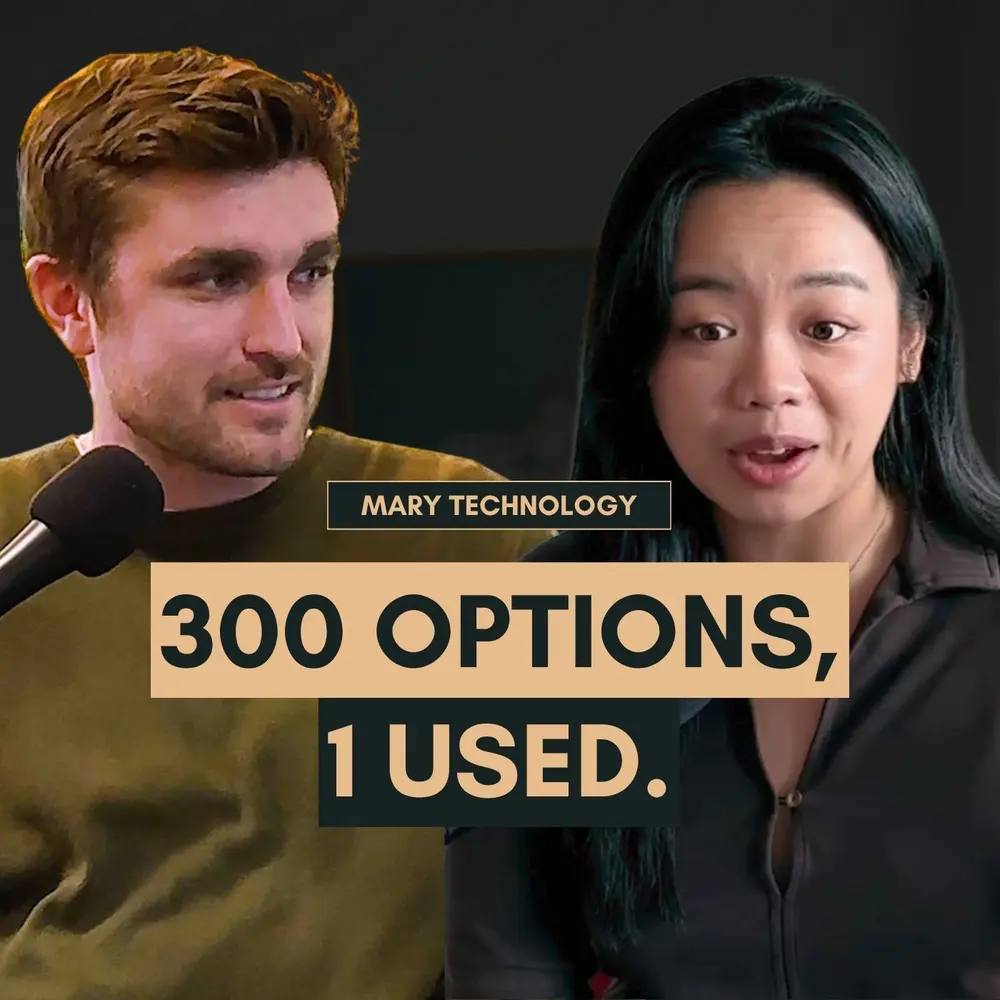
“The customers make you undeniable — not the founders.” — Rowan McNamee Before he built an AI for lawyers, Rowan McNamee took the notes himself — sitting across from people mid-divorce, writing down their custody disputes by hand.
Rowan co-founded Mary Technology, an Australian legal-tech startup that turns thousands of pages of case documents into chronologies, summaries and reports. He walks through the failed first prototype that gave lawyers 300 ways to use a transcript when they only wanted one, why Mary turns down every transactional and M&A case to stay purely litigation and disputes, the architecture built to stop AI hallucinating across thousands of documents, what changed in him once real clients' worst moments were riding on getting it right, and why the company is named after his aunt.
Chapters
0:00 Intro & Cold Open 0:20 Notes From a Divorce Case 2:13 Why Lawyers Skipped Standard Note-Takers 4:37 What Mary Technology Is Today 5:30 The Big Red Button: First Prototype 6:42 The Pivot: Stop Building for Everyone 9:07 Solving AI's Memory & Hallucination Problem 12:24 Why AI Won't Replace Lawyers 14:47 Litigation Only: Drawing the Hard Line 17:29 The Hardest Fundraise: 18 Months In 20:51 Round Two, Round Three, and Getting "Undeniable" 23:56 Building a Company With Your Best Friend 25:29 How Founding Changed Him 27:10 Naming the Company After His Aunt 28:27 Regrets, Mistakes, and Skipping Law School Transcript Search or select a timestamp to jump ▾ 0:00 Rowan McNamee: At the other end of our product is a lawyer who is dealing with someone who's having possibly the worst time of their lives. When they are preparing for court, there are genuine consequences for things going wrong. You just have to be undeniable. Stop trying to go, you know, begging people for money. We are going to do this with or without, you know, your investment. 0:22 Thea Ngo: Then came a version with 300 features they had to kill. 0:27 Rowan McNamee: We called it the big red button. 300 options. The only one that really got used was the file note. 99% of these totally useless. The customers make you undeniable, not, not the founders. 0:37 Thea Ngo: Today, thousands of lawyers across hundreds of firms uses their product every day. 0:44 Rowan McNamee: My name is Rowan McNamara, co-founder of Merit Technology, and this is Founders in Motion. 0:49 Ad: You're listening to a dayone.fm show. 0:56 Thea Ngo: You're a young solicitor, someone sits across from you. They're in the middle of a divorce, of a custody dispute. You've got a notepad. What are you actually writing down? 1:08 Rowan McNamee: Sure. So yeah, like as you said, I was a family lawyer. So when people come in, they effectively tell you their life story. They talk about their finances. So I'm just trying to get a picture of exactly, you know, what has happened. So you have to get details like the history of their relationship. When did they meet? how, you know, their dating history. When did they first, uh, move in together? 1:34 Thea Ngo: Yeah. 1:35 Rowan McNamee: When did they separate? Um, how long have they been separated for? When did they have children? You know, what do they do for work? What do the other— what does the other party do for work? Um, so you're trying to get just all the basic information about the history of their relationship, um, those details. Then if there are incidences of like family violence, if there was drug use, a criminal history, all of these pieces that make up part part of the, the family law story, as well as their finances. So then you have to understand, you know, their employment history, when they buy a house, what cars do they own, all of these financial elements that form the what's called a marital pool. So that obviously is different in every family law situation. 2:21 Thea Ngo: Yeah. 2:22 Rowan McNamee: Um, but effectively that's what you're doing. You're just getting that, getting that person's story. 2:26 Thea Ngo: So obviously this seems like quite a decent amount of work to do. So why wouldn't law firms just adopt like a normal note-taker in order to do all of the things that you mentioned? 2:39 Rowan McNamee: Yeah, well, so when I was doing it, so back in around 2019, 2020, or early 2020, note-takers had sort of come out, but that was still very new. So there were certainly some law firms that had started doing that. Other law firms would record it with like an old sort of dictaphone, you know, just— 3:04 Thea Ngo: What is even a dictaphone? 3:05 Rowan McNamee: It's like a tape recorder. 3:07 Thea Ngo: Oh, okay. 3:07 Rowan McNamee: So like with an actual cassette tape and you press a button to record. So then you can refer back to the actual recording. So like, that's one way that they record things. But no, I think lots of law firms now actually do use the standard note takers. The core difference of what we did with our first version of Mary, that sort of prototype, was just actually be able to take the transcript. And one of the ways it was used is to create notes that really summarised what that type of lawyer needed, as opposed to just a summary of the conversation. 3:39 Thea Ngo: Yeah. 3:40 Rowan McNamee: And that was still an improvement on just handwriting notes or even a standard note-taker. 3:45 Thea Ngo: Honestly, a very leading question because I also used to work in strategy consulting for private equity clients. So doing a lot of like due diligences. So we also were taking a ton of tons ton of different notes. And we also tried a ton of note-taker tools in the market, but it ended up being easier if one of us do it because we're capturing the right level of context. 4:08 Speaker: It 4:08 Speaker: becomes way easier to refer later. People are not wasting time looking through blocks and blocks of text. So. 4:15 Rowan McNamee: Yeah, exactly. When you have the insight of someone who actually has to take that meeting and you know what you have to then convert those notes into, you can be more efficient with your, like what notes you're taking. You know, originally when you just have like a standard meeting summary, they'll talk about where they parked and, you know, the pleasantries of when they walked into the meeting, like it all gets summarised, which is obviously totally irrelevant. So yeah, just that first version just tailored, tailored the meeting notes to exactly what that type of lawyer needed. 4:47 Thea Ngo: Yeah, 4:47 Rowan McNamee: at least that was the idea. 4:48 Thea Ngo: Yeah, beautiful. Okay, so you've touched on it briefly. So Merit Technology, obviously you've done a few pivots, you've all in the same trajectory, but As of now, 2026, what is Mary Technology? 5:02 Rowan McNamee: Yeah, so we call Mary a fact management system, and what that means for lawyers who work in areas of litigation and disputes, when they deal with the hundreds or thousands of pages worth of information and evidence, what Mary does is extract the facts and all the events from those documents, as well as organize those documents, and then allow them to draft different things like chronologies, summaries, reports, letters, any way they can use the facts from those documents to progress their case. That's what Mary's focused on now. 5:36 Thea Ngo: First version of Mary wasn't quite like that. It was more along the line of a note-taker tool, pulling out the right context for the person that's using it later. So, but like, if you had to envision this first version, like, what did you actually ship first? 5:51 Rowan McNamee: So the very first version, the prototype, we called it the big red button. So Basically, you could do it on your phone or on your computer. It was a red button where you could record a conversation. That was all it did. And then it had a dropdown. And so you record the meeting. Of course, the first version, I think you could only record about 10 minutes. Like, that was all you could do. Okay. Which is effectively useless. But anyway, you could record about 10, 15 minutes of a conversation. And then we had a dropdown that had some ridiculous number of options, like 300 options. of what you could take that transcript and turn it into. The only one that really got used was the file note, like a summary of that meeting. But we had the option to make a letter off the back of it, draft an affidavit, all these different things that we thought someone would want to do. So that was the first version. 6:41 Thea Ngo: Okay, so you mentioned that you had all these options and then the lawyers were primarily just like trying to get a summary of the notes. So what did you learn from watching those first few users use this gigantic red button? 6:57 Rowan McNamee: Well, the biggest takeaway from that portion or that era was to not try and do everything for everyone. We want— we were— we had, you know, all, all jurisdictions on earth available. We had all the different types of lawyers. And like I said, like 99% of these, of that functionality was totally useless. One, the main reason they only used it for a file note was that was effectively the only one that actually provided any value at all. And so yeah, the biggest takeaway was, and we learned this pretty early on, was let's not try and be everything for everyone. Let's try and be the best in the world at one thing. And so the next sort of phase was attempting to be the world's best chronology tool for lawyers. 7:41 Thea Ngo: So obviously you've lived this problem, so you're sort of one of, you're like an ideal founder to be solving it in the sense that you've lived it, you were annoyed by it, and now you're building something to fix it. But you still got the first version, not wrong, but like, like a different perspective from how customers actually use it. What did that teach you about being close to customers or bringing a product to life that actually solves a problem? 8:10 Rowan McNamee: You're right, I did have to go through this problem as a young lawyer. It's interesting, you have to also sort of meet the technology where you are as well. So, you know, my— the original idea was what I would have really wanted, which is you don't have to take notes in these meetings. Yeah. And then the next 4 things you need to do are all done for you. That was my idea. I was like, oh, you finish your meeting and then the next 4 things that I would have to do are done for me. At that stage and still today, that's not actually how it would— can work. It's not how it should work. And certainly at that point, it also wasn't technically possible. you can't start at the end. 8:52 Thea Ngo: Yeah. 8:53 Rowan McNamee: And also, it was interesting. We, we didn't immediately solve for my type of lawyer either. Like, sometimes you have to go where, where the customers are leading you. I ultimately— we just discovered a better problem to work on, and it wasn't exactly what I wanted and my number one problem was, but that is what led us on the path. So just listening to your customers, I guess, is the number one, the number one takeaway from that. And don't be afraid to change quickly. 9:19 Thea Ngo: Yeah. And you really learn as you go, right? 9:21 Rowan McNamee: Exactly. 9:21 Thea Ngo: So speaking of technical problems, so there is a technical problem, like, underneath kind of current fact management systems. So AI tools can hold only so much memory at once. In a case with thousands of pages, so that means potential missing documents. And in litigation, that's not okay. How did you think about building around that? 9:46 Rowan McNamee: Yeah, well, you can't. So if we were just attempting to be sort of a wrapper on an LLM, we'd have massive, massive problems. You can't just chuck 10,000 documents and make a single LLM call to solve all of your problems. We had to really think about the architecture and how this works. And so that's had to be iterated many times, but ultimately, It's just about breaking up the steps like a lawyer, like a lawyer would do, because ultimately a human can't actually hold that much information in their brain either. 10:21 Thea Ngo: Yeah. 10:21 Rowan McNamee: A lawyer doesn't read 10,000 documents and then immediately be able to recall information about all of it. It's done in steps, it's done in stages. And really what we tried to do from the very beginning is just replicate the mental model of what a lawyer is actually doing when they have 10,000 documents in front of them. 10:39 Thea Ngo: Yeah. 10:39 Rowan McNamee: And that actually made it an easier problem to digest, I guess. 10:44 Thea Ngo: No, it's super interesting. And I do agree. I think the current hallucination problem is such a big thing. And maybe that's why my personal thesis is that we're going to move to sort of niche or more process-oriented models rather than using these bigger LLM models for most things in life. 11:02 Rowan McNamee: Yeah. And even with the massive context windows that are available now, it's still it still doesn't solve that human understanding problem. You know, in our line of work, you can't just give lawyers the right answer. You have to walk through the steps so that when they're done using Mary, they have the same level of understanding as if they had gone through the incredibly painful and manual process themselves. 11:29 Thea Ngo: And I can imagine like the traceability is also really important to how it comes to that conclusion as well. 11:34 Rowan McNamee: Yeah, absolutely. Traceability, verification. it's super important. You know, we talk about this concept of them at the moment called, you know, cognitive surrender, which effectively means just letting machines make decisions for you, which you, you can't do that in law. They are licensed. It's a licensed, regulated industry. Lawyers have to understand what they're doing, what decisions have been made, what has been chosen to be— to have been ignored. It, yeah, it is more complicated than just allowing a massive AI system to do everything for you. 12:10 Thea Ngo: Yeah. Now, I think it's really interesting with AI adoption, right? Like, I think 2024, 2025, people had this notion of like, oh my God, like this, these gigantic systems are going to replace people and replace like common thinking. But now everyone's realising the limitations of the software and finding ways to actually marry them into um, um, like a practice like law rather than trying to replace it like as a whole. 12:38 Rowan McNamee: Yeah, I mean, the real role of a lawyer is to exercise judgment. I mean, that's the— that's what they're trained to do. That's what we entrust with that profession. Um, that's a very human-to-human thing. Um, And so, I think law's got a long way to go. I mean, there are some areas we do see like AI speed cameras sending out tickets autonomously. So, there are some— 13:07 Thea Ngo: I don't know if people love that, but— 13:09 Rowan McNamee: No, I don't love it. I certainly don't love it. But there are some areas where perhaps you can allow for some artificial judgment to happen. But whenever it's seriously important, I don't think humans are going to going to give up the role of other humans to make those important decisions. So yeah, I think we're a long, long way before AI really takes a big chunk out of the legal industry. 13:35 Thea Ngo: Yeah. And like the stories you mentioned earlier, it's like you're sitting across from these people going through big major life decisions, like going through divorce, trying to figure out settlements, their will. These are very personal events in their life, and it's not just kind of a binary A or B answer. 13:55 Rowan McNamee: Yeah, exactly. It's every, every single— and then we talk about family law here— every single relationship and family has a totally different set of circumstances. They have different wants, they have different types of children. People go to family lawyers not to— not just to get an answer. They actually want someone to help them and care for them. You know, if you know, you can imagine you go to a family lawyer and they come back to you with some advice, and then you ask a follow-up question, they have no idea because they haven't looked at anything. We're just so far, we're so far from anything like that. People, people want, people want lawyers and humans to, to really take care and take responsibility and ownership over their problems. That's what they're being paid to do. 14:41 Thea Ngo: Okay, so you've also talked about like trying not to be everything for everyone. And you guys have obviously drawn a very hard line, litigation and disputes only, not transactional work and not M&A. Why litigation and disputes? 15:01 Rowan McNamee: It's a different type of problem. Litigation and disputes, ultimately what's happening is you're looking backwards, something has happened. can be all kinds of different things. A contract may have been breached, a family, you know, a relationship is over, someone's been injured at work. These are all, all different things that have happened to someone or a company, and you're looking backwards and you're trying— and lawyers are needing to make sense of what's happened and then effectively what should happen next. 15:29 Thea Ngo: Yeah. 15:29 Rowan McNamee: That's actually a technically very different problem to a transactional lawyer who, you know, people have gone to them for help for something that needs to happen next. 15:39 Thea Ngo: Yeah. 15:40 Rowan McNamee: It's a different set of documents. It's a different, it's a totally different experience and it's different type of lawyer. It's just a different set of problems. That's the problem we set out to solve from the beginning. And I think trying to do both at once, you know, there's just the risk of doing them half-baked. 16:00 Thea Ngo: Yeah, but I want, I do want to challenge that perspective a little bit because I, so I used to work in like M&A transactions and I remember we still were completely buried in documents, findings from everything, right? From customers, market, old records, Stripe data, and all that stuff. So yeah, like, I can also imagine that's a huge, like, fact management problem, like, huge, like, historical context. So what do you mean by, like, they're fundamentally different? 16:31 Rowan McNamee: Yeah, no, that's true. There's plenty of documents and you're still looking at the past. It's just slightly different in that you are analyzing, you know, a set of records, a set of contracts. It's just different in the nature of when we talk about Mary being a fact management system. You're, you're going through thousands or millions, even effectively little things that have happened, that have taken place, whether those are in emails, in medical records, in criminal records. Each of these pieces of evidence, you know, videos, even transcripts, Each of these pieces of evidence represent a set of many things that have taken place that might be considered, you know, in that area of law, a fact or an event. It's just a different type of analysis that's taking place. And so, look, yes, you can have— there are many legal products that serve both ends of that, of that market. It's just the angle we have chosen to do, to go. We've just chosen to go, to go deeper, um, on that side. 17:34 Thea Ngo: For sure. Okay, so moving to a different topic that might or might not be more fun. You've raised 3 rounds. You described the first one as the hardest, a year and a half convincing people with very little traction. So I want to go into that period specifically. So at month 12 of an 18-month raise, what were you and your co-founders telling yourself? 18:00 Rowan McNamee: First of all, it wasn't exactly like that. It was Sorry, I made it very dramatic. I wouldn't say it was an 18-month raise. I mean, ultimately it was. I mean, we knew that's what we wanted to do, but it wasn't from the very beginning trying to immediately raise money. There was a point where we were really struggling to get the momentum we needed in a round. We had a prototype, we had some people saying that it's really good, There came a point I remember with the 4 of us where we sort of realized you just have to be undeniable. You can't just have, you know, you can't just be, have a good idea and a maybe. You have to, when you're trying to raise money, especially at the start and especially now in this era, it has to be so clear. The momentum has to be so strong. And so we sort of had to change our mindset. Yeah. Like, let's stop trying to go, you know, begging people for money. We have to get this to a point on our own where it is just clear that we are going to do this with or without, you know, your investment when we're speaking to someone. That was the biggest sort of mindset shift, probably, yeah, 12 months in. Of course, there were many trials and tribulations over that process and different points, but I'd say that was the real turning point in trying to get that, make that first raise happen. Effectively what happened, the first raise we did was right around the same time we actually launched a product that could be used by law firms. So we had the investors on at that point, discussing what to do about the next raise with them was happening the entire time. So it was just a different, it was a different process. And that's, I guess, what made it easier by comparison, even though I still think that's the wrong word to use because it's still a process. 19:47 Thea Ngo: We are over it. So that's always a good thing. Maybe the third time will be even easier. than the second time? 19:58 Rowan McNamee: No, I wouldn't say so. So this, this third time around, you know, the plan was to do a bigger seed round, which did mean bringing on different type of investor. So it is effectively back to square one for us. There's also the decision of do we go to the US and try and get some momentum and traction there before doing this bigger seed round, or do we utilise our momentum in Australia, in Australia and find an Australian backer to help take us over to the US as well, which is, which is what we ended up doing. So yeah, it's easier because we did have a growing customer base, we had growing usage, um, you know, we had product-market fit, but we didn't have, you know, any US momentum yet at that point. So it's still ultimately you're trying to get a larger investor to believe that you are the founders and that you're the company and that you have a product that can, you know, scale to overseas. Easier than the first one, but Still very hard. 20:58 Thea Ngo: I feel like I need to stop asking these fundraising questions. It is just going to motivate people to never try it. 21:04 Rowan McNamee: No, no, no. The only piece of advice is just be undeniable. I think you can't be begging investors for money. You need to have momentum already. They have to believe that you're going to do it without them. That's just the mindset you have to have and you have to make it a reality. And yeah, back yourself to do that. 21:28 Thea Ngo: So what do you think about the 4 of you that makes you guys undeniable? Other than like the momentum, the traction, and that you're going to do it either way. But do you think there's anything uniquely about you guys like together that makes you guys undeniable? 21:42 Rowan McNamee: You know, it's a combination of things. I mean, maybe there are some founders out there that are just so incredible that they're undeniable just purely on their own. But no, it's the combination of things. It's the combination of customers really loving the product, momentum and growth, you know, being able to articulate the problem really well. But then also, yeah, showing, showing some competence. I think just as a founding team, we complemented each other very well. You know, we had some software— we had software engineering background. I was a lawyer. We had Luke, who has had a really deep product expertise, and then Harry in more growth and marketing. So it was just a good, well-rounded team at that stage, as well as we had also very early on brought on Lawrence and Jesus as founding engineers who are, you know, incredible. But ultimately, it's the customers. The customers make you undeniable, not, not the founders. Maybe there's, you know, the investors have to like the founders too, but your customers have to be doing the work for you. 22:46 Thea Ngo: Yeah. 22:46 Rowan McNamee: That, that's what makes it undeniable. 22:49 Thea Ngo: Yeah. Okay, amazing. So you touched on your co-founders a little bit. So one of your co-founders, Harry, has been your best friend since you were 3. They say never mix friendship and money. So has the dynamic between you and Harry changed since you started working together? 23:07 Rowan McNamee: Yes, I mean, it's definitely changed. We talk about work far more than we used to, rather than, you know, just our social lives. But no, yeah, it's a risk. I actually, I still wouldn't recommend it to anyone. 23:22 Thea Ngo: Oh, really? 23:23 Rowan McNamee: No, it works for us. I don't think it would work for everyone. We're pretty good at separating, you know, our social friendship and our, you know, our work life. As I say that, I almost think actually maybe that's not true. I'm probably lying right now. We talk about work a lot as well. But It works for us. 23:41 Thea Ngo: Yeah. 23:43 Rowan McNamee: We, you know, maintain our friendship. Otherwise, we have, you know, same group of friends that we can hang out with and not talk about work. So yeah, it's a risk. But, you know, we believed in this so much that we were willing to take that risk. 23:55 Thea Ngo: I think it's also good to be in friend groups that don't really talk about work. So they help you. They help you guys pull out of that mindset as well. 24:04 Rowan McNamee: Yeah, totally. You know, we Yeah, we have a great group of friends. They're all very supportive. But yeah, when we hang out, we're, you know, we're just a group of friends as we were before. And so yeah, it's important to still maintain that. 24:18 Thea Ngo: That's nice. So, okay, so you said that this company has really changed you as a person, that you've really grown up in the last couple of years. What do you think is different about this version of Rowan versus the Rowan of a few years ago? 24:33 Rowan McNamee: That's a hard question, quite introspective. You know, when I answered that question before, it was really around the responsibility. It's hard. I actually really don't know the actual answer to that question. You know, the responsibility of employees and customers relying on us and their customers, it just has— it just gives extra weight to this sort of discipline and dedication. that I and the rest of the team need to have to what we're doing. You know, I always think back to the very early days when that wasn't the case, where every so often we'd end up playing table tennis for a few hours extra than we may have. But, you know, now we really don't have that option. You know, at the other end of our product is a lawyer who is dealing with someone who's having possibly the worst time of their lives. 25:26 Thea Ngo: Yeah. 25:26 Rowan McNamee: When they are preparing for court, It's not, it's not a light thing. It's not like a nice-to-have product if they're relying on us. There are genuine consequences for things going wrong. And so just having that in your mind, it, you know, it's changed me. I'm sure it's changed many of the people in our team in the care and the, you know, dedication in our work. I'd say that's the main thing, but good question. I might need to go to a psychologist to answer it properly, but that's what I can think of. 26:00 Thea Ngo: Yes. But I do think it's like, I think it's a hard question to answer, right? Because I feel like naturally as people, we change a lot over the last few years. And it's hard to figure out like, what are the main reasons for that? Could it be company? Or is it just like growing up? Or is it just us growing to be different people based on the environments around us? So it's hard to say. But okay, so you also named the company after your aunt. What did she say when you tell her that? 26:29 Rowan McNamee: Well, I think I asked in a way where I was like, is that okay? Like, is that all right? Do you mind? And she was like, no, of course not. That's wonderful. You know, she was immediately supportive, you know, and I hope, you know, she's honored in a way. So, you know, she's been supportive from day one. And there's been no lawsuit to date from my auntie. So yeah, no, she's great. 26:56 Thea Ngo: Okay. So right now, like, Mary supports some of the best kind of litigation and disputes law firms in Australia. In the next 5 years, like, if you have to think about that future, what would you want Mary technology to be? 27:13 Rowan McNamee: I would want Mary to be supporting legal teams, you know, companies and law firms all over the world, you know, any, any, any country, any jurisdiction, maybe 100+ in 5 years. Um, I would want us to still be supporting, you know, one-person law firms, some very small companies. And then I, uh, I think we'll be working with the majority of the largest law firms in the world by then. Of course, it's impossible to, you know, have a crystal ball for 5 years from now, especially in this AI era. Like, things change so fast. But that's what I think we're going to do. 27:53 Thea Ngo: Yeah, 27:53 Rowan McNamee: that's the plan. 27:54 Thea Ngo: You know, I think if you believe in it, it will come true. 27:57 Rowan McNamee: Exactly. It's been— it's worked so far. 28:00 Thea Ngo: Yeah, like consistently executing towards the vision, it will come true. And then we've talked a lot about like challenges and changes over time. So it's been a while. It's been a big journey for you and your co-founding team. Is there anything that you regret in the process? 28:20 Rowan McNamee: You know, we've made heaps of mistakes. Many, many, many mistakes, of course, which you have to do. I don't think regret is the right word because I think all of the mistakes and all of the things we've done wrong is what's led us to here. So no, I have no regrets, honestly. There are definitely mistakes. There's plenty of them. But no, I have no regrets. I think it's had to turn. It's had to go the way it's gone for us as a founding team. Yeah. You know, everyone's on their own journey. You know, some companies have grown quicker, some grow slower. This is the journey we're on. And, you know, we're getting better and better every day. And like, I think that's how it needs to happen. 29:04 Thea Ngo: Yeah. Do you ever regret not pursuing a career in law? 29:08 Rowan McNamee: Well, I did pursue a career in law. 29:10 Thea Ngo: Yes. Yeah, you did. 29:12 Rowan McNamee: Briefly. No, I, I, you know, I have no regrets about that either. I think, again, I think it had to happen like that. I'm glad I got some experience, um, actually as a practicing lawyer. I think it's helped today. I'd say my one regret was, again, and maybe it had to happen like this, I think this is quite common for founders, but, you know, I wish I utilized my time in law school better. Um, you know, I wasn't the best student. I don't think I took it as seriously as I could have. I might have benefited from that if I had now. So yeah, I would love to do that again. Yeah, I'd say it's a regret, but again, not really, because I think that I had to be that type of person to go down this path. Yeah, it is what it is. 29:53 Thea Ngo: Yeah, it's hard to pay attention in school, you know. 29:56 Rowan McNamee: Yeah, exactly. And I think it's very common with founders. Founders are the type that they don't like being told what to do and they want to do things their own way. And so, yeah, I think being that type of person has led me down this path. So I don't regret it. But, you know, I do recommend people try hard in school. 30:17 Thea Ngo: You know, it's actually very funny, like a very common advice that founders are always like, yeah, I really wish I went back to school, but they were all horrible students. 30:27 Rowan McNamee: Yeah, it's very common. It's like it's a personality type for sure. But I think then you become a founder and you have no choice but to learn really quickly. And then perhaps you embrace, you know, an attitude of learning a bit later on. And then you realize, wow, law school would have been a really good place to learn and study. So yeah, I think it's a personality type. 30:58 Thea Ngo: Yeah, for sure. Well, thank you so much, Rohan. 31:01 Rowan McNamee: Thanks for having me. 31:01 Thea Ngo: I appreciate you. 31:03 Speaker: That's a wrap. If you like this episode, please hit the like and subscribe button. It helps us bring on more awesome guests, level up production, and bring on new series you'll want to watch. And if you want to hear more early-stage builder stories, check out our other episodes. 31:16 Thea Ngo: Okay, see you next time. No transcript lines match that phrase. Try fewer words.


 ▶
 ▶
 ▶