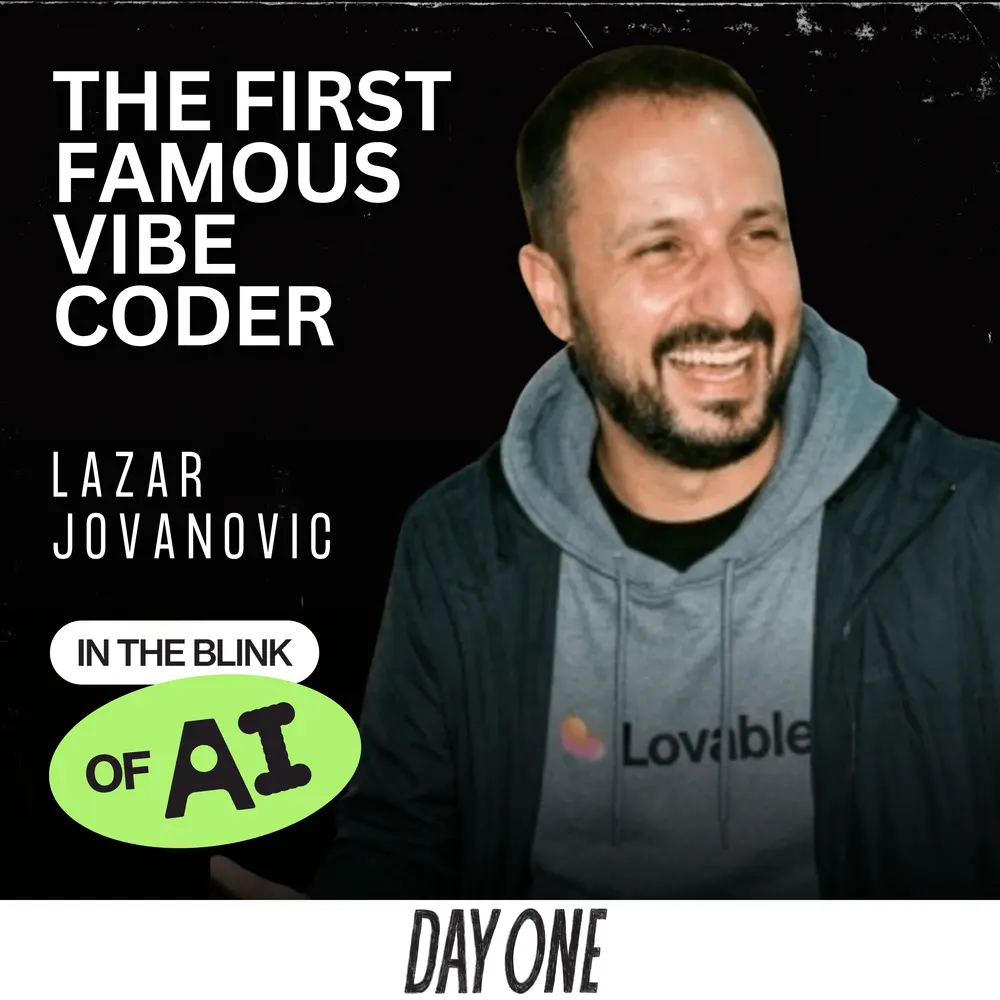
Lazar Jovanovic didn't go to engineering school. He found a beta tool called GPT Engineer, set himself a challenge to build a new app every week, and filmed the whole thing. Two years later he's Lovable's in-house vibe coder, building load bearing internal tools that engineers tell him used to take a team of twenty.
In this episode of In the Blink of AI, Georgie Healy hands him her own website and asks him to roast it live. He does, in about four minutes, and the fixes he gives are ones you can apply to your own site today.
From there it gets sharper. Why "explain it like I'm five" is the worst thing you can say to an AI, and the exact script to use instead. Why opening four tabs costs you less than fixing one bad build. Why he thinks almost nobody writes their own code by hand anymore, and why that was never the valuable part of engineering anyway.
And when Georgie asks why people blame the tools, he gives the line the whole episode hangs on: it's a vehicle, it's faster than you, and if you won't take the wheel, enjoy the cliff.
Plus what's actually left for humans when building gets cheap, the three tools he can't work without, and who he thinks Georgie should book next.
Hands on episode. Get a pen.
Transcript Search or select a timestamp to jump ▾ 0:00 Georgie Healy: Do you want a hot take from the world-class vibe coder that works at the 2-year-old, $13 billion AI company? I mean, of course you do. 0:10 Lazar Jovanovic: We are not naturally gifted to talk to AI. So if you find good moments of inspiration where you're, you feel like, oh, I'm, I just prompted this exactly the way I would wanna prompt it every time, or like, oh, I finally figured it out, record it, save it as a skill, put it in your project knowledge, put it somewhere so that you build a repeatable system that is not dependent on whether it's 10:00 AM after a hungover night or 10 PM after an extremely long day at work. In both of those extremes, you will probably not be able to produce your best. So my hack is actually cloning the best version of myself and placing it in such a way that I can just forward slash invoke it whenever I need it. I challenge anyone to come to me and tell me that they are writing more than 5% or 10% of their code by hand. I think most people don't do it at all. Everybody's using AI. I'd love to hear something that's not just about a bro token maxing either, but like There's other people out there doing really, really cool stuff. 1:07 Georgie Healy: Today on In the Blink of AI, we have Lazar from Lovable, who said, if your AI output is garbage, it's your fault. We start the episode with like the AI hack of the week, but then get straight into roasting my vibe-coded website live. Lazar said, AI never tells you your idea is stupid, but your mates I mean, I guess I'll choose not to take that personally. But seriously, Lazar was incredible. This was such an entertaining and honest chat with things that I think will stick in my brain for a long time. He's generated 38,000 prompts and counting. He knows what he's talking about. Side note, guys, I love how many of you are listening to the episodes. I can see the recent numbers. It's incredible. But only 10% of you have clicked that subscribe button. On Spotify, Apple Podcasts, YouTube. And frankly, it's a weekly show. AI is moving really quickly. If you miss an episode and it's someone that you would have loved to listen to, chances are things have moved a lot since then. So if you click the button, you'll be first to find out when an episode comes out. And we have some pretty incredible guests lined up behind the scenes. So don't say I didn't warn you. But until then, the 0.1% Best vibe coder on the planet, Lazar from Lovable. Let's go. 2:30 Ad: You're listening to a dayone.fm show. 2:36 Georgie Healy: In the Blink of AI is proudly sponsored by Deal, the global HR and payroll platform that's behind the expansion of companies like Revolut, Shopify, or fans of the show ElevenLabs, who quadrupled their workforce in 54 countries. Lazar, thank you so much for joining In the Blink of AI. I have actually been aware of you, seen you quoted in many articles before. It's a real pleasure to have you here today. Thank you for joining. 3:13 Lazar Jovanovic: Thanks for having me. 3:14 Georgie Healy: We always start In the Blink of AI with an AI hack of the week. What's your hack of the week? 3:21 Lazar Jovanovic: I want to say it's probably leveraging skills, leveraging project knowledge, working with drafts, like really trying to amplify what's good and what you know works. And in a way, eliminate yourself out of the equation as much as possible. I think one thing that I always emphasize to people is that we are not naturally gifted to talk to AI. So if you find good moments of inspiration where you feel like, oh, I just prompted this exactly the way I would want to prompt it every time, or like, oh, I finally figured it out, record it, save it as a skill, put it in your project knowledge, put it somewhere so that you build a repeatable system that is not dependent on whether it's 10:00 AM after a hungover night or 10:00 PM after an extremely long day at work, right? In both of those extremes, you will probably not be able to produce your best. So my hack is actually cloning the best version of myself and placing it in such a way that I can just forward slash invoke it whenever I need it. 4:32 Georgie Healy: Wow. You know, it's funny you say that because I feel like this time a year ago, people were talking about prompt engineering a lot. And it kind of reminds me a little bit of that. But how is this different in the way you see it, or is it different? 4:47 Lazar Jovanovic: It is different because prompt engineering always considered, as the name of the word implies, crafting and engineering better prompts, but it did not take into account the reusability factor, right? My system is better than that in the sense that it does— it's not dependent on your inspiration. It's dependent on a system that's repeatable. Right? It's almost like a law that you put in place and then based on the need invoke pieces and bits of it. Good example I think that will resonate with most people is design. Like people are very opinionated about how they want things to look like, right? And we've all heard of the term AI slop and a lot of times your first draft of something unless you are specific and you provide proper references may come out as something that is not the way you would like it to be. So in those cases instead of saying things like, make it prettier, which is quite subjective, right? I, I, whenever I see that prompt, I'm like, okay, what does pretty mean to you? Because pretty for me and pretty for you is 2 completely different things, very likely. So I, what I do is I build systems that are deterministic. So I can say forward slash and I can use a skill that is like a retro skill. If I know that I want this to be retro, or if I know that I just wanna redesign, maybe just a redesign skill, which invokes a couple of things that would perfect that original idea. So that's, I think, different from prompt engineering in that way where like prompt engineering, I think, assumed that you would just become very good at producing unique prompts all the time. This is the complete opposite. You produce a system that works and you just play that on repeat. 6:35 Georgie Healy: I love that because my brain just doesn't work after 12 PM. And thank you for already bringing, you know, tangible insights. I knew this episode would be very hands-on. People, get your pens and paper out, get your recording device out. This is going to be one of those episodes. But Lazar, before we go any further, what's the most non-AI thing that you still do to this day, despite working at, you know, a very well-known AI company? 7:01 Lazar Jovanovic: Well, I'd say the first thing that comes to mind is manual video editing. I still, you know, cannot find a way to vibe video edit. Right? And it's such a pain. Like, I can't wait somebody to solve this, uh, but for real, like really solve it the way I would do it. I've tested a couple of tools. Nobody's close. Um, so that's one, super manual. Believe it or not, I write most of my emails and social media posts, uh, using AI. Again, tried so many of these scheduling tools. Nothing just sounds like me very quickly. I see soundbites that are clearly, clearly written by AI. My vocabulary is, as a non-English, as a non-native English speaker, is not like, I'm not using those words, right? I'm trying to really keep things simple and super actionable, and I feel AI is like very verbose sometimes. I will use AI for things like, for example, if it's a longer format write-up, let's say Substack. I'll use it to do the first draft but never out of the blue and always based on my brain dumps. Really, I would just go in and just dictate into AI like a super, super long 5-minute-long rant and then just really use AI just to like reorder things and then I will polish it up at the end, right? So wherever there's a core idea need that's in my head, I just really keep it within the bounds of the human. And then whenever I just need a little bit of structure around, you know, something that's super fuzzy, I may use AI. So like, you know, obviously I use AI for all the coding, but as I said, you have some video editing, emails, believe it or not, which, you know, people are trying to automate, and then social media posts are top 3 things that I still do myself. 8:57 Georgie Healy: Mate, you're making me feel better because I keep trying to video edit with like a click of a button and it does not work. does not work, so that makes me feel better. I also, at the end of this episode, you know, I get the transcript and I say to AI, what are all the topics that were talked about? But then when I write my intro, I read those, but then it's all in my own words. It's like, yeah, I feel like, I feel like if you take away our personality, what's the point of doing anything? Agreed. Okay, mate, um, I am so excited to be roasted by you. Hi, thank you. Uh, because my personal website is built on Lovable. I did this well before before we met, well before I knew you were coming on the show. Genuinely, not sponsored, not meant to say this, but I love Lovable. It, it, you know, was a very easy, user-friendly tool to get my website up and running. But you're gonna roast it today because I want to make it better, and frankly, I don't know what I don't know. Are you ready to roast my website? Oh, 9:58 Lazar Jovanovic: any day. I, I love, I love watching Lovable projects. I seeing them in the wild and especially like this in an unexpected setting. Okay. So nice. All right. Do you want me to get started on this already? 10:15 Georgie Healy: You know what? Dive right in. And if you're listening, guys, you should be able to view this on YouTube or on Spotify as well. We've got video as part of this. So have a look at what we're going through. 10:27 Lazar Jovanovic: I like the color tone contrast. Like, I always think in terms of like, Most people consume content on their mobile. Yeah. And likely it's going to be in an outdoor setting. It's going to be in a setting where brightness coming from an outside source, sunlight, whatever, can impact the readability. And I see so many websites where they're like 5 shades of blue or something, and you're like, man, I can't read this for, you know, if you paid me to do it. Whereas this, like, super high contrast. I like that, you know, you're trying to Get the colors of what you wear match kind of the color of the website, so it's kind of like easy to read. That's kind of the first thing that that I'm seeing here, right? Well, let's move on. I mean, you can scroll down again. Yeah, get more contrast. Very good story. All right, nice. Images do get cut off a little bit weirdly if you want like a roast in the sense that like your body is just like. just gets cut off, like, before the end of that scroll. So it's like, yeah, maybe, maybe some padding adjustment. Like, you can kind of adjust the— where, where that section ends and the next one begins based off of where your image ends. See how right there, uh, at your thigh level, it just kind of gets cut off? That's kind of— 11:49 Georgie Healy: Yes. 11:49 Lazar Jovanovic: Making me feel weird about it a little bit, you know? 11:52 Georgie Healy: Yeah. 11:52 Lazar Jovanovic: Um, but yeah, um, Otherwise, it's good coverage. Okay, cool. All right, question. Why so late on introducing what you do? I feel like, you know, I assume podcast is your like number one thing. 12:11 Georgie Healy: It is. 12:12 Lazar Jovanovic: I will say this, like based on anything that I've done in the past and like analyzed websites and, you know, have a decent experience in SEO and A/B testing and stuff like that, I can tell you 95% of people are never gonna scroll this, uh, this far on your page. So it's like if people somehow in the wild came across your website, they would not be able to realize what you do until they reach this section. So like you're— I would think all the way by now it's like, oh, This lady is just having a personal brand. Like, I wouldn't even understand based on what— obviously you have the story bit, but I will tell you, people also don't read these days much. Our attention spans are, you know, really going to zero almost. So this is a cool section that I would somehow try to maybe incorporate a little bit earlier, just because that's— I feel like that's kind of gonna drive me To then learn your story, I think I would rather know what you do and see these numbers say, "Oh, okay, cool, nice." Now let me now I'm bought in to the this person. Let me learn more about her. So maybe just like flip them and swap them. Yeah, yeah, yeah, yeah. 13:30 Georgie Healy: Great shout, great shout. And also these numbers are all so wrong. Like hooray! I'm doing so much better than these numbers. Is there an easy way to hyperlink those numbers? Would you recommend doing that? 13:44 Lazar Jovanovic: I mean, technically, yes. You could build like a function that like, because if these come from YouTube, for example, YouTube has a free API and like you could just say, hey, just connect it. You would just need one key and which is free to obtain and you could read directly from YouTube or you could— there's ways definitely, right? Yeah. Okay. To do this. Yeah. So it's— that wouldn't— should not be your bottleneck in this case. Yeah. 14:12 Georgie Healy: Okay. This is the newsletter. 14:15 Lazar Jovanovic: Yeah. Again, all of this bottom stuff, I don't, I don't look at too much because by this time, if somebody spent, uh, the effort of scrolling and reading through this, they should already be bought into it. I think like the goal behind a website is to get a buy-in from somebody to take the next step, whatever that may be. In your case, it can be a newsletter. If they go all the way down, I feel like the likelihood of that happening is higher. So I always focus on the top, like first 2 or 3 sections really are enough for most people to make the call and say, oh, okay. So I could even go as far as saying maybe you want to embed your last episodes, any episode that comes out. Yeah. It's like, check out my new, my latest episode. Because in a way you want people to know you better and the only way that they're going to do that is by listening The best way for somebody to get to know you better is to watch your videos, right? So I would probably like open with that, right? Because you're on video, you're a podcaster. Like, why, why so static, right? Let's make this a little bit more vibrant and more dynamic. 15:35 Georgie Healy: Look, we get it. Global hiring and payroll can be a headache. Companies like Shopify, Revolut, and ElevenLabs already scale internationally with And Airwallex, the leading AI finance platform, they manage and pay over 1,185 employees across 16 countries, and they build their global team with Deal. So visit deal.com/dayone and start expanding your business today. Oh my gosh, that's genius. And then it ups the views as well. Hooray. Exactly. 16:17 Lazar Jovanovic: Yeah. 16:17 Georgie Healy: You're, you're an absolute legend that I feel very cheeky getting you to do that, but you must see these websites day in, day out. Is there anything that people get wrong about vibe coding their websites again and again that you wish you could tell them, stop it? 16:33 Lazar Jovanovic: Oh yeah. I mean, you hit the nail on the head. I love talking about this one because it's super counterintuitive. Right? For most people, the biggest mistake people make is settling for the first design option they get. People think, okay, I type in the prompt, I get the output, and they just settle and say, okay, well, I guess I'm gonna spend the next 3 days fixing this thing. What I do is I just open a new tab and I start a new project. The reason why my mode is 10 times better than that mode is because Every tool on the market, Lovable included, are optimized for that first output, meaning that the ratio of work the agent is going to produce versus the token spend is the most optimal for that first request, that one-shot prompt, right? Meaning that you're gonna get a far better output if you refine your first prompt than sending 10 prompts in a build that is never going to be the flower that you want to blossom out of your idea. So the way I do it is first tab, pure brain dump. I leave it, open a new tab. In that new tab, brain dump, but I turn on plan mode or something like that. I let the tool make the decision Sort of become my designing partner or co-founder in this case, right? Help me out because I don't know what I'm doing sort of a thing. Open up the third tab. Third tab, I'm already giving references. I'm looking for award-winning websites. I'm looking for examples out there in the wild of like, these are the things that I admire. 2 or 3 screenshots, a couple of links, and I'm like, just take this inspiration, right? Like I'm trying to give the tool the target, right? Because in the end, that's our job. Our job is still judgment and taste. We are the ones that are setting the goal and the outcome. AI is just a better fuel to get there, a faster car or whatever, right? Or a rocket in this case, right? But in the end, it's up to you to dictate that. That is the human piece that is still ours to dictate, right? So I think The most— it's the most cost-effective way, even though for all people that I talk to, it's counterintuitive because it's like, but I'm starting 4 projects. Well, technically you're not. Like, you're starting 1 project and you're just having 4 variations of it. 19:05 Georgie Healy: Oh, I see what you're saying. People are worried they're going to use up more credits if they've got more screens, but they're not because it's still the same number of prompts, right? Yeah. 19:14 Lazar Jovanovic: Oh, and even smaller. Like, I guarantee you, you open 4 tabs, you try out 4 different things, you spend whatever the amount of tokens, whatever the amount of credits is for those 4 first prompts, that would equate to 10, 15, 20 prompts in a bad design project of fixing. Mm-hmm. So actually, if you're committed to take a project all the way, you're gonna save a bunch by just simply taking this more aggressive approach, even though it's not, it's just really like, I just like to have a choice, really. Yeah. And expecting that from yourself or from AI to nail it on the first attempt, I think, is a little bit of a reach. Like, you should expect the first output not to be great, but then you sit and you're like, okay, I could have probably said this better. You go to the— again, to the next step and you improve on it, right? And as I said, people are not providing enough references. People, I think a lot of times say, build me a world-class website. World-class, again, similarly to the words pretty, cool, or whatever else, they mean different things to different people. Yeah. Please, please, if you take out anything out of this, an image is worth a thousand words. Just use a screenshot. Go find a library of designs that are good looking. Like I love websites like Awwwards with 3 W's or Dribbble with 3 B's in the middle. Like, those are, those are like places where top-class, world-class designers that get awards post their designs out there. And you can just go and— you're not supposed to rip them off, but you're supposed to say to Lovable, hey, use this as a reference, use this as an inspiration, right? Lovable also has specifically— Lovable, again, I don't know about other tools, but Lovable specifically has this option where you can say to it, offer me 3 design options to choose from, and it will pop up a window with 3 unique designs, and you can just pick them before they actually get rendered, right? So giving yourself more choices is something that I'm seeing people do the wrong way every time, and whenever they kind of adopt this approach of mine, I think they just unlock a multitude of new possibilities for Uh, their websites to look great. 21:36 Georgie Healy: Can I tell you what I get sent a lot of and what I— my feedback is to people? And tell me if you agree or see the same thing in your industry. I get so many people offering, you know, their services. It's usually consulting in AI, but there's no photo of them. There's no personality. It's always like, here are my services, here's the pricing, done. And I'm like, Every website looks exactly the same. It's always very dull. Do you see this? You're nodding. Okay. Okay. 22:07 Lazar Jovanovic: Unfortunately, and it's not, I think, due to the lack of creativity. I think that people, just because they adopt this first output mindset, they just don't know what's possible. They're locking themselves out of something 10 times better simply because they're not trying enough. Right. I think the expectation is sometimes too high from the AI without always coming back to understanding that it's you, my friend, right? Mm-hmm. In the end, you're the one dictating into it. You're the one making the request. AI is only doing what you ask from it. So whenever you get a bad output, I think, you know, you should point the finger to yourself first to try and be honest with yourself and understand, okay, if another human told me what I just told to AI, would I be able to understand what that person wanted with no context? And the answer is going to be no. Trust me, it's going to be no. Like, whenever I would read my prompts with this mindset, I would realize, okay, it's actually me. Because like, if somebody told me this, I'd be like, I'd have like a million questions, right? So yeah. 23:17 Georgie Healy: I've actually heard someone say that you never say to a graphic designer, Make it pop. And it's the same thing, right? To a graphic designer, it's like they're completely the most educated in the space of making designs, and you say to them, make it pop, and they're like, what the hell are you talking about? Exactly. I have to ask you, Lazar, because I was watching a video a year ago, and this is when everyone was talking about vibe coders. This is a new term. This is a new job description. It didn't exist before. Your face and name flashed up on screen as like, this is what a vibe coder is. Tell the listeners what it means to you, that title. Do you like the title and what it means that you do day to day? 24:08 Lazar Jovanovic: I mean, today I feel less and less the vibe part, if I'm honest, because like I've done this for 2 years now. And what I do day to day, I feel has nothing to do with vibes anymore. I think it's a little bit past that term. I meet with engineers daily that are like looking at the output of my work and saying, look, this used to require, you know, 10, 20 people with decades of experience to build. Like, this is no joke. Like, these are load-bearing tools connected to multiple different connectors, multiple different data sources and systems of record, and have extremely complex AI functionalities. So for me, I mean, the term is endearing, right? That's my official title still, but I feel it's just software creation, right? It's— you can call it whichever way you want. It's what everybody does. It's what people with engineering degrees do as well. Like, I challenge anyone to come to me and tell me that they are writing more than 5% or 10% of their code by hand. Probably, I think most people don't do it at all. Everybody's using AI, right? Which is, I think, totally fine because in a way, when you think about it, I don't think that syntax and writing syntax was the only value, right? It was very valuable, don't get me wrong, but like the true value behind engineering was the ability to judge whether something will work and whether it will pass the test and whether it's secure and whether it will fail or not at scale. at pressure. It was never typing it out, it was seeing whatever was typed out and understanding what's going to happen after I press the launch button. Engineers still do it, it's just AI doing the grunting work of typing it out. I think that if even the engineers themselves, if they're honest with themselves, they're probably very happy because— 26:27 Georgie Healy: Yeah. 26:27 Lazar Jovanovic: They can now offload something that I would personally feel was tedious. I know that some people may say, well, I perfected the craft of actually writing the syntax and actually writing the code and I enjoyed it. And I don't think that's going to go away either fully, but it's not the, I think, the main thing that's making engineering special these days. I think what makes them special and what makes people that engineer special is, again, just really good judgment and really the experience of understanding what may fail at scale. 27:02 Georgie Healy: you would say that perhaps we're regressing to the mean in terms of software engineers are using AI more, maybe vibing a little bit more. And then vibecoders are getting more technical. You're starting to be, you know, you don't need your hand held as much as perhaps you might have 2 years ago. Would you say that's a fair statement? 27:25 Lazar Jovanovic: I think it is. I mean, unintentionally, you, you do become technical. Your vocabulary extends beyond what it used to be. You're like, if you're using AI properly, if you're using Lovable properly, for example, you are asking it a lot of questions, clarifying questions, really. When, when you read the, the response from an AI agent, the best thing you can do is say, I don't understand that, can you explain it to me? But never in like People a lot of times say, explain it to me like I'm 5. Never say that. Like, that's the wrong term because like then it's gonna write a fairy tale. You will not understand that. That's gonna be even worse. What you should say is something like— what I do is I say, look, I'm not an engineer. I'm a little bit technical, but like I really don't understand what XYZ means. Just please avoid using tech jargon. Plain English only. TL;DR, like keep it to the point of like where a normal human can understand this concept. And usually you get a response that's satisfactory and you kind of, as any other intelligent human being would, you just connect the dots. And then later when you see the term or the situation repeat, you're like, oh, okay, I've seen this in the past. So if you kind of operate under this, you kind of start developing the flywheel that I always say I use, which is the more I build, the more I know, the more I know, the more I build, right? So it's like It's just this forever enforcing mechanism that works again in your favor. I also think that a lot of engineers can learn a lot of things about product design, design in general, distribution, because like in the end, AI can be a very good companion for somebody who's used to being confined into just doing the technical bit, right? Now that the technical bit is solved and you can also do a couple of more things that are beyond what your expertise in engineering used to be, you can also benefit from learning just how to ask better questions, really. 29:27 Georgie Healy: Beautifully said. I want to ask you now, you touched upon the fact that you do some video editing. That might have been a bit of a tease. How did Lovable find you? How did you get the job? 29:39 Lazar Jovanovic: Well, it is, I think, probably the best possible segue because if you ask Elena who hired me, she's Like, I'll always remember seeing a video of you when I was like in an airport talking about comparing Lovable with other tools and like really showing that, you know, you're deep into the weeds of this. And then you sent me a message a couple of days later because I did message her completely something completely different and, you know, kind of turned out to be probably the best message I sent in my life. But all in all, I was, I think, discovered by Lovable early as a very early user of their beta, which used to be called GPT Engineer. So Lovable used to have a different name. Like, they were just ongoing a very small launch. I've discovered it out there in the wild, signed up, and got on board with the team. So I kind of knew them, and I was sending emails with them back and forth, giving them feedback, sort of beta testing things. But it was very like casual, right? It wasn't like there was a regular cadence there. And then I just had this idea of like putting myself onto like a New Year's challenge in the beginning of 2025 because I was like, the only way I think I'm going to learn this thing is if I do it. I was very eager to learn how to code at that point or like build or whatever you want to call it because vibecoding wasn't a term then. Vibecoding was coined later. 2 months later. Like, I was just— I was already doing it for like 6 months before it was a term. And then I just started a YouTube channel called 1550 Challenge where I, in the beginning of 2025, when I think it was probably still considered a very crazy idea, with a full-time job at that point as a VP for a startup, I said, look, I'm going to spend my mornings, nights, and weekends building apps, and I'm going to build a new app every week. And right now, if you said that Today it would be like, sure, whatever, anybody can do it in 10 minutes. But back then, building an application with a backend, AI functionality and stuff like that was super, super hard, right? So most people told me that I was crazy or that I'm not going to do it, which kind of fueled the fire in me, I guess, a little bit. And then I just started showing up every Saturday. I would just record a new demo. Like, this is what I built for the past week, tell people what I learned, If you ask me if I had any expectations or a plan like, oh yeah, this is going to get me to lovable, I mean, I'd lie if I say so. I had— I don't know why I was doing it, if I'm honest. I was just like, I think that the main driver was really, I just want to be better at the craft. And I think I'm going to get better if I try many new things. And then so many things happen as a result of it, right? Started getting some traction. Starter Story reached out to me. They were like, hey, we want to do a course with you. We want to do a video on YouTube with you. I mean, they have 700,000 subscribers. So that was like a bit of a pop moment for me. I was like, oh, okay, this guy's doing it, right? And then, as I said, I think, you know, out of the blue, in just a couple of weeks' time, me and Elena got in touch. She gave me a shot. I kind of took advantage of it, really. I felt that this was the opportunity of a lifetime that I've always been waiting for. I'm very— because I'm very inspired by Lovable's mission overall, right? I'm the ideal user persona. There's millions and millions of Lazars that are like wanting to build their whole lives and felt that either it was very gatekept or required a lot of permission, a lot of knowledge, a lot of school, a lot of experience. And now all of a sudden, I can just build whatever I feel I'm the person closest to the problem to. if that makes sense. Like, if I ultimately know the problem, I can actually solve it for myself. Like, I don't know that I've always wanted to be a founder or not, but I always knew that I had this conception in my mind that if I ever wanted to build anything, I have to partner up with a technical founder. Like, that was just my limitation in my head, and now I no longer have it. And I believe the same is true for so many other people. So for me, I think Building in public, obviously. I was very public about it, my successes and failures. Video editing skills, no matter how poor they were, probably helped. You know, like, I just, by the way, today crossed 4,000 subscribers on my YouTube channel that's completely like out of date. So it's an encouragement for me to start recording more videos. But yeah, I think that was my kind of gateway to lovable. from an early user to somebody that now sent 38,000 messages to Lovable so far. So I think I may have had a lot of luck getting to this stage, but staying where I am is a product of a little bit of hard work too. So yeah. 34:38 Georgie Healy: You said that you love the mission of Lovable, and just hearing you talk about, gosh, in the past, if I wanted to bring something to life, I'd need a technical co-founder, I really relate to that. I brought an app to market and I needed to pay through the nose to app engineers. And this is, you know, 6+ years ago now. And even to update the app would require, oh my gosh, throw more money at it, like find app designers. It feels really delightful to say to people, you know what, you don't need to be able to code to bring your vision to life. What else about Lovable do you think is great that people might not be aware of? Like, this is a European company too. I feel like most of the time we hear about these American AI companies. Perhaps you could talk to me a little bit about that. 35:25 Lazar Jovanovic: Yeah, definitely. I think it's the team. Um, most people say the same thing, and not to say anything bad about any other place that I worked at, but I personally felt— and I've heard this from many other people at Lobal— I was the only person that really cared in my previous job. And, you know, when I say cared, that means if something's not right, I'd stay up as long as it's needed. I'd work on a weekend. I'd work on a holiday. It doesn't matter. I'm just like, I care a lot, right? And Lovable, amazingly, somehow— I really don't know how, like, I don't have an answer to— but like, so many people resonate with this, and so many people like just support each other in this motion of like, we all care. so deeply, where I feel like people are willing to go way beyond anything else that they could have imagined physically. Even when we talk about— it's not just about emotionally you feeling driven by the fact that like 1 million or 1.2 million projects get created on Lovable every week, right? Which is massive. Wow. But it's like, it's not even the number. It's like driven by the fact that like so many other people alongside you are willing to go and, and learn whichever skill they need to learn and feel as much discomfort as needed to get us to a place where we can support these people building, right? So, the unique bit from my point of view on Lovable is that it's just like the most amazing team you could ever assemble, really. And I say that with super high confidence because everybody knows we just kind of raised Again, a new round that like we're a $13 billion company that's two years old, right? So that doesn't happen by accident. Like, lovable isn't where it is because you know we're in this AI bubble or whatever. It's it's because it's it's an amazing collective of people that's distributed across the world. And I think what's super unique about us is also how. How well we are able to spread context, which I think is everything really about things without physically always being with each other. Like we're distributed across the globe. We have teams in the US, in London, Stockholm, in Europe, right? And even other countries and other places, yet information is somehow very well distributed. We also built a lot of internal tools. We have our like company brain and stuff like that where like we can extremely fast share information. And act upon it. And I think the most craziest bit is that in any company I ever worked at in the past, even thinking about touching the codebase was like impossible. Only this person can do it. Only like there was a lot of gatekeeping. In Lovable, it's actually the opposite. You are encouraged to ship something in production on day one. Which for everyone is mind-blowing, even for non-technical people. We are encouraged to find something that we can improve on the product and either improve it ourselves using Lovable or find an engineer to help us, right? But like, the idea is to empower people to build even internally. So it's not a mission that's on paper and that's being said by people on podcasts. We are living it internally as well. Right? So everybody— 39:00 Georgie Healy: Yeah, it's very day-to-day. 39:01 Lazar Jovanovic: Yeah, everybody becomes a builder on day 1 in Lovable, period. Right? So to me, that's super, super powerful and a very unique experience. I've never seen or heard anybody do it that way ever before. 39:13 Georgie Healy: Okay, well, I want to bring something up with you that I hear murmured now. You know, vibe coding and vibe coding websites, super popular. Everyone seems to be using them. But of course, there's backlash with everything. And one of the things that I hear about is, oh, they're not secure. What would you say to that? Are vibecoded websites not secure? 39:37 Lazar Jovanovic: Nothing in the world is absolutely secure, right? There's no such thing. That's why you have security teams in place, right? I will say the one unique thing about Lovable specifically, if we take the vibecoding landscape, is that we have a system which is called our Security Center and Security Reviewer, which will prevent you physically prevent you from publishing your website if there is a vulnerability in your codebase or in your dependencies or in your database. It will literally stop you and say, look, this is a warning, you will have to review it, right? It is number one, free to use it, which is cool because a lot of people would think, oh, but I would have to spend credits to fix it. Why didn't AI fix it in the first place? Well, AI is AI, right? It's still sometimes average intelligence. So it's not— you're not always going to get the most sophisticated output, or better yet said, you're going to get the best possible output, but it's not always going to be all-encompassing, all-fixing everything in your application. We're not there yet. We're getting pretty damn close, but we're not there yet today. That's why there are some residuals that are left out there for our security scanner to pick up and say, Look, these are the things I flagged. Do you want to fix them? Now, you can say because maybe you're building an internal project for a demo, you can ignore it. You can say no, this is not a risk. I'm doing this for me. I don't don't worry about it, right? And you you don't have to do it, right? Even though there's no harm in fixing a security vulnerability, right? So I'd say if people think something isn't secure. They should never blame AI. And that this goes for any platform, not just Lovable. Any platform you use, it's your fault. It's 100% your responsibility. Just because the code was written by AI doesn't mean yet that you don't own it. You own whatever you build. Like, and in the end, it's your job to just ask the question. I think it goes back to the, the main lesson that I always give to people. If you would ask me what's the biggest trigger in the world in vibecoding? The answer is 2 words, just ask, right? Mm-hmm. If you don't know it, just ask the tool. If you're like, is my database secure? Let it scan it. Is my website secure? Let it scan. Can my website survive 1,000 bots trying to spam it in a single minute? Just ask the tool. It will fix it. It will put rate limits in place, right? So like, as long as you ask, you won't have any problems, security included. But again, in terms of Lovable, I want to say that for us, security is not an afterthought that comes at publishing. It's something that we do all the time. So every request gets this basic scan, so to speak, with the ability to run a deep scan manually whenever you want to do so. We are also the first platform in the world that received the AIUC1 certification, which is like the pinnacle today of secure vibe coding, if you want to call it that way. So we're the first ones to get it. We will all the time get audited by independent auditors in this space and always get the highest grades. So I can only speak on what I know, and I know Lovable. But again, even with other platforms, it's your code, right? So you really have to be the one that does the best job possible to secure it. 43:06 Georgie Healy: Do you think people blame the tools a lot? Like, if I crashed into a tree, I was like, this car, this car is crazy. It's got a mind of its own. But for whatever reason, I seem to think that people are like, the AI, ah. 43:20 Lazar Jovanovic: Pretty much. Great analogy. It's really a vehicle. It's just a very fast-moving vehicle that's usually more capable than you are. But if it's going down the cliff and you don't want to take the wheel and steer it off, I mean, go down the cliff. I mean, in the end, you're the driver still, which I think is great, right? Yeah. That is the key position that I think us humans should be in. We should be happy that we get this amazing opportunity to orchestrate such a powerful tool in our lifetimes. But again, you're orchestrating it, so you can't blame it for misbehaving based on poor instructions that you give it. And I don't want anybody to get offended. I'm the first one that will always blame myself first. So I can— I'm only going to tell you to do what I do for myself, and that is if you review your request and if you are objective, you will always, always understand that it's your fault. 44:21 Georgie Healy: Beautifully said. I tend to agree. And when I can see someone's vibe-coded a beautiful website that's secure and amazing and they've used the exact same same tool that I did and mine looks like garbage, I feel like maybe I need to work a little bit harder on those prompts. Liza, what is left for human beings if Lovable can do all the building? Like, you know, I, I'm thrilled to be in a time where I don't have to pay tens of thousands of dollars to a software engineer to build a website for me, but what, what should I be focusing on as a human being now? 44:52 Lazar Jovanovic: Well, look, first of all, I don't think we've solved building in the sense that there's nothing left to do, right? I think we've dramatically lowered the cost of turning idea into software. So that is true. But building was never the whole game. It was never like building from a codebase, building a business, building something that survives beyond coding, building a great company is more than just writing good code and good software. SQL. It's understanding the customer, making a lovable product, making good product decisions, finding means of distribution, very important, earning trust, ability to iterate, ability to understand customer needs overall, right? So like humans end up working with humans more as a result of this revolution, which is I think the best thing ever, right? Because Because in the end, we are social beings overall. I've heard somebody also say we're mammals. This is nature. We want to be closer together. And you're like, okay, well, that actually makes sense. I heard this from another engineer. And she said it, quote, if the ability to write great software was all that it took to build a great company, every amazing engineer would already be a millionaire. And we know that's not true, right? So it was never just about engineering. It is about engineering. And there's plenty of things to engineer, but it's really more about showing up on the marketplace and being there for your customer. And, you know, I think as when building gets cheaper, it just amplifies the importance of that, right? So I'd say there's plenty of work left for us humans to do. Yeah, 46:44 Georgie Healy: guys, you don't need to book that retirement just yet, perhaps. So what does vibe coding look like in 2 to 3 years, if we even use that as the term anymore? I feel like no one uses it as a term anymore. 46:58 Lazar Jovanovic: People are still using it, but I think eventually it's just going to be coding, period. Like, maybe it's always going to be kind of about vibes and whatnot, but I think we're slowly going from like prompt token maxing into goal maxing era, which means that like right now today we tell an agent what we want to build and we iterate, iterate, iterate, iterate, like micro interactions, micro iterations, right? I think eventually, and eventually meaning very soon, you will just be able to say and describe the outcome that you want, right? You will not think in terms of I want this to be green. You will think in terms of I want this website to attract more customers, right? So you will focus on the endgame and let AI basically prompt itself to get there. So agents talking to agents to get you there. You will talk to one agent that will talk to dozens of others specialized in trying to get you there, right? I also wouldn't be surprised that in 2 to 3 years' time we don't start building more software for agent-agent relationship, meaning you're building something with zero intention of a human touching it, right? You're just building something that is supposed to talk to another agent. So your agent talks to my agent, they negotiate something on the marketplace, use each other's services, move information around, whatever, right? Just in And we're going to get to that place. But I also think we are going to see a bit of a slowdown. We forget how small of a bubble this is, really. I'm grateful and humbled by the fact that I live in an area where nobody around me is in this space. They're not engineers. They're not in IT. They're like just normal people having normal jobs. They're not building. They're not maybe even interested in building at the moment, right? So I think at some point we're gonna hit this kind of saturation plateau of like, okay, these early adopters are all in, all— they're all pilled, but now the next generation needs more. They need something else, right? So I think that there is going to be a little bit of a slowdown in, in terms of like just the amount of people that are doing it, but I think we're going to see dramatically deeper usage from those that have adopted it, meaning that people that are building websites today and thinking live coding is only for prototyping will start to understand that they can run and grow their businesses. They will be outcome-oriented. They will, you know, increase the economic impact of their businesses and Platforms that are helping them get there are going to tremendously grow. It's just going to go deep versus wide, I think, for a little while in the next few years. 49:59 Georgie Healy: Fascinating you say that. It's brought me— this is a little off topic, but by the time this episode comes out, my episode is a deep dive on Elon Musk goes out. It's so interesting. The time when the internet came out, his first company with his brother was getting websites— creating websites, essentially. They went from white pages to websites. I feel like we're almost in that era. A local coffee shop? We can vibe code your website now. Then it's, okay, well, the internet's come a really long way. Then you spoke about SEO and things like that. You can really optimize an area. improve. Just from what you said, I feel like we're at that dawn of AI currently still, but it's gonna evolve. Perhaps maybe I've interpreted that wrong. 50:49 Lazar Jovanovic: No, yeah, you did, but I think with internet it took 20, 30 years. This is gonna be much faster. This is just gonna be way faster. Like, it's, it's the same cycle. 51:01 Georgie Healy: How fast? How, how quick do you reckon? 51:02 Lazar Jovanovic: I have no idea. I mean, again, I think One of my biggest regrets actually is not understanding velocity well enough, which is I was super early and in the first 6 months my output was like subpar, honestly, in the sense that like I was just like, eh, I'll do this once a week, twice a week type of a deal. I wish I understood the speed I just had nothing to compare it against really because AI is the fastest thing that grew ever. So if I knew how fast it's going to be, I think I would much better utilize those first 6 months to position myself to like, because I was like, I had this fortune of finding tools like Lovable Cursor on their like day 1, right? And I was just like, I'll just use this next week, you know, instead of just like getting all in immediately. So I can't predict anything really, except that like, I just know it's going to be faster than anything else we've ever seen. 52:10 Georgie Healy: Mate, when I started this AI podcast, people were like, oh, it's the next metaverse. AI is like, you know, maybe like crypto, maybe like VR headsets. Like, it'll come, it'll go, and your podcast will last I tell you, I was early on it, but I wish I doubled down even harder as well. Yeah, 52:34 Lazar Jovanovic: I bet everybody feels the same. Yeah. 52:36 Georgie Healy: Okay, mate. Yeah, I look like a genius now. Um, mate, we are at the rapid-fire part of the show. I want 1-minute answers. This is the stuff that gets clipped up in social media. Uh, no pressure, but try your best to get these answers under a minute. We'll see how we go. Number one, you told me when we last spoke that you are pro AI coding till you die. Why? 53:04 Lazar Jovanovic: Let's see. Yeah, I think it's probably gonna be similar to what I said, but here it is. Like, I'm pro AI coding because I don't think typing code was ever the highest value part of engineering. I think the most valuable part was always what should be built, understanding how systems work, seeing all the trade-offs, knowing when something's going to break, making good security decisions, just exercising your judgment. I think that today I personally want to be heavily involved still because I'm still building software for humans. I'm a human, right, myself. And I have opinions obviously about how something should feel and work. And I don't want to outsource That judgment, right? But eventually, who knows, right? Maybe we're going to be building software primarily for agents, agents who are going to communicate with other agents, and then the abstraction is going to change again. But that's going to make me even more pro-AI coding, not less. 54:06 Georgie Healy: So well said. Apart from Lovable, you can't pick Lovable. What's one tool you can't 54:18 Lazar Jovanovic: That's a hard question because Lovable is always going to be for building. I can talk about tools that I can't build without otherwise. Number 1, Slack. I build internal tooling for Lovable. I need to have the ability to quickly communicate with my team and get their feedback fast, and Slack is just the place. All context lives there. You work with humans. You get power from working with humans. That's the number one. Aside from it, WhisperFlow. I'm a heavy brain dumper dictator into the tools. Like WhisperFlow is my, you know, go-to. And I love Granola, the best note-taker out there. Like really helps me later like understand how I did. Even this interview is going to be recorded with it. So I'll ask it, hey, how did I do? Can you grade it to me? Can you help me do this better next time. So those would be kind of the top 3 ones that I just can't live without today. 55:17 Georgie Healy: Well, granola for the record, I think Lazar nailed it. What's one thing you wish someone told you before you started this journey? 55:28 Lazar Jovanovic: I guess it's probably the bit that we mentioned, which is Hey, this is gonna be very fast. You, you gotta, you have to push the pedal now. I had the time, I had the means, I had everything. Like, I had all the pre-existing conditions to go all in, and I just didn't, right? So I wish somebody on the side would have told me, hey, this is gonna be very fast, and whoever makes the move first, they're gonna capture the whole market, right? And I, I would have probably, because I was there before Claude Code. I was there before Lovable. I was there before Cursor. And, you know, I'm not saying I didn't capture it. I mean, I do work at Lovable, so I eventually got there. I just feel like I could have done way better and way more if I just did a little bit more in the beginning. 56:23 Georgie Healy: What's the most overrated AI hot take that you keep hearing? 56:30 Lazar Jovanovic: The most overrated AI hot take for me is that token maxing is somehow a bad thing. I actually think people should experiment more. Try 5 different approaches. Build things you're not sure whether they're going to ever work out. I think people are very token spend averse to a degree that they stop discovering things, right? I always compare it to the alternative. If you wanted to do this manually, what was the way? 5 years of engineering school, 5 years of experience hiring developers, hiring agencies, hundreds if not thousands of dollars, right? So if spending $25, $50, $100 is what's going to take you from not knowing what you're doing to like, oh my God, I, I tried 100 things and 99 of them didn't work, but damn it, one worked and it's amazing. To me, that's an amazing investment. So So, I feel again, hot take, people say is like, oh, token maxing is somehow bad. I don't think it is. It's actually the best thing ever. 57:31 Georgie Healy: Oh, loved that. And what's the most underrated AI hot take? No one's saying it and you wish people were aware. 57:40 Lazar Jovanovic: I think the most underrated effect is that it actually raises people's ambition. Because once again, tying back to what I just said, once you realize that you can build something in a weekend or very quickly, you naturally, I think, start thinking, okay, it's not about can I do this, it's about what else can I do, right? So all of a sudden there's this crazy, uh, for me at least, ambition of like, oh, I can do anything, right? And then also something interesting about how encouraging AI is, right? A lot of times when you say a crazy idea to a friend, to a relative, they'll immediately tell you you're crazy and give you 10 reasons why it won't work. AI does the opposite. It explores the idea with you, brainstorms with you, helps you figure it out. So I think unintentionally AI is giving people more confidence to try new things they probably would have talked themselves out of before. So that's kind of, I think, the one thing that nobody's like saying it out loud, But you can see it, like, and I'm living proof of it. Like, I would never embark on an opportunity to record YouTube videos about me building, but because I think because AI was like always encouraging me, oh yeah, this is a great idea, that is a great idea, you were like, okay, maybe it's a great idea that I actually go and do this thing, right? 59:00 Georgie Healy: AI is my most encouraging, supportive business partner I've ever had. So I totally relate to you on that. 2 more questions. Number one, I've already got my favorite AI vibe coder on the show. It's you, Lazar. But who would you suggest I go after next? 59:18 Lazar Jovanovic: I'd say 2 avatars that are a little bit underrepresented that I'd love to hear and see more from are women who vibe code. There's plenty of them out there in the wild that I see on LinkedIn every day. You know, sometimes they'll tag Lovable or tag me or show me what they're building. Like, I, I feel like, you know, it's unfortunately from a perspective of, of voices, a very loud male-dominated world for no reason whatsoever. I feel there's so much untapped creativity on that side of the aisle, so to speak. And then, um, small business owners, people out there in the wild, the Main Street heroes that are like finding ways to just get their problems solved that they couldn't find the right software, couldn't afford it, and now they can build it themselves. There's super amazing inspiring stories like that I hear while working in Lovable. Again, we get tagged a lot, we get a lot of emails, messages from people giving us these crazy, crazy examples. Um, even like people that are using it for social good, uh, for, for, you know, charity and things like that. So I think I'd love to hear something that's not just about a bro token maxing either, but there's other people out there doing really, really cool stuff. 60:35 Georgie Healy: Yeah, my Instagram algorithm is cooked because all it is is young dudes putting Zin, whatever they're called, and vibe coding all night to be a billionaire. I agree with you. I want to see more AI for good, more women in AI. My final question, Liza, you have been such a brilliant guest. What would you ask the next guest? I'm gonna pay this forward. It can be a spicy question. It can be like a genuine question you have. What should I ask my next guest on In the Blink of AI? 61:10 Lazar Jovanovic: If we really believe that AI is going to eventually do most of the things, it's kind of a twofold question. The first part is, what's the thing you're most excited to be replaced by AI? And on the opposite side, what's the thing that you're most excited to finally have more time to do? 61:31 Georgie Healy: What a feel-good ending to an amazing interview, Lazard. Thank you so much for coming on the show. How do people find your YouTube channel? How do people follow you? Take it away. 61:45 Lazar Jovanovic: It's very easy. Just type Lazar from Lovable, Lazar Lovable, you'll find it. I'm still the only Lazar at Lovable and it's— I'm quite, quite easy to find. I'm most responsive on LinkedIn. As I said, my YouTube is kind of dead these days, but I promise here publicly that I will do my best to get it up and running a little bit more. But yeah, those would probably be the best 2 ways to engage with me. 62:12 Georgie Healy: We're gonna keep you accountable. We're gonna see some more YouTube videos come on. I loved this. Thank you so much for joining me on the show. 62:21 Lazar Jovanovic: It was a pleasure. Thank you for having me once again. 62:23 Georgie Healy: Thank you so much for listening to In the Blink of AI. If you want to go deeper on anything we've spoken about today, I write a weekly Substack called Attention Is All I Need. Yes, It's hilarious. It's a pun. And essentially, I go into AI rants, tech news, events I'm going to, and more. It's bite-sized, and I hear it's awesome. Uh, the link is in the show notes below. No transcript lines match that phrase. Try fewer words.


 ▶
 ▶
 ▶
 ▶
 ▶
 ▶
 ▶
 ▶
 ▶