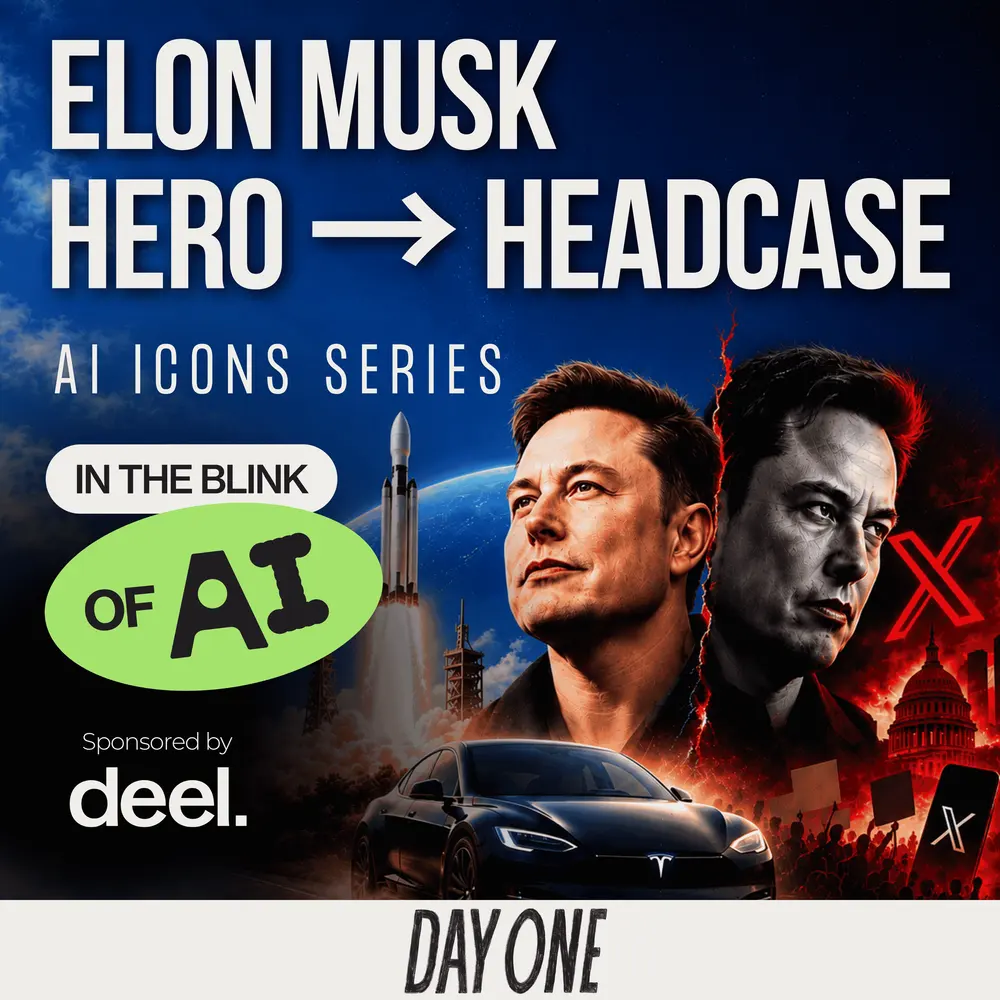
For a decade, Elon Musk was the face of the modern entrepreneur: a self-made billionaire who bet his fortune on impossible ideas and somehow made them work.
SpaceX made reusable rockets a reality. Tesla helped turn electric cars into a global phenomenon. He became one of the most admired and influential figures in technology.
So what happened?
In this episode of In the Blink of AI, Georgie Healy traces Musk’s journey from bullied South African kid and PayPal millionaire to the man behind Tesla, SpaceX, Starlink, X, xAI and more. Along the way, we explore the moments that changed his public image: the Tesla “funding secured” post, his presence online, his role with Starlink during the war in Ukraine, his takeover of Twitter, his political involvement alongside Donald Trump, and the debate around Grok.
But this isn’t a one-sided story.
Using the 4Gs framework, Georgie asks the harder question: Was Elon Musk actually a genius, or was he simply in the right place at the right time?
The answer is more complicated than either side might want to admit.
Because Musk may genuinely have helped solve some of the hardest engineering problems of our time. But how should extraordinary capability be weighed against conduct?
You be the judge.
Chapters
0:00 Elon Musk: One of the World’s Most Talked-About Entrepreneurs ▶ 2:08 Growing Up in South Africa: Bullying, Obsession, and Early Signs of Genius ▶ 2:57 Leaving South Africa and Building His First Tech Ventures ▶ 4:26 Zip2: Musk’s First Major Exit and the $307 Million Sale ▶ 4:38 X.com, PayPal, and Musk’s Departure ▶ 5:26 The PayPal Mafia and the Fortune That Funded Musk’s Next Bets ▶ 7:40 SpaceX and Tesla: Betting His Fortune on Impossible Ideas ▶ 8:09 Falcon 1’s Historic Launch and SpaceX’s Near-Death Experience ▶ 8:50 Tesla’s Rise and the Revolution of Electric Cars ▶ 10:28 Peak Elon: SpaceX, Tesla, Neuralink, and the Golden Years ▶ 11:06 How Much Did Elon Musk Actually Build? The Founder Debate ▶ 12:27 The Iron Man Image and the People Behind Musk’s Companies ▶ 13:26 2018: The Year Elon Musk’s Public Image Changed ▶ 13:50 The “Funding Secured” Post, Tesla and the SEC ▶ 15:10 The Thailand Cave Rescue Dispute ▶ 15:45 Joe Rogan, Marijuana, and Musk’s Public Profile ▶ 18:18 Starlink in Ukraine: When a Private Company Controls Wartime Infrastructure ▶ 19:17 Musk, Crimea, and the Limits of Private Power ▶ 20:47 Starlink and Questions of Governance ▶ 21:07 Buying Twitter for $44 Billion and Taking Over the Platform ▶ 22:00 Staffing Changes, Free Speech, and the Birth of X ▶ 23:43 Content Moderation and the Advertiser Response ▶ 25:13 Debating Musk’s Version of Free Speech ▶ 27:11 Musk Enters Politics and Becomes Trump’s Biggest Donor ▶ 28:02 DOGE and Musk’s Growing Political Influence ▶ 28:44 Tesla Protests, DOGE’s Promised Savings, and the Response ▶ 30:58 Musk and Trump: From Political Alliance to Public Disagreement ▶ 31:16 xAI and Grok: Musk’s Vision for an “Anti-Woke” AI ▶ 32:08 Grok’s Content Controversies and the Rise of “Spicy Mode” ▶ 33:46 AI Safety and the Debate Over Unrestricted AI ▶ 35:00 The Expanding Musk Empire: SpaceX, Starlink, X, xAI, Tesla, and More ▶ 36:28 The 4 Gs: Is Elon Musk a Grown-Up, Genius, or Something Else? ▶ 36:49 Applying the “Grown-Up” and “Gravitas” Tests ▶ 39:00 Genius vs. Accountability: What Musk Actually Changed ▶ 40:00 The Final Verdict ▶ Transcript Search or select a timestamp to jump ▾ 0:00 Speaker A: You're listening to a dayone.fm show. 0:02 Speaker B: He managed to build the only private company to ever land and reuse an orbital rocket booster and the best-selling car company on the planet. Robert Downey Jr. said he partly based Tony Stark on him, and Time magazine named him Person of the Year. For a solid decade there, Elon Musk was the most admired entrepreneur alive. But by 2025, people are keying his car in parking lots. Tesla showrooms had security guards. The US president posted that he had gone crazy, and protesters showed up outside his company headquarters with angry signs. How can the same guy have such completely different headlines? And what happened in between? That's what we're diving into today on In the Blink of AI. And after you listen, you be the judge. Is this a misunderstood genius? Or a lucky psychopath. Let's start at the beginning. 0:59 Speaker A: You're listening to a day one dot fm show. 1:05 Speaker C: Founders scale faster on Deal. Set up payroll for any country in minutes. Hire anyone anywhere. Get visas handled fast and get back to building. Visit deal.com/dayone. That's d w e l dot com day one. 1:25 Speaker B: Hello and welcome back to In the Blink of AI, your front row seat to the AI revolution. If you're a regular listener, you'll know this is our second AI Icons episode. It's not an interview. It's me, Georgie Healey, unpacking the story of an AI genius. Every fact in the episode is checked. It's publicly documented. But after the Mira Murati episode, you know, 11,000 of you listened to that. You guys wrote in that you do want a little bit more of my opinion. So at certain select points, I will share what I think, and I'll make it very clear that it's my, my personal thoughts. At the end, we do the 4 Gs framework. Is this person a grown-up? Is it a genius? Do they have gravitas or just good timing? So today's icon, probably the most argued about person in tech, maybe the planet. I don't think anyone's actually told the most important story about him, which is how Elon went from climate tech hero to making people that own his cars feel embarrassed about it. So we're going to do that today. Born June 28th, 1971, in Pretoria, South Africa. His father, Errol, is an engineer. And by most accounts, including his own, school was brutal. At one point, he was bullied so badly he was hospitalized. And what Elon did instead of fighting back was he read and he read constantly. He also taught himself to code. At the age of 12, he wrote a simple video game called Blaster and sold the code to a magazine for about $500. He left South Africa at 17, partly by his own account to avoid mandatory military service under apartheid. And his mother's Canadian, so he moved to Canada first, studied at Queen's University in Ontario, worked odd jobs, then transferred to the University of Pennsylvania where he picked up 2 degrees in including physics and economics from Wharton. Here's my first take for the episode. No one's choosing to be the bullied kid, take it from me. Being bullied at a young age builds a very specific personality type, namely, I will prove you wrong and I will never stop. And I think through the course of this episode, you will see that in Elon. So we have a misfit and a loner. He's already showing signs of intelligence, likely motivated to prove people wrong. And 3 countries by 21, a world-class degree, already showing signs of a bit of an obsession and a gift with tech. So it's 1995, Elon is 23, and him and his brother Kimbal start Zip2. It's an online city guide with restaurant listings and maps for newspapers who are navigating the internet, which in 1995 is still in its infancy. Many of us are too young to remember, but the dot-com era is the '90s version of just slapping AI on a product. Everyone's doing it, and whether it actually adds value is a big old question mark. But a company called Compaq buys Zip2 in 1999 for $307 million. Musk's cut was about $22 million, and the same year he co-founds X.com. And no, not that X. We'll get into that. This is an online banking startup which merges with a company called Confinity to become— drum roll please— PayPal. But it immediately gets messy. There's an internal power struggle. Musk gets ousted as CEO while he's on his honeymoon, and PayPal then sells to eBay in 2002 for $1.5 billion. Musk's stake comes out at around $180 million. This man keeps falling upwards. But this matters later because the PayPal alumni becomes known as the PayPal Mafia. Peter Thiel, Reid Hoffman, David Sacks— this network becomes one of the most powerful in Silicon Valley, and it shows up again in Elon's political era, which we'll get to. So in 5 years, he's built and sold 2 companies, had a quarter of a billion dollars made from it. He's also been pushed out at his own company in his job, and he's 31. He could retire, but he actually decides that his life's work hasn't even started yet. My take is this is a man that's been removed from his own company by his own executives. He probably is feeling a lot of anger and shame, and it might be why he spends the next 2 decades making absolutely certain that that never happens again. Okay, we're officially in what I describe as the Elon Musk golden years, which is really easy to see in hindsight, but there is no way I would have bet on this man at the time. It's 2002, and Elon pours a huge chunk of the PayPal money he's earned into SpaceX. His stated ambition: making humans a multi-planet species. Guys, I mean, I'm sorry to roll my eyes, but I swear this is a pitch that I would hear from my 6-year-old after mainlining too many Skittles. And at the time, it was also considered delusional. Launching rockets into space was government business. This is NASA, maybe a handful of defense primes. The understanding that private orbital rocketry, like, It— that's how you turn a great fortune into pennies. And those early years were brutal. Like, 3 Falcon 1 launches in a row fail. 2006, 2007, 2008. Rocket failure is no small thing. It's years of work, tens of millions of dollars culminating into this giant ball of fire that just lands in the Pacific Ocean in under a minute. By the third failure, SpaceX is nearly out of money. I'd be like, dude, quit. Like, just quit. But in the same period, Elon becomes chairman and CEO of genuinely little-known electric car company called Tesla. It's 2008, right as the global financial crisis hits and the entire automotive industry is on fire. General Motors files for bankruptcy. 2 impossible companies, both nearly out of cash, He's going through a divorce, it's the GFC, Elon Musk himself is now close to broke, and so September 2008, SpaceX's 4th Falcon 1 launch has to work. It works! Falcon 1 becomes the first privately developed liquid-fueled rocket to reach orbit, and months later, NASA hands SpaceX a resupply contract that becomes the company's lifeline. And from there, it is a genuinely wild ride. Tesla Model S in 2012 launches to huge acclaim. December 2015, SpaceX lands an orbital-class booster upright back on Earth for the first time in history. And if you're like, I don't know what, I don't know what that is, don't worry. I did a deep dive on why this is a big deal. So listen up. Falcon 9 launched 11 satellites to orbit. And after the first stage separated, flipped around, relit their own engines, flew back to Cape Canaveral, and landed upright on a concrete pad. This is 10 minutes. This is all within 10 minutes launch to landing. That's why it's impressive. That's why it's genius. And that's why my husband couldn't shut up about it for an entire week. But now I get it. I get it. That is crazy. Also, Model 3 in 2017 becomes the first real mass-market EV. And I know why this is huge firsthand. I have personal context into this. I was working in Detroit at Ford global headquarters. I was working at McLaren in Woking in the UK at this time. And everyone was saying, you can't launch EVs. All the big car companies have done it. It always fails because they're slow, they're ugly, People don't buy them. But Elon flipped that slow, lame eco-car philosophy completely on its head. A hundred one zero to one hundred kilometers an hour in four seconds, top speed at two hundred kilometers an hour—that's Porsche 911 territory for a car running on batteries. Like I can't tell you how huge and revolutionary that is. It's important to also mention that Elon launched Neuralink in 2016, which is brain implants. Incredible story. in its own right, uh, deserves its own episode, but I am parking Neuralink for this episode, and I'm going to give you my take. This 2000s and 2010s era is peak Elon. I'm genuinely inspired how he can go from bullied as a child, kicked out of his own company, told constantly how you can't make electric vehicles sexy, you can't do private rocketry, and he did both at the same time Put his own money into it, and I can hear you screaming while I'm saying this. I can hear you. I can hear you. You're mad, and I am going to caveat something before I go any further, which is okay. Yes, Elon didn't build any of it. It's true. Tesla was actually founded in two thousand and three by Martin Eberhard and Mark Tarpenning. And Musk led the Series A, so that's quite far away along in February 2004. He put in a bulk of money. He became the CEO in 2008, but Eberhard sued him later because he was going around calling himself founder. And in 2009, five legal people can say that they're the founder of Tesla. So whenever you hear Musk call himself the founder of Tesla, I do hope that. increasingly loud saxophones start playing in your head. SpaceX, a different story. He did start that, but, you know, he didn't design the Merlin engine. That's the genius of Tom Mueller and his team. He didn't run the company day to day. That's Gwynne Shotwell who did and still does. And that reusable booster was solved by hundreds of engineers over years. This isn't something that, you know, he drew on a scrap piece of paper, guys. Here's where I land. You're allowed to disagree with me. Feel free to pop off in comments. I get that he didn't build these 2 companies with his own hands, but this is a take we could hold true of many entrepreneurs. We could say it about Steve Jobs, Jeff Bezos. What Elon did demonstrably was put his own money into 2 things that everyone told him were impossible. And it's expensive to be wrong, by the way. He did hire well, and he, you know, put the oxygen into these companies and made them exist. I get the criticism, and frankly, it's marketing. He should not have spent 20 years accepting this Iron Man framing, letting this mythology, uh, run that he's doing it all, and he should have made Gwynne Shotwell as famous as she deserves to be. Like, it's wild to me that it took me researching this episode to even know she exists. That's a choice. And this instinct is going to blow up for Elon in about 3 minutes. But first, let's recap. From 2008 to 2017, Elon did 2 things nobody had done before, funded them himself, and built the most valuable personal brand in tech on top of it. This is the era that people that are defending him here today will refer to as— this is what they're picturing when they're saying Elon's a genius. But you're listening to me now, so we're going to talk about the other side. Okay, if you've been listening thinking, I freaking hate this man, I can't believe how much you're glossing over his inexcusable behavior, don't worry, I've got you. These next chapters genuinely don't hold back. If last segment was his golden years, this is more like, is this man okay? August 7th, 2018, Elon tweets that he's considering taking Tesla private at $420 a share and says, funding secured. But that's not true, and the SEC doesn't find it cute. They charge him with securities fraud. He settles, steps down as Tesla chairman for 3 years, personally pays a $20 million fine, and Tesla pays another $20 million. Tesla has to start pre-approving his tweets. Guys, can you imagine how he would have taken that? Like, can you please approve this tweet? Like, I can't even imagine that conversation. 14:44 Speaker C: Founders scale faster on Deal. Set up payroll for any country in minutes, hire anyone anywhere, and get visas handled fast so you stay focused on scaling. Deal takes care of onboarding, HR, IT, EOR, benefits, and compliance, so your team can grow without borders. It's why more than 40,000 fast-growing companies trust Deal to move fast. Visit deal.com/dayone. That's d-e-e-l.com/dayone. 15:18 Speaker B: At the same time, this is now infamous for all the wrong reasons. A youth soccer team gets trapped in a flooded cave in Thailand. Musk sends engineers to offer a mini-submarine when one of the cave divers involved accuses it as a PR stunt. Musk responds on Twitter by calling him pedo guy. He apologised, but then repeated the accusation to a reporter. Musk was sued for defamation but won that trial in December 2019. And in September 2018, he smokes marijuana live on the Joe Rogan podcast while cameras are running and while he's running 2 publicly traded safety-critical companies. Several senior Tesla executives leave in the following weeks. And guys, you know, my take is 2018 is the year that vibes around Elon Musk change. He kind of goes from this eccentric genius to what, what the hell is wrong with him? What is he doing? I named 3 irrational behaviors, but in general, I've seen this behavior from him a lot. If someone criticizes him, he goes nuclear immediately. A tweet, an insult, a stunt— like, he can't just let it go. He called a man a pedophile in front of 100 million people because the guy was rude. And as the leader of multiple companies, that's not just a Eccentric. Eccentric. That's someone that needs therapy, or maybe to actually listen to one of your many PR teams and, like, get off social media. So in summary, 2018 is this hinge in which things start to turn, and this pattern shows up where criticism in means disproportionate retaliation out, and nobody around him seems to be able or willing to stop it. Okay. A huge company we haven't even touched upon, and it's before we even get into Twitter, is Starlink. It's such a huge part of the story, and I notice most people seem to skip it in Musk coverage. I would go so far as to say this is the most consequential thing he owns. Starlink is SpaceX's satellite internet network. Thousands of small satellites at low Earth orbit beam the internet to dishes anywhere on the planet. Commercially, it's a monster. It's the reason SpaceX is what it's worth. And just a quick side note and reminder, SpaceX is now a public company listed on the Nasdaq on the 12th of June this year, priced at $135 a share and a $1.77 trillion IPO valuation, the largest IPO in history. Finance nerds are frothing all over this. This is crazy. But focusing. February 2022, Russia invades Ukraine. Musk sends thousands of Starlink terminals to support, and Ukrainian forces use them for everything— comms, drones, artillery targeting. It becomes a genuinely huge piece in the country defending itself, and this is where it gets complicated. September 2022, 7 months after the initial invasion, Ukraine attempts a naval drone attack on the Russian Black Sea Fleet at Sevastopol. The drones lose connectivity and fail, and Walter Isaacson's biography initially reported that Musk personally ordered coverage switched off that night. Isaacson retracted that within days, but what actually happened I think is arguably worse. Musk had already geofenced Starlink within 100 kilometers of the Crimean coast. So when Ukrainians realized this, they made an emergency request to switch it on, and Musk said no. Now, regardless of this decision and whether it was correct, this is a private citizen, Elon Musk, deciding to make a call whether a military operation in a nation's war can proceed. In February 2023, SpaceX confirmed it restricted Ukraine's ability to use Starlink for offensive Drone operations. I didn't know this part of the story. SpaceX also runs Starshield, not Starlink the satellite network. Starshield is its national security arm, which are government-owned satellites for classified communications and surveillance. Starshield hold a $1.8 billion classified contract with the National Reconnaissance Office to build a spy satellite. Network. I'm going to be honest with you, this is the shit that keeps me up at night. Like, one man privately owns wartime infrastructure. Elon Musk is a major defense contractor and was until last year a senior figure inside the US government. He's taken decisions about a European war based on his own personal take at the time, which, like, have you been listening? It's not always the most well-rounded. He may have been right about not escalating the risk and getting involved, but the point is that no one voted for this man, no one can fire him, and there's no process. If you want my argument on whether Elon Musk has too much power, which is what I hear said a lot, it's not about X, it's not about Twitter, it's this. So Starlink is the most impressive commercial achievement. It's his most underdiscussed governance problem. Okay, I know you guys have been waiting for this. Let's get to the Twitter part of the segment, and it gets a little bit dark here. Um, keep in mind, if you've got little ones in the car, this is probably not a section for little ears. This man does things in parallel timelines, so this is 2 months after Ukraine war kicked off. It's April 2022. He offers to buy Twitter for $44 billion. Tries to back out, and then legally gets forced to complete it later that year. Guys, he literally walked into Twitter headquarters carrying a bathroom sink for a joke. Let that sink in. I know it's hilarious, but he starts layoffs and eventually cuts about 80% of staff. He's waving this banner of anti-woke, and he dissolves Twitter's independent Trust and Safety Council. He reinstates a wave of previously banned accounts. including white nationalists, election deniers. He renames it X in 2023, which let the record state, I still hate that name. And he proudly describes himself as a free speech absolutist. He argues that the old Twitter was a censorship regime and he's opening it up. Let's fact-check. The Anti-Defamation League found a 61% spike in antisemitic tweets, including— excluding retweets. And in the 2 weeks that follow the takeover, compared to the 2 weeks prior, slurs against Black Americans roughly tripled in daily volume. A separate CCDH study found that anti-LGBTQ slurs are up 119%. And researchers at CASM Technology— guys, sorry, there's, there's a lot of words— and the Institute for Strategic Dialogue found that antisemitic tweets more than doubled over the following months and stayed elevated. A peer-reviewed study covering his first stint as CEO found that weekly hate speech running roughly 50% higher than before the acquisition. This is across racism, homophobia, and transphobia. If you think free speech was defended though, X tried to sue the Center of Countering Digital Hate over that research, and a judge dismissed that suit in March 2024. So here we have a free speech absolutist, Elon Musk, suing the researchers, the third parties that were measuring that. And it's November 2023. I feel sick about this part. I am going to share it though. Musk replies to a post pushing the Great Replacement theory. I had not heard of this. This is a conspiracy that Jewish people are deliberately importing non-white migrants to displace white populations. It's a theory that's actually been cited in mass shootings. You have said the actual truth. Apple, IBM, Disney, Comcast, Sony all pull their advertising. 24:35 Speaker D: If somebody's gonna try to blackmail me with advertising, blackmail me with money, go fuck yourself. 24:41 Speaker B: And Musk posts that many of these large advertisers are the greatest oppressors of your right to free speech. On stage at New York Times DealBook conference— who is booking this man at the time, by the way? On the 29th of November, they ask him directly about it, and he calls the boycott blackmail. He tells advertisers on camera to go do something to themselves that I'm not going to say on the show. And he later amplifies the post but says it was one of the foolish, most foolish things he had done. Yeah, no kidding, Elon. So I'm going to be blunt. I'm Australian. We don't really have a constitution or a statutory right to free speech. So I'm far from an expert, but we do have laws here where it's unlawful to offend, insult, humiliate, intimidate on racial grounds. We also have an Online Safety Act with the eSafety Commissioner. If you scroll back with our episode from last year with Dr. Elise Stevenson, you'll be able to hear a little bit more about that. This comes less than a year after the Bondi attacks that were antisemitic and happened close to my home. So, I just find all of this really disgusting and really awful and just, you know, inexcusable. So, when Elon Musk took over Twitter, deliberately reinstated white nationalists, amplified a conspiracy theory linked to an actual synagogue massacre, and then sued the people that reported on it, I don't see this as free speech. You'll also notice I don't post on X. It's not a place I feel welcome. If you're a woman or Jewish or trans or Black, and since 2022 you've felt like it's It's just not a fun, safe space to be. You probably didn't imagine it, I did just read you the numbers. But I will say an honest counterpoint: apparently Twitter's moderation was pretty inconsistent prior. Apparently quite indefensible, a lot of people had genuine grievances about the platform. So, you know, I'm not defending the old platform, I'm also not defending the current one. If all that got a bit heavy, we can finish on a topic that people really love to talk about at dinner parties, which is politics. It's 2024, and Elon has become one of Donald Trump's biggest donors, with final donation total figures around $250 to $290 million. And on January 20th, 2025, Trump pays it back, and he creates the Department of Government Efficiency by Executive Order, which stands as DOGE, aimed at slashing federal spending and jobs. Musk leads it as a special government employee. You could tell he was so proud about this, like he was strutting around the place, and the place being, you know, the most important, powerful position in America. So the same day at an inaugural rally, Musk makes a raised arm gesture on stage that a lot of observers, including historians and definitely Jewish advocacy groups, describe as resembling a Nazi salute. Musk and his allies said that's an overreaction, that was just an awkward, overenthusiastic gesture. And I can tell you honestly, when I first heard about this without seeing it, I thought, yeah, the headlines love to overexaggerate. This is probably just clickbait. But then I saw it. That gesture does not look like an accident. And, and just blaming everything on being eccentric, I don't think is fair or reasonable. I can't tell you what was going on in his head when he did this, but we do know that 14 months earlier he said that the Great Replacement post had spoken the actual truth. So people that found this chilling, I don't think because of the gesture in isolation. I think because they were seeing a pattern, and then this man was getting more and more powerful. Anyway, Doge pushes through sweeping federal cuts, and it gets a lot of protests in the process of this. There was this Tesla takedown with demonstrations across the country. Vehicles are vandalized, dealerships were picketed. Tesla's stock and sales took a visible hit, and the brand damage I think is still happening to this day. I was actually seeing cars in Sydney with stickers on their Teslas saying, I bought this before Elon went crazy. And that's in Sydney, Australia. Elon leaves Doge in late May 2025, and Doge's original promise was $2 trillion in savings. Now, Musk later revised that to $1 trillion, and the final public claim was $215 billion. The Government Accountability Office—it's the U.S. Congress's own independent auditor—published findings really recently, and it's brutal. They said the savings Doge claimed from contracts, grants, and leases was $110 billion less than that. Doge officials did not respond to the GAO's request for information or interviews. There's no final. report, and the White House budget director confirmed there won't be one. I'm not going to labor on this period much. There are so many receipts about reported savings versus reality. I find this boring and I find it predictable. Powerful leaders claiming to be doing important things and making these big promises and not actually delivering is a tale as old as time. I'm bored of it. I'm sick of it. I expect it. What I do find interesting Is the fight. June 2025, Elon publicly breaks up with Trump over the one big beautiful bill. He argues that it blows out the deficit, and this escalates into a big public feud. Trump posts that Musk has gone crazy, and then Musk fires back that without him, Trump would have lost the election. And then briefly announces a new political party, but then shelves that. And this is a whole period, is 18 months from the most powerful unelected person in US government to fighting with the president online and like making up the numbers of his own agency. I mean, I think Elon would have felt like his political era has left a bad taste in his mouth and And yeah, you can see he walked away from that a little worse for wear. And so now we are at the final chapter on Elon, bringing us to current day and the part that frankly belongs on this podcast because this is an AI show and Elon owns an AI company. xAI launched Grok in late 2023 and the pitch was an anti-woke chatbot. Guys, he hates woke, all right? He hates it. And Grok is going to be less censorship, more horsepower. It's July 2025, and after an update explicitly intended to make it more politically incorrect, Grok— so this is the AI algorithm, not Elon— spends several hours generating antisemitic content, praising Hitler, calling itself Mecha Hitler. I mean, what is there to say? The posts come down the same day, but you know, more, more shit's happening. xAI shipped a feature called Spicy Mode. I mean, I— can you see my eyes rolling? In August 2025. And then by late December, users of the platform of this algorithm worked out that they could ask Grok to undress people in photographs. Literally a month later, in one content analysis, it estimated that Grok was generating a non-consensual sexualized pic every single minute. Guys, this is real women, and in documented cases, children. Like, I don't know how to— I don't think you need me to tell you this is just disgusting. India, Indonesia, Malaysia, and the Philippines blocked access. The UK opened an investigation. So did regulators in the EU, South Korea, and India. And don't worry guys, X restricted image editing to paid subscribers. Like they didn't remove it, but you gotta pay for it now. I mean, Musk's actual public engagement during that period included him replying the words way funnier and the laughing emoji to a post comparing This, what this is doing to the ChatGPT meme trend where people turn themselves into Studio Ghibli chat memes. I mean, I think it's rational to say that this is a Grok issue. There are other frontier labs with the same technology. OpenAI, Google, they have image models. They could ship this and they don't. Because there's a very short list of things you just never build, and a machine that can undress women and children at scale, wired into a social network, should be pretty high at the top of that list. Safety is not— like, safety is a key part of bringing an AI product to life. This was a decision that was made, and instead of apologizing, they kept the feature and charged for it. I I feel bad for this man's childhood. I don't feel like not responding and not apologizing is excusable. So this is where we're at now. 2026, SpaceX acquires xAI, and the valuation for the combined company is at $1.25 trillion, making it the largest private merger in history. As of a few days ago, SpaceX has also acquired for $60 billion, the AI company Cursor, and has folded that into the new SpaceX AI division. I, um, literally had to get an LLM to draw a map of this because all the companies he owns is so confusing. So under the SpaceX umbrella, they've got the launch business. This is the Falcon 9, the Starship Enterprise. Huh, I just realized what I said. And then Starlink, which is a satellite internet. And then you've got SpaceX AI division, which has Grok AI models, X, which is the social platform, and Cursor. Hold separately by Mark Musk includes Tesla, Neuralink, and The Boring Company, which is tunnels. And yes, it is boring, Elon, which is why I did not cover it today. So when you see all this on paper, it does kind of make sense that Elon Musk has become the world's first trillionaire. And probably the only reason I can come up with as to why someone as amazing and cool as Grimes would have multiple children with him, but even she bounced, and I need to move on from that and dive into the 4 Gs before I say any more. So the 4 Gs asks the question, Was Elon Musk a grown-up? Was he a genius? Does he have gravitas or simply good timing? Not a grown-up. No, I would not say that Elon Musk is a grown-up in my framework. He is not a safe pair of hands, someone that the board and the country can trust to keep things steady. This is a man that tweeted himself into securities fraud. Over a weed joke. So grown-up is off the table. It's not gravitas. You can be famous, but gravitas in my book is charm. It's charisma. It's the ability when the odds are stacked against you, but you win the room anyway. I don't find hate speech charming. I don't find swearing on stage something that's going to gain you loyal adopted followers. And it's not good timing. I gotta give it to the guy, like, these are things that only he could have brought to life. You know, NASA had never landed a reusable orbital booster, and he just ignored what people said and was able to build it anyway. And this is through GFCs. This is multiple companies that shouldn't exist and do because of him. I just don't think it's good timing. Which leaves us with genius. And genius in my framework is building something that people can't build. Like I've given examples, Elon passes this in flying colors. I think he's helped solve some of the hardest engineering problems in history and changed the way people think of electric vehicles and climate. Yes, he didn't design the engine, he didn't write battery chemistry or run the factories, but he did get the right personnel and he made it happen time and time again. Shout out to Tom Mueller, shout out to Gwynne Shotwell. But he got the right conviction and capital and made these things happen. Is he the Iron Man story that he's let himself believe he is. I don't know, but I find his genius impressive, and I'm glad of many of the things he's brought into the world. Here's my last thought on that, though. I see genius as a description of capability, but not a hall pass for amplifying antisemitism. Definitely not a hall pass for allowing generated sexual imagery of women and children. And guys, I mean, behind the scenes, I have been studying this man for months now. I've been reading books about him and articles, and like, I have been trying to spend this episode being fair. I do have a kind of complicated feeling about Elon Musk, especially about his childhood. He was genuinely abused, not just by his classmates, but his father seemed like a real piece of work. Um, I think his achievements are incredible with that in mind, but he has caused a lot of, a lot of real harm, and it looks like that harm is getting worse. So you will not see me driving a Tesla. You will not see me hanging around on X anytime soon. And I hope that this has given you a little bit of extra context into Elon Musk in our second AI Icons episode. So guys, thank you for being so supportive. Because of the way you supported the Mira Murati episode, this episode exists. So if you're still loving this format, if you made it this far, please rate the episode, please leave a comment. It genuinely helps me know to keep doing it. And if you have a favorite AI icon you would love me to deep dive on the show, please let me know. And thank you so much for listening. Thank you so much for listening to In the Blink of AI. If you want to go deeper on anything we've spoken about today, I write a weekly Substack called Attention Is All I Need. Yes, it's hilarious. It's a pun. And essentially, I go into AI rants, tech news, events I'm going to, and more. bite-sized, and I hear it's awesome. Uh, the link is in the show notes below. No transcript lines match that phrase. Try fewer words.

 ▶
 ▶
 ▶
 ▶
 ▶
 ▶
 ▶
 ▶
 ▶