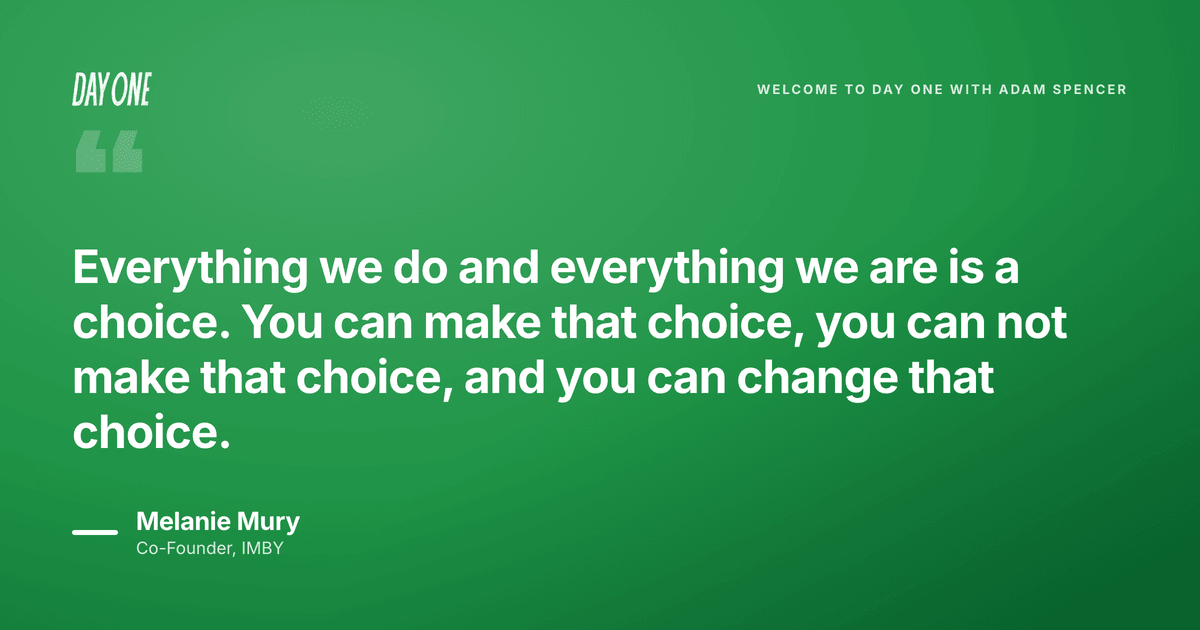
Transcript Synced · select any line to jump ▾ 0:00 Adam Spencer: You're listening to a DayOne.fm show. 0:06 Melanie Mury: What drives you to make bold moves, to build something that didn't exist before, to live, lead, and choose life with intention? Welcome to Perspective X. I'm Pauline Fatowi, and this is not your typical business podcast. Each episode, I get to speak to extraordinary entrepreneurs and leading innovators to unpack what truly fuels their journey. Not just the wins, but the inner work, the overlooked decisions, the mindset shifts, and the personal moments that sparked something bigger. This show is about the ripple effect of choice, the kind of deep accountability that lets us respond to life rather than react to it. Because when you realize everything is temporary, and you are the creator of your own experience, you start to play the game differently. So if you're curious about how people build meaning alongside success, how they evolve through challenges and shape the world with intention, this is your invitation to listen in. Perspective X, where we go beyond the highlight reel and into the moments that changed everything. Available now wherever you get your podcasts. 1:20 Speaker C: This is gonna sound so bonkers. I generally rise at 3:22 AM in the morning. 1:28 Adam Spencer: That specific? 1:29 Speaker C: Yes, because 3:20 is too unreasonable, so I set my alarm at 3:22. It makes it so much better. 1:37 Adam Spencer: Hi, and welcome to Day One, the show for regional startups and the organizations that support them. I'm Adam Spencer, and today I'll be sharing with you the story of Melanie Murie, co-founder of Imbi. 1:50 Speaker C: Hi, my name's Mel, and I am the founder and CEO of Imbi. Imbi sits in the prop tech space. It stands for In My Backyard, and our core purpose is to make the future of the built environment radically transparent. 2:03 Adam Spencer: Imbi was founded to solve a problem born of bureaucracy. When anyone in Australia wants to build anything more substantial than a dog kennel, they need council approval. But with 560 different local councils, each operating with their own systems, anyone wanting to understand future development at a point where council boundaries intersect may be met with a tangled mess of bureaucratic and technical challenges to overcome. To understand how Melanie came to co-found Imbi to tackle these challenges, first we need to go back to day one, where an 18-year-old Melanie would have her life forever changed by a year abroad. 2:48 Speaker C: I came to architecture after a bout of travel. I was really fortunate to participate in a student exchange for 12 months after high school, and I was based in Germany for that. And I was exposed to lots of lovely opportunities around Europe during that time. Yeah, it was incredibly exciting for me as a young 18-year-old to have this sort of level of independence. It was a real privilege. It was an eye-opener for me. I was a girl who hadn't travelled widely and I was exposed to lots of lovely opportunities around Europe during that time. And I was, I guess, a little bit flummoxed and intrigued by how humans mould their environment and create architecture for public and domestic use. 3:33 Speaker D: Yeah. 3:34 Speaker C: So during that 12 months, I sort of radically changed my direction of career and applied to study architecture. At Newcastle University, in fact, and that's where I met Chris. And we've enjoyed a great professional and personal relationship for over half of our lifetimes now. 3:56 Adam Spencer: After meeting while both studying architecture at Newcastle Uni, Melanie and Chris's relationship blossomed, both romantically and professionally. Over the course of a couple of decades, the pair would go on to get married, have 3 kids, and work as architects around the world. The pair worked primarily in commercial and large-scale construction. It was a decidedly more domestic project, however, that set them on the path towards founding Imbi. About 6 years ago, they undertook a renovation of their own private home. It was during this process that a specific problem really started to niggle at them. 4:32 Speaker C: The property sector, the property and construction sector, is one of Australia's largest and most valuable sectors. And it largely, if I was being completely frank, it largely operates off a 20th century model. So it's ripe for improvement, disruption, and clarity. It's quite opaque as it stands. At the moment in Australia, there's over half a million changes to the built environment applied for and approved every single year. And the lion's share of that process happens at a local government level. So typically, if you want to build a hospital or cut down a tree, you apply for that change to happen, and it gets interrogated, and it gets assessed against a lot of statutory documents, and it either gets a green light, an orange light, or a red light. Ah, at the moment, because it happens at a local government level, it's quite difficult to find this information, Because there's over 560 different councils in Australia. They all operate different systems and they all have different language sets. For instance, I'm gonna use a really lo-fi example here. If I'm on one side of a street and there's a council boundary that runs down the middle of that street and there's another boundary that happens at the end of my street, I have to look at 3 different silos to gather that information. And we thought, well, heck, everybody in this sort of $10 trillion sector, everybody's really struggling. It's pub— sorry, I should prefix all of this. It's public information. 6:13 Speaker D: It's just not curated. 6:14 Speaker C: It's not curated, it's not cleaned up. It's— I'll give you an example of that. Last month in New South Wales alone, there was, I think, 48 different ways to say something was approved. 6:29 Speaker D: Wow. 6:30 Speaker C: And it really was through, it was a collision of things, to be honest. We had this sort of professional knowledge and professional exposure. We also had a situation where we were renovating our own home. You know, everyone invests their hard-earned savings into this like mammoth mortgage. And we were traveling down a path of doing a renovation and we're like, how can you be investing this, you know, chunk of change into something when you have no idea what's going on around you. How do you not know that you've got your views about to be blocked? How do you not know that, you know, and we spent time researching and this is madness. Like, surely we can solve this problem. 7:14 Speaker D: Right, so which one contributed to you guys? Equal. 7:20 Adam Spencer: Equal? 7:21 Speaker C: Equal. No, I know that sounds like we're towing a line there. But it was, I think without the sort of professional knowledge that we had trying to tackle the problem, it wouldn't have been possible. 7:34 Adam Spencer: While working in the same industry, Melanie and Chris have each worked in different roles. And as such, over decades they have built up contrasting skills and experience which complement each other. 7:46 Speaker C: Chris and I have really disparate careers in architecture. I've practiced largely in a sort of business development, administrative communications role. So at director level, again, around the world. Chris has always wanted to be an architect from a child. And he is very skilled at putting big complex buildings together. He loves it and he's good at it. 8:14 Speaker D: Did he play Lego when he was a kid? 8:15 Speaker C: Oh, I think so. But he, at the same time as he played Lego, He was also building his own computers because his father had an interest in this and his neighbor happened to be a fellow called David Strong who brought Apple computing to Australia. 8:29 Melanie Mury: Wow. 8:30 Speaker C: So they had, I think, the Apple Lisa on their kitchen table in 1986 or '87, you know. 8:36 Adam Spencer: That's really cool. This combination of Melanie's experience in business development and Chris's tech savvy meant that when they faced this problem of tangled bureaucracy during their home renovation, it crossed their mind that they might might just be the right people to untangle the mess. 8:58 Speaker C: I knew that we had the skills to give it a crack. We didn't dream that it would turn into a business. It was a folly, if you like, to start with. 9:08 Speaker D: Can you remember the moment or the time where you and Chris kind of had that conversation around, "This is really annoying, this problem." Yes, I can remember it exactly. Can you take me there? 9:21 Speaker C: Okay, so I don't need to scare your listeners, but we're in our pajamas. It was late at night, the kids were in bed, and Chris, it was Chris, he said, I've been scratching around, and he said, I've started to code up a bit of a framework to see if I can solve pulling all this information together, 'cause we'd had conversations around frustrations, just niggling, "We've got a hectic family life." And I said, "Sure, is this something you really want to solve?" And he said, "Well, I don't see why we shouldn't." Had you ever, up until that point, ever considered the idea of going into business or starting a startup? 10:06 Speaker D: Did you even know what a startup was at that point? 10:08 Speaker C: No, no, no, I didn't. Because a startup is, oh God, I'm gonna betray my age here. A startup's just a business, right? 10:17 Melanie Mury: Yeah. 10:17 Speaker C: And we had run our own practice previously. We'd written software for our own practice before to solve a problem within the business. Nothing put me off. It wasn't scary and it wasn't a thing. It was just an idea that we were investigating, interrogating. We're hopeless at doing nothing. So, um, it was Oh yeah, this is something that could be solved. Let's take on the challenge. Let's do it. Not imagining that it would grow into a business. 10:51 Adam Spencer: So Melanie and Chris began dabbling in their free time, as limited as it was with demanding careers and 3 kids, and began to sketch out what a solution to this problem might look like. This is where Chris's background in computing and software came in very handy. 11:08 Speaker C: So he taught himself various languages to write software and came up with, I guess, the software itself. 2015, we moved to Thailand for work. 11:19 Speaker D: Yep. 11:19 Speaker C: To Bangkok. We continued to play around with developing the software in the evenings, on the weekends. God, we're dull. [LAUGHTER] In Thailand, we had our first crack at the front end in, say, 2016, we met some developers, invested our hard-earned dollars into creating a front end to play around to see if it had any legs. 11:48 Melanie Mury: Yeah. 11:49 Speaker C: Determined that it did have some legs, came back to Australia end of 2016, made a commitment at that point that we were going to give this idea some oxygen and see where it took us. 12:01 Adam Spencer: So Melanie and Chris are feeling confident they can build a solution to this problem. And ready to commit to Imbi in a big way. But there are still significant hurdles to be overcome. Building the software would be one thing, scaling up the software into a profitable business was a different kind of challenge. 12:19 Speaker C: We had created the software but we had skill sets that were distant from the type of skill sets required to get a tech company off the ground. 12:29 Adam Spencer: Right. On top of this, their hectic lives meant that they already had their plates full and didn't exactly have a lot of free time. 12:36 Speaker C: We've constructed a lifestyle whereby one of us is on the ground, uh, working in MBIE, moving that business along. The other is working in a different city throughout the week. So we've got a divided family where one of us is away from Monday to Friday. So we're sort of committed to MBIE to the point where we're prepared to do that. 12:59 Melanie Mury: Yeah. 12:59 Speaker C: The one that's on the ground manages 3 children, one's profoundly disabled, and we've got twins who are neurotypical but super active. Chris and I are really cognizant of time. We're incredibly time poor in our lives, balancing work life, family life, disabled children, all of those sorts of things, you know, all comes into the mix. Yeah. 13:29 Adam Spencer: Then in 2019, an opportunity arose that proved too good to pass up. BlueChilli, a startup accelerator, were partnering with the property development company Stockland to launch a new program, the Stockland Accelerator. 13:43 Speaker C: We got word of the Stockland BlueChilli opportunity and saw the offering as a good one for us. BlueChilli were a really skilled startup factory. For want of a better word. 13:58 Melanie Mury: Yeah. 13:58 Speaker C: They had the staff and experience and resources. Stockland were in our target sector, client sector, customer sector. They are a prestigious Australian brand who were looking to innovate. Those stars aligned, and with that sort of combination of, I guess, pedigrees, that's where we sort of said, let's, invest ourselves in this and spend our time, you know, because it was an intensive program. Let's do this. The process to apply to the BlueChilli, uh, Stockland Accelerator was multi-stage. 400 applications, they shortlisted down to I think 25, there was a boot camp, and the final 10 came out of the boot camp. 14:44 Melanie Mury: Yeah. 14:45 Speaker C: And, um, it was during that boot camp that sort of it altered our perception of what a business model could be, and it proved to us that it was a really relevant thing for us to do because we had no exposure or experience in that space. 15:01 Speaker D: What was your vision for the business before BlueChilli? 15:07 Adam Spencer: What were you— 15:08 Speaker C: We had always thought that our starting point would be a B2C business model. 15:12 Melanie Mury: Right. 15:13 Speaker C: And during that bootcamp and through the sort of, I guess, the persona investigations and the, and the number of interviews that we did during that process, it sort of stacked up to, the better starting point was definitely a B2B model. 15:29 Speaker D: Right, so before going to BlueChilli, you were thinking you guys would develop this product as a website that consumers could log onto. Yep, yep. They're going to apply for renovation, any kind of DA application. 15:44 Speaker C: You know, a really sort of generous, information portal for consumers. But we realized very quickly that that was probably not the best commercial starting point, that there was probably a better commercial starting point, and that was in a B2B model. 16:00 Speaker D: Yeah. And so switching from that idea of what it could be, where people would log on, they would pay maybe a set fee— 16:09 Speaker C: Yeah, a report, download a report. We moved it to a subscription model. 16:15 Speaker D: For who? Who had your customers become now? 16:17 Speaker C: Okay, so our customers became essentially the builders and developers of the world. 16:25 Adam Spencer: The Stockland Accelerator lasted for 7 months with intensive weekly commitments and monthly meetups around the country. By August, with the help from the support they received, Melanie and Chris were ready to bring Imbi to market. 16:42 Speaker D: Actually, tell me about the first customer you got, how you got the first customer and how that made you feel about what you guys were doing. 16:50 Speaker C: Oh, it was very exciting. The first time someone put a credit card down and said, "We wanna pay for this," was thrilling. We'd had a meeting with a, and I will say, this was a really prestigious outfit. We did a cold call. An email that went to one of the directors of this company who within an afternoon had said, "Let's meet and I'd like the CEO to meet." And this was a business of, I think they've got about 800 or 900 employees. 17:21 Speaker D: Wow. 17:21 Speaker C: And we went and had this lovely meeting in a couple of weeks' time when everyone's diaries aligned. And they were so terrifically enthusiastic about Imbi and about the potential of that data for their business. And in that meeting, the CEO opened his wallet and put his credit card down and said, "Sign us up now." Wow. So it was a really thrilling scenario. 17:49 Adam Spencer: Once Imbi was ready for market, Melanie and Chris's decades of experience working in the property and construction sector proved invaluable. They knew who their ideal clients were and pursued them selectively and strategically. 18:03 Speaker C: We professionally receive these sorts of cold calls often, and we know what a pain in the butt they can be. So I'm sorry, I'm being very, very honest here. This is great. So we've not done that blanket thing. We've not done that fire off a billion emails emails, we've not done the scattergun thing, we've been really targeted in who and how we approach potential clients. We're in for the slow burn, we're not, we haven't got the capacity or resources to grow quickly, so what our strategy has been is we're wanting to develop our product to best fit our targeted clients. So we'd rather have fewer clients, get the product right, build the resources around it, then try and go hard and fail. 18:59 Melanie Mury: Yeah. 19:00 Speaker C: So, because it hasn't stacked up. 19:02 Speaker D: The fact that you only send out a few emails to very targeted people, that just speaks to your product market fit, and the product you've created is something that is desperately wanted by these people. 19:14 Speaker C: We haven't approached someone where a meeting hasn't resulted. 19:19 Adam Spencer: That's making, that's awesome. 19:22 Speaker D: And it's making me very jealous because I'm a business as well and I'm reaching out to people too and I'm at about a 20% hit rate. 19:31 Speaker C: No, we've— 19:32 Adam Spencer: That's incredible. 19:32 Speaker C: There's not been a single approach that hasn't been responded to. And I think it speaks to our conservatism, which is, I think both has its pros and cons. 19:41 Speaker D: Yeah. 19:42 Speaker C: Throughout the accelerator, you know, we were in some ways reprimanded for our conservatism. But our conservatism has grown out of our experience in this sector. We know these are our people. We know what's gonna fly and what's not going to fly. Yeah, that's a good point. And because we are time poor ourselves, we've had to be very selective about how we go about these things. 20:06 Speaker D: Right. 20:08 Speaker C: So I know that sounds really, old-fashioned. 20:12 Speaker D: It's smart, you're being very strategic. 20:13 Speaker C: But it's the way we've chosen to do it. It's not a one-size-fits-all, like I'm not trying to preach to anybody because everybody's business startup is different. But for us, yes, it is strategic, yes, it is deliberate, and yes, it's where our comfort level lies. 20:32 Speaker D: Right. 20:33 Speaker C: And where our experience has led us. 20:35 Speaker D: Can you wrap any figures, doesn't have to be financial figures, but just metrics that you have used to to measure your success, things that you can go, wow, this is amazing, like customers served, code written, I don't know, the most important thing metrics to you to determine the health of your business? 20:55 Speaker C: There's a long pause in the audio here, 'cause I'm thinking of this, and I'm sort of reluctant to be truthful, but I'm going to be truthful. Okay. Measurement hasn't been a driver for us. And I'm going to be really honest on this, rightly or wrongly. The creative development of this idea has been our metric. You know, from solving a problem that was not on anyone's radar to a really robust product and the creative adventure along the way has been our driver. Fortunately for us, other people have enjoyed the fruit of that effort and have understood the value of the data and the way that we deliver it to their businesses. You know, I know that it's typical for young businesses to measure their development either through endorsements or customers served or clicks. 21:59 Melanie Mury: Oh. 22:00 Speaker C: Those sorts of things. For us, that has been no less relevant, but for us, less of a driver. We continue to mould our lives around giving Imbi oxygen. It's not our primary revenue stream yet. Certainly it's intent, but it's not our primary revenue stream. So we do other things to pay our bills and feed our family. Yep. But again, getting the finance into the business hasn't been our preoccupation. I know that sounds naive and ridiculous, but it's about developing a product that is fit for purpose and adds value and delivers on our core purpose to create a more transparent lens for the future of our built environments. 22:57 Adam Spencer: From the very beginning, discussing the problem on the couch late at night while the kids were in bed, the focus of Imbi has been on solving the problem as best they can rather than focusing on metrics like revenue, and I'm sure that this has been a huge part of their success so far. Undoubtedly, another contributing factor is Melanie's remarkable work ethic. 23:19 Speaker C: This is going to sound so bonkers. I generally rise at 3:22 AM in the morning. I'm the one on the ground at the moment. 23:30 Adam Spencer: That specific? 23:31 Speaker C: Yes, because 3:20 is too unreasonable. So I set my alarm at 3:22. It makes it so much better. I work till about 6 o'clock in the morning. Then we go into the preschool. Arrangement, ferry people around. You've got a clear run in school hours to work, and then literally every afternoon, I'm no different to most families, there is activity and I'm divided across those things. You have your partner arrive home at the end of the week and then you've got all the sort of stuff that goes on there. We collaborate on Imbi across the weekend. We sound so rock and roll, don't we? 24:10 Adam Spencer: Well— 24:10 Speaker C: But it's, um, But I guess what I'm trying to say is the challenge is maintaining the commitment to the idea. 24:19 Speaker D: Yeah. What time do you go to sleep? 24:23 Speaker C: Usually around that sort of 10:30 mark. 24:27 Adam Spencer: Wow. So what's that, 5 and a half hours? 24:29 Speaker C: Yeah, I don't sleep a lot, but I do get really cranky. [LAUGHTER] But you know, I catch up at different points. You know, it's consistently, I think throughout the accelerator when we were balancing so much, you asked before if there was a time that I was going to break. I think towards the end of that I may have broken, but you recover, don't you? 24:57 Speaker D: Were there any tears? 24:59 Speaker C: Oh, tantrums and tears, of course there are. We have so many in the family. 97% of them are mine, so. No, it's, I guess it's just about, you know, everyone's different. Everybody's got different circumstances. I went to a talk, I'm gonna give some context. I went to a talk a couple of years ago and Simon Longstaff, who's the CEO of the Ethics Centre, was philosophizing. Is that the right, how do you say it? Anyway, he was talking about life, and he said something really profound that has stuck with me. He said, "Our lives are a consequence of our choices." What I took from that is that everything we do and everything we are is a choice. You can make that choice and you can equally not make that choice and you can change that choice. But at the moment in our sort of startup, and I'll use, I've done a few little inverted commas in there. Yeah. In our startup world, we are choosing to do this. So, you know, we can have our tears and our tantrums, and we can have our sort of downtimes, and we can have our break times, and we can let our challenges eat at us, but at the end of the day, Chris and I always come back to say, "We are choosing this." We could equally not choose it, but we are choosing this. And that drives us. Yeah. 26:26 Adam Spencer: A huge thank you to Melanie Muri for taking the time to speak with me. This episode was produced and hosted by me, Adam Spencer, and edited by Andy Jones. Information about everything mentioned in this episode can be found on the show notes page at welcometodayone.com. Music by Lee Rosavere, full attribution on the Welcome to Day One website. If you'd like to support this show, please consider leaving us a review or supporting us on Patreon. I'm Adam Spencer. Thanks for listening. 26:55 Speaker C: Thank you.