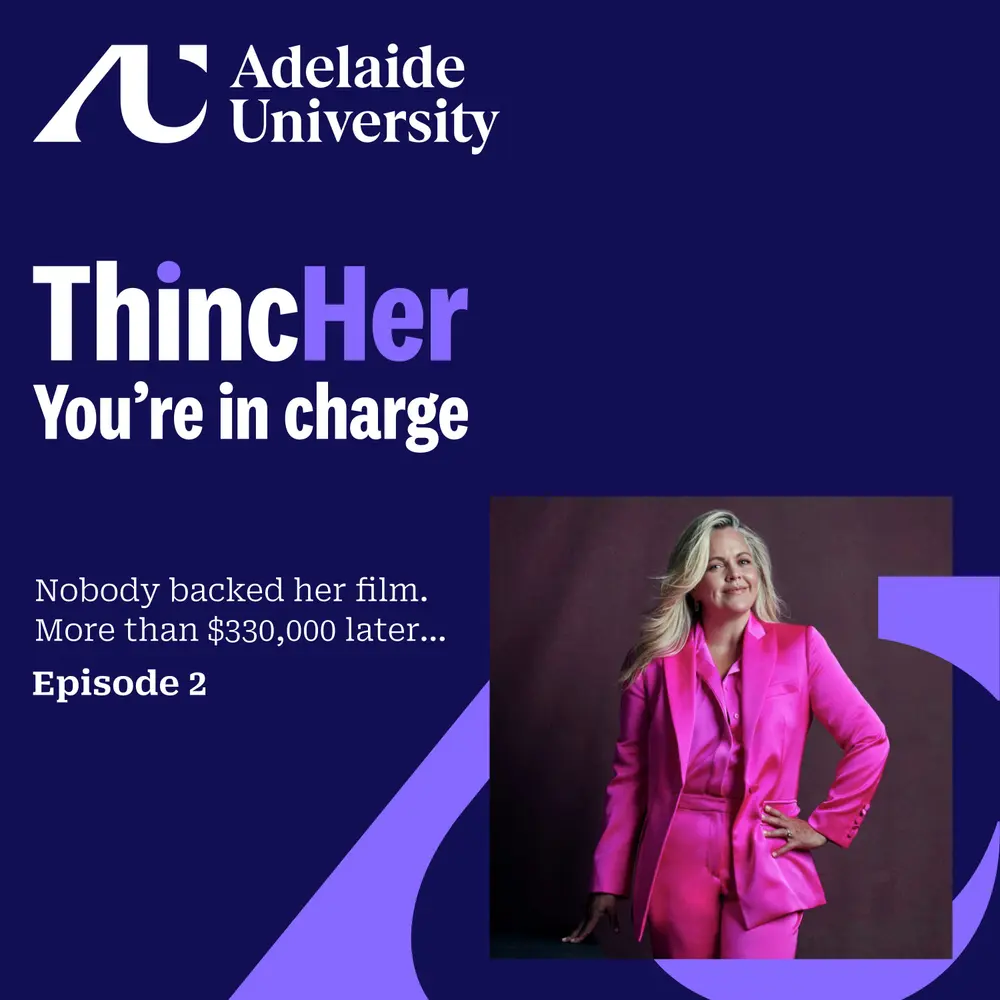
Taryn Brumfitt posted one photograph and it travelled around the world. What followed was 7,000 messages from strangers, a book, a Kickstarter campaign nobody thought would work, and a documentary that beat Guardians of the Galaxy on opening night at the German box office.
In this episode of You're In Charge, Sav Perera sits down with the 2023 Australian of the Year, founder of the Body Image Movement and co-founder of The Embrace Collective, to talk about what actually got built and what it cost.
Taryn is candid about the early years: selling a car, working a second job, and painting a Steve Martin line onto her office wall because the rejections kept coming. She talks about why removing ego mattered more than being the smartest person in the room, why self-compassion beats self-criticism as a performance strategy, and why she is now taking body image into boardrooms through Embrace@Work.
There is also a conversation about doubt that Sav names as her own biggest takeaway. Taryn does not try to get rid of hers. She gives it a rug, a thermos of tea, and a seat in the boot of the car.
If you are early in building something, or deep in it and quietly hard on yourself, this one is worth your time.
Recorded on Kaurna Land. You're In Charge is brought to you by ThincHer, an initiative of ThincLab at Adelaide University.
Chapters
0:00 Cold open ▶ 0:15 Welcome to Season 2 ▶ 0:41 Meet Taryn Brumfitt ▶ 1:36 Before the world was watching ▶ 3:18 From body positivity to body neutrality ▶ 5:26 The motherhood double standard ▶ 6:18 The photo that went everywhere ▶ 8:50 Kickstarter: $331,000 and 8,909 backers ▶ 10:41 "Who's we?" Building the team ▶ 12:10 Scaling without diluting the message ▶ 14:58 The runner and the coach ▶ 16:30 Reframing doubt ▶ 18:20 Be so good they can't ignore you ▶ 19:55 When they go low, and the messy middle ▶ 22:15 The least interesting thing about you ▶ 24:14 Body image goes to work ▶ 26:55 Getting in early with Embrace Collective ▶ 29:32 Movement, not punishment ▶ 32:50 Showing up authentically ▶ 34:29 Feminine leadership ▶ 35:09 Where do you put your doubt? ▶ 38:46 Ask for 15 minutes, not a coffee ▶ 40:40 What Taryn wants to master next ▶ 41:36 Sav's takeaway ▶ Transcript Search or select a timestamp to jump ▾ 0:00 Taryn Brumfitt: No one was going to take a punt on me. I'm a bit of an all-or-nothing person. 0:04 Sav Perera: I'm so glad to hear you say that because it took me a long time to get myself out of, oh my God, this is punishment mentality. 0:11 Taryn Brumfitt: I think if every woman I, I know did that, gosh. 0:15 Sav Perera: Welcome to season 2 of You're in Charge. My name is Sab Pereira. I'm a chef, business owner, and now a judge on MasterChef Sri Lanka. In today's episode, we are going behind the curtain and getting deep With a truly inspirational leader. 0:32 Taryn Brumfitt: Hi, I'm Taryn Brumford. I'm the 2023 Australian of the Year, founder of the Body Image Movement, and a bad drummer player who wants to be better. 0:40 Sav Perera: That's right. As the co-executive director of the Embrace Collective and founder of the Body Image Movement, Taryn has built a career around encouraging women to dismantle the fears that hold them back and embrace who they are at heart. In 2023, this work was recognized as Tarin was named Australian of the Year. She's written award-winning books, produced life-changing documentaries, and given countless passionate speeches worldwide. But today, Tarin is shifting her focus to a new space. Embrace at Work is her latest endeavour, which she'll be taking into boardrooms and break rooms to show that body image isn't just a youth issue, it is a leadership issue. But today we are not here just to talk about the movement. We are here to meet the woman behind it all. Unscripted, raw, real, and reflective. Pleasure to have you here. To dive in straight away, before all the millions of people, before that viral image of you, before the world saw any of it, there was just yourself, Taryn, and going through what I think would have been a very private personal thing that you decided to then be so courageous and brave and share so publicly. Take us back to that moment of what you were, if you can, going through by yourself before the world actually turned its attention on you. What was that like? Like, walk us through that from what you remember. 2:13 Taryn Brumfitt: Yeah, my goodness, it feels like a lifetime ago, um, but After I had my children, I ended up hating my body. And I remember just looking in the mirror and hating everything about my body and how it changed. And I wanted to get my body back. And there's a really strong narrative in the world that we should get our bodies back and we should look different. And there's trillion-dollar industries that wanna prey on our insecurities to make us feel bad so we buy their products. So it's no wonder that so many people struggle with how they feel about their bodies. For me though, when I learned to embrace my body, it was something that I wanted to share with as many people as I could. And I think it goes back to being raised by beautiful mum and dad. But my dad in particular always said to me, if you know something that can help other people, it is your duty and your responsibility to participate, not just be passive, but to do. So that's what I've been doing ever since I learned to embrace. And gosh, how many years? Probably 12 years, 13 years on, it hasn't slowed down and it has been quite a ride. 3:18 Sav Perera: Just in terms of, cause you said it hasn't slowed down, the landscape of, I think, body positivity and self-image and all of that has changed, but then the political landscape has changed again, I would say in the last 4 years or so, which means that we're in a way regressing as well. So what's your place in the world now like with that changing landscape as Like things were getting positive for a while and now we're taking a step back and then we're like having the diversity piece, but then having it taken away. So how are you navigating that? What does that look like for you now with, um, Embrace It and doing all of these things? 3:57 Taryn Brumfitt: Yeah. I mean, I think it's important to note that nobody can take that diversity piece away. Not one person, not anybody. Um, that's something that we can hold onto for ourselves, our values around how we feel about that. When it comes to body positivity, um, That's where I started out. I, I'm a bit of an all-or-nothing person. So I hated my body. I learned to love my body. And then I was like, hey world, I want everyone to love theirs too. And I remember a few years into the body image movement, someone tapped me on the shoulder and said, Taryn, it is not nowhere near possible for me to love my body, but I could be okay with it. And so we've also been talking a lot about body neutrality in the last few years as well. So there's a spectrum. You can like, love, be okay with your body. And what we're teaching people is to be more accepting of their body. You don't need to be positive about your body all the time, but I do want people to know it is a superpower in life. It will give you an edge to feel comfortable. But most importantly, through all of the research and all of our work, the one thing that has stood out to be the most impactful and effective strategy to help people, whether it's do with their bodies or life or business or whatever is self-compassion. Yeah, we're so hard on ourselves. And if you can make peace with who you are and the mistakes or the challenges or whatever happens along the way, that is critical, um, to help support you to get to where you want to be. 5:25 Sav Perera: And I think there's a big part in— there's a big significant thing in what you said because you're a mum. And I think when you are a woman, it's already starting off, unfortunately, like, well, you're always fed these lies of like, okay, this is the ideal, this is the standard. And it, I think, gets doubly worse when you're a mum because then you have to navigate being a mum versus like having the perfect postpartum body. And like, exactly as you said, like, you've got this expectation on you. Um, talk to us a bit about like now, because you started off as a film and now it's become This, it's become beyond, it's more than a movement because like I knew who you were straight away. I've seen all the bits and pieces that you do. And as a person in a larger body, I've resonated. I didn't necessarily have to be a mum. I'm not. But that piece of always feeling like I'm never at home in my own skin and then hearing other people go, okay, actually I feel the same way. And as a woman, I feel the same way. Talk to us a bit about how you started off with this film and now you've grown into this movement and what that journey has been like in that time. It's over a decade now. 6:39 Taryn Brumfitt: Yeah, sure. And I think it's really important whether you're a mum, not a mum, however you identify in your body. Unfortunately, negative body image impacts every person across every culture, across every body type and shape. So this is, this is a problem for everyone, but that's okay because there is a very universal solution for everyone as well. So going back to, yes, I made the film. So the way this sort of came to be was I posted a non-traditional before and after photograph where usually you see a woman or a man in a larger body before, they're deeply unhappy, they lose weight, and then miraculously in their after, they're really happy. I was like, BS. Um, that's not true. That's not the whole truth here. It's a whole story which I won't get into on this podcast because an entire feature film called Embrace that people can watch that unpacks the story. But for me, posted that photograph and it really resonated with people around the world where they were sharing with me how they felt about their bodies. And I was doing all this work in the media. I had a Russian film crew come out and spend 3 days with me. I was on Good Morning America, Polish news. It was headline news. It was everywhere. And up until this point, I had never had any interest in having a public figure. I was a photographer. I had 3 young children. It wasn't like my life's pursuit to be everywhere. And that was the reality. But what people didn't see was the 7,000 emails and messages that I received from people around the world sharing their heartbreaking stories about how they felt about their bodies. And it It saddened me, but it also frustrated me. And I felt like I had been on my own journey to go from hating it to being good about my body. And I wanted to share that with people. So wrote a book. I bet there's so many people who are listening to this won't even know who Ricki Lake is, but I'll say it anyway. She was a talk show host in the US and she wrote the foreword and the book had some really great sort of success in the US, but it needed more. Mm-hmm. So I thought, well, I'm a photographer, I like telling a story. How hard could it be to make a film? I work at Adelaide Studios now, so I'm always saying to filmmakers that I'm so sorry for being so nonchalant about making a film. It's really hard. Of course, first-time filmmaker, no one was going to take a punt on me. So I needed to be innovative in my thinking about how to find the money. So I went to Kickstarter and set out to raise $200,000. It was a 60-day campaign, raised that on day— by day 12, went on to raise $331,000. And there was an extraordinary bunch of people, 8,909 of them around the world, that took a gamble on my vision to make a film, which we then made. And that had, you know, enormous success. You know, it beat Guardians of the Galaxy on opening night at the box office in Germany, did $1 million in one night at the box office in Germany. 9:37 Sav Perera: Yeah. 9:38 Taryn Brumfitt: 52,000 Germans came out to watch the film. These are, you know, these are heavy-hitting numbers for any film, but in particular for a film, a doco on body image from Australia. Like it was— 9:52 Sav Perera: And a novice. 9:52 Taryn Brumfitt: That's, well, that's right. Yeah, I was a novice, but it worked. You know, it worked. And then since then it has been a constant, there's a problem, how can we fill it with a solution? How can we create something? So there's really not much that we've not done. We've made a second film now, Embrace Kids. We've got research attached to both of those films to show that they increase body appreciation for women in the first film, for young people in the second. We've written songs, we've got classroom programs in schools. You know, Libby Trickett's done a sports masterclass. We've reached over 200 million people in 190 countries. So I think we've definitely made our mark. And it was because we set out to create change and we just weren't gonna let anything get in the way of, of helping people. 10:42 Sav Perera: You said we quite a lot in that piece. Who's we? Who's now? You know, I know there's a lot. Talk to me about the key people and about actually getting them on board as well to essentially build this huge global movement. 10:56 Taryn Brumfitt: Yeah, sure. I mean, what we've done is we've often worked in like project-based. So with the film in particular, working alongside Anna Vincent as a producer, she's a local here in Adelaide. Tim White is an executive producer. We put together a great incredible crew here in South Australia and took our work to the world. It depends, it depends on what project, but there have been many, many people along the way. And I always say we because one person can't create this much change. You know, leadership is important, but having that team around you that are on that journey and that in itself, you know, has its challenges, but it also has its beautiful wins as well. I wouldn't want to do this work alone. It's great to share it with colleagues and friends now. Yeah. And some people I've worked with for years and years and years, and we have just such wonderful relationships and friendships, and that feels really nice. The early days were hard. There wasn't too many people around. It was me and some big ideas. I remember I had to sell a car and, and work a second job, and I, you know, I knew what I wanted to do to help people, but it also didn't pay the bills. So big challenging moments earlier on, but just held on. 12:10 Sav Perera: I just want to pick up on some of the things that you said because I feel like we do have a lot of younger listeners, people that are going into the business of doing whatever their business is. And you talked about, you know, the first bit was hard, you had to sell a car, but the Embrace movement has grown so exponentially. And like the numbers that you mentioned earlier, like it's, it's crazy to even think about. How do you then start? Like you start off with this very strong message that you feel deeply passionate about, that you nurture, which is in a way your baby as well. And then you grow and grow and grow. So how do you stop the dilution process? How do you still keep that strength of what it— what you're trying to actually show and like show the world? 12:57 Taryn Brumfitt: That's a really interesting question because I'm not sure that's ever been an issue. As in, you know, I'm— I almost feel like the more I do this work, the more passionate I become. And right at the beginning, I could never have imagined that a decade would pass and I'd be still doing it and still finding new and innovative ways to get the message across. I guess that's the thing, is that whether it's songs or films or books or online programs or keynotes, or it's many and varied. And I think I love the diversity in that, you know, piece of work. It can be many things. I think what's really important as well is backing yourself. So I always think about people who are listening to this and starting out, that road to success and wherever you want to go is not linear. Mm-hmm. Um, and we would've all heard, you know, the positive affirmations around how hard it is. And we've seen the squiggly lines and we're like, that's success. You know, it's all true. But I think what's really, really important is the ability to back yourself and stay true to yourself, removing ego is probably something that I wish I'd learned about 30 years ago. You don't need to be the smartest. You don't need to be the best. You can hold the space for the vision, but get the smart people around you. If you are the smartest person in the room, there's something wrong. You want your most cleverest people. And I watch still to this day, ego get in the way of someone's dreams or hopes or where they're going because they can't They can't invite people to come and join them on that, on that journey as well. I think what I would love to touch on, because anyone who's listening to this and is going to embark out into the world onto that wild journey of business ownership, entrepreneurship, like it is wild. I think for a really long time that we haven't considered how we feel about our bodies actually has a hugely profound impact on our productivity, um, and our confidence. I think body image has been pigeonholed over here and it's, oh, it's about women and weight and hashtag love your body. And I think the opportunity as Australian of the Year in 2023 gave me a very great platform to dispel the myths of softness around body image, because the way that we talk to ourselves is everything. And if you want to be great in life, in leadership, in your business, then the way you feel about your one and only body and the way that you talk to yourself has a critical impact on whether you're gonna be successful or not. And I often get people say to me, you know, Taryn, you've done all of these things, you know, what is the one thing that has really helped you to do the things you've done? And for me, it's embracing my body. 15:48 Sav Perera: Mm-hmm. 15:48 Taryn Brumfitt: So please don't, please don't underestimate the, the power of that. It is a superpower in life. And I often think of, you know, a runner, they're about to start a race, you know, they've been preparing for it, they're ready to go, and their coach comes over and whispers in their ear like, oh, those other runners look real good today. I think you're gonna struggle. I mean, we wouldn't, we'd fire the coach. 16:10 Sav Perera: Yeah. 16:11 Taryn Brumfitt: Right? So why do we allow ourselves to do that mean voice and to pull ourselves down and to throw so much doubt? I think we've just gotta be really careful to harness that thinking, reframe lots of thinking, Doubt is one thing I love talking about because there's been so many moments that I've doubted myself, but I always like to reframe the doubt as, oh, I'm pushing myself outside of my comfort zone, hence why I've got these little feelings and little thoughts that are coming in, and it's cool. Here I am again. What can I do to support me through this little wobbly moment? that's the one thing I've learned in business and in leadership and in success is that I used to think in the early days that being hard on myself and berating myself and you didn't do enough, you didn't do enough, you should have done better. I thought that was key to success. It's exactly the opposite. Yeah. 17:17 Sav Perera: It's incredibly valuable actually for me personally, and I know it will be for all of our listeners as well to hear you say that, because I'm exactly the same. I'm one year into essentially running myself as the brand that is Sav, and I'm so hard on myself. And it's— I think it becomes— it's easier now that I'm in my 30s where I can be a bit more forgiving. But I think especially when you are a younger person, a younger woman, you are harder on yourself. You're very critical. And taking the time to build that confidence in yourself It's, it's hard work. So 17:52 Taryn Brumfitt: it's worth it though. It's, it's hard work, but it's— sorry to cut you off— it's hard work, but it's worth it. Yeah, because what's the alternative? 17:58 Sav Perera: You are in that position where, like, I think it's really valuable what you said, that you still, despite, you know, the decade-plus, um, time doing this work in the body image, like, space, you still have moments where you're like, what, what am I doing here? Like, why am I in state dinner at the White House and you still have those moments of doubt. I really sort of just actually want to tap into that bit that you said about the confidence piece and how you actually foster that confidence. How is it different to back then? I know you said, you know, I don't beat myself up about things anymore, but how do you get to that point? Like, what's up? What has the process been like? 18:39 Taryn Brumfitt: Right back in the beginning, There was so much rejection and knockbacks, and I had all of what I've got now. I had a mission and I wanted to share things, but people weren't listening. So it was really hard. One of the things I did was I took my favorite quote and wrote it into my wall before I painted my office. And it's by a comedian called Steve Martin. And he says, be so good they can't ignore you. 19:05 Sav Perera: Mm-hmm. 19:06 Taryn Brumfitt: So every time I got a knockback and a rejection, I would just remember that one quote. And it would just give me, it would just soothe me in a way. And the other thing is around ensuring that you are surrounded by people who will truly, authentically lift you up. I would rather 2 people do that, that are all in, that love me and all the bad bits, the good bits, and all the bits in between, than 200 that could like or leave me. 19:36 Sav Perera: Yeah. 19:36 Taryn Brumfitt: Choose the people around you really wisely. Your counsel is so important. The other thing, I think it's really good for people to know, you know, the Michelle Obama quote where she says, when they go low, we go high. 19:50 Sav Perera: Yeah. 19:51 Taryn Brumfitt: I love it. I've got a t-shirt with it. Love it. Um, but I think there's a big part of something that's missing within that. When, when they go low and they will, there'll be times that, that people will go low in your business life, in your life. And it's always a bit ouchy. Don't ignore how it feels when people go low. And I think this was my— this was what I learned in 2023 as Australian of the Year, because any woman with a profile in Australia or anywhere in the world, um, they will come for you. And lucky— I often just joke that, um, there was no phones when I was a teenager, so they've got nothing on me. But I never would have been Australian of the Year if there was phones. Um, lucky for me there wasn't. But, um, I just remember comments and negativity and the way it felt. And I remember wearing my t-shirt going, it's okay, when they go low, I go high. And I'm like, no, I actually, I overtrain or I overeat or I snap at my kids or I'm short with my husband or there's a whole— I get anxiety or I wake up in the night or I cry at something. There's a whole range of things. Yeah. A gamut of emotions. and consequences for them going low. What I've learned though, and I wish I had learned this earlier, was how much time am I going to be dedicated to that kind of messy middle? 21:13 Sav Perera: Yeah. 21:14 Taryn Brumfitt: How that— that's, I think that's the critical piece. We can't ignore feelings and what we go through, but we can make some kind of decisions about having boundaries around how much time I'm going to Cry and wish they'd written something nicer or whatever it is. 21:32 Sav Perera: It's actually incredibly self-affirming for me to hear that because I got thrusted personally into the spotlight, like bang, just straight out there. There was no like easing my toe into the water, so to speak. And I did it as a person of color, as a woman of color and a woman of color in a larger body. Um, and also not someone that fit a mold. So I resonate so deeply with what you said about people going low because I, I obviously can't compare that to what a man's experience would be like, but I feel like it is a bit harder. Like, people are more critical of women when you're not, you know, you're not the perfect mom and you're not the perfect whatever. 22:15 Taryn Brumfitt: Or even what we wear. It's like, I mean, I spend my life teaching people that the very least interesting thing about you is the way you look. It's about who you are. It's about the contributions you make to the world. It's all of those things, not what you look like. But the amount of criticism and commentary that women get on their appearance, it's— I mean, we're getting better, but if we could— if I could fast-track anything, it would just be that. Listen to our words and listen to what we have to say. 22:44 Sav Perera: And just even little things like when women, I think, like, may be out and about doing stuff in sweats and then something happens and it catches media attention and you see comments like, oh, why is she not dressed properly? Or like, why is she doing that with the kids in like thongs? And you're like, 22:58 Taryn Brumfitt: yeah, I mean, this is the— yeah, I mean, it's outrageous, isn't it? But here's something that every listener can do that's really important to change that narrative as well. And that is never to say anything negative about their bodies or anyone else's bodies again. Because in terms of leadership and women and what we want for people to step up A big part of that is being very mindful about what you say, negative comments about your own body, because it sidelines you. 23:29 Sav Perera: Yeah. 23:30 Taryn Brumfitt: It weakens you. It diminishes your power. So you don't wanna say it to yourself. You definitely don't wanna say it in front of others. Because the other thing is when that does happen, it gives other people permission to kind of trash their own bodies as well. That's it. It really does. So we've just gotta stop that. And I think if every woman I know did that, Gosh, even just that profound impact, that ripple effect of change would be pretty big. Trillion-dollar industries making— not everyone's bad in the beauty industry or the cosmetic industry. And I'm one for your body, your rules, my body, my rules. Do whatever you want. You know, it's no one else's business but yours. But the one who prey on women's insecurities, it really makes me mad. 24:14 Sav Perera: And that's like the little fire that really is constantly burning, I bet. Um, you talked about leadership, and I really actually want to touch on that because we've gone from Embrace being this movement for, you know, you think about the consumer, the person, the woman who's like living her life, but now you've gone into the space of actually the workspace and body image in the workspace and really into this path of how do you build women that are in like leadership space in spaces of change. Talk to me a bit about that growth and being in the leadership space, being in the corporate space. What's that like? Um, did you ever think that's where you'd end up? Um, yeah, talk to us a bit about that. 24:58 Taryn Brumfitt: Uh, it's interesting, isn't it? Because body image in the workplace has never been considered in most organizations around the world. There is not a body image program under the work place wellbeing. So we saw an opportunity to do something that was needed first and foremost, and some— a place that we could create really meaningful change because people don't just leave their body image issues at the door and walk through the doors and be like, okay, I'm great. We also know, thanks to Deloitte's economic report, that $69 billion is the productivity loss in the United States annually because of how people feel about their appearance. So we know that that's having a profound impact on the bottom line, on productivity. For us, because we're very altruistic in our lens when we think about humanity and what we're here to do, people's health and wellbeing. 26:04 Sav Perera: Yeah. 26:04 Taryn Brumfitt: Physical health and mental wellbeing. There's a responsibility that organizations and corporate leaders right around the world know, but no one's doing body image. And we know that people with a high appreciation of their bodies are more likely to eat fruit and veg. They're more likely to have stable weight over time. They're more likely to move their bodies. They're more likely to wear sunscreen. They're less likely to smoke and drink and vape and take illicit drugs. And so it just makes sense. There's a place for this in the world. So corporate's not new for me because I spend a lot of my time keynotes, delivering keynotes But to have a program that we've just launched in New York last month is really exciting with our old premier of the state, in fact, Stephen Marshall, at American Australian Association. And now it's just about getting the word out, and so far so good. 26:55 Sav Perera: And talk to us about being in the space for young people and children as well, because I think that is such a huge, huge thing. I think a lot about my personal experience and growing up in the culture that I did where women are smaller, petite, and I did not fit that mold, and not actually having anything that reinforced that who I was okay as a person like that— I felt like an absolute freak my entire life growing up. Um, and to not have any sort of normalization or conversations in that space as a child, um, I think it's had a huge impact on the women in my generation because there's a lot of women like me that didn't hear those words. And the fact that you're now involved in that space, I think is hugely impactful. Um, yeah, tell us a little bit about that and how sort of that came to be as well. Like, I understand that going into the corporate world feels like that next natural step because you obviously saw the gap in the way that workplace wellbeing's run. But yeah, talk to, talk to us about approaching young people and how that's going. 28:02 Taryn Brumfitt: So when we made the Embrace film, uh, and then the research showed that increased body appreciation, we're so happy. But everyone said to us at that time, oh, I wish I had seen this when I was younger. And I just knew that we needed to get in early rather than fixing problems that have been with some women for— and people for decades. Mm-hmm. Let's get in early with prevention. So Dr. Zali Jaeger and I, uh, started the Embrace Collective, which is a health promotion charity focused on the prevention of eating disorders and body image issues. And we are really proud now that we've got resources and research to show that what we are doing works. We reached a million children in 2023. We did it again in 2024. We'll do it again this year. Yeah. I mean, we just, we, we want everyone, whether you've got children or not, you know, we, we all know young people and we, we know that they live in a world that's not sort of very conducive to positive mental health. And, you know, social media, it's part of the problem. It's not the whole problem, but it is a problem. 29:04 Sav Perera: Yeah. 29:04 Taryn Brumfitt: You know, I mean, I, as an observer of people, as a documentarian, I spend my life just watching people and, and I can't tell you how many times I just walk down the street or I'm in a cafe or at a doctor's waiting room or whatever it is. Everyone's just this. It's like sometimes I think if aliens came down from, you know, planet, planet alien and looked at us, they'd be like, what are these things that people are so obsessed with? I think, yeah, it is a bit of a— it is a bit of a problem. And if we can get people to get back into their bodies and find the joy, even in something as simple as moving our bodies— I think we have a really dysfunctional relationship with exercise. 29:48 Sav Perera: Yeah. 29:48 Taryn Brumfitt: Especially in Australia, where we think that it's something that is done to us or we have to do. Yeah, yeah. Or it's a punishment for, oh, I ate the cake. or I need to go for the run. It's like, oh my gosh, moving my body is the best part of my day. And it's one of those things in my toolkit that does give me the edge in business, in life, because it energizes me. 30:10 Sav Perera: Yeah. 30:10 Taryn Brumfitt: And I just, another takeaway, if that's one thing I could share with people and for them to take away is the importance of moving our bodies. I talked to Mark Boris about this, You know, exceptional leader in Australia and, you know, his commitment to his routine and he's moving his body and it works for him. And I think, yeah, we don't do it enough because we think it needs to be done in a particular way. We think we've got to go to the gym 3 times a week or 5. It's like dance in your lounge room or hike up Mount Lofty or go to the beach or just do something. 30:47 Sav Perera: I'm so glad to hear you say that because it took me a long time to get myself out of that. Oh my God, this is punishment mentality because certain forms of traditional exercise, absolutely hated. I'm not a runner. I have no interest in running except away from my problems. 31:03 Taryn Brumfitt: So— Running away from your problems, I haven't heard that one. 31:06 Sav Perera: That's the only time I consider running. And to the point where like I, I actually hated it, but I'm like, why am I doing this? I hate it with every fiber of my being. And I think, but then you just tell yourself, if it doesn't feel like punishment, then you're not actually doing a good job with yourself. But I'm like, why do I have to hate myself to actually do something that's really good for me? And to sort of find that, like, I love Pilates. That's what I do now. And I love swimming because it's a low impact and I just get to float around. Not everyone's going to like that, but people are going to have stuff that they like, like bike riding or whatever it is, or dancing, as you said. So I think it's really important that you have that message because we're still, I think a lot of people in general, are like, oh, you have to like do your weight training in the gym, otherwise you're like worthless as a person. 31:53 Taryn Brumfitt: There's thousands of ways to move our bodies. And I think what a, what a liberating thought that is for anyone who's trapped inside the, I have to exercise. It's like, what? And it really is. It does give you that sort of edge to, to move your body with joy. 32:09 Sav Perera: And I think I love that we've sort of moved away from just exercising and we call it movement now. 32:15 Taryn Brumfitt: Yeah. 32:15 Sav Perera: And like, even like when my partner talks to me, he's like, oh, because I'll be in a bit of a mood, and like, did you get any movement in today? And I'm like, actually, I didn't, so I'm gonna go on a stupid little walk. And it's just a 20-minute walk, it's not a big deal. It just makes a world of difference. 32:28 Taryn Brumfitt: It really does. 32:28 Sav Perera: I'm really happy to hear you say that, and I actually want to talk about how authentically you've shown up as well, um, in having this conversation, in having the many, many conversations you've had across the world, in your keynotes, in the addresses that you had with different governments, actually. Talk to us about authentically showing up for yourself, why that's important for you, but not just for you, but for also the message that you're trying to convey as well. 32:59 Taryn Brumfitt: Yeah, I mean, the first thing I think of is, gosh, it's exhausting to not show up in any other way. Like, well, sorry, hang on, let me get that right. It's exhausting to show up in any other way but yourself, because that's where it began for me, was I have to look like this, I have to sound like this, I have to be perfect, I have to be polished. That's been sort of where I've come from in terms of leadership. And now it is just authenticity. You know, it's just being who you are. And I think, A, I had to go through that myself to go, oh, it's exhausting walking off stage trying to be something that is not naturally me. And so I learned that myself. Uh, for everyone listening, I think there's this another great quote. Uh, Steve Furtick says, don't compare your behind the scenes with everyone else's highlight reel. So we do a lot of this. We think that everyone else is better and more polished or got a better life and a better job or better partner or better kids or better vacations or whatever it is. Um, if we could just focus a little less on what everyone else is doing and, and, and And try and, 'cause you can't stop the comparison 'cause as human beings, we're wired to compare, hardwired to compare. But if we could just remind ourselves, whether it's through journaling or just even just thoughts on the way to work in the car about all the good things that we're good at as well. But yeah, authenticity is key. Being real is key. I think that there's been a lot of changes, I think over the last decade where we have as a society started to appreciate when we see authentic leadership. But I think for a long time we were asleep. We were just the same type of masculine, often leadership was the one that we saw. And even for me as a woman, I was like, well, I'm gonna have to show up real hard. And I did that for so long. It's not who I am at my core. My feminine leadership is the best For me and for people around me. So it's something that's constantly evolving as well. 35:09 Sav Perera: I also just want to touch on something that you talked about in terms of doubt as well, because, you know, you're, you are showing up authentically, you're showing up for yourself, which I think is a huge thing and it creates a ripple effect because when other people see you show up for yourself, it inspires them in that confidence in them as well. So what's the role of doubt now like, like versus when you first started off? Because I think obviously there's a lot of doubt when you first start off anything and you build the confidence over time, but then the nature of doubt changes and the things that you were fretting over 10 years ago is not the same fret that you have now, but you're still fretting over something. So yeah, talk to me about the role of doubt, how it's changed, how it's shaped. What form does it take, if it does at all at this point? 35:58 Taryn Brumfitt: Yeah, I mean, I think doubt for me, when I feel it, I know I'm doing something that's pushing me a little bit outside of my comfort zone. So I actually, instead of pushing it away, which is what I used to do, like, oh, I doubt myself, or, or give myself a hard time, or try and push it away. Now it's just, ah, a new level, new devil, or something's going on, something's exciting me, something's making me feel this. But for me, it's, uh, you know, I often imagine, you know, the car with all the passengers and, and doubt will always be there in my life. Always. It's gonna be in everyone's life. It's just where we put it. Um, and I was talking to, to my husband the other day. He's studying. He, he was a nurse for 27 years and now he's studying, he's doing his master's in counseling. And, and we were talking about doubt and he's like, I said to him, I, I put my doubt in the boot. He's like, no, you can't ignore it. I'm like, it's fine. It's got a rug. It's got a thermos of tea. It's in the boot. He's like, well, mine's my passenger and I I often think about these types of sort of analogies of all the emotions that we feel, and I think it's acceptance about them. I think it's just going, yeah, sometimes it's scary. Sometimes I do feel doubt and it's actually okay. But what do I need to do to move myself further towards courage that then leads me towards action that then leads me towards impact? 37:17 Sav Perera: Personally feel that doubt's not always a bad thing. And now in the position that you're in, how do you sort of split the difference of like, is this doubt because it's a confidence piece, or is this doubt because this is actually something that's not for me and I need to walk away? So how do you set the boundary? What's that process like? 37:39 Taryn Brumfitt: Yeah, I think it's actually an analysis of doubt. I'm just, I'm thinking in real time here because I'm thinking I'm about to deliver a new keynote. And I've noticed in this process over the last couple of months of writing it that doubt has crept in. And I'm like, well, where's the gap? Is it a knowledge gap that's creating the doubt? And I'm like, oh yes, it is. Okay, so I need to go down this path and feel more confident in what I'm talking about. And then the doubt lessens. So I think for people to analyze their doubt, What's driving it and how to move and transition through it. I think that's a really important part of the process. 38:23 Sav Perera: I think there's a lot of value in what you said about actually acknowledging and sitting with a lot of these feelings, because I think a lot of people, when you're new to business, when you're new to entrepreneurship, you're in this space of building something that, like, you're on that precipice. I think it's very easy to just compartmentalize and go, I'm just gonna shove that into the box. And because I think it becomes one of those things that comes back to bite you. 38:46 Taryn Brumfitt: Any emotion does. I mean, gosh, I went through a divorce in 2020 and I'm like, I'm fine, I'm fine, I'm fine. And try to, you know, dance my way out of that. Okay. And it did come back to bite me. Um, so I think it's really important that, that we, we accept, um, that and it's okay. The other thing I reckon is really helpful is to talk to people who are perhaps what you might consider further down the road. where you want to be and asking them, you know, for a quick catch-up. You know, don't ask for, you know, people asking people for coffees all the time. It's like people don't often have a lot of time for coffees. Lots of people got time for 15-minute Zoom. Can I have 15 minutes of your time to ask you 1 or 2 questions that's going to really help me in my career? That's what people need to do more of. 39:32 Sav Perera: That's— I love that. I love that you said that because I, um, actually have a musical background. And one of the things that one of my best friends, who's a very, very, very talented musician, said to me about getting better is you play and sing with people that are better than you, and that's how you get better. And I've carried that with everything that I do. And it's so, so nice to hear you in the position that you're in, having achieved all these amazing things. in your life to say, actually, yeah, take— make, make the time with people that are further down the journey to actually engage. And I think it's important for young people to hear that because a lot of the times people do feel discouraged and like, I'm just muddling through and I don't know. So I'm really appreciative that you said that. And we always ask, ask our guests this, um, on the podcast. You've Had this amazing, amazing career, like no doubt as a result of very, very hard work. What do you want to master in the next year for yourself, career-wise, personally? 40:40 Taryn Brumfitt: One of the first things I think of is drums, uh, because I bought myself a set of drums when I, when I, when, when Australian of the Year happened, uh, and the first couple of media articles happened. I was like, oh my God, this feels terrible. I said to my husband, drive me to Derringers, I need to buy drums so that That's my release, but I still can't play them, so I just kind of hit them. So I'd love to master the drums this year. 41:03 Sav Perera: Ryan, it's been an absolute pleasure having you. There's so much meat to take away, but it has been such a juicy conversation in the best way possible. So I just want to say thank you so much for your time, all the valuable insights. And I know the world's watching, but we're so proud of you here for from here in SA for what you've done, for how big a job you've taken on. And yeah, I hope you give yourself all the flowers. 41:31 Taryn Brumfitt: No, thank you so much. Thanks for having me. 41:33 Sav Perera: What an amazing conversation we had with Taryn Brumford. I actually enjoyed this chat so much because there was so much for me to take away from all these bits and wisdom that she shared. I think the biggest thing, however, is when Taryn spoke about doubt. Doubt is such an active and real presence in my life, in what I do, and it's my companion every day. So to hear that there's doubt still in her life, how it's changed, and to really dig deep into the confidence-building piece of, you know, how do you let that doubt be productive? And how do you let some of it go? How do you use it and use it as a functional thing in your life to actually drive you forward? I loved hearing Taryn talk about all of that. So I am so sure that all our listeners are going to find that valuable too. Make sure you hit follow and share this show with your friends, because next week we're sitting down with someone who's mixing social influence with social impact. Join me for my chat with Poppy Radbone as we unpack the realities of business, motherhood, and sharing it in front of a global audience. 42:48 Speaker: No, I'm not going to stop working. Like, I'm just a workaholic. I love to keep like going, going, going. Like, I think that's why actually having kids made me like work harder. 42:57 Sav Perera: Keep inspiring, keep striving, and always remember, you are in charge of your business journey. You're in Charge is brought to you by ThinkHER, an initiative of ThinkLab at Adelaide University. Google ThinkHER, that's T-H-I-N-C-H-E-R, to join our empowering community of like-minded women in business. You're in Charge was recorded on Kaurna land. No transcript lines match that phrase. Try fewer words.




 ▶
 ▶
 ▶
 ▶
 ▶
 ▶
 ▶
 ▶