What does it really take to lead at the very highest levels - and do you ever stop questioning whether you're good enough?
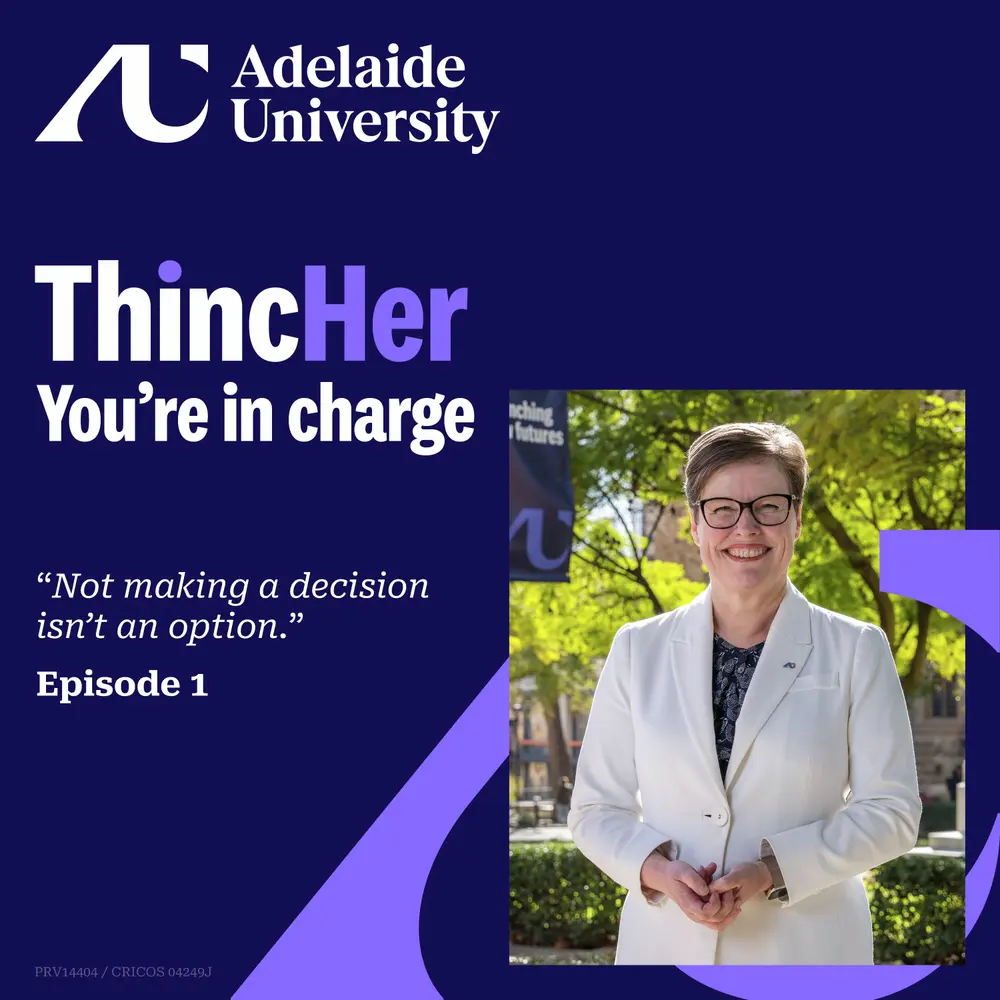
In this episode, Sav sits down with Professor Nicola Phillips, Vice-Chancellor and President of Adelaide University - one of Australia's newest and most ambitious universities, formed by the merger of the University of Adelaide and the University of South Australia. With 30 years of experience across the UK and Australia, Nicola brings a rare mix of academic rigour and hard-won leadership experience to one of the most significant roles in Australian higher education.
Nicola and Sav go deep on the questions that matter most to women in leadership: the non-linear path to the top, the impostor feelings that persist even at Vice-Chancellor level, how to make clear decisions when the buck truly stops with you, and why the human element of leadership isn't a soft skill - it's the whole game. They also talk about what it's like to lead an institution of tens of thousands of people through a once-in-a-generation transformation, and what the future of Adelaide University looks like from the inside.
If you've been waiting for someone at the very top to admit that self-doubt doesn't disappear with seniority - this is that conversation.
Transcript Search or select a timestamp to jump ▾ 0:00 Nicola Phillips: I really do think I have the, the best and the most interesting and fascinating job. You do the very best you can in the moment because not making a decision is just not an option. There is a lot in the world of leadership that can still feel off-putting to women. 0:14 Sav Perera: Welcome to season 2 of You're in Charge. My name is Sab Pereira. I'm a chef, business owner, and now a judge on MasterChef Sri Lanka. Today we are joined by a leader who is at the forefront of significant transformation in Australian higher education. 0:32 Nicola Phillips: Hi, I'm Nicola Phillips. I'm the Vice-Chancellor and President of Adelaide University. 0:38 Sav Perera: From rethinking the role of the modern university to strengthening global engagement, student experience, and research impact, her leadership comes at a time when universities are being asked to evolve faster, think differently, and engage more deeply with the world around them. Today we'll talk about what it really means to lead through change at scale. We'll also explore the future of education in an ever-changing landscape. Let's get into it. Nicola, thank you so much for being here in this beautiful building at Adelaide University. 1:14 Nicola Phillips: Oh, it's such a pleasure. Thank you for inviting me. 1:17 Sav Perera: Of course. Now, before we actually dive into the big business of what you've achieved being Vice-Chancellor at this amazing institution. I just actually want to touch on who you are and perhaps who you were and who you had to become to now be in this very, not just prestigious, but also very serious position of essentially molding young minds, really. Mm-hmm. Talk to me a little bit about the journey. 1:47 Nicola Phillips: Gosh, that's a big question. And I think it's so often the case that these things fit together with hindsight, but it's not necessarily a straight line or a set of farsighted decisions that lead you to this place. But it is an extraordinary privilege now to be in this position. And looking back, I can see how over the course of my career, certain moments in time, certain people in time, set me on a path in this direction. Who was I and who am I now? I think we could be here for some hours talking about that. But there were key moments as I went along. One of them was my first experience of real leadership. 2:36 Sav Perera: Right. 2:37 Nicola Phillips: When I was asked to be a head of school. And I really liked this idea. I could see that it would be really interesting. I thought I would like to give it a go, but I wasn't quite sure what it was going to to be about. I hadn't had any formal leadership development, but I was interested. And I'd been an academic until that point. Right. And so the reward and the buzz of the job came from more sort of individualized things, that real buzz that you get when you teach a good seminar or you give a good lecture or your paper's accepted in a great journal or you get a grant, all of those things that we're very familiar with as academics. So I wasn't quite sure where the reward of leadership was going to come from, where that buzz was going to come from. I very quickly learned that the buzz was even greater. 3:26 Sav Perera: Right. 3:26 Nicola Phillips: And the reward felt to me, to me, even more meaningful than it had before I took on those positions. And of course, you're learning as you go along all the time, you're testing yourself, you're being stretched in directions that you didn't know you could stretch in. And here I am with this most amazing job. I really do think I have the best and the most interesting and fascinating job in higher education anywhere in the world at the moment. And I couldn't feel more fortunate to have ended up in this position. I think the shift for me from where I was perhaps immediately before taking on this job to now is that I've— or perhaps it was, you know, it's an accumulation of lessons that I learned over the course of my leadership career. Right. The, I think 2 things in particular. One is the level of comfort with being in the spotlight all the time, sort of on parade all the time, and knowing that every word you say and every twitch that you make is being interpreted in some way by people. And it's quite a process of becoming accustomed to that and becoming comfortable, particularly if sort of by disposition, you're not somebody who— 4:46 Sav Perera: Yeah. 4:46 Nicola Phillips: Who seeks the spotlight and wants to have a camera in their face all the time and so on. And I think the other thing is to just become comfortable with the idea that you have to make decisions and that you do the very best you can in the moment because not making a decision is just not an option. And sort of backing yourself and being comfortable with the idea that not only do you have to make those decisions, but you are accountable for them and the buck stops with you. 5:16 Sav Perera: Right. 5:17 Nicola Phillips: And thinking that that's a really important part of the job of leading. And being open to the idea that there will be some decisions that with hindsight you might have made differently or more quickly or more slowly or come to a different view. But you do the very best you can. You draw on all of your experience, all of your knowledge, all of your instincts in the moment, and you do the very best job you can at that particular time. And if you need to correct course afterwards, you do so. Or if it's absolutely the right decision, then you— 5:48 Sav Perera: Right. 5:48 Nicola Phillips: You know, you can feel You know, confident that you, you know, that you— it's about sort of almost your responsibilities in this job. And I find those moments really rewarding in a personal sense as well, where you back yourself, you marshal everything that has brought you to this point, and you make the call. 6:10 Sav Perera: You created the perfect segue actually to circle back to something that you touched on just before. about making that shift from being in academia and then into leadership. Um, a lot of our listeners are often, uh, young women and women who are looking at getting into business, into starting their own businesses, into going into entrepreneur— entrepreneurship. And there's always a confidence piece in that. Um, and you just spoke about backing yourself, but you also spoke about that shift. And you said, you know, you wanted to find out about the buzz, but, and this may be an abstract question and a little bit difficult to answer, but if you could reflect on where the confidence comes from, how did the confidence look at that point in time? And what does it look like now for you? 6:58 Nicola Phillips: Yeah, I think it's a really interesting question. And I grapple with this quite a lot. And I think it is a question that that very often, not entirely, but very often does have a significantly gendered dimension to it. And obviously, your question points in that direction. But I'm not sure that— I think it is a very, very good thing to question yourself, not to doubt yourself so that you're paralyzed or so that you don't take opportunities or so that you don't take decisions. But I think anybody in a leadership position should be questioning themselves. And I don't think that should ever disappear. here, which is probably a good thing because I don't think it ever does. And certainly in my case, it hasn't. And so I think it's perhaps useful, but I also think that it's a positive attribute of leadership. But I'm certainly a person who will be thinking about what I've done, thinking about what I've said, picking apart every word of a sentence that I constructed, wondering about how it could have been interpreted, worrying about whether I expressed myself as well as I could or should have done, whether I was articulate as I should have been, and so on. Or about a decision that you make or about the way that you approach a difficult conversation, looking back on it and thinking about whether— worrying perhaps about whether you did it as well as you would have wanted to or not. And so I think that's healthy so long as it doesn't drive you into paralysis. 8:33 Sav Perera: Yeah. 8:33 Nicola Phillips: And I don't think— I think anybody who says that they feel 100% confident, that no self-doubt 100% of the time is possibly not the person who's best suited to leadership and possibly not being entirely truthful either. So when talking with, particularly with young women, very often I like to emphasize that it's not being lacking in confidence to question yourself or to think, gosh, can I do this? Or to think, maybe I didn't do that as well as I would have liked to, and therefore I've got a few things to learn. Or perhaps I should seek some advice because I'm not quite sure what to do now. That's not lacking in confidence. I think there's a healthy level of humility so long as it is not preventing you from moving forward, so long as it is not preventing you from taking opportunities or from believing in yourself. 9:23 Sav Perera: So how do you, in that case, and this is something I often grapple with myself, the paralysis that you mentioned, I resonate deeply with that because oftentimes it's always, oh God, am I good enough to be here? 9:36 Nicola Phillips: Yes. 9:36 Sav Perera: Like, should I be doing this? 9:38 Nicola Phillips: Yes. 9:39 Sav Perera: And a little personal example I can give is in my background being on MasterChef Australia, I've now gone on to become a judge for MasterChef Sri Lanka and the only woman on the panel and also the only person under 35 on the panel as well. Yeah. The other 3 chefs are veterans and highly respected, so there's a lot to grapple with. So it's always that question of like, do I deserve to be here? And I know Um, as you said, it is a bit gendered. There are often women do get into that pit. So for you personally, how does that process of getting yourself out of paralysis look? Is it a matter of the experience that you have and the wisdom that you've gleaned over the years, or what does it come down to really for you? 10:29 Nicola Phillips: Yeah, my partner's often reminded me over the years that we've been together that, um, and he's absolutely right, and even before I knew him, um, this, this was the case that Before every jump that I've made or every job that I've applied for or every job that I've walked into, I've had exactly that. Can I do this? Am I up to it? Yeah. Not that level of self-doubt, you know, of being sort of hypercritical of yourself, but gosh, you know, I hope I'm up to this. I hope I'm good enough to do it. And I don't think that ever goes away. I really don't think it ever goes away. Right. So how do you do it? I think some of it is just that you, in my case, it's been that I can't not have a go, that I want to do this. I hope that I can do it. I want to give it a try. I think it's important. I think it's worthwhile. And it's that sense of purpose perhaps as well, that this is something that that means something to me, and therefore I should take a deep breath and step into it. And I think over the years, then experience does help as well. You know, you look back at what you've done and you thought, well, you know, I doubted whether I was ready for that, but I did it and I did it well. And I've moved on to the next thing and I did that well as well. And so you can look back and take some confidence from what you've achieved, but also what you've learned. And in my case as well, it's it's often been about people. Not people telling you something that you didn't know about yourself, but people perhaps just tapping you on the shoulder and saying, you should really go for that, or you could do that, or you did a good job, or this would really suit you. And it's not because you lack the resources to do that yourself. But sometimes those moments— 12:27 Sav Perera: The boost. 12:27 Nicola Phillips: Have been really important for me. And I try to you know, work really hard to make sure that I'm doing that for other people now as well, because I know that that mattered at moments. You know, when you were probably close to a decision that yes, you were going to go for it, but somebody just to say, go on, go and do it. 12:46 Sav Perera: Just that little bit of encouragement. 12:47 Nicola Phillips: That's really important. And people helping you to understand your strengths as well. I think there are a lot of people probably like me who are not particularly good at telling themselves what they're good at. excellent at telling themselves what they're not so good at and where their weaknesses might be or where the gaps in their experience might be, but not so good at being able to articulate for themselves, even just to say the words, I am good at that. And sometimes it does need other people to give you the confidence to say that and to, you know, to give you that sort of validation and that encouragement. 13:19 Sav Perera: Support networks are important. Essentially, that's what I glean from what you just said. Now let's talk about the big thing, which is your leadership through a massive transformation process. So yeah, 2 huge universities in the Southern Hemisphere. And I was actually literally thinking while I was coming in today, uh, because when I went to uni here, this is University of Adelaide, it wasn't anything else. And I was still looking at some of the signage that said University of Adelaide, and then the other half of it says Adelaide University, and I'm that's just one little thing in the thousands of things that you need to actually think of on the daily. I'm just literally looking at the signage on the doors. That's just one thing. It's a massive, not just a transformation, but a merger, all of those things. And you're literally at the helm of overseeing all of it. 14:16 Nicola Phillips: Yeah. 14:17 Sav Perera: So talk to me about that process. I know It's a lot. But tell me a little bit about how it's been for you. What actually have you found rewarding? 14:28 Nicola Phillips: Oh, there isn't any single aspect of it that isn't rewarding. And I think that comes from how worthwhile this is, you know, that sense of purpose, that sense of motivation, that sense that what we're trying to do here is quite extraordinary and so consequential, not just for us as a university, but for for our city and for our state and for the nation. And that's what motivates me. That's what gets me out of bed in the morning. That sense that the job that I am doing, and it's been the case in previous ones as well, but particularly with this job, is just for me the most worthwhile way that I can imagine spending my time and the most worthwhile contribution that I could hope to make. 15:13 Sav Perera: How have you surprised yourself then in leading these two? Well, because it's not just the university, because we think of universities as this entity, but there's a very real human value of what sustains these places. 15:27 Nicola Phillips: That's right. 15:28 Sav Perera: So what have you found actually? Have you surprised yourself or what have you found surprising about the process? 15:34 Nicola Phillips: I don't think I found anything surprising about the process, but I've certainly had what I had been thinking and what I had been imagining reinforced in spades. And the depth and the breadth of the task has certainly come into full view. 15:52 Sav Perera: Yeah. 15:53 Nicola Phillips: So, I knew what to expect. There haven't been any big surprises, you know, no big shocks in terms of what leading through a process of change on this scale was going to involve. But of course, the colour and the movement starts to get painted in as soon as you arrive. in the job on day one. And that's been an exhilarating process, a fascinating process. I would be lying if I said that there weren't days when I went home, you know, often late in the evening, and thought, my goodness me, you know. It's 16:29 Sav Perera: a 16:29 Nicola Phillips: lot. Oh, wow. But never, ever in a way that's dented that feeling of determination and motivation and purpose in doing the job. I think what it's reinforced in particular is is, I think, what we all know, but particularly in this context is just overwhelmingly palpable that part of the job of leadership is technical. Part of my job at the moment of bringing 2 universities together is the sort of nuts and bolts and the machinery and strategy and narrative and all of those sorts of things. But at the root of it all is culture. 17:07 Sav Perera: Yeah. 17:07 Nicola Phillips: And human beings, that these places are living, breathing, human organisations. And if you were only to focus on the mechanics of the process of bringing them together, or the process now of building this new university into everything that it can be and needs to be, at the expense of focusing on the human elements of this, then you have absolutely no chance of success whatsoever. Yeah. And culture is the foundation of everything else that we need to to be able to do in this university. So that's been absolutely underlined in spades in this role, but it's something I always knew. But now the task of having to actually make that real is— Monumental. My everyday life. Have I surprised myself? In some ways, absolutely, for sure. Stamina, scale of the job, I'm used to scale. I've worked in very, very big universities before, but obviously this is on a different level again. Oh, I know. But the scale of the task, the kind of discipline, the kind of strategies that you need to develop for yourself in order to be able to stay on top of the most enormous range of issues that any given moment in any given day, the chance to think, the chance to reflect, which always is a challenge for anybody in the kind of position that I'm in, and the ways that I've needed to adapt to organizing my time. I think I knew to expect those, but it's not until you're in it that you really know what it feels like. But I am loving it. It is the most extraordinary privilege. And it fills me every day, you know, with that sense of motivation and that sense that I'm in the right place doing a job that I love. 19:12 Sav Perera: It feels like a calling. 19:14 Nicola Phillips: I mean, that might be a slightly grand way of putting it, but it certainly feels like— I certainly know that there is nowhere in the world that I would rather be at this moment and no other job that I would rather be doing. Right now. 19:31 Sav Perera: Amazing. 19:32 Nicola Phillips: And, um, and that's— I, I, I can't tell you actually what a, what a privilege I feel that to be. It's, it's quite something. 19:41 Sav Perera: I love that. I also actually just want to touch on— you talked about having to reconfigure and recalibrate your life, which you said was a little bit of a surprise in the way that— not that you weren't prepared for it, but as you said, until you're in it, you don't realize exactly what recalibrations are needed. Um, that actually sort of connects to how I want to actually talk about leadership, because as you said, you've been a part of these big institutions, but this is on another scale. And you also spoke about culture, and I think it's one of those words that get thrown around. 20:21 Nicola Phillips: Yes. 20:21 Sav Perera: But we don't necessarily dive deep into what that actually means. And having had some amazing people and leaders and women sitting where you're sitting on this podcast. It's been defined in so many different and wonderful ways. So without going to the definition of culture, I think what I want to ask you is, do you have a leadership style that you feel like you've defined for yourself so far, or is it more of a dynamic thing? And how does the culture that you actually want to filter down into this body of people, essentially? How does that filter down? How does that work? 21:04 Nicola Phillips: Yeah. I always worry slightly when people pronounce very confidently on their leadership style and how it's received by other people, because obviously the point about leadership is that it's for other people, you know, to playback to you what your leadership style means to them. But I do know, I obviously spent a lot of time, and I think it's really important getting, you know, over the years receiving feedback from people, hearing from people about what kind of impact I have, you know, how they perceive me and so on. And also a lot of time thinking about what kind of leader I want to be. And I think the best way that I can capture that is by saying that I think I am, and I mean, just by instinct, I don't know any other way to do it. I would describe my leadership style as one that is human. And that is something that I work at as well. It's sort of instinctive. I wouldn't know any other way to be, but I do think about what it means to be a very human leader. 22:21 Sav Perera: Yeah. To be somebody, 22:23 Nicola Phillips: hope, with whom people feel that they can have a relationship, that they can speak openly, that there's emotional intelligence in the mix, that I'm thinking about them. And just being human in interactions with people rather than robotic, trying to speak in a human way rather than sounding scripted or sounding bland or trying not to say too much about anything. Yeah. And I think that's the second characteristic that I Again, by instinct, by personality, I am, but I work to make a characteristic of my leadership that I want to be open, that I want to speak respectfully and openly with people in a human way, that I want to share information. I want people to feel that they are part of the organisation, the university in my case. Be approachable. To be approachable, but also to speak honestly, to accept if there are things things that are not going very well, to acknowledge what people are saying and feeling rather than simply overriding that and trying to say that everything's absolutely fine and positive and so on. And the same in engagement right across the board, not just within the university. And I think in terms of how that then filters down, those are among the hallmarks of the culture that I would like us to have, that we interact with one another as human beings, that we are open with one another. we are honest. I believe very, very sincerely in the importance of transparency and the importance of ethical positions as driving leadership, that we're not here just for ourselves, we're here for the collective good. And in our case, for the public good as a university. And that all gets filtered through a culture, an organizational culture. Yeah. But I think also just in the way that we as human beings behave with one another. And I think that goes for people right across the— or if it's going to be a culture, it needs to be right across the university. But I do also quite profoundly, and I've said this to colleagues before, profound— I don't like the vertical language much, but it's a common phrase and so I'll use it with apologies. But I do think that the tone is set from the top. 24:48 Sav Perera: Yeah. 24:48 Nicola Phillips: I do think that culture is It's in a really important sense defined by leadership. And it's not sufficient because obviously the tone that is set and the culture that is being developed has to be embraced by people, has to feel authentic to people, has to feel meaningful to people. They have to want to be part of it. But it's simply impossible for it to come into being without leadership and without leaders really exemplifying what sort of values, what sort of interactions would define that leadership. 25:22 Sav Perera: I love that you you said that because we always touch on this, because a lot of the, um, leaders that we've had on the podcast thus far, um, always talk about different mechanisms on how they carry their value system through. And it actually always does come back down to what you said about, as much as you don't like the language, it does come from the top. 25:42 Nicola Phillips: It does. 25:43 Sav Perera: Uh, whether it's a simple, straight, sort of straightforward mechanism of I hire the right people that align with my values, or whether it's you know, this is what I put out there and this is what I want to encourage. Um, I think it's really interesting to hear you say that because it's actually been a consistent thematic thing that we've seen from all the leaders that have been in this chair talking about building the right culture for their organization, um, and surrounding themselves with the right people. But I also want to reflect on something that, um, Tanya Hosh actually said. 26:20 Nicola Phillips: Yes. 26:20 Sav Perera: Um, and she said sometimes you need to know when to take a step back as well, and you need to trust the people around you. 26:27 Nicola Phillips: Exactly right. Yeah. 26:29 Sav Perera: Talk to me about that process in not just culture, but in your leadership, in actually your day-to-day. 26:36 Nicola Phillips: Yeah, it's really interesting. I'm not, and I've never been a control freak. Or, you know, put more positively, you know, somebody who feels that you know, that they want to have their hands on absolutely everything and there's only one way to do things. I'm not that person. And I think obviously in a job like mine, you have got absolutely no chance of succeeding if you have either of those traits because it is simply too vast. The scale of what you're dealing with each day is simply too vast for any human being, no matter how good, you know, to have their hands on everything or to be controlling everything. And I don't think that's a sign of a healthy culture either. Yeah. I also think that there is a really important point that you make about alignment of values. And obviously, it's not possible to imagine an organisational culture or a university culture emerging if there isn't that broad alignment on values, on what is important to us, on what we expect of one another, how we would want to be interacting with one another, how we work on a daily basis. But it is really important in that, with the that alignment of those core values, that people are given space to do things in their own way. Yeah. And that's something that I've learned in my leadership career. I sort of came of age, as it were, in leadership terms where conformity was something that particularly women were told was important. And where very often the narrative was that in order to be an effective leader, you had to conform with the dominant culture that you were looking at the way that other people did it and be, feeling the pressure implicit or explicit to conform. And I learned that there's only one way to do it, and that is in a way that feels right to you, authentic to you. Do it in your own way. Yeah. People will see through inauthenticity in a heartbeat. So, you know, you're going to fail anyway. But also, it's just soul-destroying to be doing something that isn't authentic to you and authentic to your values. And I've learned how important it is to give give people space to do things in their own way, to be clear and in clear agreement on what needs doing, to set direction, to make sure that expectations are clear, but to give people space then to go about it in a way that feels authentic to them, but also rewarding, that this is something that they can— I mean, no one person owns anything, but you know what I mean, that they can feel pride in, that they can feel that they're trusted to get on with. And so Tania is absolutely right, knowing when to take a step back. and let people get on with it. And knowing when you do actually need to step right into the middle of it and be more prescriptive about how things need to be done is a judgment call. And one, I don't think there's any recipe for it. You just learn as you go along, sometimes from not quite getting it right. But your instincts just tell you when, what's called for in given moments. 29:46 Sav Perera: The reason that actually came up for me is, and I think a lot about that what she said, what the wonderful Tanya Hosh said about that you don't have to fight every fight. 29:56 Nicola Phillips: Absolutely. 29:57 Sav Perera: And I think when you're starting in business and when you're starting something new, you're going into a new role, whether it's leadership, business, entrepreneurship. And I, I have that deeply within myself because it's your baby and it's this thing that you've created. There's— it's very hard to sometimes relinquish the control. 30:14 Nicola Phillips: It is. And I think that depends on personality as well. But, but I, I think, you know, particularly in the kind of role that I'm now in, But I think in any leadership role, you have to be really clear and almost disciplined in saying that I can't control anything, everything. And it's also not healthy for me to try because that takes other people's agency away from them. That takes accountability away from people as well. 30:40 Sav Perera: And 30:40 Nicola Phillips: autonomy. And it's, you know, no one person can do these jobs. You know, they all depend on teams. And that sort of control, that sort of micromanagement is not a healthy culture, but particularly in a role 30:52 Sav Perera: of 30:52 Nicola Phillips: this kind. of scale, you just can't. And the way that I've found it quite helpful to think about it over the years and with encouragement and learning from people is to think about, to try, you know, and especially if you feel that temptation, you know, if you are a person who likes to walk towards things and get them fixed and get them done and that's going wrong, I can't leave that over there and so on. It's just to try to reflect and remind yourself, you know, about what your job is, you know, what you uniquely need to be spending your time and energy and attention on, what the priorities are, what is most important. And inevitably, in a job of this scale, then you are saying, I would love to get that sorted out, but there are 44 things over here that are just more pressing at the moment. You know, maybe I'll come back to that, maybe I won't. But just to be clear that you have to make choices sometimes because you can't do everything at once and not everything is equally important. 31:54 Sav Perera: That's actually very helpful for me because, like, being a chef, And like, whenever you're running a service, I always end up running the pass, which means before the food goes out, I have the final say. And sometimes you just can't get hung up on a little onion being out of place. And this is very small scale compared to the work that you do, because I'm worrying about whether a prawn is in the right positioning on a plate. But it's still the same. 32:18 Nicola Phillips: Yeah. 32:19 Sav Perera: Control issue. Yeah. And I think I recognize that in myself. And I just go, if it's a severe issue, then you need to address it. But if it's just a small little misalignment, it's not the end of the world. And I think sometimes it's just literally telling yourself it's not the end of the world. There's bigger fish to fry, literally. 32:38 Nicola Phillips: And I think there's a sort of personal tendency towards perfectionism that sometimes we have, and depending on your job and the task at hand, that can be quite strong. But the job of leadership, and particularly at very senior levels, is to be holding the big picture. yes, to be attentive to detail, yes, to be on top of your brief, you know, and to know what's happening, but it's to hold the big picture. And the big picture then allows you to say, well, that onion is really annoying me, but it's just not the thing that I have to focus on today. Focus on, yeah. Or if I do focus on that and I spend the next 24 hours getting that onion sorted out, this over here is going to have fallen over and that's going to be far more Yeah, 33:26 Sav Perera: and it is, it is relevant in the sense that— I'm sorry to use this onion example, but it's the, it's the difference of if I worry about this, that means I'm not— what I can't— I lose actually the service aspect of it. I lose actually the, like, the patrons that are in the restaurant. I lose their service, their hospitality, their drinks, the rest of the service. 33:48 Nicola Phillips: Yeah. 33:49 Sav Perera: And I think that's the bigger picture that you're talking about, even though it's on a different scale and on a, in a different iteration. Yeah. Um, but speaking of those, um, tendencies where you feel like, you know, you need to always be on top of everything, constantly sort of be engaged and control everything and do everything, I feel like, as much as I hate saying it, women do have that pressure on them a little bit worse, a little bit harder. Um, I think worse so if you are a mum and you've got kids and you're managing all of that. Um, I actually do want to talk about women in university, women in higher education. Um, I actually come from a mum who pushed me to go to university because she never had the chance and she loved learning, uh, but she had to start working straight out of high school in Sri Lanka because she had to support her family of 6 other people. And I think there was a real hunger in her that she wanted for my sister and I, who both went to university here in Adelaide. And then she later on in her life went on to get her degree and get her master's in her 50s, which was amazing for us to see as kids. And she was in a leadership position in a very different field that had nothing to do with academia. We know that a lot of undergraduates and postgraduates are women. women. However, there's a pipeline issue about them actually getting into governance and getting into positions of leadership. So in your expertise, in your years of actually watching this all happen, being in the thick of it, where's the pipeline problem? Like, what's actually stopping women from going to that next step, do you think? 35:40 Nicola Phillips: It's, it's a really interesting one, um, and I think that there are very few sort of blanket answers in this. Everybody's life is different. Everybody's instincts are different. Everybody's aspirations are different and so on. And so I'm always a little bit uneasy with generalisations, but we know that there are some things that are really important for many women in these kinds of situations. Yeah. Some of them you've mentioned already about different pressures on time, on people's ability to advance in their career at the same pace as other people might be able to. And I think we're slowly getting better at that in recognising that there is more than one path to promotion. There is more than one path that people take through the course of a career. And I think that's right across the board, not just for women, but for many other people as well. That we used to have an idea that it was basically a straight line. 36:42 Sav Perera: Yeah. 36:43 Nicola Phillips: And almost a tick box, you know, and a very sort of almost a template of the person who was going to be promoted in a university or was going to be appointed to a head of school position or a director position. And I think that's softening a great deal now. I think there is still a lot about what it takes to do these jobs. And again, this varies across different sectors, but I think it is the case for women that that we are judged differently, that the demands of doing the job are different. I interact quite a lot with women in politics who run for political office. Yeah. And we all know about the kind of scrutiny and abuse and judgment and so on that comes with that. And in other sectors, including mine, it's certainly not on that kind of scale, but it is There is a lot in the world of leadership that can still feel off-putting to women. And I think we all need to work to make sure across all sectors that women can feel confident that they are going to be taken for who and what they are without judgment, abuse, the kinds of scrutiny that other people don't necessarily experience. Yeah. I think there's a lot about mentoring still, which I think we're getting much, much, much better at. And that idea that women can see people doing these jobs and hopefully begin to recognize that you don't have to— you can do these jobs and still be a human being and still have a life and still not lose your values and still not have to compromise who you are in order to do these jobs. And I mean, surrounded by dazzling women, both here and all the way around the country and all the way around the world, who demonstrate that every single day. And I think that demonstration effect is really important. And then, of course, it varies by sector. We know that we have a particular paucity of women in leadership positions in certain parts of the economy, in certain kinds of companies, in certain kinds of institutions that we need to deal with as well. So I think it's a very complex— Yeah. set of circumstances and factors which shape the way that women see leadership, but also the kind of experiences that women leaders have. I do believe that we are moving in the right direction, far too slowly. 39:40 Sav Perera: What you said actually brings to mind something I heard a few years ago, actually, in hearing the former Sex Commissioner Elizabeth Broderick speak. And she said, do what you can when you can. And sometimes you just can't do anything about it, but do what you can when you can. And I think it was reflective of what you said about actually just showing up and showing up— 40:06 Nicola Phillips: Every day. 40:07 Sav Perera: Authentically, unapologetically, in— and just sometimes just almost stubbornly digging your heels in. I think, well, I'm going to be here, I'm going to be in this position, and I'm going Yeah. It is what it is. 40:22 Nicola Phillips: Yeah. I think there's something really important in that, just the showing up each day, or showing up when things are difficult in particular, or fronting up when things aren't going right, or going along to a meeting where you know that it's going to be really difficult and there are difficult messages to give, but never ever doing that by email, but rather being there in person and being a human— 40:45 Sav Perera: It's like a breakup text, isn't it? 40:46 Nicola Phillips: A human being about it. So I think the showing up is important. And I think think, and I'm not very good at this, but I'm learning to think that there is— as much as we might have been conditioned to try to be this all of our lives, nobody is perfect. No human being on the planet is perfect. No human being is going to get things right all of the time. To just go a bit easy on yourself sometimes. Yeah. That you're not going to be able to do everything in the space of a single day. You're not going to have the whole universe sorted out in the space of a single month. You're not going to arrive in a job like the one I've taken on and think that everything is going to be absolutely perfect within 2 months, however much you might want it to be. That things are going to take some time, that you do need to give people space as well to do things. that there are mistakes that you and other people will make. There will be setbacks and so on. And to, you know, and I find this one quite difficult, but just to try to go easy on yourself and step back and look at the bigger picture regularly to remind yourself of what has been done rather than going home every night fretting about what's still to be done or what's not perfect over here or the problem over here. But just to remind yourself about the the positive bigger picture and to, you know, to get encouragement and renewed momentum from that. 42:16 Sav Perera: Speaking of the bigger picture, leading this transformation and this merger, this coming together of 2 big universities through the AI technology, all of this, I actually just really want to talk to you or ask you about what that's been like in terms of making sure that actually this university is like at the forefront of doing all the new things, the cool things, and being ahead in terms of research. Yeah. How does that work now that there's 2 entities that have come together? And it might be a big question. And what do you hope essentially for the future, for the, let's say, for the next 5 years? 43:08 Nicola Phillips: Oh my goodness, that's an absolutely enormous question. 43:11 Sav Perera: I thought it might 43:13 Nicola Phillips: be. What's the experience of this been or what's this involving perhaps? And I think, and I've been talking with various teams across the university about this quite a lot, that it involves motion, movement, momentum on all sorts of different fronts. So the very worst thing that we could do, having just been through 2 or 3 years of seismic, tumultuous change, everybody's exhausted, everybody's tired, everybody— well, you know, a very large number of people frankly had enough, you know, and were just relieved, you know, to get to day one. Mm-hmm. And to no longer sort of be in the process of doing a merger but to feel like a normal university again. In that context, the very, very worst thing that we could do would be to stand still and take a breath. And that's really hard when everybody's been working so hard for so long, absolutely flat out for so long. It's exhausting. And so somehow, and this again is the task of leadership, somehow to sustain that momentum in terms of everything that needs to be done to build this new university, but to encourage people to take a deep breath now and lift again into this next phase. Yeah. And that is really, really hard. Some people embrace that very readily. Some people find that much, much more difficult in a state of tiredness, having been through such an exhausting process of change, but it's what's needed. So what does this involve? It involves the very real focus on the minutiae of the day-to-day in terms of fixing machinery of the university, getting that to be really humming, all of the work that was already planned for the post-merger period, but some work as well that has become apparent we need to do that is going to take a considerable period of time, a lot of processes that aren't quite working. I've said before that we're in an organisation, or we have an organisation now that people are working in, where there's no established way of doing anything that is familiar to everybody. There's no established team. team in the university. Right. Side to side, top to bottom, every single team in the new university is coming together for the first time, getting to know each other, processes, systems, and so on are new. And that's a huge effort for any organisation, you know, particularly coming out of such a process of change. At the same time, we have to be charting our course now for the next 5 10 years, and doing those things simultaneously. Again, we can't focus on the minutiae of the day-to-day for the next 2 or 3 years and then look up to the horizon and think about what we're going to do next. Yeah. We're going to miss our moment if we do that, and it's really important that we're articulating the identity of the new University, the vision, the strategy for the new University, that sense of direction for the next decade now, simultaneously with doing all of the, you know, the sort of mechanics work to, you know, to get our organisation working properly. And that's not just about us as a university, us as a sort of organisation looking inward on ourselves. It's that this is a university that's a public institution. It belongs to the society of South Australia. Our purpose is outward-looking. It's about a contribution to society. So we have to be engaging right across that society about what this new university is going to be about, about finding out from other people from right across society in South Australia about what they want and need the university to be, what our opportunities are, how we can best serve society, what is the work that we most need to be focusing on now, building the university in the imagination of society, and allowing people to understand what the potential and the promise is now of this new university on this kind of scale with this kind of prestige. and this kind of capacity now that it brings to South Australia. And working on all of those different fronts simultaneously. And we're a vast organisation. Of course, we should be firing on all sorts of different fronts at the same time. Yeah. But having been through such a prolonged period of change, it is quite challenging to be having those multiple areas of focus simultaneously. But that's the job. And I've been so pleased and so heartened to to see the commitment, the dedication, the determination, bloody-mindedness that's needed in our university community and the goodwill for the university outside it as well. And I think that puts the wind in our sails and gives us that sense of purpose now in what comes next. Drive, yeah. Even while, going back to the previous part of our conversation, there's a very real element where we We have to just go a bit easy on ourselves, understand that all of this isn't going to be done overnight, pace ourselves a little bit, keep celebrating that each day things fall into place, that we're going to be building this, that the timeframe for the next phase is a decade, not a year, and certainly not 2 weeks. 48:50 Sav Perera: Yeah. It's been amazing having this chat with you. We always end We always end our episodes with a question that feel free to answer it however you wish, whether it's personal or professional. But we always ask our guests, what do you actually want to master in the next year? 49:10 Nicola Phillips: Sleep. I love that. I would love, I would love to figure out how not to be waking up at 3 o'clock in the morning. 49:19 Sav Perera: When you figure it out, I'd also love to know. I feel like I'm also in the same boat. 49:24 Nicola Phillips: If I could crack that one, I'd be a very happy person. 49:30 Sav Perera: You're also a lady with a lot of things to manage, as we've heard. But I do actually want to say thank you. It's been amazing hearing you speak about all of this, not just the work, but also the leadership and hearing the passion that you have and the love that you have. It's often such a great sign when you hear someone in a position of leadership saying, I love being here because I actually love the work. So I just want to say thank you. It's been, it's been an absolute pleasure having you. 50:05 Nicola Phillips: Thank you so much. I've really enjoyed the conversation. Thank you. 50:14 Sav Perera: Incredibly insightful chat with Professor Nicola Phillips, who's a Vice-Chancellor here at Adelaide University and the President as well. There were actually lots of things of value that she shared about leading this amazing transition between the 2 universities into Adelaide University, about being in governance, being in leadership, and actually doing it as obviously a woman as well. But I found I found it incredibly insightful where she spoke about knowing when to actually drive the little tiny day-to-day gears of change, but then also knowing when to step back and say, okay, I can't get hung up on these details because I actually have to look to the horizon and hold that bigger picture and everyone else accountable to that picture as well. I found that really reflective, and I have no doubt Make sure you hit follow and share this show with your friends because we'll be sitting down with global speaker, award-winning filmmaker, author, and 2023 Australian of the Year, Taryn Brumford. I'm so excited about this one. You won't want to miss a thing. 51:25 Speaker: Removing ego is probably something that I wish I'd learned about 30 years ago. You don't need to be smartest. You don't need to be the best. You can hold the space for the vision, but get the smart people around you. Get the— if you're the smartest person in the room, there's something, there's something wrong. 51:41 Sav Perera: Keep inspiring, keep striving, and always remember, you're in charge of your business journey. You're in Charge is brought to you by Thinker, an initiative of ThinkLab at Adelaide University. Google Thinker, that's T-H-I-N-K-E-R. H-I-N-C-H-E-R to join our empowering community of like-minded women in business. You're in Charge was recorded on Garnerland. No transcript lines match that phrase. Try fewer words.




 ▶
 ▶
 ▶
 ▶
 ▶
 ▶
 ▶
 ▶