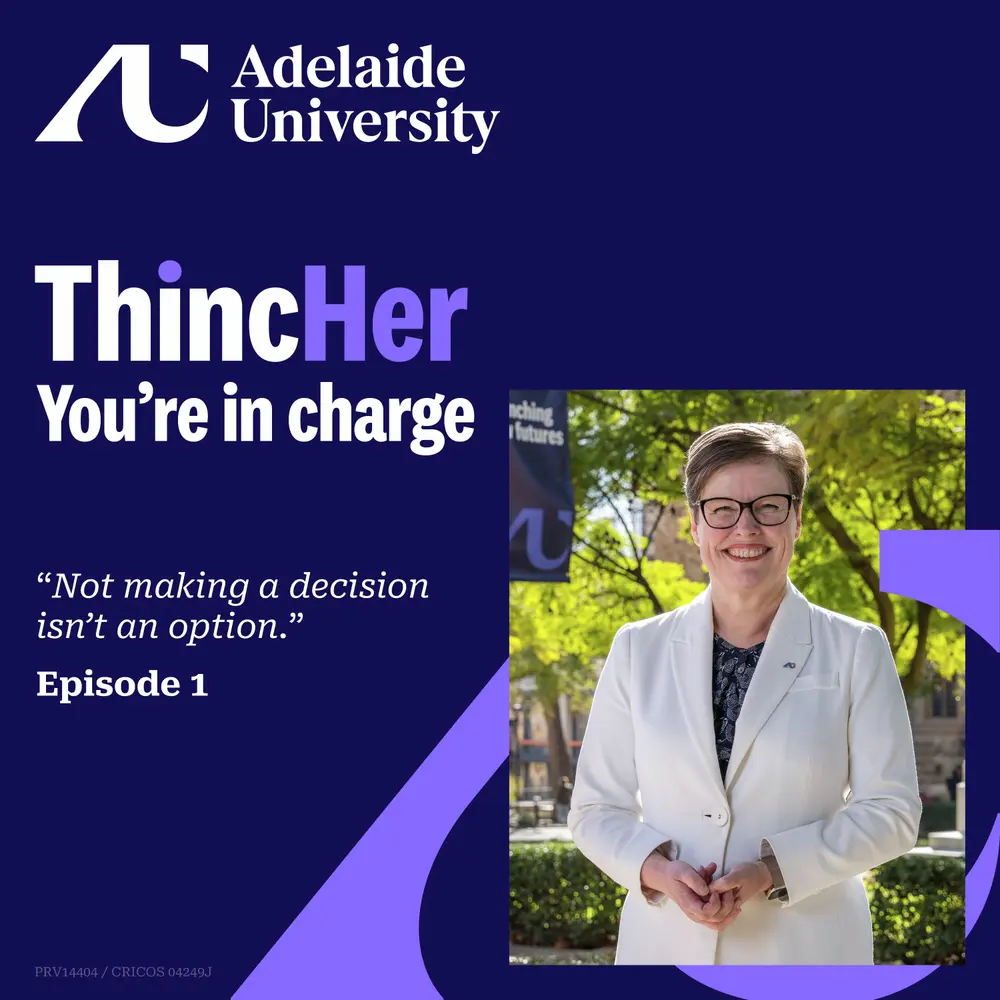
Working on the frontlines of one of the biggest mergers in South Australia today, Professor Jessica Gallagher has a unique understanding of the risks and opportunities that come with shepherding brands into a new era.
In this episode, Sav sits down with the new Deputy Vice-Chancellor International and External Engagement at the brand-new Adelaide University. Together, they lift the lid on the university merger and discuss the evolving realities of being a woman in leadership.
You’re in Charge is brought to you by ThincHer, an initiative of ThincLab at The University of Adelaide.
Transcript Search or select a timestamp to jump ▾ 0:00 Jessica Gallagher: Bringing together these 2 universities and creating a whole new curriculum, a whole new research strategy, whole new brands. There's risk. There's risk to that. But that's exciting because if we always did things the same way as the people that came before us, then there would never be any innovation. You would never see progress. 0:19 Sav Perera: Hello and welcome to You're In Charge, where we are helping you with starting your business journey by sharing stories and insights from the best in the biz. My name is Sab Pereira, and you may know me from MasterChef Australia. And just a few months ago, I decided to leave my corporate job and go into the world of private chefing and working for myself in my own business. And it is true what they say— starting your own business is hard work. But the great thing is, starting your business can also be incredibly rewarding, which is why I've teamed up with Thinker at the University of Adelaide to learn a bit more about the business of doing business. Together, we will sit down with some trailblazing women and talk to them about the business behind their successes. I'm talking about the business of building confidence, the business of bouncing back, the business of brokering security, and the business of being you through it all. 1:16 Speaker: Today, we are joined by Professor Jessica Gallagher. Hello, my name is Jessica Gallagher, and I'm the Deputy Vice-Chancellor External Engagement at the University of Adelaide and the Deputy Vice-Chancellor Chancellor International and External Engagement Elect for Adelaide University. 1:31 Sav Perera: With a background in comparative cultural studies, Jess has built a global career in business development, strategic partnerships, and driving growth through engagement. After taking on her current role at the University of Adelaide, Jess has used her skills and experience to drive recruitment initiatives, strengthen international outreach, and bolster alumni relations. And with the brand new Adelaide University set to launch in 2026, I'm looking forward to hearing how Jess will approach this time of massive change. Jess is a true leader in education, industry, and community engagement, and I have no doubt that you will be able to walk away with tips and tricks to apply to your own leadership style. Jess, thank you so much for being here. It's a pleasure to have you. Just to get things kicked off, it is— this is a bit of a broad question for you, but tell us about your day-to-day and what fulfils you the most in your role at the university. 2:34 Jessica Gallagher: Well, great to be here and thanks for the opportunity to have a chat today. So I am the Deputy Vice-Chancellor, International and External Engagement, which means that every day is very different. So this morning, for example, I announced a new partnership for Adelaide University with the Adelaide Thunderbirds. So ways that we'll be able to work together to support the community and to position the university's programs in exercise and sports science, community health, nutrition, but really thinking about ways that we can connect with a broader cohort of learners and support shared values that both organisations have around wellbeing and sport and exercise, the importance of that. So I started the morning with that. obviously have an opportunity now to talk to you about innovation entrepreneurship. This afternoon I have a steering committee with our partners in the UK talking about research collaboration that we are fostering in energy transition, space, AI. So every day is really diverse. Mm-hmm. And I can start my day with conversations in the US and end my day with conversations in China. And then in between there are opportunities to support government industry activities here in South Australia, thinking about ways that we can profile and position the university and higher education in media and through partnerships. So it's, it's such a privileged position to be in because I get to meet so many fantastic people, both within my institution but also with our partners. And I think there are very few roles where you are surrounded by so many talented people and having an opportunity to learn about their academic pursuits, their research activities, and then take that to the world. So through partnerships, expand opportunities, and through our marketing and media and other activities, elevate visibility of the great work of the university. So it is definitely the best job in the world. 4:38 Sav Perera: Oh, I love, I love that. And it's also nice to see that even though you're sort of not necessarily in the strict side of academia, that innate curiosity, which I think is in people that are in academia, it's still in you. And that's, I think, like reflected in that bit that you said about, oh, I love learning from all these like different people, which then sort of brings me to ask, there's traditional academia, which, you know, we all know, for the lack of a better term, can be a bit rigid. Yeah. What do you do, or in your position, how do you then drive innovation, or what strategies do you have in place to drive innovation in a setting that is, you know, quite— that can be quite traditional? 5:28 Jessica Gallagher: Yeah, and I look, I really think that universities are evolving. There is that perception of us being in our ivory towers and quite rigid, quite bureaucratic. But the fact of the matter is, is that we are wonderful sandboxes. You attract universities attract people from around the world. We have amazing diversity of our demographic. So when you have all of these creative, innovative people that want to push boundaries, actually, that's where a lot of magic happens. So I think that universities are incredibly innovative spaces, because you've got these people who are asking why. They, irrespective of their discipline, whether that's through research efforts in humanities or in engineering or in cutting-edge work in health and AI, you've got students, staff, partners, all wanting to discover new ways to unpack and understand our planet and our world and our societies. And to posing questions and developing new research projects and products that come from that. So for me, it's a very easy environment to be able to get people to ideate, to come together to collaborate, to really think through an issue before you jump to a solution. So we spend a lot of time really trying to understand what is it the problem that we have, and who are we trying to solve it for? And then through bringing together the expertise across our institutions, we look at data and evidence and new ways of thinking and multidisciplinary collaboration to chart new paths. So it's a pretty cool place to be. 7:15 Sav Perera: And I love that you said, I think this is really valuable for our listeners as well, because there are a lot of young women, a lot of young female young adults that are possibly thinking about you know, is university right for me? Yeah. Is this something I should consider? And someone who has been in academia, I'm all for it. I advocate for it. And it's really, I think, refreshing and important to hear you say it's a sandbox and that's where ideas are born. And I think it's also really important that you brought up the humanities, the social sciences, as well as like the hard sciences as well, like being in STEM and the equal opportunity and importance of both. So I appreciate that. 8:00 Jessica Gallagher: Well, now more than ever, in my opinion, I think we really need to ensure that we've got the humanities and social sciences working really closely with STEM fields because the state of the world is maybe not where we would want it to be. And I think it is about through coming together as, as humans, as people, to understand what is it that is driving our communities and our societies and how do we harness technology in the right ways to be able to best support some of our most vulnerable and to ensure that we leave a positive legacy for the generations that follow. And you only get that by multidisciplinary dialogue and collaboration. 8:43 Sav Perera: Yeah, I love that you said that because I think there's in— well, not, not saying I'm old or anything, but I think when I was studying and I was at university level, there was that definitive split. It's either you went into the social sciences or you went into STEM. And it's really nice, I think, in this day and age to hear someone that's in your position as a Vice-Chancellor say, no, we need both. I think that's incredibly encouraging. Now, to actually touch on sort of your role and what you do, because there is the branch of like academia and managing that, but there's also entrepreneurship, which is what we're all about here. Yeah, I think— how do you bridge the gap? Like, where— so it is a broad question, I do realize, but where does it meet? And talk to us about the risks that are involved as well for you in your role. 9:36 Jessica Gallagher: Sure. Well, look, I think we Universities are big organisations. We have thousands of students, thousands of staff, and we need to be ensuring that we're meeting their expectations, that we're running these billion-dollar businesses. And that comes with high levels of complexity and risk. There isn't a single thing that we do, whether it's about forming a new partnership, developing a new program, entering new markets to support student recruitment activities, that doesn't come with some degree of risk. And so it is about understanding that. So gathering as much intelligence as you can, so that due diligence around any particular opportunity, and then thinking through how does this align with the strategy of the organisation? What is our risk appetite and what might be approaches that we might take to mitigate risks to the organisation? We are merging, so we're creating Adelaide University, which you know, and that is a hugely risky project. There is so much attention on it. And I think so much hope from within the South Australian community, and probably, you know, beyond that, that we get this right, and that it is something that will make the state proud, that will support continued economic prosperity for the state, and that will deliver great outcomes for our staff and students. But doing this, bringing together these 2 universities and creating a whole new curriculum, a whole new research strategy, whole new brands, there's risk, there's risk to that. But that's exciting because if we always did things the same way as the people that came before us, then there would never be any innovation. You would never see progress. And that is definitely what the new university stands for. We are full purpose and we are absolutely looking at progress and how we can bring together the expertise and the strong foundations of the 2 existing universities to be able to do more. So I think risk, it's a balancing act. It's about understanding that with every opportunity there comes risks, but being able to gather intel, to surround yourself by really bright people who you can test ideas with, and then, yeah, taking calculated steps to ensure that you get great outcomes. 11:58 Sav Perera: Now, you spoke about risk, and having, you know, studied at LIMB in South Australia myself, there was always that, you know, split between like the universities. So it's a huge thing that, you know, this whole merger that's happening, it's like you said, it is massive. Talk to me a little bit about like the typical challenges that you come across, especially in terms of like perception and public perception, if you're allowed to actually speak about anything like that. Yeah, like, yeah, risk and how it's perceived. 12:29 Jessica Gallagher: So I think as I said, there, there's a lot of hope and ambition sitting around the construct of the new Adelaide University. And so there are lots of different ideas. There are lots of people come with different perspectives and different backgrounds. And the greatest opportunity that we have is to harness that. There is an assumption that the University of Adelaide, we celebrated our 150th anniversary last year, is a bit, perhaps a bit more old-fashioned, a little bit more stuffy. Whereas the University of South Australia is only, you know, 30 years old. 30-plus years. So it's, it's more industry-facing, it's less proven, doesn't have the research track record. And all of these, these are just stories that we tell ourselves. There are— the complementary nature of our universities is phenomenal. There are real strengths with both foundation universities. And if we can truly harness those strengths, we are going to have something that is really, really exceptional. And so that is the work that we're doing. And there are hundreds, thousands of people who are intimately involved in the development of the new curriculum, in thinking through our research priorities, in developing our brand and marketing strategies, in positioning the new university to the globe, because that's what we can do. So the new university can be a really significant attractor of talent to this state. And that's what South Australia needs. And that's what South Australia deserves. It is, we have such incredible opportunities here with the sectors in South Australia. So the role that we can play in the green transition, the role that we're playing in space and AI, the role that we are playing in national security, these are all really interesting sectors. And the university has the capacity to bring in talent to continue to bolster those, but also be involved through industry and global partnerships in delivering research solutions that help us make a step change in the work that we're doing. So it is really about harnessing the best of both and then taking it to the next level. 14:46 Sav Perera: And I just love the enthusiasm that you have because it's always— I think it's really refreshing to see someone at the top of a project like this who's quite high level, who is really actually passionate about the actual project itself and not like bogged down by— I cannot imagine how mind-bogglingly complex it is and how much weight is possibly on your shoulders. So kudos to you. Which actually brings me to you because we've spoken about the university and all these amazing things that are happening in the merger. But you yourself as a woman who has now, you know, gone through the ranks and come into this amazing position of being a decision maker and a change maker, really. I'm sure there are barriers in place and we always talk about how, yes, roles are becoming more equal. It is becoming more gender equal in Australia, I would say. However, not necessarily at the levels of senior leadership, not at the levels of senior management. So talk to me a little bit about that and your experiences. 15:53 Jessica Gallagher: Yeah. So look, In the higher education sector, I think you are seeing more females in, more women in senior positions. And there are quite a large number now of women vice-chancellors, which I think is fantastic. But, but you're absolutely right. It's, if you look across sectors, there still is a significant imbalance as it relates to gender in leadership roles. And that's something that we need to continue to work collectively to address. It's why programs like ThinkHer are so important and why I'm so proud to be able to be involved and to provide support, because it is about building confidence. It's about building confidence, building networks, providing opportunities for young women to connect with role models that can potentially help to sponsor and to steer them in the path where they wish to head. Because there are those challenges, I think that I've certainly found through my career that as I've had children, I've had to balance responsibilities in a very different way to my husband. There are, continue to be clichés at times around women leaders, women leadership that we need to address. But by coming together, and then that's, it's not, I always say this is not a woman's problem, this is a system's problem. And so we do need to ensure that we're working collectively with our male colleagues to shine a spotlight spotlight on the issue and to look at ways that we can address it. And in the entrepreneurship space, this, this is significant. If you look at the capacity for female founders to access capital, it's abysmal compared to their male counterparts. And yet we know that female founders are really successful. I mean, the data tells us that where you've got mixed founders or female founders, the businesses really succeed. So why is it that they have so much difficulty in finding that investment? And so we need to continue to build a groundswell. And the more that we support each other and provide role models and get behind the generations that come, I think the easier the path will be. But I'm, I'm realistic here in that this is not something that changes overnight. I still get very frustrated, frustrated by gendered conversations, and I see them. And somebody very wise once told me that once you see them, you can't not see them. You, you can't overlook them. And it is true. So, um, I do get frustrated. I have 2 daughters. I want more for them. I, I don't want them to see the types of gender imbalances that I think we still see today. And that means we've got to work together and we've got to be committed to, to making change. 18:47 Sav Perera: Thank you for that response. I love that you said it's not like just a woman's problem. No, it's a systemic problem. I love that because I think a lot onus completely falls on women to demand more, to ask more. But then there's another half of your population and like the society that's also not addressing it. 19:06 Jessica Gallagher: I get so frustrated with that. I have to say that I'm very fortunate that I get asked to speak at events about women in leadership and my career trajectory. And I get very frustrated when I look out into the audience and it's 90% women. Because we know the problem, you know, we're living it and breathing it. I get really frustrated when I don't see that there are male counterparts there because we cannot do this alone. And it's something where we really need to be working. You know, there are male champions of change, there are plenty of advocates out there and thinking about ways that we can have a more balanced conversation because us continuing to talk to ourselves is not going to deliver the change that we need. We've got to find ways to infiltrate. But also to bring others on board and to understand why organisations do better when there is better diversity at the top and the value of having a balanced leadership group from gender but also from other cultural perspectives. How do we ensure that we have the right organisational cultures to enable that? 20:18 Sav Perera: That actually brings me to talking about leadership and your position and about your actual personal style when it comes to leadership, because I feel like women who are in positions of leadership, they're— and like you said, there is a lot of success with female-run businesses despite the fact that there are barriers to entry into industry. Yeah. And that might be possibly because of the way that women approach leadership. So talk to me about like your style of leadership. 20:48 Jessica Gallagher: Yeah, it's an interesting one because it's not something that you sort of sit there and go, what kind of leader am I? Although it's something that I've been asked before. I generally think that my leadership style, I like to learn and I like to learn from people around me. So I don't go into a situation thinking that I know everything because I know that I don't. Yeah. I like to work as a team. So I really love being a part of a team environment where we all push up our sleeves and get in and do the work. I am outcomes-oriented. Yep. And solutions-focused. So I can make decisions. And I think that probably one of my strengths as a leader is my capacity to make the tough calls. So where there are situations that do require obviously an understanding of the issue, but someone needs to make a decision, I can definitely do that. And I do that by equipping myself with as much information, data, and seeking views from trusted colleagues as I can. but I can make decisions. I like to have fun and to have workplaces where people can celebrate successes. I am a big one for gratitude to the extent that sometimes people will say I say thank you too much. But I think it's genuinely important that we recognize the contribution of other people and understand that there is no lone wolf, that the whole kind of mantra about, you know, going alone and, you know, you won't achieve very much, but being part of a team is so important. And so really harnessing the strengths of those around you and recognizing the contribution that they are making to achievement of goals. And so kind of creating the environments where that thrives. So really building a team culture where collaboration is expected and is key, where we celebrate successes, where we take calculated risks and we can be creative and flex our innovation and entrepreneurial muscles. But that we have fun, that life is short. And so providing opportunities to be able to reflect on the great things that have happened, to have a bit of a laugh, and then get back in the trenches together. 22:59 Sav Perera: And I think we love to throw the word culture around. Yeah, but it is like, it's important having it as like collaborative, supportive network. And I think especially for a lot of our listeners who are possibly in like the toddler stages of what they're doing, you know, they're just starting off. that are thinking about going into owning a business, starting a business, into entrepreneurship. I think it's incredibly valuable that you said, I can make decisions when I need to, I can make the tough calls. And I think as often, in my experience anyway, I've been really conscious of causing too much upset in having to make a hard decision. I think it's important that there are people like yourself that young women can look up to that go— that make it okay to say, hey, It's okay for me to like set the rule. 23:44 Jessica Gallagher: And it's not always easy. I think you definitely, your skin gets thicker the more experience that you have. It's part of human nature to want to make people happy. Well, part of my human nature to want to make people happy, to not upset people. But the fact of the matter is, is that that's not always possible. And I think it is your responsibility as a leader to be able to make the tough calls when they need to be made because that's what they have you there for. And that's how you build trust and respect amongst your teams as well. When making decisions, being able to articulate, you know, what it, how you've come to that decision. And so having open dialogue about it, but you do, you don't have to be everybody's best friend. Yeah. It is about being respectful. Professional courtesy and respect is, I hold higher than anything else really. It's so important to me. That doesn't necessarily mean that you are going to make everybody happy and that's okay. And I think that that's something that we keep learning. And so, you know, there are times in your life where that will feel harder and the sting will be greater than other times. But to be, I think for the people listening to this podcast, you know, these are future, these are founders, these are our future leaders, these are going to be champions of industry and they're going to have tough times. And so knowing that there will be others that will be going through that same situation as them and then really tapping into that network and supporting each other is gonna be really important. 25:17 Sav Perera: Personally for me as well, because I went into setting up my own business in a very heavily male-dominated industry as well. And often something that you come across is you get these certain labels when you do, when you are unapologetic about the way that you show up. That doesn't mean you have to be rude. Like I said, there's nice courtesy, but that normalization of setting boundaries, setting and saying no and making tough decisions, especially I think for younger women, it's still not normalized because you're told to, you know, soften yourself. 25:50 Jessica Gallagher: Yeah. 25:50 Sav Perera: Be like, you know, gentler. But why? Like, why should you? So I loved hearing you say that because I think it just adds to that conversation of like creating that visibility around saying, actually, it's okay to make the decisions and be tough. 26:09 Jessica Gallagher: And you do it in your way. You don't have to do it in the way that your male counterparts might do it. Yeah. And I think that's the other thing that I believe is changing. I think that there was this view that in order to be a leader, you had to be one of the boys, you had to be tough, you had to be like one of, you know, take your influence from male leaders. I don't think that's the case anymore. I hope, I certainly hope that that's changing in that we get to define our own style of leadership and we get to take some of the great feminine attributes and apply those to leadership settings. And it is about, like I said, learning, seeing, seeing what works for some, what's good practice, what's not so great, and then adapting that so that it's your style and that you feel comfortable because it's authentic and it's who you are. 26:52 Sav Perera: Yeah, I just want to touch on what you said about not like losing what, like the feminine attributes, because I think especially in roles of senior management and leadership and when you are sort of, you know, high up on that corporate ladder, I would say that a lot of those feminine attributes, so to speak, the subtle, the subtlety, the gentleness, it's almost demonized in certain contexts, which is quite sad. And I think that does discourage a lot of women sort of from pushing forward going, well, I'm not one of those people that's like this, you know, tough as nails boss. How am I ever going to succeed? So I think it's really valuable for people that are listening that you said that. 27:33 Jessica Gallagher: Yeah, they need to be able to see that there are lots of different ways of leading and there is definitely not a one size fits all. 27:40 Sav Perera: Yeah. Yeah. Now talk to us about imposter syndrome. Now this is something that's really, really significant for me as well because I think, I don't know what it is and I don't know why women, well, I do understand why women have it a lot more because unfortunately society will tell them, oh, it's still not good enough what you do. But this is really valuable for me personally because I look at some of the things I've achieved, which are pretty cool, but I'm still here like, oh my God, like it's not— it's never good enough. And did I really do that? And talk to us about the role of imposter syndrome in your life if it does exist and how you possibly work through it. 28:25 Jessica Gallagher: It's so funny that you ask that because honestly, I think 2 nights ago my 15-year-old daughter asked me what imposter syndrome was. And so I was trying to explain it to her and she said, but you don't have that, Mum, do you? And I said, darling, Everybody has it. Everybody has it. And it doesn't, honestly, I genuinely think from the teenager through to the 80-year-old CEO, everybody has it to some extent. I think that we all are sitting here thinking any minute now they're gonna work out that I really don't know what I'm talking about and it's all gonna come crashing down. But, and you pinch yourself, I'm the same as you. I think that sometimes I look at what I've been able to achieve and the role that I'm in And I think, oh my, how did this happen? Like, this is just bigger than even my wildest dreams could have been. And you sort of start to think, well, I don't, I don't know what I'm doing. And new scenarios come up and you think, how will I manage that? Will I manage that? And the fact that whole kind of fake it till you make it is totally true. I mean, it's something that obviously lots of people say, but you don't have to be perfect at everything. You have to be willing to give it a go. And I'm a big believer in saying yes. So where you can lean into new opportunities, don't look at all the reasons why you think you can't do something. Find the one reason why you think you can and go full, full forward with that, because that's, that's what you need. But by putting yourself out there, you have an opportunity to get exposure to all kinds of new people, new experiences. And so don't let the imposter syndrome— it sits there on the shoulder. And just pat it every now and again. But on the other side, you know, have, have your champion, have your voice that tells you about that your star is rising and that you're able to go with that and to take the chances. 30:20 Sav Perera: I love that you said there's like the little devil within, like your little angelic champion. And I think it's one of those things where sometimes like the negative voice always gets louder, but it does get louder and it's really hard to drown it out. And I think it is— I'm like, with the women that I work and deal with, I don't know if it's like with men, it is more than fake it till you make it. And they— a lot of them will act like, oh, well, I know what I'm talking about, even though they may not necessarily. Um, and I, I don't know if it's like a lack of confidence, especially in young women, that stops them from faking it. it till they make it. But I think there is a bit of a shift now, especially in younger groups of women where they do take ownership, they step up and they own what they're doing. And I think it's really important for our listeners as well to hear someone at your level saying, yep, it exists for me too. And it's not this thing that just kind of disappears when you like hit 35 and then you're done. Like suddenly you're just I was completely self-confident. 31:27 Jessica Gallagher: But we gotta work together to, I think, to support our girls coming through because I agree, I think that somewhere in the teenage years that little devil gets bigger and they're far more attuned to that side. And so they stop making choices that are going to give them breadth of opportunity. And so the more that we can do in schools, I think, to help to counter and to build that confidence is really important. We, I got to speak at an event, I think it was last year, and I read some research about 8-year-olds being asked about what a CEO looks like. And it was something like 80% draw a picture of a man. And so at the time my daughter was 7 and 14. And so I asked my daughters to draw me what a CEO looked like. First I had to explain what a CEO was to the 7-year-old. I said, it's the boss. Draw me the boss. And what was so pleasing that both of my girls, I sent them off to different rooms to do this as my own kind of social experiment. And both of them came back with women. I love that. And so my 7-year-old had this gorgeous, it's the most gorgeous picture. I have it 'cause I will treasure it always now. But this picture of a woman and she had her finger out 'cause she was telling people what to do. And I thought, we're not quite sure whether she's gonna use her powers for good or evil, my little dictator. But I thought it was quite funny that she was like, well, she's got her finger out, grout because she's telling people what to do. My 14-year-old at the time drew a CEO that kind of looked like Elle Woods from Legally Blonde. Love it. But for her, it was sort of this kind of classy, kind of fun, hip. And I thought, you know what, we're making progress. That if they see leaders and heads of industry and founders as women, and they can see themselves in that type of role, then, then I think as a mum, I'm I've done a good job. I need to keep working on that. But holistically within our society, that's something we need to continue to do. 33:29 Sav Perera: I think it's valuable, especially for our young listeners that hear that, because there's all these things that you're fed about, oh, this is the kind of person that you need to be in business, and this is the kind of woman that you need to be in leadership. And there's always these structures, and there's a lot of like women get told how to show up. If that makes sense. Yeah. So I think it's valuable hearing you say, hey, you know, it's important to have the support, but— 33:56 Jessica Gallagher: Take the best bits of the advice. So be willing to listen and to hear different perspectives because I think that there may be a gem there that is going to be really valuable for you in the future, but disregard the rest. So it's okay to surround yourself with different opinions. And I think it's really good to surround yourself with different opinions and different perspectives. But take the things that will serve you and leave the rest and show up the way that you need to, to be authentic to yourself and to your values. And we haven't really talked about that so much, but I think values are incredibly important and understanding who you are, what you are, what you believe in, what you're prepared to tolerate and what you're not. The earlier I think that you can sort of establish that for yourself, the better it is. In particular, I think again for the audience, You know, that there will be tough times. I'm so in awe of female founders. Really, I want to be an entrepreneur. I just haven't found my big idea yet, but any moment now it's gonna come. Mm. I love the idea of being, that having an idea and being able to turn that into a business or service and the grit that comes with that, the knowledge that you've gotta put yourself out there and you gotta pitch to investors and you've gotta convince family and friends and colleagues that this is something something that has legs. I, I just am so inspired. So the fact is, is that a lot of the people that will be listening to this are already so ahead of the game in terms of my level of respect. I think that they should feel confidence in, in knowing that they've done something that most of us look at and go, wow, if only. This is incredible. 35:39 Sav Perera: That's actually the perfect segue because I was actually— I'd still want to ask you about start like building the confidence? Because I think confidence is that big thing that you need to get over when you are like, before you even get to the stage of like attracting investors. But like, how do you instill that like for yourself actually, that confidence in yourself to go, yep, I, this is the decision that I want to make, the rest is noise. Like, how do you, what's your process in filtering and building that confidence? 36:11 Jessica Gallagher: Yeah. So part of it I think is looking at the little wins. So kind of keeping a little bit of a record book of where you've had to make tough decisions or where you've been put in outside of your comfort zone in the past and how you've stepped up and how you've been able to succeed in those environments. And so remembering that this isn't the first tough thing you've had to do. And so if you could get through it once, then you can get through it again. And I do have that. I have days where I think, it's almost overwhelming the amount of work to get through and challenges associated with projects. And you think, oh my gosh, how am I ever going to do this? And then I tell myself, well, I've done it before, I'll do it again. And that's, it's as simple as that. You've done it before, you'll do it again. Will you do it exactly the same way? Probably not. Mm-hmm. You'll continue to enhance your toolkit, you'll gather experiences, you'll gather advice, you'll gather people around you that will make those scenarios easier in the future. But it is about look to the things, look for evidence of past. So not, like I said before, it's not about the reasons why you can't do something. Think about the things that you have done and why that might set you up to be able to do the next thing, which it's a bit of a, it is easier to hear the negative. And it's a task that we have to kind of focus on the positive. And you don't get it right all the time. Gosh, no. There are many days where I drown in self-doubt and then you've gotta kind of climb your way back through. But mostly it's because I genuinely love what I do. I genuinely love it. I genuinely think that I'm making an impact, a positive impact, and that I am in such an incredibly privileged position to be able to do the work that I do and to be making that positive impact with the communities and the stakeholders that I serve. And so it's bigger than you. You have a responsibility to show up and be the best you can because you are in that privileged position. And lots of people would love to do that, but you get to. And so don't waste it. You know, make sure that you're actually delivering for those that believe in you, but those who you also have a responsibility to. 38:27 Sav Perera: Jess, it's been incredible having you here and listening to all these amazing little gold bits of gold actually that you shared. Now, Now, for you yourself, whether it's your career or personal life, what do you want to master in 2025? 38:45 Jessica Gallagher: What do I want to master in 2025? 38:47 Sav Perera: Literally anything, because we had Javita ask that she wanted to master doing like a particular move on a surfboard. 38:53 Jessica Gallagher: Ah, okay. Well, there's a couple of things. So I've decided that I really want to learn how to play tennis. I'm not sure that I'm going to be able to master it in a year, but I have signed up for tennis lessons. and I'm very excited about it because it also contributes to my desire to get better at work-life balance. So to have other activities that I do that don't involve email, so being able to get out and get fresh air and spend time with family and to learn a new skill. But I also really want to give my 100% to creation of Adelaide University this year. We have less than 12 months until we open, and there's a huge amount of work that needs to be done still to ensure that we ready for day one. And that, yeah, I think for me that's a really significant goal and something that I'm proud to be a part of. So we'll be putting a lot of focus and effort into that this year as well. 39:49 Sav Perera: So not seeing you at the Australian Open yet? 39:52 Jessica Gallagher: I think it's going to be a long time before you see me at the Australian Open. But with any luck, I'll be able to hit the ball back over the net sometime soon. 40:00 Sav Perera: Jess, thank you so much for being here with us today and for the great chat. And yeah, any little parting words of wisdom for our listeners? 40:10 Jessica Gallagher: Oh gosh, parting words of wisdom. I would just say the best advice is the advice that you can give yourself. So definitely seek input, gather ideas, but, but trust in your instincts and trust in yourself. 40:25 Sav Perera: It was an absolute pleasure to have a chat with Jess Gallagher today. And for me, me, some of the key takeaways with the conversation that we had really focused around imposter syndrome, but also about expanding the conversation, not just in terms of how the industry and the world of entrepreneurship looks at women, but about bringing in our male counterparts as well. I thought those insights were incredibly valuable because, as Jess said, we have women showing up for a lot of industry initiatives that cater to women, but why do we not have men showing up as well? It's given me a lot of food for thought, and it was incredibly encouraging to see someone of Jess's caliber and someone who's at the level that she's at in her career also say, hey, I also have imposter syndrome, I also have days where I don't believe in myself, and then also give us a few tips and tricks to get herself out of that mentality. 41:30 Sav Perera: So it's been an incredibly valuable conversation for me. Here at You're in Charge, we are all about you and your business. 41:38 Sav Perera: So if this chat has inspired you as it has inspired me, definitely tell us. Search for ThinkLab— that's T-H-I-N-C Lab— on all the socials and leave us a comment, or email us at [email protected] . All the links and info you'll need are now in our show notes. Make sure you hit follow and share this episode with your friends because next week we are talking to Sasha Baranekov. Sasha is a self-made entrepreneur and growth strategist that thrives on the challenge of building business. 42:12 Speaker: Because at the end of the day, anyone could, like, 3 people can have the same idea, but someone will get, you know, Get it done. There's that level of resilience. People that kind of embrace challenge, you know, I'm somebody that I'm just drawn to challenge, like almost, you know, I'm not drawn to drama, but I'm drawn to, drawn to the hard thing. Then I think curiosity, like I said, you just want to learn and explore and, and go, how could I do that better or differently? 42:43 Sav Perera: Keep inspiring, keep striving, and always remember you're You're in Charge of your business journey. You're in Charge is brought to you by ThinkHER, an initiative of ThinkLab at the University of Adelaide. Google ThinkHER, that's T-H-I-N-C-H-E-R, to join our empowering community of like-minded women in business. You're in Charge was recorded on Kaurna land. We acknowledge the Kaurna people, the original custodians of the Adelaide Plains and the land on which the University of Adelaide's campuses houses at North Terrace, Waite, and Roseworthy are built. No transcript lines match that phrase. Try fewer words.




 ▶
 ▶
 ▶
 ▶
 ▶
 ▶
 ▶
 ▶
 ▶