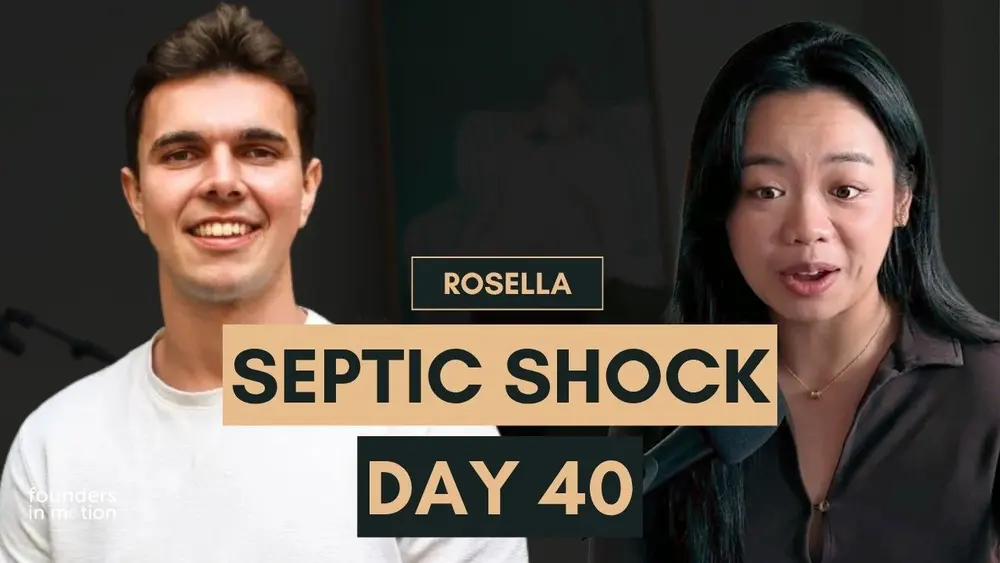
Hayden Smith started Pearler, a wealth management platform for everyday Australians. Eight years later, Pearler has over 100,000 accounts and $1.5 billion USD in holdings, making it one of Australia's most recognised long-term investing platforms.
We cover why a brokerage would actively discourage frequent trading, how his first startup CompareMeals died from exhaustion rather than failure, the equity split mistake most co-founders make, why he kept his lecturing role at UNSW for years into building Pearler, and what patience actually costs in a fast-moving industry.
Chapters
0:00 Intro 0:27 What Pearler actually is 0:54 Getting people started on the boring habit 2:46 The products: long-term, super, and investing for kids 3:36 CompareMeals: the first startup that fizzled out 5:29 Equal equity and the co-founder trap 7:42 Investors vs. "get rich slow" 10:00 Why he never quit lecturing at UNSW 10:33 The early days of Pearler 11:48 The mental-health edge 12:36 When it's actually worth going all in 14:43 Is patience a skill or a virtue? 16:19 Perspective, aging, and one last piece of advice Transcript Search or select a timestamp to jump ▾ 0:00 Hayden Smith: I had like no money because I just had this like bicycle crash. 0:02 Thea Ngo: Hayden built a company that tells you to invest, then leave it alone. He started it broke, kept his teaching job at UNSW, and built it slowly on purpose. 0:14 Hayden Smith: Patience probably has a much higher dividend outside of like immediate financial outcomes. Like if you're more patient with things in life, you'll generally just have happier days, better relationships, whereas it's hard to skill your way through. 0:24 Thea Ngo: And that startup built on the premise that boring compounds. Over 100,000 managed accounts and $1.5 billion 0:32 Hayden Smith: Hi, my name is Hayden Smith. I'm the co-founder and CTO of Perler, and this is Founders in Motion. 0:36 Thea Ngo: Every other platform in the market is trying to pull your customer's attention. New assets, new features, alerts, reasons to log in. Perler's pitch is basically set it up, then ignore it. First off, like, what is Perler? And then secondly, how do you keep someone committed to the boring thing when the whole industry is designed to make boring feels wrong. 1:03 Hayden Smith: The high level of Perla is we describe ourselves as, you know, the, the finance app or the wealth management app for the new generation. Our job is that people can have a bank, they can have a credit card, a debit card, they get paid from their job, they go and, you know, buy their groceries, they pay their bills, then they've got money left over. Yeah. And our job is to take every dollar of that money left over and put it towards a better, brighter future for them, their family, their kids, their grandkids. Cool. That's the crux of it. In terms of how we keep people, you know, on the journey, a huge part of that's always going to be about goal setting and like painting the picture. You know, I, I have this fairly strong view that once people understand how their actions can lead to something better, um, they can keep doing it. So the same is true for like health. Like let's say someone goes to the gym they want to lose like 1 kilogram. Once they realize that if they eat a certain way and then they lose a kilogram, it's like the rest is really easy. So a lot of it for us is like just trying to help people get started, get on the journey, because once they see that they save $1,000 and then they get this, you know, $50 dividend every year, or basically a dollar a week coming into their account, it's like, oh my God, that makes sense. I can see this journey now. I just need to do that more often. 2:15 Thea Ngo: There seems to be like a whole gigantic education component. And also making sure everyone gets that reward pretty quickly at the beginning. Like, how do you think about that when you think about product design? 2:28 Hayden Smith: A lot of it's just talking to customers and trialling things out. Like, you know, for instance, we used to have all this kind of complicated goal setups for people. And we've kind of changed that now to say, you know, if it's your first time investing, we're not going to set a why for the goal. We're just going to say, let's just invest $1,000. You know, keep it really simple because No one who's starting investing has an idea of what they really want a lot of the time. Like, yeah, they might say, I wanna retire or something, but they don't really have a number in their head. They don't know what that number means. They haven't really thought about it. So just keeping things really simple is like a huge thing for us in general. There's so much in finance that's complicated because people just haven't bothered to make it simple. 3:06 Thea Ngo: I'm starting in my investment journey as well, and it is really daunting. I have a finance degree, so I should be very financially literate, but all the things that we learn about are pretty inaccessible to people starting out with small sums of money. So if I were to log into Perla right now, what are the types of products that I could be investing in? 3:25 Hayden Smith: We have products that help you invest for the long term so you don't have to work forever. Basically build up a portfolio for a typical Australian that's gonna be like, you know, $1 to $3 million over many decades that they can live off, particularly before retirement as well. There are like ASX and micro products. We have like our super product, which is much more like kind of after 60. Yeah. Because a lot of people don't want to be like, wait until they're 60 to have financial independence, you know. They want to be able to like maybe go part-time in their 50s, so they need to build that up outside of super. And then we also have other product, another product that's really focused around investing for your kids. Because, you know, that's a, that is a big part of some of people's objectives is to like build a nest egg for their kids so they don't have to stress too hard about what's coming in the future. 4:10 Thea Ngo: Before Perler, you had a bit of a business. There was a meal kit comparison platform, CompareMeals. And you don't talk about it often. But take me all the way back there. Like, what happened with CompareMeals? What were you trying to do? And where did it end up? 4:27 Hayden Smith: We started off trying to make a business where it was easy for people to eat together and split the cost. We found that that was going to be quite difficult to make it. We ended up transitioning towards a business that was then just focused on meal kit, meal delivery services. Like, we saw a market opportunity because of the fact that these things were skyrocketing in popularity and no one had a place to frankly just like compare them. And we thought, wouldn't it be good if we could just capture that and capture the audience interest? So we literally just built a website focused on SEO. We went and scraped all the data from these companies manually. We put it all in, and then our objective was to quite literally just do what Finder and stuff do where we gatekeep it, we get a bunch of traffic in, and then we say it's going to be cheaper for you to pay us for the traffic than it will be to use Google Ads because we've got, you know, good qualified people coming in. And the crux of it was pretty good. Like, we got the business going. We mostly just ran out of like stamina. We got fatigued. We didn't know how to raise capital. We didn't think we wanted to. You know, we just were very inexperienced and, you know, we started making some revenue, but it kind of just fizzled out a little bit towards the end. Obviously, there are lessons there that were learned that helped in a business like Perla, but you've got to go through it the first time, you know, make those mistakes. But the principle of it was a good business. But often, like, a good business idea is only a tiny piece of the puzzle too. 5:54 Thea Ngo: So that's a really great segue. So from this first business, what do you think you've learned that you really brought into Perla? 6:01 Hayden Smith: There's a lot of, there's a lot of little things. Like one good example was when we started Perla, I was probably the least fussy about equity because I'd been in a startup that had kind of gone for a while and I'd watched people argue about equity, kind of seen the, you know, the manifestation of that idea of 100% of zero is zero. Yeah. You know, so I kind of went into Perla being like, that's a distraction to me. I still tell founders to these days, I generally think equal equity is the way to go. Unless there's like a clear power dynamic, because the second you make things unequal for like what is a generally equal relationship, it creates like strange perverse incentives and disincentives for people. 6:44 Thea Ngo: So say like it's a 50-50 co-founder, but I've seen some place recommend where one person should have 51% and the other person 49% for easy decision-making. What's your perspective on that? 6:56 Hayden Smith: You can pretty much answer every founder question by looking into questions you'd have about romantic relationships. People say like, how do you find your co-founder? I'm like, I don't know, how do you find your life partner? Like, you just spend time in the world, and the more time you spend in the world and the nicer you are and the more interesting you are, like, it would just kind of happen. Yeah. You know, it's not like you say you go to this place on a Friday night and you will find your future husband. And but it's kind of similar to the 51 thing. Like, there are types of relationships out there that thrive in their, like, equality in their partnership dynamic. There are types of relationships that thrive when there is a power dynamic, or there are different roles that people have, you know. There's no right or wrong answer there. Yeah, 51 could work. Uh, I think it's just no matter what happens, nearly every single time I've seen a dynamic, if, if someone has 60 and the other has 40, um, that person who's got 40 will work less hard. Eventually. Yeah. And I think that's the biggest thing people miss is like, it's all happy at the start. But then like, you know, when you're under the pump and it's Saturday and you've got a lot to do and your co-founder who has more equity than you isn't working. Yeah. You know, it's really easy to just not work. 8:13 Thea Ngo: Yeah. 8:14 Hayden Smith: And that will kill the business. 8:15 Thea Ngo: Perler's philosophy is all about going slow. But you've raised external capital. 8:21 Hayden Smith: Yes. 8:21 Thea Ngo: And with external capital, investors have expectations. So growth timeline, eventually an exit. I can imagine there's a version of Perler where their philosophy around getting rich slow and growth levers are pointing in different direction. So have you had investors who want to come in and change the way you operate? 8:41 Hayden Smith: One of the reasons it's hard to grow quickly is because there's a lot of inertia in finance. People don't change what they're doing as much, but that has a benefit on the flip side that you also have a much lower churn. Yeah. So I think investors are smart enough to see that, is that, yeah, okay, you might grow slower than Duolingo might be able to grow. But on the flip side, most customers tend to stay with you. We see this with the superannuation at the moment as our superannuation products growing slower than our other products have grown historically. But also the rate at which people will be leaving superannuation will also be much lower because that's why it's hard to get them on because For the other super companies, they're not leaving them too, because it's such a sticky product. So I think our investors seem pretty good at understanding that that's just sometimes the nature of finance, but there's always more you can do, particularly for the easier products, for sure. 9:32 Thea Ngo: Yeah. What about like investors who are not on your cap table that wanted to come in, but they were like, oh, I'll only come in if you like, I don't know, start trading crypto or stocks or whatever? 9:42 Hayden Smith: The mood changes a lot. Like it's so interesting. You know, we went through the crypto phase. It was like, what are you doing in crypto? crypto, and then that died out, and then it kind of became the AI phase. And then it's still the AI phase a bit, but I think like back in 2024 it was very like, what are you doing to like keep up with all the OpenAIs of the world? Yeah. You know, and now there's a much— there's a different proportion of the energy which is more like, how are you going to make the business more efficient? Or how are you going to do this part of AI? We're starting to see that people are starting to, to some extent, reappreciate the fact that we are a fairly stable business. The fact that we're not a type of business that AI is going to eat. So in that sense, it's like the way investors feel about you kind of comes and goes. And I'd say it often oscillates. 10:35 Thea Ngo: Throughout this entire time, you've held onto your role at UNSW. as a lecturer. So a lot of founders, especially these days, shed everything that isn't the company. 10:48 Hayden Smith: Yeah. 10:48 Thea Ngo: Why have you held on to the role? 10:50 Hayden Smith: In the early days, I needed the money. Like when we started Perla, I think the first 3 and a half years I put money into Perla. You know, I put less than my co-founder Nick, but yeah, I wasn't making any money from it. I had very little money when we started Perla. I think I'd actually think I had like no money because I just had this like bicycle crash and I'd paid all my medical bills. So I was like negative money basically. I was negative money in the sense I had like $5,000, but I had like a surgery coming up that was like more than that in the next couple months. So at that time I just needed the money. Yeah. You know, after a while, like I think once we started making money, it was less about like I'll do this for the money and it was more like I'll do this because it's There's a few key elements. One is it's just helpful to connect with so many students and the uni generally. 11:43 Thea Ngo: Keeps you young, in touch with the generation that you're serving. 11:46 Hayden Smith: Yeah. If you go back till 2019, I think it's something like 6,000 or 7,000 software graduates in Australia in the last 6 years have had to be taught by me at some point. And it's like, that's a lot of people. And that's practically useful. It's personally fun bumping into people. It's hugely motivating, which I think gets into the second point, which is like, I don't have children. And I think I find this really funny as someone without kids, because like people often look at founders and whenever founders have to do kid stuff, they're like, oh, that makes sense. But then if they do a non-kid thing, it like is seen as a distraction. It's healthy for people to come home to something that's broader than their startup. I've only seen a few of them in my orbit, but some of the really like the most worst-case mental health cases you've seen with startup founders, they're often young people, I find. So I think it's like the shortest explanation I give is like a mental health hedge. It's like an easy way to think about it is like to have something where sometimes it's a really crappy workday and I'll go to the uni at 6 PM and I'll lecture for an hour and it perks me up seeing all these young people excited to learn about computing. And then sometimes the students will be very difficult and annoying and then I'll go back and do some work with my employees And I'll just realise how smart and talented they are. And I'll be like, you're amazing. I appreciate you all so much. So it's just a way to break up life. The argument to go all in gets stronger the later you get, which I think a lot of people have this image of like the best way to start a company is to go all in. And it's like, it depends what type of company. Like, because a lot of companies you just can't do that many productive hours. Like if you're a health tech or a fintech. 13:25 Thea Ngo: It's going to take some time. 13:27 Hayden Smith: takes time. So the idea of like going in from 9 to 5 before you've launched a product is like crazy because you just— it's— you're going to be making up BS work, and then that's just going to stress you out that it's not achieving anything. The aim is to work as hard as you possibly can for all the work that matters. I'm feeling that with AI a lot, is I'm doing like less teaching, less personal hobbies, less like outdoor activities than I've done in a long time because, you know, in, in April of 2026, I feel this existential changing point with AI. And I feel like uniquely right now, more than ever, is me just spending literal— I'll spend hours on my Sundays just using it. Yeah. Whereas 2 years ago in 2024, I was like, yeah, I don't really see what I'm going to do with this yet. I'm not saying I was right or wrong there, but now I'm like, oh my God, I can see the dividend of the time I'm putting in. So I think it's just good to use common sense as to when is the right time to just completely go crazy with it all. 14:26 Thea Ngo: I think everyone has this notion where AI can help you do your work better, which is true. But then you just feel like, holy shit, because I can do so much work, I need to do more stuff. 14:37 Hayden Smith: Yes. 14:38 Thea Ngo: It doesn't really help you spend more time doing other things. It just makes you have higher expectations for yourself. Well, 14:44 Hayden Smith: that's the funny part I think people miss is the next 20 years are terrifying in my view. The like 30, 40, 50-year case for AI is extremely positive. Yeah, because like once we figure out all the crazy things we can do with it, it's going to enable us like nothing else, right? And that's that feeling, I think. It's like realizing, like when you see that opportunity, like I had this yesterday, I was like, we could build games. 15:07 Thea Ngo: Yeah. 15:08 Hayden Smith: Like I could, I could just make a game, like an investing game. I could never do that before because intelligence wasn't commoditized like that. 15:16 Thea Ngo: Okay, so Hayden, you've built Perler for people who want to do the boring things consistently. Do you think patience is a virtue or a skill? 15:26 Hayden Smith: It'd be hard to look past skill, but a lot of people don't have skill or access to it, I think. Or they might have the access to, even through their natural temperament, through their access to resources, through their life circumstances. I think what's tricky is that patience probably has a much higher dividend outside of like immediate financial outcomes too. Like, if you're more patient with things in life, you'll generally just have happier days, better relationships, and stuff like that. Um, whereas it's hard to skill your way through some of those. I tell people that's my— that's like the coolest part about getting older, because like getting old is demonized a lot. For me, is like, I— as I get older, I feel like my capacity to understand patience gets improved. Because I've had to wait for stuff. Yeah. And I realized as well that things will solve themselves, which also helps my stress levels too. Like when I talk to a young person, they're like, I have this problem. And I'm like, well, it's fine, you just like wait it out. Like if I'm dealing with a difficult employee, if I'm 21, I just want it to solve today. 16:28 Thea Ngo: Yeah. 16:28 Hayden Smith: Whereas like now I'm kind of like, that's okay, you know, we'll sort it out by Christmas. Like these things take time, all things take time. If we want to grow the business, it's going to take another few years. Like all of that stuff. And I think that is one of the coolest parts about aging generally is you've just seen more. So you're like, your ability to— like, I think aging makes you more patient as a general rule. 16:49 Thea Ngo: I mean, one thing I really like is that like a lot of small disparate things that feel super random in the moment typically ties up into a beautiful little bow. 16:57 Hayden Smith: Exactly. Yeah. 16:58 Thea Ngo: At one point. 16:58 Hayden Smith: Yes. So that's another example is like the older you get, the more likely you are to kind of just see like this is probably going to be part of something That I'll understand later. 17:07 Thea Ngo: So, okay, if someone is still young, they haven't aged yet. 17:10 Hayden Smith: Yeah. 17:11 Thea Ngo: How do you think they can like add more patience when everything else is going like a mile a minute? 17:16 Hayden Smith: I think the way to solve most things in our head is perspective at the end of the day. So the more you can do to get perspective is great. This means like talking to different kinds of people, going to different kinds of places. Like I'm a millennial, so I don't want to fall into like the, like, travel is self-actualization trope, but it's like— 17:35 Thea Ngo: I've learned a lot in my travels. 17:37 Hayden Smith: Yeah, and just, just doing stuff, you know, it's something I think about a lot is like, how often do I talk to McDonald's shift workers these days? When I was 17, I did a lot because they were just like around, but then it's like your career kind of hyperfixates you in— 17:52 Thea Ngo: That's true. 17:53 Hayden Smith: The same area. Um, I miss uni because I used to hang out with all kinds of different people, and before uni, hung out with people that weren't even going to go to uni. Um, so I just think broadening your perspective however the hell you can. Go read— like, I'm generally like a fairly left-leaning voter. I love reading right-wing news just because I'm like, what the hell is this stuff, you know? And it's like, whatever you can do to do that, I think that the flow-on effects of like your patience, your understanding, your stress levels, your— like, all those things will, I think, often fall into place if you can get a good perspective on as much as possible. 18:29 Thea Ngo: So you've probably picked up a ton of wisdom, but you have to say the one, one, one thing that when an eager early founder comes to you and asks for advice, what's that one piece of advice that you would give them? 18:43 Hayden Smith: Make sure you save more money every year than you started it, and make sure you're learning as much as you can and that you say yes to as much as you can. I don't know, that sounds very generic and not startuppy, but I think it carries pretty well. 18:58 Thea Ngo: Generally carries to a lot of aspects in life. 19:01 Hayden Smith: Yeah, because it's hard to kind of give startup advice because it's so idiosyncratic. It's like giving relationship advice. It's like some people say, oh, communication's really important in a relationship. It's like, well, yeah, obviously. But then it's like, okay, well, common values are, and a common understanding of the future. There's so much to unpack. And like different dynamics of different people in different situations would mean that certain things matter more than others. But for me, it's like, if, yeah, if you just keep learning and you just keep saving— saving's obviously a bias because like I don't come from like a wealthy background. So I found that as long as you're saving, at least you're not going backwards. Yeah. Because a lot of people, I think, like a lot of financial— a lot of startup struggles do end up being about finance at the end of the day. Um, I've seen it firsthand, people overleveraging on their startup. And they have like meltdowns because they're like, I've screwed myself financially. I like sold the house. I'm like, don't sell your house to start the company. I'm like a very pessimistic person in that regard. When someone's like, I'm all in, I'm like, unless your parents are like worth millions of dollars and we'll just like guarantee it all for you, like don't take huge bets. So, you know, keep your life stable is what the save more is. And now as much as you can, then yeah, just keep learning. 20:10 Thea Ngo: Well, thanks so much, Hayden. This is great. 20:14 Hayden Smith: Yeah, thanks, Thea. 20:15 Thea Ngo: That's a wrap. If you like this episode, please hit the like and subscribe button. It helps us bring on more awesome guests, level our production, and bring on new series you'll want to watch. 20:24 Speaker: And if you want to hear more early-stage builder stories, check out our other episodes. Okay, see you next time. No transcript lines match that phrase. Try fewer words.



 ▶
 ▶
 ▶