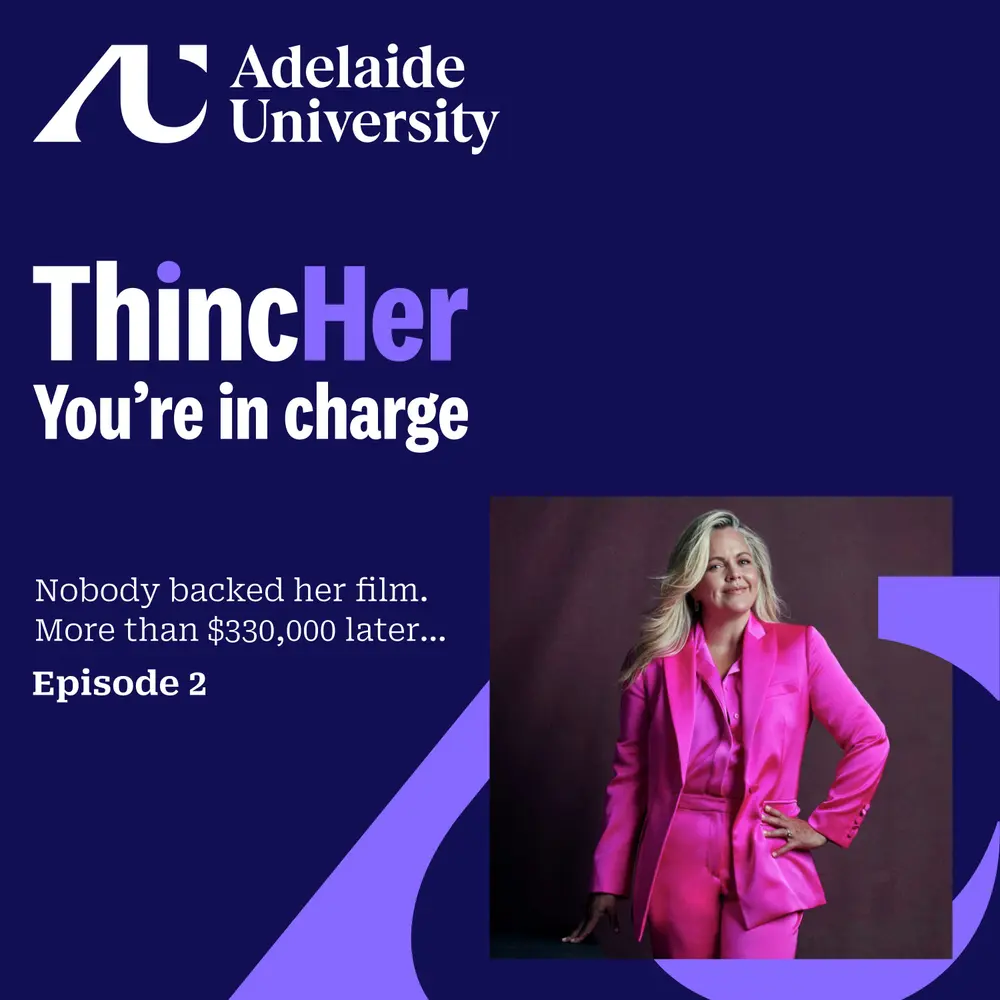
After winning The Block in 2013, Alisa Fraser and her twin sister Lysandra took the leap into business. These days, the two lead a multi-million-dollar interior design empire and are constantly looking for new ways to meet their customers’ needs.
Today, Sav sits down with Alisa to unpack burnout, the mindset you need for the first 5 years, and the realities of business after reality TV.
You’re in Charge is brought to you by ThincHer, an initiative of ThincLab at The University of Adelaide.
Transcript Search or select a timestamp to jump ▾ 0:00 Alisa Fraser: At the very beginning, when you're starting a business, like you need to say yes to everything. You need to be able to put yourself out there. You don't know what opportunity will lead to the next. So you do. You need to say yes to everything. Yeah. And that's just the game. 0:14 Sav Perera: Hello and welcome to You're in Charge, where we are helping you with starting your business journey by sharing stories and insights from the best in the biz. My name is Sab Pereira, and you may know me from MasterChef Australia. And just a few months ago, I decided to leave my corporate job and go into the world of private chefing and working for myself in my own business. And it is true what they say, starting your own business is hard work. But the great thing is starting your business can also be incredibly rewarding, which is why I've teamed up with Thinker at the University of Adelaide to learn a bit more about the business of doing business. Together, we will sit down with some trailblazing women and talk to them about the business behind their successes. I'm talking about the business of building confidence, the business of bouncing back, the business of brokering security, and the business of being you through it all. Today we are joined by the amazing, inspiring Eliza Fraser. You may know Eliza from her time on the hit TV series The Block Australia alongside her sister Lissandra, and this experience revealed their passion and talent for interior design. Since then, Elissa and Alessandra have gone on to establish their own interior design business, A&L Interiors, and in 2020, they launched their personal care brand, Alive Body. Get ready to hear how Elissa's resilience and creativity has led to her building a thriving business. Let's dive in. Elissa, thank you so much for joining us here on You're In Charge. It's an absolute pleasure to have you here. Just to kick things off, you've had this amazing trajectory. You've gone from being a police officer to winning The Block and then going to design, and now you've got this amazing brand. All of that is happening while you're having your— fostering your personal relationships, while you're having your life, and now you're balancing this ever-evolving career. 2:21 Alisa Fraser: Mm-hmm. 2:21 Sav Perera: Talk to me about that balance. How does it look like for you? What is it? What does it take? 2:26 Alisa Fraser: It's always like a juggling act every day, but I think, um, over the years both Lawson and I have managed to work out little things that we can do that help us like juggle the day-to-day. And obviously when you are starting a business and you have to dedicate every waking hour to it to build the business up to a point where you can then start employing people to help, you know, like my husband now is a full-time stay-at-home dad. So that is a massive help for me, but that's taken 13 years being in this position to be able to really bite the bullet and go, I'm hiring myself an EA. I've got, you know, Well, Sandra's got her own assistant too and just a team to support Um, you know, the everyday-to-day running of the business. So it's always going to be a bit of a juggling act. And but it's just, yeah, it's just finding those little things that you can do that, you know, having the brain capacity to, you know, be present with your family or take a day off if you need to. Or, um, but yeah, it's, it's certainly, you never get it the right balance, that's for sure. 3:47 Sav Perera: Yeah. I'm interested in you saying that, you know, because your husband's taken on that role of actually being in that space of being at home. And I think for our listeners particularly, there are a lot of young women that are getting into business or thinking about it. And I think for a lot of those people, it's valuable hearing you say that delegation is important because I think that's where, like, when you have your own little— this child really that you've had as well, this baby. 4:15 Alisa Fraser: Totally. 4:15 Sav Perera: You do want that control over it. Yeah. Talk to Talk to us about that process of like, actually, you say, you know, it's taken you 13 years to hire someone and get your team. 4:26 Alisa Fraser: Yeah. 4:26 Sav Perera: Like, tell us about that process and how like letting go of that like degree of control was for you. 4:31 Alisa Fraser: Yeah, been 13 years. And I guess when Lissandra and I came off The Block, we started our own design business and, you know, we had one or two assistants that helped us within that business, but probably wasn't really until we launched Live Body that, that's when we started to really get a team around us and it went from, you know, 1 staff to 3 staff to 4 staff to 10 staff to 15 to 20. You know, we're nearly at 40 now. 5:00 Sav Perera: Yeah. 5:00 Alisa Fraser: So that's been a, you know, an evolution. But I think as well, especially being new to this whole running a business and what it looks like is It's that fine line of letting go and delegating, A, when you can afford to pay people to do it. 5:21 Sav Perera: Yeah. 5:22 Alisa Fraser: So that you are running profitable business and you're not just taking, you know, money out of the business because you don't wanna do something. And then it's that it takes time to make sure that you get the right people in the business that you can trust, that you can then let go of the control. 'Cause I am, naturally a massive control freak. 5:43 Sav Perera: I can relate. 5:45 Alisa Fraser: And I know what I like, I know what needs to happen. And if, you know, my standards are bloody high, unless that person is at the level or the standard that I would expect, then I really don't let go. So that really comes down to you're only as good as the people that you hire. 6:01 Sav Perera: Yeah, it's amazing that you said that because we kicked off this whole series with Junior Ellis, who actually said something very similar about taking on people on board who have a similar value system to you. And it's— I think it's really valuable hearing you echo that sentiment as well, as someone who's started her own business and built up this amazing career. Because, you know, you— it's not something I think you think about until you have to think about it. 6:28 Alisa Fraser: And I agree. And I think, like, if there's any piece of advice that I would, you know, tell my younger self or tell anybody else Um, you know, any entrepreneur out there that's starting their own business is do not underestimate the power of making the right hire. And there are times when we've settled when we shouldn't have. There are times when— and I think that probably comes down to just being a little bit naive and understanding what talent is out there, because it's very easy when you don't know something to think, oh, they're okay. But then when somebody better comes along and you're like, well, that is the caliber. 7:11 Sav Perera: Yeah. 7:12 Alisa Fraser: That this business needs, not this. Yeah. Then all of a sudden that's when you start to— yeah, you just start to be a little bit more— you understand. I think with time you understand the impact that the right people can have and the negative impact that the wrong people can have. Because trust me, you're never going to get it right. And if you hire a bad— and it's happened to me recently— that if you hire a bad hire, it can be toxic for the entire team. And then you spend your time focusing on building culture and worrying about HR issues when you really— your sole focus should be on building the team and also building the business. 7:55 Sav Perera: Yeah. And it's taking time away from things that you Like they're not making your life easier when they're supposed to. 8:00 Alisa Fraser: They're not making it and they're not making you money. 8:03 Sav Perera: Yeah. 8:03 Alisa Fraser: At the end of the day, you're spending time over here when you need to be spending time over here building the business. 8:08 Sav Perera: Yep. And because you— we were talking about like values as well. So what are those like in terms of how you run your team, how you run the business? It is a broad question. What are the things that you really champion and actually value in your team as well? 8:25 Alisa Fraser: So to me, it's— again, I do have very high expectation of what good looks like to me. And, and that's commitment. That's the ability to be able to— if I walk out the room, you're still going to act the exact same way. You're still going to be as committed. You're not turning around. 8:48 Sav Perera: Yeah. 8:48 Alisa Fraser: Having a conversation, you know, not doing work. It's It's a worth ethic. And I think because I've always— both Lissandra and I, we grew up with a single mum. We— she had her own business when we were growing up. We saw how hard mum worked, and that was instilled in us. So everything we do in life, it's 150%. So that's just something that's been instilled in us, and now I expect the same of others. Yeah. But yeah, it's that commitment, it's the, it's the integrity. Yeah, you know, if you turn your back, but yeah, they're still going to, you know, be working. Um, but it's also the ability to work in a team and be able to support each other. And if everybody needs to roll their sleeves up and help each other out, that they do. It's not, this isn't my job, I'm not doing it. Like, I hate that. And you know, things do go wrong in business, so if you don't have people in your team that are like, all right, we're all in this together, let's, you know, let's figure it out together, then you're never gonna— Yeah. You're never gonna last. Um, and then for me, the other thing is just, I think, the ability to have an open and honest conversation. 10:09 Sav Perera: Yeah. 10:10 Alisa Fraser: And actually have a voice. I would much rather somebody across the room in a meeting sit there and tell me their opinions, tell me their thoughts, tell me their, you know, we should do this because of this, I worry we should, you know, this, you know, could be an issue down here, or, or are confident enough to challenge me. 10:33 Sav Perera: Yeah. 10:33 Alisa Fraser: Than somebody that sits in the corner and doesn't have an opinion. 10:37 Sav Perera: Sure. 10:39 Alisa Fraser: So I think that's the other thing is that you have to be able to bring something and not sit on the fence. 10:46 Sav Perera: You encourage dissent. 10:47 Alisa Fraser: Yep. 10:48 Sav Perera: Yeah, I love that. I also actually want to touch on something you just said about your mum being a hard worker, and I reflect on my own mum who was also the same, and I think that's a generation. She was born in the '50s, very, very, very hard worker, but with that also came burnout as well. So now you're in the second generation of continuing that fabulous work ethic, so How does, like, how does the management of burnout and, you know, making sure that you are still actually feeding yourself as well, how does that look like? Um, you know, we— you're never gonna have, like, yeah, the perfect day every day. So yeah, what does that look like for you? 11:28 Alisa Fraser: Yeah, I think, like, life has just been so busy for the last 13 years, and I mean, for the first 6 years it was you know, getting into bed at 2 AM and waking up at 6 AM, and it was just like incredibly busy. And I, I actually don't know how Alessandra and I didn't burn out 11:49 Sav Perera: then. 11:49 Alisa Fraser: Then, like, it's just not like human— like, it's just not— nobody should go through that. 11:56 Sav Perera: I think men just kind of go, yep, that's just what I got to do. 11:59 Alisa Fraser: Yeah, it's not human nature to put yourself under that much stress. It wasn't really until last year was probably the hardest year for me, um, just with a lot of internal issues, um, and business was going great, but the internal issues suck you up and they just take you off. And it's just so emotionally challenging. That at the end of last year, it was like, that's probably the first time I had officially like burnt out in 13 years. I just crashed and I hit rock bottom, rock bottom, and I couldn't see the light. I was like, I can't do this anymore. I'm like, I've got nothing. Luckily got to the end of the year, Alessandra and I took the family and the boys and we went through New Zealand and spent time in nature, which is always, you know, grounding. Yeah, I had time to reset and, yeah, crashed when we were on holidays. And then the new year came and I was like, something has to change. I can't do that again. I don't want to do that again. Um, and so yeah, I hired an EA, said I'm working from home 2 days a week. I just need to distance myself a little bit and get out of my own way. Got a team around us now. We don't need to being there every day and I absorb people's energy too much. 13:28 Sav Perera: Right. 13:28 Alisa Fraser: And I'm, you know, a bit of that empath where I pick up on energy, which can be really exhausting when you're working with so many people. 13:38 Sav Perera: Yeah. 13:38 Alisa Fraser: And everybody has their on days and their off days. And I just was like, I am wearing this energy and I can't because I'm not being the best version of myself at work. I'm not giving the, the company what it needs. So I made a really like— yeah, it was, it was a decision to say 2 days from home, give myself some headspace and just get out of my own way. And I have started to do that this year, and already I feel like 80% better. Yeah. But yeah, I think it's just important to, to realize when you are, and taking the time to work out what are those. And it doesn't have to be changing the world. It's like, what are those small things that you can do to prevent that? So small things such as, now I get my hair washed once a week. 14:33 Sav Perera: Yep. 14:33 Alisa Fraser: Because I've got thick hair and I can't think of anything worse than getting home and wasting an hour washing and blow drying my hair. 14:43 Sav Perera: Yep. 14:43 Alisa Fraser: So now I go to the hairdresser's, I work on my phone, I get so much done because I'm by myself. I'm not getting interrupted, and it's nice and relaxing. It feels nice, and I can switch off from everybody coming at me. So it's little things like that. 15:00 Sav Perera: Yeah. 15:00 Alisa Fraser: It's saying on Fridays, you know, my husband and I will go for a coffee and we'll go for breakfast, and then I'll start work. So it doesn't have to be huge things. It's just Yeah, being able to recognize it and recognize what those— what are those things that cause you anxiety? 15:16 Sav Perera: I, I really love— well, firstly, I hope you're proud of yourself for actually recognizing, you know, you needed to work on this aspect of not burning yourself out completely. Um, and I think it's really valuable for our listeners to hear that, like, despite being in the biz, in your business for more than 10 years, that that balancing act is so very real. And I think people just expect that you just, you just make it work. But to hear you be vulnerable and say, actually, it wasn't servicing me and I needed to set a boundary for myself— because I think for me personally as well, I struggle to set the boundary because if someone's like, oh, let's just do this. 15:59 Alisa Fraser: Yeah. 15:59 Sav Perera: My first inclination is to people-please and say, yeah, I'll do it, not think about, oh, like, have I even looked at my calendar? Can I even do it? Is this like feasible, like fiscally? So I think it's been incredible to hear you say, you know, it's okay to set your boundary for yourself. 16:19 Alisa Fraser: And I think just on that as well, like that ability to say no to things. And I think because we've been in the game now long enough at the very beginning when you're starting a business, like, you need to say yes to everything. You need to be able to put yourself out there. You don't know what opportunity will lead to the next. So you do, you need to say yes to everything. Yeah, that's just the game. I think as you go along in your journey and, you know, you've been around long enough to go, well, that— and it's— and it is— it was not a selfish thing. Am I going to benefit from this? 16:55 Sav Perera: Yeah. 16:56 Alisa Fraser: But taking my time away from work or my family to spend time over here when, hey, I probably don't really wanna do it. I feel like I'm obliged. I feel like I should versus I actually don't have any time and now you are taking time away from my family or that 3 hours on the business is far more valuable than it is, you know. 17:18 Sav Perera: Yeah. 17:19 Alisa Fraser: Being invited to a luncheon or whatever it is that you get invited to a million times, you know. throughout the, the year. It's really sitting down and going, do I have the energy for that? Will I enjoy it? Do I want to go? And what am I giving up if I go? Um, and, and you definitely get better at that. 17:38 Sav Perera: And I just love that because that's really like an emotional cost-benefit analysis, really. Um, and on that, I just also actually wanted to ask, so because we will have a lot of listeners that are young entrepreneurs and young women looking to get into business. And I think the ability to say no comes with confidence as well. 17:59 Alisa Fraser: It does. 17:59 Sav Perera: So when you first started out versus now, like, how did you foster that confidence and what does that look like for you? It's a big question. 18:06 Alisa Fraser: I also— and I did say yes to everything. 18:09 Sav Perera: Yeah. 18:10 Alisa Fraser: And we don't— I don't regret that at all. Like, it all leads to where we are now. And I do think if you— the thing is, if you're young and you've got the time and you're not giving up time with your family and you're starting off, then I think like, yes, there's a confidence thing, but then there's also a, yeah, I should be doing this. 18:33 Sav Perera: Yep. 18:33 Alisa Fraser: Because it's almost like you need to— it's not earning your stripes as such, but it is like everyone needs to start somewhere. And to me, that whole part of saying yes to everything at the beginning, that's just a part of earning your stripes, I think. Because if you're not saying yes to everything, then you're saying no to a potential opportunity. Yeah. And I think the further you get along, and there's always, every time you say no, even now, there's potentially an opportunity that we're giving up. But it's funny the way that you change. Like when you look at, If you're looking at it from a commercial sense, it's like working out how much you earn a year, how profitable the business is, dividing that by every hour and going, all right, I earn this much an hour. And over here, like, that looks good on paper, but when you actually break it down, this is what I earn an hour. So why would I give up this? Yeah. and spending time growing our own business for something over here that's paying a lot less. And if it doesn't not serve us, or if it doesn't fill my bucket up for whatever reason, then I'm doing myself a disservice by just saying yes to people please. 19:54 Sav Perera: Yeah. And I think, um, what you brought up now about, you know, what do I pay myself an hour, incredibly valuable. Because I think when you're starting off in business and that certainly was the case for me as well. It was, it was heavily focused on, okay, I need to like get all the opportunities I can get. But then you just forget to pay yourself a fair wage to actually put value on your time. Yeah. And I think a lot of like young women especially are like fed that thing of like, no, you just, you know, got to do all this backbreaking work because that's just what's expected. But then You know, you need to build up that confidence to charge what you're worth. 20:33 Alisa Fraser: Yeah. 20:34 Sav Perera: Yeah. 20:34 Alisa Fraser: And that just comes with time, really. Like time and confidence. And, and at the beginning you do, you do just have to— 20:44 Sav Perera: yeah, 20:45 Alisa Fraser: you have to work for nothing. You have to put in the hard yards. 20:49 Sav Perera: Yeah. 20:49 Alisa Fraser: And if you think it's going to be anything other than that— and I think this is why unfortunately so many people don't succeed because they try it for 2 weeks, 2 months, or, you know, even 2 years, and I'm like, I'm not getting anything from it, or I'm not, you know, this isn't what I thought it would be, or this is too hard, or this is— I don't want to do this. Well, unfortunately, that's part of it, and you've got to take the good with the bad. It's not just the good. Yeah. And, you know, if you can't do this, then you're not gonna— you're not gonna survive over here. 21:23 Sav Perera: Yeah. And I think the motivation piece is really important in that because I've Actually had this chat with a few of the MasterChef contestants because a few of us have actually gone into the business of hospitality and food. And a common thing that comes up is like, oh, I don't know if I'm making enough money. Like, it's like so much like hard work and etc. And I think you just have to keep reminding yourself that any small business in the first 2 years is really not going to turn a profit. 21:52 Alisa Fraser: 100%. 21:52 Sav Perera: And you just have to keep your cash flow alive. And I think people just don't clock to that. So like, talk, talk to us about that motivation piece for you when you started off. 22:02 Alisa Fraser: Yeah, we were very fortunate at, you know, to have the money that we won from The Block to support a lot of the decisions that we made and not being able to pull money from the business for the first couple of years and reinvesting it. But you're right, when you're starting a business, you get paid last. 22:20 Sav Perera: Yeah, 22:20 Alisa Fraser: because that is your sweat equity going into the business. And anybody that thinks that they can start a business and pay themselves a decent wage to begin with, yeah, I mean, unless you're getting investment or, you know, unless it's family wealth, then you're dreaming. 22:40 Sav Perera: Yeah, 22:41 Alisa Fraser: yeah, 22:41 Sav Perera: yeah. And it's like, it's a hard pill to swallow, I think, because there's like this disillusionment. Yeah. You're like, oh, I'm going to succeed straight away. And I think like it comes back to what you say, that's why a lot of people fail, because, you know, you— 22:55 Alisa Fraser: Nobody understands. Like, nobody understands the dedication, the work. And it is a long game. Like, only now are we building the nice homes, driving the nice cars, going on the good holidays, going— that's taken 13 years of freaking hard work. Like, I don't know anybody that has worked as hard as Lissandra and I. 23:22 Sav Perera: Yeah. 23:22 Alisa Fraser: I'm talking day, night, every bloody week for 13 years. And so it's a hard pill to swallow when people come around to your house, oh my God, I should own my own business. And I'm like, oh my God, oh, you've got no idea, no idea. what it takes. And unfortunately, you're right, people glamorize, you know, the whole entrepreneur owning your own business, you know, blind, you know. And I think potentially like the Instagram and, you know, showing Instagram versus reality hasn't helped. 24:02 Sav Perera: Yep. 24:02 Alisa Fraser: But, um, the reality of it is, is that if you're not willing to put in blood, sweat, and tears. I mean, I'm gonna say probably for the first 5 years. 24:13 Sav Perera: Yeah. 24:14 Alisa Fraser: Then, um, and if you go in with that mindset, then I think, yeah, you're not going to set yourself up to be disappointed or fail. 24:23 Sav Perera: Yeah. And you just said something really interesting about the whole, like, social media versus the reality aspect of it. And I think people do, you know, celebrate their successes on social media, which does actually, I think, lead to a lot of the disillusionment. Yeah, disillusionment as well, because what you're seeing that's presented so nicely could have 10 years of work like in the background. 24:48 Alisa Fraser: So, oh, you've become a success story overnight? Yeah, in your eyes. You didn't see what I did for the last 10 years. Like, it's not that— like, it's— you, you can never become an instant success overnight. 25:01 Sav Perera: Yeah. 25:01 Alisa Fraser: That— but that's what social media does. That's what, you know, everybody thinks from the outside, that it's just 25:08 Sav Perera: quick, 25:09 Alisa Fraser: easy, you're done. 25:10 Sav Perera: And because you only, I think, ever really share like the positive side of it. Um, and I've actually, uh, for me personally, I've post being on TV and then doing all this stuff. 25:21 Alisa Fraser: Yeah, 25:22 Sav Perera: I do actually take my time because social media is the game. You have to keep on top of it. 25:27 Alisa Fraser: Yeah, 25:27 Sav Perera: everyone has to be their own content creator. 25:29 Alisa Fraser: Yeah. 25:30 Sav Perera: And I try to actually share a lot of my fails. 25:32 Alisa Fraser: Yeah. 25:32 Sav Perera: Um, and a lot of the work that I do during the week, I am working with like a lot of food, doing all that stuff. And I'm like, I'm not this perfect cook. There's stuff that's burning because I just completely forgot about it because I was doing stuff. And I think there's a lot of value in like engaging with that vulnerability as well, especially for young people wanting to go either into your industry or into like entrepreneurship. So yeah, tell me a bit about like You know, vulnerability and like the role that it plays in your life. 26:00 Alisa Fraser: That's probably why Alessandra and I maybe have, you know, been successful for 13 years post-block. And the number one thing that we get from our followers or people on the street, or, you know, if we go to an appearance or whatever that looks like, is that you guys are so real. And I don't think there's enough authenticity out there. I think, you know, maybe it's not just social media, maybe it is people glamorizing, you know, entrepreneurship, you know, themselves. But, um, I feel like we equally, if not, I probably show more of the, oh, I just had a 14-hour day at work. 26:42 Sav Perera: Yeah. 26:43 Alisa Fraser: Than more of a, oh, like this. 26:45 Sav Perera: Yeah. 26:45 Alisa Fraser: You know, you do the high— I would do the highlight reel at the end of the year, but yeah, we certainly don't like make it look glamorous, that's for sure. And we certainly don't sit there and say it's easy because it's not. But I do think being vulnerable— and if you look on social media, who do you gravitate towards? Yeah, you gravitate towards the people that are real. 27:06 Sav Perera: Yeah, 27:06 Alisa Fraser: the people that are authentic and the people that you can relate to. 27:09 Sav Perera: Yeah. 27:10 Alisa Fraser: And Lissandra and I have always been that way. And, you know, I think that's probably why we gravitate to people that are that way as well. And I think it's so important. 27:18 Sav Perera: I I think that what you said was incredibly valuable because we had Brooke Upton on the podcast who said, you know, you wake up and go to bed with these people, and if you can find a moment to actually validate that, like, give a bit of validation to someone that they're doing okay, like, it doesn't have to be all like roses and rainbows all the time. 27:39 Alisa Fraser: Yeah. 27:39 Sav Perera: I think that's incredibly valuable, especially for our young listeners, um, especially, you know, being in the sort of I think climate now where things can get really overwhelming. Yeah. And to 27:51 Alisa Fraser: say, like I said, like, I feel like it was— I think, um, when you're authentic and vulnerable and you don't know what impact you're having on people at the time, and it's not until someone will come up to you or, you know, Sandra and I went to a, um, a bathroom expo where we, um, had our vanities on display and we saw all these people come through the door from our, uh, you know, they're interior designers or in that space. And the amount of people that came up to us that day like they had known us for 15 years and said, you guys are so inspiring, you inspired me to start interior design, you inspired me to do this, was so— like, by the end of the day, we were just like, What the actual fuck just happened? 28:41 Sav Perera: Yeah, 28:42 Alisa Fraser: because you don't think that you have an impact on people. Like, we don't ever think like our words or what we do actually have that effect on people. 28:51 Sav Perera: Because to you it's just you're on your little phone. Exactly. In your little— 28:55 Alisa Fraser: Yeah. And you're like, who am I? How am I gonna like help somebody? When you hear that kind of thing, you're like, shit, like we need to make sure that we keep doing it because if we can have an effect on people's lives or inspire them in a certain way, or whether it's, you know, they were going to quit, but, you know, they've been inspired to keep going because we've shared the fact that the journey is hard. And if you keep pushing through, you'll get there. Then like, how cool is that? 29:24 Sav Perera: Yeah. And I think like, because you said at the beginning, you know, you are taking a lot of opportunities when you're starting the business off. And obviously the drive is you want to make money and money, be successful. But it must be amazing now down the track that it becomes enmeshed in your motivation to go, actually, what message am I giving to these people? Because they are listening. That must be amazing. That must be an amazing feeling. 29:46 Alisa Fraser: Yeah, it is. It's good because like sometimes you just feel like you're putting your head down. You're not really having an impact. You don't have the time and energy to give back. And there are certainly those times where you're just like, if someone asked me for one more thing, I don't— my bucket is tipping. 30:04 Sav Perera: Yeah. 30:04 Alisa Fraser: And I don't have a single bit of myself to give. 30:07 Sav Perera: Yeah. 30:08 Alisa Fraser: And then there are other times where your bucket's half full and then you've got that clarity to go, okay, like, how do we give back? How do we offer? You know, even if it is— and my God, we get so many DMs on Insta. Can you please tell me what rug I should buy? Can you just— I'm like, oh my God, like, please be respectful of our time as well. Like, it's actually phenomenal. And you might write one question. Yeah. 30:31 Sav Perera: Yeah. 30:32 Alisa Fraser: And then they like ask another 10, and it's like, okay, okay, okay, enough. So when you've got the time and you've got the capacity to give back, I think that is the greatest joy. But sometimes you just can't if, if you don't have anything to give. They're the times where it's just like, leave me alone. 30:52 Sav Perera: Yeah. 30:53 Alisa Fraser: But other than that, it's like, listen, I always say the fact like We can't wait to be in a position where most of our time is spent on helping people. 31:04 Sav Perera: There's an amazing woman called Elizabeth Broderick who was the Sex Commissioner for Australia, and something that she said a few Women's Days ago stuck with me. And she says, as women, you have to do what you can when you can. 31:18 Alisa Fraser: Yeah. 31:19 Sav Perera: And I think that really reflects what you said as well about just waiting for that moment where you don't have it up to your ears. in stress to actually go, okay, now I have a bit more of my time to give. 31:29 Alisa Fraser: Yeah. 31:29 Sav Perera: What can I do? 31:30 Alisa Fraser: Yeah. 31:31 Sav Perera: Yeah. 31:31 Alisa Fraser: Yeah. 31:32 Sav Perera: What I also now actually wanted to ask is, 13 years in the game, you've had, like I said earlier, like this amazing trajectory where you've really worn all these different hats. So talk to us about diversifying the business now, because you've gone from the interior design aspect to now Alive Body, which is like, yes, there's, you know, parts that are crossing obviously because it's lifestyle. But, you know, talk to us about that diversification process and also possibly what's next. 32:02 Alisa Fraser: Yeah, well, that happened very organically. Wissam and I obviously started our interior design business when we finished The Block and then did that for 5, 6 years. And then we kind of fell into the next venture of bought a property in Albert Park in Melbourne and we flipped it, and then the market crashed and we didn't actually make money on it. I mean, this is why everything happens for a reason, and you need to trust the universe. And our idea was make money on it, continue to flip homes. And when we didn't make money on it, we're like, holy shit, this is not like— we can't, we can't do this again. That was way too stressful. Got back and, well, yeah, it just— the idea came into my head. Just, 32:48 Sav Perera: yeah, 32:48 Alisa Fraser: it was like literally something that just jumped inside my body because we were struggling to find beautiful hand soaps to style our bathroom with in our Albert Park project. And then it just came to me like I was literally just at the desk one day and I was like, we should partner with Palmolive to create a designer range. And then I was like, no, like, we're not partnering with Palmolive. We're doing this ourselves. 33:17 Sav Perera: Yeah. 33:17 Alisa Fraser: So I kind of just went underground for 6 months and just worked on the concepts, the name, the ethos behind the brand, and then kind of came back up for air and said to Lissandra, like, what do you think? She's like, love it, let's do it. And so, yeah, she believed in it that much that she sold her house. to put money into the business. Wow. Yeah. And lived pretty rough for the last, like, well, not now, but when we started the business, you know, she was living in rentals and at the back of her friend's house. And that's what people don't see. Yeah. You know, people don't see the sacrifice that you get. People don't see the risks that you wear. 33:56 Sav Perera: Yeah. 33:56 Alisa Fraser: For making big decisions. That took 2 years to get off the ground. And yeah, we've been around. We're celebrating our 5th birthday at the moment. 34:03 Sav Perera: That's so exciting. Yeah. And how do you keep things fresh now with the brands, with the— 34:10 Alisa Fraser: Oh, well, it does help having ADHD because I can't stop. Like, my brain doesn't stop. And being naturally, you know, we're both very creative. We're never short of an idea. 34:21 Sav Perera: Yeah. 34:22 Alisa Fraser: So, you know, ask a non-creative person that and they'd really struggle to go, oh, you know, we have to do market research, we have to, you know, but it's just like I've got too many ideas in my head to actually execute. 34:34 Sav Perera: Yeah. And where does your team come in in terms of ideas as well? Because you spoke about like creating this like inclusive space where they can dissent, where they can actually have their opinions and stuff. 34:45 Alisa Fraser: Yeah. 34:45 Sav Perera: How much of that does actually end up going into what you implement? 34:50 Alisa Fraser: So we, we've got a full NPD, which is new product development, R&D, research and development team, and we meet regularly to talk about what's in the new NPD pipeline. Where are the gaps? What's customer feedback? And then a lot of the decisions will be formed or initiated from Lasada and I seeing a gap in the market or something that we're like, oh, that's annoying. Like, if that's annoying for us, then that's annoying for other people. So a lot of it is fed down from us and then into the team. But like, even 2 weeks ago, we had a session where everybody puts their ideas into a big spreadsheet. whether it's come from our reps out on the road, from feedback they're hearing, whether it's internal team members or their friends, or whether it's from Lissandra and I. And then we sit down and we discuss why it's a good idea, why it's not, the feasibility, the commercial, you know, does it make commercial— is it commercially viable? Yeah. And yeah, and then we kind of create the pipeline from, from that. 35:57 Sav Perera: Yeah, that's so exciting. But like I said, it's taken 13 years to get to that point where It's more of a seamless process now versus when you had to do literally every single thing. 36:07 Alisa Fraser: Yeah, we— Alaya's been for 5 years and that's where we've really built the team. So, but I guess, yeah, well, from that 5 years now being able to go, this is my idea. 36:21 Sav Perera: Yeah. 36:21 Alisa Fraser: Or Cassandra going, hey, can we do this? And then conceptualizing it. which is like sometimes the hardest part is putting it all together so it makes sense with how it flows in with your other product offerings or how you see it in your head and then like trying to get that out of your head onto, you know, a piece of paper to then hand it over. So there's a lot of time spent in that space and then it gets sent down to the team from, you know, brand marketing down to NPD through to graphic design and, you know, then onto the salespeople or onto ops. So at some point you're like, job done, on to the next, go. 37:04 Sav Perera: Love that. Post-block, as you said, you know, you've had the— obviously the finances to fund this thing that you've been doing. 37:14 Alisa Fraser: Yeah. 37:15 Sav Perera: Would you have gone into interior designing anyway if you didn't win? 37:17 Alisa Fraser: Probably not. 37:18 Sav Perera: Really? 37:18 Alisa Fraser: I think I'd still be in the police force, probably. Okay. 37:21 Sav Perera: Yeah. And that really did make a huge impact. 37:25 Alisa Fraser: 100%. We would not be sitting here today if it wasn't for the Block. 37:28 Sav Perera: Tell us a little bit about, like, you know, what were, like, the early opportunities like? What were you actually doing versus, like— I know you said, like, you do bigger projects and stuff now, which is natural. 37:39 Alisa Fraser: Things like, you know, working with big national brands like Forty Winks. We created our own bed range. You know, we still continue to work with Island Tiles, Reece Bathrooms, Luxaflex. There was just so many different opportunities to work with, you know, Mirvac, which is a big development, development company. Just so many opportunities. But remembering 13 years ago as well, I feel like it was a different space for brand collaborations, partnerships, whereas now it's a little bit more authentic from a you working with them ongoing to create that relationship. It's not so much more brand ambassador. Yeah, anymore. Yeah, because every influencer now is a brand ambassador, um, whereas in the day before, like, social media was a big thing because really Instagram was only starting to be big when we were coming off. Well, we didn't jump on the train. We're like, what is this Instagram? They want us to post like We don't like this. So it was really only becoming big then where it was like back in the day it was like sponsorships and brand ambassadors and that, that have one, you know, person representing the brand where I think that that really is starting to change. 39:01 Sav Perera: Yeah. And I think it's also like it wasn't really used as a business tool like it is now because people have careers built entirely on promoting stuff. 39:10 Alisa Fraser: Yeah. 39:11 Sav Perera: On TikTok and Instagram. 39:12 Alisa Fraser: Yeah. 39:12 Sav Perera: Which like blows my mind. 39:13 Alisa Fraser: Like that LTK or whatever it is where they just promote stuff to get. 39:17 Sav Perera: Yeah. Yeah, which is— I think it's like, it's good, but then there's also like, it's hard, I think, when you're starting off in business because you've got to be your own content creator, you've got to edit your own videos, and that's on top of running a business. Yeah, sure, you've got— yeah, yeah. And like, it's so— and like, I'm sorry to make like a food analogy, but it's literally like you've got 4 pots on the stove. 39:38 Alisa Fraser: Yeah. 39:39 Sav Perera: And you're just literally like trying to like juggle. 39:41 Alisa Fraser: Yeah. 39:42 Sav Perera: Where they're going. 39:43 Alisa Fraser: And I mean, I personally can't think of anything worse than being in front of the camera. Like, get me behind a camera for a product shoot any day of the week than put me in front of the camera. Hats off to influencers that can do it, jump on stories, talk, you know, just like being in front of the camera, because it really is like— it's— you deserve to get paid. 40:07 Sav Perera: It's a different skill set. 40:09 Alisa Fraser: It's a different skill set, and it's work at the end of the day. Like, It takes so much time to film the content, edit the content, post the content. Like, you get every bloody cent that you make. 40:21 Sav Perera: And I think you're constantly having to like assert yourself as well, especially when you are younger, when you're a woman, you just have to be like, no, this is my value. And you constantly have to, 40:33 Alisa Fraser: you 40:33 Sav Perera: know, be like, no, like, pay me what I'm worth. And it's hard. Yes. And I think we'll have a lot of listeners that are like, how do I manage that aspect of it, especially when the landscape has changed for how you market yourself and how you market your product and your business? 40:49 Alisa Fraser: Yeah. 40:49 Sav Perera: Yeah. So for you, like, life's changed. You said you've got, you know, 1,000 ideas in your head, but what inspires you? Where do you find inspiration to go, hey, that's something I want to include? And it can literally be about Alive Body, about interior design, about your actual personal life? Like, what— where do you draw— where do you draw inspiration from? It's a big question. 41:13 Alisa Fraser: I think definitely nature. Like, I'm— something about nature. Like, get me in the hills, get me in 41:23 Sav Perera: trees, 41:23 Alisa Fraser: water areas, water by the sea, whatever it is. So a lot of inspiration comes from that, from like I guess from a color palette-wise, like an aesthetic. But it's really hard to ask a creative where they get their ideas from because, like, I know this sounds really like a cop-out, but they're just in my head. Mm-hmm. And I can't explain it. Like, and that's why I guess, you know, we I guess are successful is because it's not— some people have to really try to get ideas. It's like, I don't know, it's like an accountant. You can put numbers up, they get it. 42:14 Sav Perera: Yeah, yeah, I'm the same. 42:17 Alisa Fraser: Like, I get numbers, but I'm like, how did you do that? Where did you— like, how did you learn that? I don't get— so it's like design. It's like you can't really explain. I feel like design and creativity, you either have it 42:33 Sav Perera: or you don't, 42:33 Alisa Fraser: or you don't. And it's not something that you can explain, but it's also gut intuition. It's a— it's an intuition. Like, Lasana and I, when it comes to interior design, we would move things around like something doesn't feel right. And we would have this process of if it wasn't— if she wasn't feeling it, if I wasn't feeling it, then we would fight it out. 42:58 Sav Perera: Yeah. 42:59 Alisa Fraser: And then it was this gut of like, something's not quite right. And then we would keep going until it was. And then we'd both look at each other and go, that's it. 43:08 Sav Perera: Esoteric. Yeah. 43:09 Alisa Fraser: Yeah. So I think it's just this intuition that you can't— I don't think you can teach it. Yeah. And The thing is, we didn't know we had it until it was like— 43:19 Sav Perera: Tested. Yeah. 43:20 Alisa Fraser: So it's interesting. And I think that's probably a good takeaway for your listeners as well, is that you don't know what lights you up. Like, I, I mean, I knew that interiors lit me up to an extent because I loved making over my house. And when my friends would come over, I'd be like, oh, this is really beautiful. Really wasn't. But I guess for the time it was. Yeah. So I knew that lit me up, but never did I think I could make a career out of this, or I'm good enough to do this. But I think once you give yourself the opportunity, or somebody has the belief in you that you potentially didn't have in yourself, that it's amazing what you can unlock. Because what else is there that we haven't done that we would feel equally as passionate about? We were just given the opportunity to unlock this. So if you're stuck in a job or you're doing something that you don't love and you're like, I don't know what my, you know, what lights me up. Yep. Just keep trying those things because this lights us up like we would never believe. It's so hard. We put in all this dedication, like we work our asses off, but we are so lucky that we get to do what we love every single day. And I look at the clock and I'm like, oh my God, please don't be 5 o'clock. I'm not ready. I don't want to like it's not time, I'm like, I'll keep going. And to find yourself in that position of doing something that you truly love and that you're passionate about is the best. And if you're doing something that doesn't light you up in whatever way, and it's not necessarily running your own business, and I think that is the thing, you can be equally as successful and equally as fulfilled working for somebody else who takes the stress out of cash flow and running a business and all the bullshit that comes with it, and you can still like play in your space or, you know, get to do your art that you want to do. Oh, what's it called? There, there's a name for it. Where is it? An intrapreneur. 45:27 Sav Perera: Hmm. 45:28 Alisa Fraser: Where we've got a lot of entrepreneurial people that work for us that are very driven, very but don't want to run their own business or probably wouldn't be good at running their own business, to be honest. But they're very motivated and they're very aspirational with inside the business. 45:45 Sav Perera: Yep. Yep. 45:47 Alisa Fraser: And probably equally as fulfilled. 45:48 Sav Perera: I loved like hearing about like that creative process about inspiration because I think it's easy to forget that when you are a creative, there's just so many branches of it. Because for me personally, like I know where I draw my inspiration from straight away. it's always rooted in nostalgia. And I know that, like, I cook from memory, I cook from childhood, and then find different ways to translate it. But then yours is a lot more of like an intuition feel and where you're just like, if it's right, it's right. If it's not right, it's not right. And then you get people that are in like classical creative fields, like painting and art and that kind of thing, which is a whole entire process. Yeah. But I love that you said that it's Yeah, that you normalize really that it's okay to actually not have this thing of like, that's where I'm getting inspiration from, that's what I'm inspired by. Yeah. Because yeah, 46:42 Alisa Fraser: it's funny, like with artists and singers, like a lot of that is like fed down from generation. Yeah, that is just again a talent that you're potentially born with. That is your calling. That's probably been something that's been passed down through your family. You know, yours is nostalgic. I do think there is a— Lissandra and I grew up with a single mum. She had no money. We lived in housing trust. And I remember just feeling mum always made sure we went to good schools. And so we were surrounded by middle-class families who had a nice house, you know. 47:17 Sav Perera: Mm. 47:18 Alisa Fraser: The, you know, dad at home, mum stayed at, you know, mum at home, dad was working. So we got to kind of see how the middle class lived. 47:28 Sav Perera: Yep. 47:28 Alisa Fraser: And then also going like, there was that feeling of like, as a kid, embarrassment. 47:37 Sav Perera: What? 47:38 Alisa Fraser: Going, oh, our house doesn't look like their house. Our street doesn't look like— our suburb doesn't look like— so there was potentially this unknowing Like, we would paint the house to make it look nicer. We would, you know, back in the day, suede paint was a thing. And like, you could, you know, do anything to Housing Trust homes. Like, you didn't need permission to, to do it up. And like, so we tried to make it feel like, I don't know, nicer, like our own home. It was our own home, but, you know, we didn't own it. And so maybe it was then. Maybe it was that how do you make something look good on a budget and being able to look at something and turn it into something else? Yeah. So I do think that there was this underlying element to how we got brought up. 48:33 Sav Perera: But, and there's also, I think, like that's what you said before about certain things just can't be taught. And I think that's true of all creatives because what you're essentially doing with your product, your art, your thing that you're doing is you're creating an emotion. And a lot of the times it is an emotion of warmth and comfort. And you can't be taught that. Like, I— that's to me, like, it sounds so silly, but I'm like, I want to cook. I don't want to cook like a chef. I want to cook like a nonna because that's the feeling that I want to give people. And I'm sure that, like, you create these spaces for people to feel warm and safe in. 49:10 Alisa Fraser: Yep. 49:11 Sav Perera: And that's like something that just can't be taught. You just, you just know that it feels right. 49:15 Alisa Fraser: Yeah. Yeah. And I think you're right, like it's not sterile. It feels homey. It feels, you know, um, it feels functional. It feels considered. It feels safe. Intentional. Yeah. 49:28 Sav Perera: Yeah. At least it's been amazing having this chat with you. Just for yourself, what do you want to master this year, whether it's a personal skill, whether it's a professional skill. Yeah. What do you, what do you want to master? 49:43 Alisa Fraser: I think for me it's just prioritizing my mental health, getting out of my own way and allowing myself the space to empty the bucket so that I can find moments of joy. 50:03 Sav Perera: Yeah. I love that. Elisa, thank you again for being on You're In Charge. I actually have learned so much to take away from this entire conversation, and I'm sure our listeners have as well. So 50:15 Alisa Fraser: thanks again for having me. 50:16 Sav Perera: It has been amazing having Elisa here with us at You're In Charge, and there were lots of bits of wisdom that she shared with us. But for me personally, the main takeaway was how inspiring she was in saying that You know, you really do need to be kind to yourself when you are starting off a business because really you're not going to see the profits of your hard work for about 5 years. I think when you are in the entrepreneurial space and you are a business owner, you do, you know, want to make the money. You want to make sure that you've got that business flow correct, but it does take time. And for me, it was a really good reminder that what I'm working on now is setting myself up for success in the next 3 to 4 years' time, and I just have to keep at it. So that's my takeaway. I found it incredibly valuable. But here at You're in Charge, we're about you and your business journey. So if Elisa's chat has inspired you, tell us. Search for ThinkLab— that's T-H-I-N-C Lab— on all the socials and leave us a comment, or email us at All the links and info you'll need are now in our show notes. Don't forget to hit that follow button and share this episode with your friends, because trust me, you won't want to miss what's coming up next. Our next guest is none other than Professor Jessica Gallagher, Deputy Vice-Chancellor of External Engagement at the University of Adelaide. It's going to be an inspiring conversation. So stay tuned. 51:51 Speaker: I have 2 daughters. I want more for them. I don't want them to see the types of gender imbalances that I think we still see today. And that means we've got to work together and we've got to be committed to making change. 52:04 Sav Perera: Keep inspiring, keep striving, and always remember you're in charge of your business journey. You're in Charge is brought to you by ThinkHer, an initiative of ThinkLab at the University of Adelaide. Google ThinkHer. That's T-H-I-N-C-H-E-R, to join our empowering community of like-minded women in business. You're in Charge was recorded on Kaurna land. We acknowledge the Kaurna people, the original custodians of the Adelaide Plains and the land on which the University of Adelaide's campuses at North Terrace, Waite and Roseworthy are built. No transcript lines match that phrase. Try fewer words.





 ▶
 ▶
 ▶
 ▶
 ▶
 ▶
 ▶
 ▶