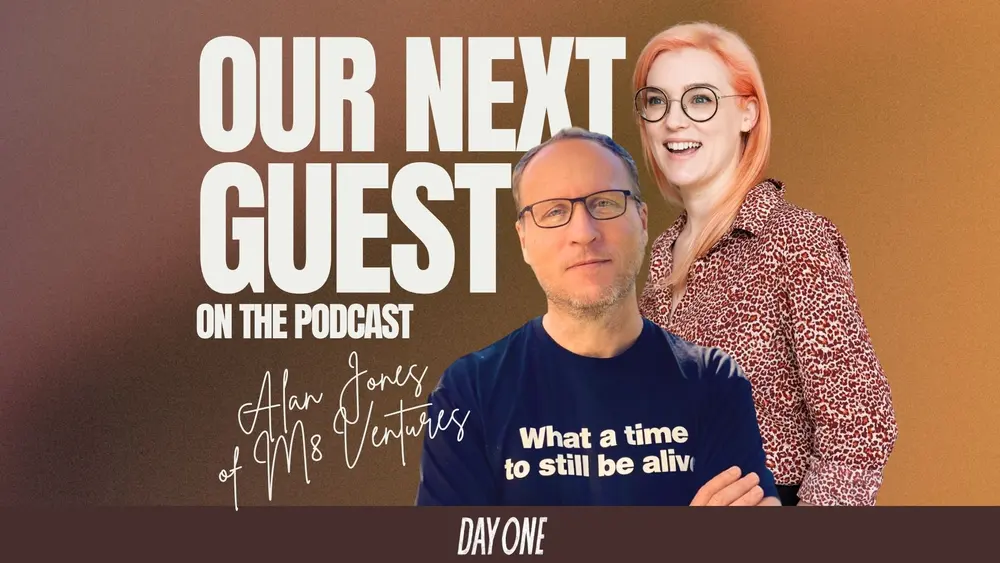
Transcript Synced · select any line to jump ▾ 0:00 Kali Norman: Welcome to the podcast, Alan. 0:02 Alan Jones: Thank you so much for having me on the show, Carly. I'm really excited to be here. 0:06 Kali Norman: Well, let's get right into it. I know we've just given a high level overview, but in your words, what was your path into investing? 0:14 Alan Jones: Yeah. So in the late Carboniferous period of the tech industry, I was a tech journalist. I was reporting on that on the tech industry. And I started falling in love with with some of the culture and some of the little startups that were forming in the industry at the time. Now, remember this was just at the dawn of the web. So most journalism was still printed on paper or in TV or radio. It wasn't really online media at that time. But when I first saw a website with words and photos and ads on it, I thought, man, this is gonna be so much more cost efficient. You're gonna be able reach a global audience. This is gonna have a really big negative impact on print journalism. I'd better figure out how to do this. So fortunately, not very many other people knew how to do anything about that. And I was just nerdy enough to be able to figure out some of the basics of of building and and designing websites. I I blagged my way into a a job at Microsoft for a little while and and then blagged my way into a much better job early as as an early Yahoo employee. 1:09 Kali Norman: But in tech, yeah. 1:11 Alan Jones: Yeah, when I left Yahoo in in two thousand and two I'd been there for five years through the whole craziness of the dot com boom and the dot com crash and and and you know my grand title at the time was was product director Asia Pacific. and so I was full of ego and also I made some meaningful money in in Yahoo ESOP. And I thought I'm gonna be a startup founder now because I know how to do it. And what I forgot was that the shelf life on on on the orthodoxy on the way that you build a startup and find a a customer and and get to market changes every few years. and and so, you know, what I'd learned at Yahoo was already out of date by the time I started to become a startup founder. I I tried to do it though for about ten years. And looking back on the first ten years, by that time I was hitting about forty, I thought if if if I continue at my current success rate, it it I may be in my late sixties by the time I have another big win, or maybe I won't do it all. How can I use my experience and my network and my brand and my remaining capital to to do something different that might be more likely to be successful. And so I thought maybe if I learned how to be an investor, then I could have instead of one egg in the basket at a time, I could have 20. so, you know, as an English major at school, I I continued to be terrible at maths. I've always been a bit concerned that being a successful investor might have something to do with being good at math. and so I very reluctantly became an angel investor because I really couldn't see any other way to apply my skills and experience. 2:45 Kali Norman: So really leaning into your strengths and areas of understanding. But I also really love that you saw the potential in the internet instead of fighting that changed, really worked to see the upside in an industry that you were currently in, but as well what was going forward with with your work with home screen. 3:00 Alan Jones: We're at a time of great disruption right now in the world. And every one of these moments of a great disruption in the world brings great opportunity and and and great fear and great risk and and downside for for a big part of of the world, right? So it's always very scary at at these inflection points to go, I'm going to go and see if I can find opportunities in this place, you know. Where the biggest at at a time in which the opportunity is the biggest, the risks are also the the largest as well. And so I I continue to struggle, I think most of us do. v approaching the end of the precipice, do I believe I'll I'll be able to to ta sprout wings and fly? Or am I gonna fall over the waterfall with everybody else and end up in the trash heap? 3:44 Kali Norman: That's true. I heard somebody say, none of us have a crystal ball, but we can learn to read the tea leaves. Yeah. And I thought that that was a nice way to sort of describe how one could make a bet. 3:55 Alan Jones: Yeah, history doesn't repeat but it rhymes. That's a favourite on mine. 3:59 Kali Norman: gonna use that. I'm gonna quote that to people now. Thank you, Alan. so back in the 90s, having had that experience with both Yahoo learning on the ground and what it was to be a startup founder as well, making the decision to go into Angel, when you first started your angel investing journey, what did your investment thesis look like? 4:19 Alan Jones: I attached myself to accelerator programs very early on because I thought that should be an easy way to get some qualified deal flow, you know. So more companies apply to an accelerator program than get accepted into it. And I figured the people doing the screening might know as much as I do about what makes a good startup or a bad startup, but I can sort of outsource the responsibility of that to the people running the accelerator program. Then if I lean in and do some mentoring in the program, I ought to be able to learn more about the the character of the founders of the company and and their rate of progress towards commercializing their idea. And then at the end of the accelerator program, we'll kind of a bunch of my due diligence has been been done for me by the program. it's probably a better company by then if the accelerated program does what it says in the box. And also I might be able to make relationships with some of the other angel investors doing the same sort of mentoring as me. And together we might be able to, you know. get a read off each other about what we think about about the companies coming through the program. So for me that was that was first pollinizer and then start mate after that. And in both cases, most of my early investments were around things that I might use myself as a as a head of product in a in a startup. So they were mostly tools to help with software engineering or product management, marketing or design. So an example there might be Bug Herd, which still exists today. Hooray out of the first cohort of the StartMate program. Bug Herd is a visual bug tracking tool. So if you're working with a bunch of people that are are in areas outside of engineering, often Jira is not their favorite thing to use. and often when they report bugs, they're not very good at it. And there's nothing worse than a bug report that you can't do anything with, right? Because you you think you know that there's something out there, but you don't know where to look for it and what sort of conditions it exists in there. So Bunkherd was and is still a really great tool for encouraging everybody in an organization or all of your customers to tell you exactly what goes wrong for them when they're trying to use your product. I that. Very early on, it it kind of came sort of accidentally along the way. And some of the people that I was mentoring I didn't like so much. And and I would unfairly distribute my support and help, you know, I would try and help the people that I liked more than I would try and help the people that I didn't like. And and I started to evolve this thesis that, well, you know, if angel investing is only partly about the check, if it's also partly about giving people access to your network and and giving people advice and so on, if if the angel investors associated with the company or trying really hard to help the company because they really like the team. then maybe that team has a better chance of succeeding in the long term. So I started to kind of favor backing founders that I liked. And and to this day, that's why Maid Ventures is called Maid Ventures. Like we want to be mates with the people that we've invested in because then we're more likely to help. 7:23 Kali Norman: actually a really beautiful way, particularly because and I appreciate coming through an accelerator program. As you mentioned, there's a pre-vetting in place and often you've had a chance when you're attached to one and I believe you're still attached to remarkable at the moment as well. you have a chance to see people, how they act, how they interact with others, you get to know them over a series of weeks as well. But in terms of that idea of being more than money, often when you are angel investing, I think somebody else referred to it as you're investing in a team in a dream. Like it's it is very much about the people. And I'm gonna ask you more about that when we come to our green flags, Alan, because I'm really curious to hear your take on it. But so you've mentioned that previously when you started, you used accelerator programs to help somewhat be a bit of a an assistance to your own learning journey with the vetting and the progress of of how to find qualified, I guess, investments when you were starting out. Over the years, you've been investing for over 20 years now. How has your investment thesis evolved to where it is today? And do accelerators still hold a key place in it? 8:27 Alan Jones: Yes. So I've just invested in a another cohort of of start make companies. I'm looking forward to their demo day next week. and and I'm still involved with as many accelerator programs as as I can find time for that kind of align with my interests. So I've got a mentoring call coming up soon with with some founders in the Energy Lab program. I'm very excited about the opportunity in in renewables and it's great to get involved with things like that. So gradually I I started to move from I want to invest in things that I would have used as a product manager and I also want to invest in people that I like. as as as more like my my paper write up, you know, l like the notional value value of of my investment in a company started to go up a bit. I hadn't actually pulled any cash out yet, but but on paper I was I was a successful tech investor. I I started to broaden into Other aspects of my life that that I care about. So I care about community, I care about health, I I care about wealth distribution and equity. I care about the creative arts, you know, I'm a I'm a terrible musician, but but passionate about music as well. and so I started doing things like investing in in music-related startups, in content creation startups. So again, like I think if you if you have a particular passion for the problem that the startup is solving and and you care about helping them build a better solution for the customer than the current solution, then again you're more likely to lean forward and if if you can be helpful and th and that works out, then you've got this wonderful flywheel of, Hey, I'm not actually just funding the salaries in the company. I'm actually maybe helping it succeed. And and that every now and again you get a bit of feedback that that maybe y you're helping. and and that's a huge reward. this I don't think should ever just be about money. 10:30 Kali Norman: So you've actually ticked off quite a broad range of of sort of sectors. If you look at it, we've touched on music, remarkable as a disability tech, accelerator, energy lab going into renewables. 10:43 Alan Jones: I've invested in a startup called Xylo, which is developing novel therapeutics to to treat PTSD anxiety and depression. I this year I invested in a a a fusion energy startup. I've invested in in a number of AI platform startups. a challenge about being a VC is is you go out to your potential LPs and you say, okay, we're raising a fund. And it's going to be very targeted, focused on a particular sector in a particular stage, you know. And so there was a time there when NFT and crypto were huge, and all these fund managers went out there and told their investors, give us a hundred million dollars, we're gonna pile it all into NFT and crypto-based startups. And the challenge when you're managing a fun a vertical fund like that is like, whoa, but there's all this really cool stuff happening over here, right? Right. And then what happens when you know the NFT and and crypto market, you know, takes a massive downturn? You still trying to find successful investments for for your for your LPs. A luxury that you have as an angel investor is that you don't necessarily have to be quite so focused. Now, if you want to be, you can be. But you can also be, you know, very discretionary. another challenge about VC is that typically you're writing your first checks in your first few years of the fund and then through the middle stage of the fund you're really only able to do follow on capital in those companies that you backed in those first checks. And and and you have to deploy the the capital in the fund. Obviously, if you raise a hundred million dollars, you've got to invest a hundred million dollars. And and all of that's got to be exited from as well by by the end of the fund lifetime. So that's that's pretty challenging. As an angel investor, you can just go, you know what, I'm feeling a bit, you know, like I'm I'm gonna I've been working a bit hard. I'm going to ease back on the accelerator pedal for a while and make fewer investments this year, or I'm, you know, I I want to invest in. 12:16 Kali Norman: Spend it. Yeah. 12:39 Alan Jones: in in my relationships with my friends and my family, I'm gonna ease back a little bit. I'm going to you know, I had a a financial setback and something else that I've invested in, I'm gonna ease back a little bit. And then also, you know, I've just really liked this person and the mission they're on to make a difference in in in mental health. I'm I'm gonna invest in that even though to this point it hasn't been part of my thesis. 13:03 Kali Norman: So a little bit of being master of your own ship a bit more when it when it comes to angel investing necessarily than a VC path. And if I can distill that down from what you've just said. So as an angel investor, you investing in things that you feel solve a problem that you yourself are attached to, whether it be for Alan personally or for society at large through the exposure that you've had. I guess just through being a human at the end of the day, isn't it? 13:29 Alan Jones: Yeah. I mean even a great investor is gonna find that most of their investments are unsuccessful. Right. And when you look back at at what you've invested in, it helps a bit when you look at how many of them have failed. It helps a bit if you can look at them and go, Well, I really cared about what they were trying to do and I really cared about the people who were trying to do it. So I did my best and they were great people, and they tried to do important things in the world. It didn't work, so I feel much better about the fact that I I lost money on that company. 14:01 Kali Norman: I think that that's an interesting point to take. And I have a a couple of follow-on questions for you about that. Very quickly, just to get it out of the way, when we're talking about putting checks into these businesses, in your current day investing style, what sort of ballpark size check does Alan Jones write as an angel? 14:19 Alan Jones: The the first few checks that I wrote into startups way back in two thousand eight, two thousand and ten, the checks, the minimum check sizes had to be very large because they were always priced equity rounds. So this was so safe notes are relatively recent innovation. Before Safe Notes there were convertible notes, and then before that was really only priced equity rounds. Those used to be very expensive, v very slow, very inefficient fundraising processes. And so you had to be able to commit like a thirty thousand or a fifty thousand dollar check. Now sometimes you'll see somebody get away with with writing a a two or a two and a half thousand dollar check into into a company. So like you know more than 10x smaller than than it was back then. So over time there's been this this marching down as as the efficiency of of raising capital improves, right? So one thing I've been focusing on in the MayFenture's been focusing on over the past two years has been investing through a syndicate. So we can take that minimum check size, that's that's kind of the the smallest viable investment for a startup, or we can split that up amongst the members of a syndicate, and then everybody else gets to make a a much smaller minimum check size that they do. So in in the Mate syndicate that Emily and I run, we commit to all of our syndicate members that that Emily and I will participate in each deal. that we will make the same minimum commitment that we're asking our our angel syndicate members to make. so for most of the deals that we've done in the past year, the minimum check size has been only five thousand dollars. Yep. But you get twenty people to put in five thousand dollars and you've got a a meaningful check and makes a difference to to the round. 16:04 Kali Norman: Yeah, and I think as well, also on the cat table, because you want to limit as a startup founder. So there's a benefit to the business as well as a benefit to the investor in in working through a syndicate in that way. So I completely appreciate why you're doing that. I also want to touch on something else that you mentioned because particularly, and thank you for drawing it back to the name of mate and the fact that you want to invest in people that are your friends. When you're in when you're reviewing early stage founders and early stage pitchers. If you had to weigh it as a percentage of the person versus the product, how important is each one to you at that early first couple of conversations? 16:41 Alan Jones: it has to be two ticks for me. yeah, both the people and the product have to be a tick. I I d so it's it's fifty fifty. but but they're both non negotiable. so there are customers that I care about. They have problems that I don't care about and and so even if it's a great person who wants to go and solve, I you know, I just so I kind of learned to my cost, you know. So there've been opportunities to invest in things for the fashion industry. And and, you know, just look at me. I'm in a ball cap and a and a black t-shirt and a pair of jeans. That's that's my uniform kind of always has been. I've had the opportunity to invest in some things that were fashion startups and and in some cases I've been persuaded that there's big money to be made here and it'll be a successful investment. And I participated. And then whether I succeeded or not. I just haven't had that same sort of connection to the customer and the problem. I don't care if you get a a better fitting item of clothing or if if you get to customize your own pair of heels. Like I just 17:53 Kali Norman: We just cry. 17:55 Alan Jones: But and and but also sneakers, right? You know, like there's an amazing Australian startup called Push Us. Yes. P U S H I S. Yeah. I I had opportunity to invest in that. I just I had to have a pass on it. Like for me sneakers are functional and I just don't see them as an asset class. I just it doesn't work for me. 18:16 Kali Norman: And so that makes sense. So both need to tick a box for you when you're reviewing early stage deals. And I guess when you're going through that process as well, do you have any hard and fast rules on what a green flag or a red flag looks like during those early conversations? 18:31 Alan Jones: Both of them are really hard and fast, but a few of them are pretty hard and and and fast ish. medium pace. Hard and medium pace. So one is that I really want to invest in teams that are setting out to build a world class technology product. Okay. As the solution to the problem. So sometimes in in tech There are very successful startups that are basically about an innovative business model. So an example here might be Uber or Airbnb, or Seek or realestate.com.au. Technically, none of those technology platforms that run those businesses are really very unique or special or different. They're they're made of a bunch of parts that you can use to build a bunch of other things. and and every now and again they get a little bit of a lead o over their competitors and the in the way that they execute using those technologies, but there's nothing particularly unique there. What what's made them very successful has been their completely flipping the business model and doing things in a different way in the business model sense. That's, you know, valid, obviously. If you were an early investor in Airbnb or Uber, you'd be very happy about how that's performed. But for me personally, I also really care as an ex product manager about how good the the t actual technology is. So I think because Australia's never had a Stanford or an MIT, we've always had a bit of a shortage of skilled and experienced technology talent in Australia. And so our our investment community has kind of grown up with a bit of a relaxed attitude to how the technology is built. Which I don't see when I'm in Silicon Valley. You know, so so here in Australia, another investor might approach me with a s with a startup and and they'll they'll tell me all about the founders and I'll say, Which of which of them is the the technical co founder? And I'll say, they've they they haven't got a technical co founder yet. They've outsourced the the the MVP or version one point to to a team offshore or a startup studio or a digital agency or something and That for me is is not immediately a red flag, no, but it's an item of of real concern. 'Cause what I want to see is that the the companies aspiring to build a world class technology product. That's gonna take a commitment to finding the people who can build that. Because those people are short on the ground in Australia you know, hard to find in Australia and expensive, difficult to persuade to join an early stage team. so what's the degree of commitment to solve that problem? Because we can't build a world-class technology product without a world class technology team. And that's that's hard to build. And then if that technology team is over in a silo on another floor of the building and there's no representation from product and engineering and design on the leadership team of the business, then then we have people who don't know anything about technology products issuing orders to to To the the tech team saying, I think the buttons should all be blue, you know? And and and I'm sorry, but like that's that's really inefficient. And it can take the business into building products that satisfy satisfy the vanity of people in the leadership team. And and I've seen that go wrong many times before. So I wouldn't say it's definitely a no, but it's but it's an item of concern, and I would like to see a commitment to to solving that. I have the same problem with diversity, you know, so so. One advantage of being so old is that I've worked in organizations that have been very diverse and organizations which are very much a monoculture. And I do my best work in diverse teams where I'm comfortable with being challenged and asked questions and and you know, w where where other points of view are are brought to the surface with no tension and no drama about it. It's just always the way that it works. That for me has always been My favorite way of working and and the kind of organization which I can thrive. And so I want to invest in organizations that that aren't 18 white guys in their 30s. It's just it's it's a bad thing. sooner or later a lack of diversity catches up with an organization. By the time it catches up with an organization with 500 employees, it's very, very expensive to fix and may never be fixed. Sometimes that becomes, you know, a a badge of honor amongst the people who are there and they will fight diversity to the bitter end. 23:03 Kali Norman: You've actually mentioned here a few times team and how a team is structured when you're looking at a deal. Do you have a preference just as a just as a sort of a a quick yes or or no? Do you have preference on fan investing in companies that have co founders or come with a founding team versus a solo founder? 23:22 Alan Jones: do have a preference to invest in in teams rather than solo founders. I have also invested in solo founders. but it's the exception rather than the rule. and often it's in the hope that I might be able to influence or assist with the building of a team. 23:41 Kali Norman: Okay, so we have an investment thesis that is more like a series of guardrails, but you will on occasion step outside of it for the right for the right thing. Do you have an example of maybe what would make you, for example, back a solo founder when that's come up, what was it that you loved so much that you couldn't say no to? 24:00 Alan Jones: So most often I find people who are solo founders are either a software engineer or someone from a, you know, a sales and marketing sort of like a a management career, but with no experience building a technology product. And both kinds of founder, the technical and the non-technical founder, have different issues when it comes to building a team. For people from from a non technical background, it can be really challenging to understand how an engineering mindset works. We all have different brains that work in different ways and and and the sorts of neurodivergence that we often see in people who seek careers in STEM are are different to the sorts of people often that that seek careers in in culture, in communications and marketing, excuse me, in sales. And and I think the the the big challenge for for people from a non-technical background is how am I going to understand enough about what motivates somebody who loves to write code. You know, what do they seek as a reward in their work? because it's it's often got a lot to do with pride in the craft that they take. And when, you know, the craft is impenetrable lines of computer code, you know, little ones and zeros, it can be very hard for somebody who doesn't read that language to understand how much it matters that it'd be done In such a way that it could be shown to appear and found to be of great quality, you know? Well good point. Even with the assistance of AI, great code takes longer to write. But it it remains robust for logger and and it's more capable of change more quickly than than badly written code. So I think Every engineer potentially can build their own technology product. and if they are going to be persuaded to join me as a non-technical founder, then I have to find a way to motivate them to do that. If I can't afford to do it with salary and if the stock options will probably end up being worthless anyway, what is it about the problem I'm trying to solve and the customer I'm trying to solve it for that I can make important to them? So it might be something around. some of the things that need to be built to solve this problem in a in a in a better way. But it also might be, you know what, you know, with that engineering mindset, can you look at what we have as a plan for our customer acquisition funnel? Do you see any gaps in in that puzzle, right? I'm about to go out and start speaking to investors. Do you want to come along with me and learn about how raising, you know, capital works? Or at least, you know, come in with a with you know a second set of eyes, you know, while I'm talking you can be listening. you can be reading the room. maybe you want to practice talking as well. 26:54 Kali Norman: So would it be fair to say then if you were looking at a solo founder, be it from that sales and marketing and from that product side, or that product side, and I have to say that actually very much mirrors what I've seen in market as well, would coachability be important? Because I think a lot of the things that you're mentioning here is common pitfalls are coming back as well to the ability for the person occupying that role to be able to communicate and work effectively with people sitting on the other sort of side of that coin. If you were looking at a solo founder, would that would that I guess openness and willingness for coachability and learning to bridge that communication gap be key? 27:31 Alan Jones: Absolutely. Absolutely. And I I should say, for for people with a an engineering mindset when they're a solo founder, their main challenge is to understand that people don't just buy products and services because they're technically better. 27:44 Kali Norman: We could have a whole conversation about this Alan. Yes. 27:47 Alan Jones: Sales and marketing is all about persuading people to make irrational decisions in the moment, right now, you know? And and often people with an engineering mindset want to build the best solution to the problem. and then customers will behave rationally and choose the the best solution to the problem. And they won't be influenced by discounts and pricing and you know, wait lists and all the things that we use as as marketers to persuade people to make an irrational, emotional decision. so both I I I was picking on sales and marketing people there. I also want to pick on engineers and say, you also need to be coachable and start to understand that this is at least fifty percent about learning how to be a great marketer and salesperson. 28:30 Kali Norman: Well I'm glad 'cause my day job is ahead of growth. I wasn't sure if you were just having a bit of a low key crack at me there, Alan. But I think too highly of you to assume that. 28:39 Alan Jones: So so coastability for all founders is key. you know when you speak to an AI and it's very flattering about how insightful you are and you know, how how amazing your questions are? 28:48 Kali Norman: Never felt so smart, yeah. 28:50 Alan Jones: Yeah. So that can often happen as an angel investor having a coffee meeting with with with a founder or a founding team, you know. So they they tend to do the same sort of thing. They're they can be very flattering, they can nod and go, Wow, that's really insightful. but then I want to see that advice, evidence that advice might actually be acted on between now and the next time we speak. So founders that come back to me a couple of weeks later and said, you know, Alan, a couple of things really stood out for me and what we discussed the other day. And I've acted on a couple of those things. And this is what I've begun to do. And and I I'll be back in touch when I can tell you, you know, how I'm progressing with those changes that you suggested. 29:33 Kali Norman: Ooh, that's nice as well. And I do like that. and that idea, I guess, of of actually really noting and listening and coming back. And then and I mean, you know, not ever not everybody needs to agree with everything, but I think that that openness and then that decision making of what's gonna be able to be applied, I think is is important. So you're obviously branching into a lot of new areas, investing in things as new industries are coming up. You've spoken a lot about people building new technologies and not just repackaging or technologies in new business models. So you must be learning on the ground a lot. What are a couple of news sources or reference points that you can point to that somebody looking to evolve their thesis could could go take a look at or listen to? What do you use to continue staying sharp? 30:19 Alan Jones: It it amazes me how few people actually read the the startup media, first of all. So I think that's an incredibly valuable source of of intel about what's going on in the in the broader market. You know, so we all have our own sources of of deal flow. but if we focus only on that, we don't get to see what's happening in all of the rest of the market. So for me, you know, startup daily and smart company, capital brief. those are publications that I will try if I have the time to to read every day. because that tells me, you know, not just about what's happening at a government level, at an industry wide level, but also, you know, what my peers in the industry have just invested on. You know, that's an amazing company. It's just closed around. Why didn't I know anything about it? Right. So how do I, you know. How do I make sure I don't miss out on the next one of those to come along? So I think that's, you know, if if you want to just have an AI AI running in your in your email inbox looking for news mentions of of startups that have been funded that might have matched your investment thesis, that would be like a good little automation to to start running. 31:36 Kali Norman: Ooh I like that. 31:40 Alan Jones: I'm I'm I'm very excited about the investment thesis podcast. I wish that it had existed when I first became an angel investor. Thank you. The This Week in Startups with Jason Calicatis started just after I started writing my first investments, but of course it was just reflecting on Silicon Valley. and then Twenty Minute V C started or probably like eight years into my I was actually on an early episode of Twenty Minute V C. And I'd never never heard of him. He reached out to me cold and you know, he was like nineteen, twenty years old at the time. and I was late for the interview and ended up doing it from from my car pulled over on the side of a busy road on a rainy day. So the audio quality was just appalling. And of course, you know, I didn't have any notes in front of me or anything like that. it's one of the worst podcast interviews I've ever done. 32:34 Kali Norman: I'm gonna go find it and we'll link it to we'll link it to this. 32:38 Alan Jones: I can say that I've been on twenty minute VC, yeah. 32:42 Kali Norman: and I do I do love 20 minute VC actually as well. I think that actually you may have recommended it to me a while ago. but it's definitely 32:50 Alan Jones: I think it's helpful always to have a a broad understanding of what's happening over in Silicon Valley because often the trends and the market developments and the technology changes are originate there and then we sort of adapt them to our local market conditions shortly afterwards. another thing that I that I really enjoy from for the sort of the meta perspective thing is the the pivot podcast with Cara Swisher and and Scott Galloway. Yeah. 33:17 Kali Norman: I can. 33:18 Alan Jones: Yeah, I think I think that's a really good lesson. It's it's a lot about the politics of of the tech giants. and it's a lot about government, but it's also a lot about behavioral economics and and how society is changing as a result of of what we do in the tech industry. 33:38 Kali Norman: I do enjoy things that kind of give you that almost 10,000 foot view as well. So that one I hadn't had on my radar. I will go have a look at it. Thank you, Alan. Cool. and what would one piece of advice that you would give somebody building their first investment thesis? 33:56 Alan Jones: All right. I think I would say the thing that doesn't get spoken about often enough is the importance of of customer brand loyalty and distribution. 34:13 Kali Norman: Ooh. 34:13 Alan Jones: Well so there's two things. 34:15 Kali Norman: Nice. 34:17 Alan Jones: Oftentimes between our startup and customers, that total accessible market, there is an entity that controls distribution. So it's a couple of different forms of distribution. Let's say in in healthcare, in in in pharma, for instance, or in in regulated forms of assisted therapy or something, there's an FDA or a TGA between us and our customer. there may also be a large so there's a regulatory distribution aspect and then there's also an economic distribution as aspect as well. So if if we were developing a novel therapeutic, we would need to get it into market via one of the big farmers. So we'd need to have a plan for how we're gonna license it for a big farmer to complete clinical trials and then begin commercialization. I can't just take my drug and take it straight to an Australian pharmacy and say to the pharmacist, which is would you like to box, buy a box of two hundred and fifty, right? An awful lot, unfortunately, of of really great startups fail because they obsess about building that better solution for the customer. Mm-hmm. And they'll do a lot of customer research. And the customer says that they love it and they forget about investing in how we get through those distribution barriers to market. So in software, we have app stores. Yep. There are now many of them. OpenAI has got its own app store. You know, we're all using MCPs now. Can I things up together? There are platforms like Product Hunt and Software, which effectively are an on-fair advantage in distribution if we use them well. in physical products, there are things like a Kickstarter that are a very effective distribution channel if we use them well. So how are we going to use our our platforms for distribution to get out into the market? We can't simply launch something on the on the iPhone App Store and trust that we're gonna have a hit. You know, what's our actual distribution channel strategy? 36:14 Kali Norman: That's a good one. And one that hasn't come up before. So thank you so much. That's actually I'm gonna, I'm gonna remind that, remind myself of that in future. Thank you, Alan. and the last question, which I think I know what you're gonna actually say to this, it wasn't on the brief that I sent over, but you've spoken about it previously in this. As a quick yes or no, if Uber had pitched to you precede, yeah, come on. Cold pitch back in the day, would you have invested yes or no? 36:46 Alan Jones: I think I would have hated Travis. so that's that's one red flag right there. and and I don't think I would have had faith that that it could it could work. Or and I don't think that I really wanted to solve that problem. You know. That said, when Uber first launched in Australia I was one of the, you know, early adopters of the thing and back then it was all you know limos. Th there were no just you know, Hyundai's and and and Teslas delivering people. It was it was all A bloke in a in a black suit and tie. and so that was tremendously impressive. But no, I I definitely would have passed. I would have passed on on Airbnb as well. You know, I would have said, Are you kidding? Nobody's ever gonna rent their spare bedroom to a stranger over the internet. Like that's just definitely not gonna happen. And and obviously it's now bigger than the hotel industry. So I've been wrong many times and I don't mind admitting that. because every time you're wrong, if you go into it with the right mindset, then you can learn from that. You know, don't ignore your mistakes. See if you can you can pull them apart and learn from them. Make yourself a better angel investor. 37:52 Kali Norman: And that's actually a beautiful way to look at it as well, right? Because it's one of those things I feel the same as founding, you learn on the job and it's not it's not a smooth upward trajectory. 38:02 Alan Jones: Yeah. It is well like just w one more thing about that though, right? So so again, I think it's really important that you care about the customer and the problem that you're solving for them. So maybe I could have been persuaded to care about the Airbnb customer and the problem I was solving for them. Maybe, I'm not sure. Uber definitely not. I wouldn't have have cared about that. So even if I believed that both of those businesses could have been successful. I'm still comfortable with the fact that that if I'd been given a chance to invest, I I wouldn't have invested. You know, I'm not a ultra high net worth individual. I I you know, don't get me long. I I'm I'm very happy with how my life has worked out, but but I don't have enough capital to invest in every startup that I see. I don't have enough capital to invest in every startup that I think is going to succeed. Yeah. And so I may as well just focus on the things that that bring me emotional reward. 38:46 Kali Norman: That's that. 38:56 Alan Jones: And some potential financial reward down down the line, right? So that makes it easy to go, well, I'm not going to invest in that sector because I don't care about it. I'm not going to invest in that sector because I don't understand it. I'm not going to invest in that sector because it seems like everybody from that sector is is a shiny suit wearing, you know, untrustable, nasty person. So it th then you can really focus on learning these are the sectors that I care about and and these are the people and and the four market forces working in that sector I'm gonna become better investing in those sectors instead. 39:27 Kali Norman: And that's actually a really healthy way as well, because no matter I imagine as as you sort of work through a journey of being an angel investor yourself or anybody else, myself in the space, you're not going to be able to say yes to everything. And hindsight's 2020. There'll be some great things inevitably that everybody passes on. And and there needs to be a way I'm starting to learn that you need to reconcile that within yourself. And part of that as well is that you can only do so much. Same as any industry really. but thank you so much for that, Alan. It's been an absolute pleasure. I'm gonna take these learnings away and go work on my investment thesis. 40:05 Alan Jones: Thank you, Kelly. I really look forward to seeing the next episode and the next and the next. I think this is a really exciting show for angel investors in Australia.
 ▶
▶  ▶
▶  ▶
▶  ▶
▶  ▶
▶  ▶
▶  ▶
▶ ▶
▶ ▶
▶