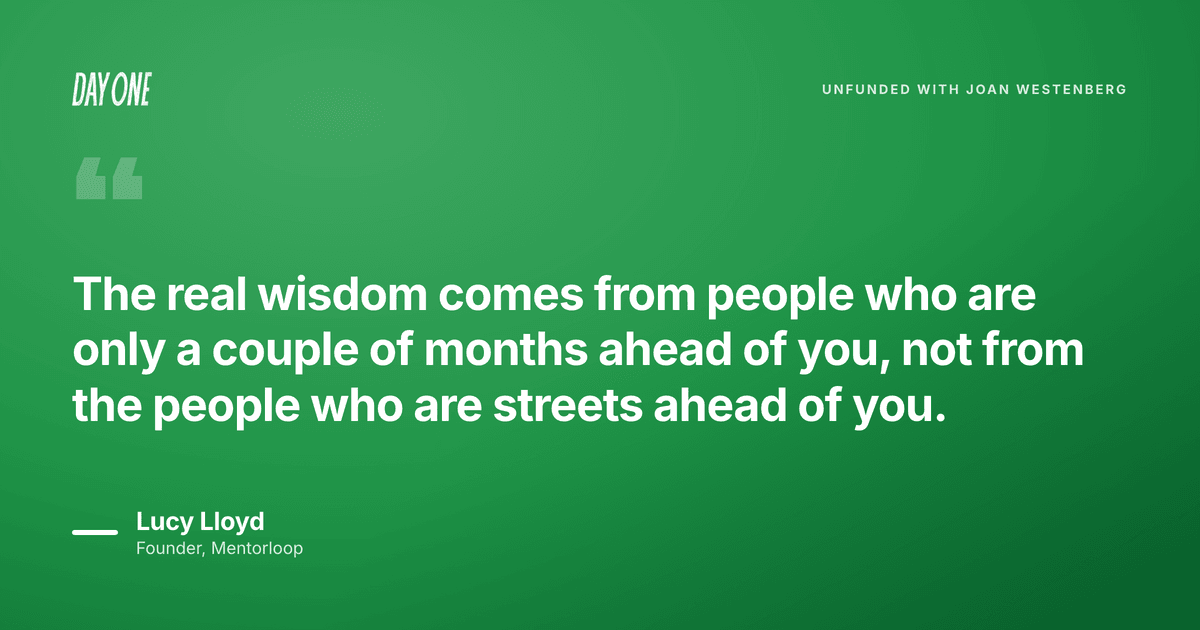
Transcript Synced · select any line to jump ▾ 0:00 Speaker: You're listening to a Day One FM show. Pick My Brain is the podcast where founders pitch me their startup and I try to give them some useful advice so they can connect better with potential co-founders, investors, media, and of course, customers. My name's Alan Jones and I was a founder myself for about 15 years, and after that, an angel investor for another 15 years. So yeah, old. Some of my ventures have been successful and some failed disastrously, But I like to think I've learned a thing or two along the way, and maybe some of that can help you. So if you'd like to learn how to tweak your pitch, subscribe to the Pick My Brain show now, wherever you like to listen to podcasts. 0:40 Lucy Lloyd: So we kind of looked deeply into each other's eyes and asked the question, what kind of business are we really building here? You know, what do we want Mental Loop to look like? Where do we want to go to work? And that really changed the conversation for us. 0:53 Speaker: Welcome to the Unfunded podcast, where we tell stories of founders building impactful and independent businesses without relying on venture capital or external funding. I'm Jenn Westenberg. I've been a journalist and tech writer sharing insights from startups and founders for over a decade, focusing on those human stories about tech, economics, and the impact of business. I love the DIY ethos, and I love the founders that don't wait for permission to launch or grow. We'll be interviewing successful founders on the grit and ingenuity it takes to build and scale a startup on your own terms. You'll hear interviews with successful founders about how they navigated their startup growth journey and how they forged their own path while creating new products, finding target customers, and aiming for profitability. Unfunded is part of the Day One Podcast Network, dedicated to sharing the real startup stories to inspire founders, operators, and investors. We hope you enjoy the episode, and if you wanna learn about how to build a self-funded company on your own terms, keep listening. Today I am joined by an incredible founder. I'm a big fan, Lucy Lloyd, who has built Mentorloop. Lucy, welcome. 2:03 Lucy Lloyd: Thank you for having me, Joan. Nice to be here. 2:06 Speaker: Well, today we're going to be diving a little bit into your story, so I'd love to start by just understanding how you came to build Mentorloop and what the inspiration was to start this company, start the startup. 2:16 Lucy Lloyd: Sure, thank you. I— my background before Mentorloop wasn't necessarily traditional tech, um, but I did kind of fall into digital digital marketing and digital project management as well. But where Mentorloop came from was my co-founder Heidi Holmes and I, we'd known each other forever. We actually had met, you know, 25 years ago while we were at school. And over a wine one night, we were discussing our careers, as you do with your friends, our, you know, the challenges you face, the, I guess, difficulty when you make a transition in your career, whether it's to a new job or even, you know, jumping over to a new industry. And we were kind of wondering aloud why there wasn't a dating site for mentoring relationships, why there wasn't a way for you to connect with a future version of yourself to help you navigate when you're making those big changes in your careers. And so, you know, mentoring was really what we were talking about, and it was kind of captured our imagination, and we started to research the space, and that's how Mentorloop developed. So Mentorloop is a platform that helps organizations build a mentoring culture for better productivity, engagement, and retention. We work with companies, like, you know, big corporates through to communities, industry bodies, universities, anyone with people, be they employees, members, or students that they want to connect in development relationships. We were also really, I guess, motivated by access. We believe that the right connection can change your life, and we wanted to make those connections more available to more people. And by platforming mentoring, you kind of open doors, you know, as you kind of mentioned gatekeeping by platforming something, you make it more visible and you remove some of those gates that prevent people from accessing those opportunities to connect. 4:01 Speaker: I'd love to talk minimum viable product for a moment. How did you first launch Mentorlib? What did it look like at its inception? 4:08 Lucy Lloyd: So we spent a lot of time on research first up. And so we did, we had that kind of period of speaking to people running mentoring programs. So often up to their elbows in spreadsheets and emails. We would then go back to them with vaporware. So basically like a slideshow of what the product could look like, you know, wireframes, and we talk them through that. And eventually we got a customer who was, you know, interested enough to almost like partner with us to build that MVP. And so Heidi and I, neither of us is a natural engineer, neither of us, you know, is a software engineer. And so we needed to engage an agency to build that first product. And so because we were tipping in our own money, you know, often one of it we take turns each month of one of us would put in money. We had to make it really minimum, you know, because we couldn't, we couldn't spend time building feature bloat. But because we had this customer on board, we were able to focus in on the features that were most important to that customer and, and, you know, build something that they could still use despite the fact that it wasn't, you know, the most beautiful product experience in the world. 5:15 Speaker: But you got it out there and you got it into the hands of the customer, and that matters more than anything, right? 5:19 Lucy Lloyd: Exactly. Got it out there and got paid for it. You know, even though it was a terrible experience, you know, it's still— it was still something that was valued by the customer. 5:28 Speaker: And so you had your first paying customer before you went to look into VC funding, is that right? 5:34 Lucy Lloyd: Yeah, that's absolutely right. So it took us a while, as I said, because we were kind of tipping in a bit of our salaries each month from our full-time jobs. But we, yeah, eventually had— by the time we started our first raise, we had 3 paying customers. 5:46 Speaker: All right, and that first raise, that was around 2017, am I right in saying that? 5:50 Lucy Lloyd: Yeah, 2000, actually 2016. So it was kind of a very, I guess— 5:54 Speaker: 2016, yeah. 5:55 Lucy Lloyd: We branded as like a pre-seed these days, you know, it was really just kind of one of those, you know, I guess a round of a few motivated kind of angels, friends, family, and fools, that kind of round. And so yeah, we had a small, got a small round up then, and then we later raised a round that involved some VCs in 2017. 6:14 Speaker: So walk me through that VC funding approach. What was that like? It can be a bit of a pressure cooker, it can be fantastic. How did you find the experience? 6:23 Lucy Lloyd: We started by doing Startmate. I don't know if you're familiar with Startmate. It's a, you know, wonderful accelerator program. 6:30 Speaker: Very familiar, yeah. 6:31 Lucy Lloyd: And we'd met some wonderful mentors as part of that Startmate experience, and a lot of them were connected to VC. And I think Startmate at that point was really geared to, you know, I guess attract VC funding basically, you know. So it kind of seemed like in the industry at that time that the only measure of whether your business could succeed, whether it was viable, was, was it investable? 6:55 Speaker: Mm. 6:56 Lucy Lloyd: And so we, we got on that train too. And I guess the, the industry is, is geared up to celebrate the raise and we wanted to be part of that club. But we didn't just raise VC, we ran what we call a party round where we raised a combination of VC, family office, angel investors. We raised a couple of rounds in total over, over 2017-18, with no one huge check or huge single investor, but lots of contributors both financially and with advice as well. 7:25 Speaker: Once you had started that raise, how did that change the strategy behind Mentorloop? Did it start to shift what you were working on and how? 7:32 Lucy Lloyd: Yeah, I think, I mean, I think it builds a whole lot of accountability in very quickly. You know, you've taken the responsibility on of taking on that, that investor's money, and so you need to, you know, you need to start multiplying it, basically. So the, the raise was— first of all, it was amazing external validation for Mentorloop, and, and, you know, I built further conviction for Heidi and I that we were doing the right thing with our lives by working on this business. And then the coverage of that raise made it easier for us to go to market. It made it easier for us to attract great talent, um, and to bring engineering in-house. You know, we'd previously been paying a third party, like, external engineering agency. And then the money itself meant that we could move more quickly so we could build a better product, we could hone our go-to-market. In, um, I think we raised at start of 2017, so that year we grew our revenue by 5 times. In 2018, we tripled our revenue. Then in 2019, we doubled our revenue and opened a UK office. And none of that kind of speed to market would have been possible on that timeline for us without the angel and VC funding that we took. 8:37 Speaker: You mentioned the, um, the pressure of external accountability. How does that compare to spending your own monthly paycheck building the startup in the early days, which is harder? Is it your own paycheck going to it, or is it somebody else's money that, you know, you have to make an account for? 8:54 Lucy Lloyd: I think there's pros and cons of both, and we have had it both ways. So when it's your own money, you certainly have to run extremely lean. 9:03 Speaker: Oh yeah. 9:03 Lucy Lloyd: And I think that leanness is a good, you know, is a positive thing in the end. But I suppose we were also pretty distracted, and so it took a long time. So we were, you know, both trying to, you know, have our personal lives as well as our full-time jobs. And so that was difficult because I think there was always that question of, are we doing the right thing? And probably the most difficult period for us as founders was when we were making that decision to jump full-time into Mental Loop. You know, like, how do we, you know, objectively judge whether this is a real product, this can really be a business? 9:39 Speaker: It's terrifying, isn't it? 9:40 Lucy Lloyd: Yeah, it is terrifying. And the easiest, clearest way to do that was to get an external signal, and a raise was a really good external signal. And so that kind of was what tipped us over full-time in the business. It's like, if we can get the conviction of investors to back, you know, the traction we've got so far, the product we've built, and the founders that we are, then we're doing the right thing. You know, let's go full-time. Let's make this our, you know, life's work basically. So I think that conviction came for us with that external validation. 10:09 Speaker: So there are, there are obvious positives here to that VC path. There's external validation, there's the ability to scale, the ability to focus. A core part of that that I've always thought would be very important for you and what you've been building is the level of mentorship that you get from the VCs who, who come on board. Um, was that a helpful part of it? 10:28 Lucy Lloyd: 100%. And from the VCs, I guess what they bring to it is not just their own, you know, individual knowledge and wisdom and advice, but also the patterns that they're seeing in the market and the trends that they're seeing across other businesses that might look like yours, have a similar kind of customer profile to yours. So you're not just tapping into these incredibly smart people and their, you know, their wisdom, you're also tapping into their broader experience and the patterns that they're seeing, which is wonderful. We also have, you know, angel investors, other investors, not just VCs that help us in that regard too. And I think we are always reminding ourselves to do better at asking for that help from, from the mentors that are available to us, because it really is, you know, it's a superpower to be able to ask for help when you need it. 11:13 Speaker: All right, so definitely positives. And that early venture capital that you did seek, it enabled you to put Mentorloop on the map. But what are the challenges and the, and the pressures that came along with that? Because if there's one thing we know about VC, it's not all roses. 11:26 Lucy Lloyd: Yeah, and I think we we were on, you know, this kind of, this, you get on this cycle, you know, this raise, raise, raise, grow, grow, grow, raise, raise, raise. You've got to keep growing to justify the next raise. And I think Heidi and I didn't think critically about what that really meant for the business. You know, we just kind of got on the hamster wheel. 11:46 Speaker: Mm-hmm. 11:46 Lucy Lloyd: But we didn't have a very good long-term plan for when and if the money ran out. And I think a lot of founders operate like this in the early days. You're overly optimistic. You 100% believe in your product. The deals will come, people will be convinced, and then you'll find the next round the next funding round. And at the time we had other founders, mentors say to us, you know, when you're raising this round, you should be thinking about the story you're going to tell for the next round and how you're going to get there. And we were like, just please God, let us get this round out of the way. So we were never, we were kind of in the game, but we weren't thinking critically about the game that we were in. 12:20 Speaker: Mm-hmm. 12:20 Lucy Lloyd: And I think we ended up contorting ourselves to some extent to match this cycle. So we focused on that one key metric, which was growth, that would match and meet VC expectations and enable us raise again, and we probably focused on that at the expense of other parts of our business. 12:37 Speaker: Yeah, and that's something that a lot of founders have said to me, is that raising funding and, and being in that cycle becomes a full-time job, and then that becomes the, the CEO or the founder's entire responsibility. 12:48 Lucy Lloyd: Yeah, and I— it's, it's, it's— you're kind of living two worlds as well because you are thinking about the raise story, and the— and then there's a lot of great strategic stuff that goes into building that raise story. But you also at the same time are looking at the reality of the day-to-day of your business. And in the early days, you know, there are things that you come across every week that could kill you. And so you are kind of almost— I wouldn't say living a lie, but you're living two worlds. You've got these two kind of parallel realities that you need to reconcile, and they don't always reconcile. 13:18 Speaker: Did it help having a co-founder in Heidi? 13:20 Lucy Lloyd: 100%. I think that's one of my key bits of advice to any, any founders that I meet, if they're solo founders, is to find a co-founder. And Heidi had probably led the original idea for Mentorloop, and then we came together over it. And I think we were a really good balance. And Heidi's very optimistic, naturally super entrepreneurial. You know, she had this enthusiasm for the business we were building, and I was a little bit more kind of risk-averse and like stand back and, you know, a little bit more kind of let's, you know, think about this. And so I think it was a really good combination. And then naturally when one of you's up, the other one, can be down and vice versa. And so it, you just get this, this balance that, that grows over time. And I think that the longer time's gone on, the more I realize how important that kind of foundational relationship is. 14:08 Speaker: So as a team, as a duo, at what point did you start to step back and have those conversations about whether VC was working for you and whether it was working for Mentorloop? 14:18 Lucy Lloyd: So it happened with the pandemic. In early 2020, we were kind of, we were gearing up for, I guess, what would be kind of defined as a Series A round, you know, in the classic definitions. So we had good results, we'd just gone into the UK market and we were thinking about raising, you know, let's say $5 million, for example. And so we started those conversations and as you know, in early 2020 is when kind of the world stopped still for a while. 14:45 Speaker: Yeah, unprecedented times. 14:46 Lucy Lloyd: Yeah, it was very all unprecedented all the time. And so we kind of in, you know, Feb, started to have those conversations and then obviously everything stopped and there was this paralysis in the market. I think there were paralysis in a lot of different markets, but you know, particularly, you know, speculative investment markets, people were sitting on their hands, you know, and we realized we weren't going to get a funding injection quickly in that market. And now we kind of look back and could we have gotten a round up? We were bullish, but you know, the market was very much wait and see. And we knew from our cash flow that if our sales also stood still, we'd be dead, you know, in 3 to 5 months if kind of a new business dropped off a cliff for us. And so COVID is what triggered us to change course and basically get off that, that, that hamster wheel, the grow, grow, grow, raise, raise, raise cycle. So while COVID was tough, it also kind of provided new opportunities to connect isolated people together in meaningful mentoring relationships. And we lost some clients, you know, like big travel-related customers like airlines, hotels, universities, but we gained in other areas because, you know, people needed to connect, they needed to continue developing even though they were stuck at home. And then we undertook kind of pretty aggressive cash management. So simple stuff, like before we'd always just build monthly because that's kind of how our subscriptions were built, and we switched to 12 months upfront. We also took the team down to kind of 80% for a couple of months to conserve cash. And we also switched our go-to-market to more recession-proof businesses like supermarkets, government, and utilities. And so really at the time we were just trying to survive, but then in that trying to survive, we got to, you know, a kind of neutral cash flow position where we could make our own decision about what we did next. 16:39 Speaker: So how did that conversation start then? Who sat down and said, you know what, we could do this on our own? 16:45 Lucy Lloyd: I think, yeah, there are a few weeks there where it felt terminal for Mental Loop. So I think the, you know, like all businesses where the pandemic felt terminal, you know, it was just, we cannot continue. And so, so that, that prompted us into action. Um, and Hyde and I do tend to thrive when, when things get scrappy. So there was a lot of talk between us about the wartime versus the peacetime CEO. Um, and, you know, the, the beauty of the old school business that's just there to make money, you know, it doesn't, it doesn't need to do anything else except make more than it spends. Uh, and we also had a lot of, you know, quoting of, we use a quote by Warren Buffett. I don't know if you know it, but it's, be fearful when others are greedy and be greedy when others are fearful. 17:30 Speaker: Yeah. 17:30 Lucy Lloyd: And while it doesn't necessarily always play out like that, we found that quote really motivating and we were just like, well, yeah, let's be greedy. Let's keep our company, you know, let's maintain as much kind of equity as we can. And yeah, so we've kind of looked deeply into each other's eyes and asked the question, what kind of business are we really building here? You know, what do we want Mental Loop to look like? Where do we want to go? To work. And that really changed the conversation for us. 17:56 Speaker: All right, so difficult conversations are gonna follow anything like that. What was that like talking to the VCs that you had on board? 18:04 Lucy Lloyd: Look, I think it was, our VCs are all very supportive of us. I think we had one conversation with an investor that was really illuminating for us. They'd given us some advice about how we were going to survive the pandemic. And I said, oh look, if we do, if we take those measures that you are describing, then we're not gonna be running Mental Loop according to our own values. And that investor said, well, if you keep running it according to your values, you'll be dead in 6 months. And I think that the kind of, that statement kind of echoed in our heads and we were like, well, what are we here for if not to run a business according to our values? You know, that's the— 18:41 Speaker: Hmm. 18:41 Lucy Lloyd: That's the beauty of what we're doing. And so that kind of, that was really motivating for us. So let's build the business we wanna build. Let's build the business that matches our values. But overall, I mean, I think our investors, everyone was dealing with their, you know, their own world of pain at that moment. And I think for our investors, Mentorloop saying, look, we're going down this path, we can get to profitability at this timeline, was great. Go do it. God bless, et cetera. 19:09 Speaker: So the end goals for a startup with VC funding are often one of two approaches. It's you get to an IPO or you get to an acquisition. Um, and that makes a lot of sense because the VCs have invested their money and they want some kind of return. Once you've stepped off that hamster wheel, how has the end goal shifted for you? Have the goalposts moved? 19:30 Lucy Lloyd: Uh, I think the goalposts have just changed slightly. So I think now we prioritize building the best business that we can, and that might sound counterintuitive because of course if you want to get a great exit, you'd build the best business that you can. But I mean, we, you we focus more on building an excellent business than we do on building a business for acquisition. But at the same time, like, we still want to, we still are super motivated to get a return for our early investors. And the benefit for us is that because we haven't taken too many rounds of dilutive funding, any exit event will also mean a return for us and for our team. And so it's still an extremely motivating thing to get that exit. It's just that now it is more likely to happen on our timeline rather than an artificial timeline. 20:19 Speaker: So that external validation that we spoke about earlier, um, do you find that you, you no longer need that because you've got the customers, you've got the team, you've got the product, and, and you're confident in what you're building? 20:31 Lucy Lloyd: Yeah, to an extent, but I miss it, you know. I mean, as I said, like, it, it— when, when you have that kind of close relationship with investors and you have that scrutiny You know, I still do kind of miss that occasionally and even the wrap over the knuckles and things. And so I think we try to seek that out in different ways. And obviously running a mentoring company, mentoring is always gonna be part of the answer, but we try to tap into this kind of, you know, our own advisory board that isn't necessarily just, you know, investor-driven or investment-driven, but helps us to still get that because, you know, it takes a village. Like you cannot do this alone. And there's so much benefit out in the market, out in the Australian tech industry. So many amazing people who have built amazing things and seen some, you know, crazy stuff. So it's wonderful to be able to connect with those people and show them what we're doing and hear their experience. 21:24 Speaker: So you must be running quite lean now since making that decision, very aware of the next dollar and what it meets. 21:31 Lucy Lloyd: We are, we are. And look, we are still bullish about building the number one global mentoring platform. We definitely are competing against companies, and we're on a fraction, you know, one-fifth or one-tenth of the budget that these other companies are on. But again, we, we thrive when we get scrappy. And, and when you run lean, you— it's— you can— you kind of make smarter decisions, you know, you make decisions that are more efficient. Uh, and I think the other thing we do is we really niche down. So when we're, we're looking at the US market at the moment, and so we don't have the, the war chest to go into the US, you know, all guns blazing. So instead we've got to niche right down to a very particular profile. But the beauty of a market as big as the US is that, you know, you can niche down and still be talking about, you know, a market worth hundreds of millions. 22:19 Speaker: So looking back, are you comfortable with the decision that you made to step away from VC funding? Comfortable and happy, thriving? 22:26 Lucy Lloyd: Yep, I'd say yeah, definitely comfortable and happy. Yeah, I think, um, I think, you know, we do watch every dollar and so not a lot has changed for us in that sense. We are very cash flow conscious and, you know, because we want to get the balance right of how much, exactly how much we're investing into our growth as well. And so I think it's a very comfortable position to be in, maybe a little too comfortable sometimes. You know, we work hard to set strategies that will motivate our team to continue to punch above its weight. But definitely it feels great. We can be really authentic with our team where we're quite open about how we're running the business and what our goals are. And I think the team can have confidence that there's not going to be this huge strategic pivot after a tricky board meeting, you know, because we are masters of our own destiny. 23:13 Speaker: And with that, how does the team respond to the new strategy? Were they welcoming it or were they absolutely terrified? 23:22 Lucy Lloyd: I think because it coincided with COVID everyone, you know, there was a little bit— everybody was kind of anything goes. You know, and so, so I don't think it was necessarily questioned at that point. Once the pandemic, you know, subsided to a certain extent, I think that, you know, the way we run our business now, like our really goal is to keep headcount fixed but, you know, continue to increase revenue over time. And so for, um, team members who maybe love the, the cachet of a, you know, big funded, high-profile kind of tech business— we're no longer that profile— and who maybe who wanted to develop by being in something fast-moving where they would amass a under them quickly. That's not what Mentorloop is anymore. But I think we can bring other advantages to play. And I think, you know, we, we can kind of hand on heart be a culture-first company because, you know, we can afford to invest in building a great culture. Does— 24:16 Speaker: forgive me if this question is too thorny, but does Mentorloop have an employee equity program? And has that shifted or changed as a result of stepping away from VC? 24:27 Lucy Lloyd: Uh, yes. I mean, it— we, we set up our ESOP, like our employee equity program, um, with the advice and collaboration of our VCs. You know, it was kind of almost their, their policy, and we're like, yep, great policy. Uh, so what's changed for us is once we got onto this track, you know, of, um, still, still working toward an exit at some point, but, you know, on our terms, uh, we moved from just offering, uh, ESOP to, you know, certain members of the team to making it a blanket offer as soon as a team member's been with us for, for 3 months. Months, they're on the ESOP. So it's something that we just— it is part of everybody's employment now at Mentorloop rather than being something that, you know, you just negotiate with the select few. 25:09 Speaker: Does that bring a real sense of community and ownership to that team? 25:13 Lucy Lloyd: I hope so. I think we've always— Heidi and I have always been careful of putting too much onus on ESOP. You know, we don't want people to feel like we're, I guess, incentivizing them with imaginary money or anything like that. You know, we want people to be comfortable, you know, living their best lives at this moment. But definitely the fact that everybody knows that everyone else is on the ESOP, I think there's definitely a camaraderie and a pulling together that comes about as a result of that. 25:40 Speaker: Yeah, and just a sense of everyone having skin in the game. 25:42 Lucy Lloyd: Absolutely. And I think for some more junior members of the team, they don't necessarily know what that means, you know, like, or maybe they don't yet. We take some time to educate on what ESOP is, and it's not something that necessarily motivates rates. But once, you know, we educate, uh, and, and show and they understand everybody's on it, then yeah, it's quite a powerful thing to all, all have ownership in, in what we're building. 26:07 Speaker: What's your relationship like now with the investors that you first brought on board? And I'm talking all the way from that friends and families round, that those first believers, to the VC funds who backed Mentorloop. Do you still have a strong relationship? 26:19 Lucy Lloyd: We do, uh, we do have strong relationships. I mean, I think we— I'm really glad that when we were first taking on investment, we were really we made sure that there were people that were happy to, you know, catch up and have a coffee or a beer with. So we continue to do that. I think during the pandemic, we were really in batten down the hatches mode, you know, so we definitely had our heads down. We were getting to profitability and, you know, on the VC side, they had bigger fish to fry than us. So we probably had a period of not talking to each other, like no animosity, but just not being on each other's radar so much. 26:53 Speaker: Mm-hmm. 26:53 Lucy Lloyd: But now we're much closer. We keep all of our investors updated with a quarterly newsletter and then and there's an invitation to find out more and we'll catch up for, you know, lunches and things like that. And then we're also still active in VC communities. We have some wonderful investors, Blackbird, Rampersand, Folklore. They each have built their own founder communities. And so that's an amazing resource that we draw on too. 27:18 Speaker: As a founder, would you ever want to go down the VC or angel investor route having seen it from the founder's perspective, would you want to go and become an angel or become an investor? 27:30 Lucy Lloyd: Oh, would I personally become an investor? I think I wouldn't be very good at it because I love every idea and think every founder is doing a great job. So I suppose I am a little bit kind of excited about all of it from that sense. And I also am— I love the execution, you know, I love getting into grips with something and making it work. So I think it's probably not completely a natural fit for me, um, but I do I love the advice part, you know, I love chatting to founders and showing them things that we've done and helping them kind of helping illuminate opportunities for them. But I don't think I'd necessarily sit on the other side of the table. 28:07 Speaker: It's almost like you're very passionate about mentoring. 28:10 Lucy Lloyd: Yeah, that's, yeah, that's exactly it. 28:15 Speaker: So thinking back to your starting days, your early founding days, you think you'd go and take that VC funding again if you had the chance? 28:24 Lucy Lloyd: I think, um, it would depend on the business I'm building. And I, I guess, you know, if it's Mental Loop, possibly. But, but what I mean by that is there's a lot of different— there's many ways to skin a cat, you know. There's, there's a lot of options for funding out there that aren't all VC. Um, and so I, I think what I'd do is— I sat on a panel recently where one of the participants talked about how grant funding. So Accelerating Commercialization, Boosting Female Founders, like there's a few grants out there that you can access. And she mentioned how influential grant funding had been in their business growth. And another panel member who'd had, you know, a big whack of VC funding kind of scoffed and said, you know, I don't have the time to bother applying for grants. And it really like illuminated to me how we're all on a different journey. 29:13 Speaker: Mm-hmm. 29:13 Lucy Lloyd: And fundraising of any sort takes a lot of time and attention. So what I would do is I would evaluate the funding landscape at that time, I'd look for equivalents to my business and to my model and to my market and even to my demographic. And I'd judge where my time is best spent. So that could be a VC conversation, it could be angels, could be family office, could be impact investors, or it could be grant funding. And I suppose I'd look for a like-for-like journey that I could model because, you know, certain types of businesses, certain types of markets, certain types of founders attract certain types of funding. Yeah. 29:49 Speaker: And certain types of customers, I would assume, as well. 29:52 Lucy Lloyd: Yeah, absolutely. And there's a lot of things, there's a lot of ways out there to evaluate the right journey for you as well. So many more than when we got started. I mean, Startmate existed then, but now, uh, this week there was, um, uh, formerly Heads Over Heels, they're now called Apropella. We went to one of their events here in Melbourne, which was fantastic. That's a kind of pitching event where the ask isn't about investment, the ask is more about customers and connections and and things like that. Uh, there's Springboard. Um, of course there are all the mentors in the industry that I've mentioned. So there's a lot of ways to evaluate what kind of funding is right for your business before you go down a particular route. 30:28 Speaker: And of course bootstrapping. 30:30 Lucy Lloyd: And of course bootstrapping, yes. 30:31 Speaker: Building the, the product first and getting the customer, which is exactly what Mentorloop did. 30:36 Lucy Lloyd: Yeah, absolutely. 30:37 Speaker: So I want to delve into marketing a little bit. One of the biggest spends that we, we often see when you get VC funding is you spend to scale and you spend to grow, and marketing is expensive. Um, how have you been approaching that without the VC money to fall back on? 30:51 Lucy Lloyd: We were lucky, um, in that my background and my co-founder Paddy's background, we were both kind of in marketing prior to starting Mentorloop, or marketing adjacent industries. I in particular had a background in SEO, search engine optimization. So search and content strategy, so organic search and building a content strategy, has always been a really cool part of our go-to-market. Like our engine is an inbound engine. You know, we build a content, you know, kind of, I guess, universe where customers discover us when they're kind of thinking about mentoring or thinking about jobs that are adjacent to mentoring, like diversity and inclusion, succession planning, engagement, retention, et cetera. And from there, they, you know, we kind of reel them in by casting a very big net in terms of the content that we publish and the tools that we put out there. So the beauty of a— well, I guess the drawback of a strategy like that is it takes— it's a leap of faith. It takes a lot of work up front to put it out there. And I mean, you'd know this more than anyone being kind of the content expert that you are. So there is a leap of faith, there's an investment required, but then once you have made that investment, you really reap the rewards and you can continue to, I guess, to maintain that dominance. And maintain a certain amount of organic traffic really naturally. The other beautiful thing for us that we're just kind of realizing now is now with the emergence of, you know, large language models and AI is that because we have so much content out there in the market already, we have a presence in a lot of, you know, if you're having a conversation with ChatGPT, for example, it is aware of Mentorloop. 32:34 Speaker: Mm-hmm. 32:34 Lucy Lloyd: And so that's really really exciting for us. It's kind of another way that that content, you know, that vast net that we've put out of content has paid off for us. And then also, again, because of AI has made it easier for us to optimize our content and to make it higher quality and to make it more relevant to our product as our product continues to develop. So, you know, I guess, you know, long story short, sorry, what I'm saying is that it was a leap of faith, but once the content engine is there,, it's really easy to maintain and, and it, it continues to pay dividends for us. 33:07 Speaker: I'm gonna jump wildly off topic here for a moment, but I keep on seeing these AI products that are promising that they can give you an AI-based mentor and you can go and chat with Steve Jobs. And people are talking about this a lot and I would love your take on the, on that idea. 33:22 Lucy Lloyd: Yeah, we're not building that. Um, no, we, um, we, I guess one, we were motivated by accessibility with building Mentorloop, but also we were motivated with by the fact that tech was taking the humanity out of so many of our interactions, and we wanted to use tech to put the humanity back into our interactions. You know, how can tech break down barriers? How can tech, you know, cross geographical divides? How can tech make these connections more accessible to people? So we very much do believe in the human connection, but we are using AI. But when we use it, we use it in more of a concierge, you know, prompting kind of nudging way. And so it's much more about, you know, here's this other friend in your chat that helps you get started, you know, introduces you, nudges you, maybe gives you some tips on some conversation starters or how to set an agenda, that kind of thing. But it's very much about still being that, that human-to-human mentoring connection. 34:11 Speaker: I think that's so important. I'm such a believer in keeping that human aspect because if we lose it, we lose everything. 34:17 Lucy Lloyd: Yeah, absolutely. And I think, yeah, I think we saw with the pandemic that there were, you know, there was kind of an isolation event, but then there was also this community event that came out of it because you did spend more time at home and with your kids and, and, you know, walking around your local park. And so I think we got a taste of that community aspect again. So I'm hopeful that we, we continue to value it, and, and I think we were headed down a really isolating path before then. 34:46 Speaker: All right, so over the past 6, 7, 8 years now, yeah, you have built a thriving startup. You have Taken VC funding, you've gotten to profitability, you started building things your own way. Has there ever been a moment where you've looked around and thought, you know what, I, I'm ready to be a mentor now? Or do you still have that imposter syndrome that I guess so many of us have? 35:07 Lucy Lloyd: I think, you know, that's one of the big things of stopping, like, not getting off the VC, I guess, cycle. Huge imposter syndrome about the businesses that we were hanging out with. And so our peers have gone on to raise, you know, bigger money and they're growing at a faster rate. And so I think that's something that I kind of, when I walk into a room of founders, I need to overcome. I'm like, no, no, no, no, just because you haven't raised as much as any of these businesses doesn't mean that your experiences isn't valid, et cetera, et cetera. So definitely still imposter syndrome. I think, you know, we all have it. Whenever you take a track that's a little bit different from the norm, you're naturally going to be like, why don't I match the pattern of what's around me? 35:48 Speaker: Yeah. 35:48 Lucy Lloyd: There's something wrong here. But in terms of being a mentor, I guess what we do at Mentorloop is we try to remove the hierarchy from mentoring relationships. And I think— 35:59 Speaker: Hmm. 35:59 Lucy Lloyd: As soon as you start a business, you're ready to talk to someone else about their business because I find that often the most illuminating bits of insight, the real wisdom comes from people who are only a couple of months ahead of you, not from the people who are streets ahead of you. Because the people who are only a couple of months ahead of you or maybe a year ahead of you still have that kind of, I guess they never made all the right decisions, you know? Like they still have some insecurity about the decisions they're making. And when you have some insecurity about the decisions you're making, you're still analyzing them really deeply. And it's in that analysis that, you know, the gold comes from. 36:33 Speaker: From your perspective, do you think there's a paradigm difference between building a startup and building a company? 36:39 Lucy Lloyd: Yeah, and I think they need to come together. They need to converge a bit more than they have. 36:45 Speaker: Yeah. 36:46 Lucy Lloyd: We don't say startup anymore, we say business. And I think that was something that we've consciously said, you know, old school business rules rule, you know, like make more money than you spend, like that, it just, you'll never go outta business doing that. And so we definitely changed how we spoke about Mentorloop and said, no, it's not a startup, it's a business. You know, this is a business we're building. And then by extension, you know, the business rules apply. I think that when we say startups, sometimes that can kind of separate, will create a separation in our minds that, you know, means the old school business rules don't apply to us because, you know, we're the special kind of beast. And so I think there needs to be more of a convergence of those two concepts. 37:28 Speaker: What advice would you have for other founders who are considering VC funding or considering a different path? 37:35 Lucy Lloyd: I think always, always, sorry, I'm sorry about this, but always my advice is, is ask for help, you know, is seek out mentors. It really is a superpower. When you are starting something, sometimes you want to do it all yourself, and so you do turn inward because you want to prove that you can be as good as everybody else, and you're less likely to ask for help. But that is at those times of like serious discomfort when it's most important that you ask for advice and ask for help. So if you are considering, you know, VC, chat to companies who have taken VC money and who haven't, you know, I guess try to build as big a data picture as you can of the possible future for your business, and from there, you know, navigate your own path. And I guess that's the other thing is, you know, when you do speak to too many mentors, you can start to feel like you're being blown in all directions, but you've still gotta back yourself. You are the person who knows your business best. And so, you know, the kind of, the genius is in grabbing as many data points as you can, but then having that belief that you can navigate them yourself and make the right decisions. Yeah. 38:38 Speaker: And if you're a founder who wants to get off the hamster wheel, how do you start having those difficult conversations with the investors? How do you, how do you broach that topic? 38:47 Lucy Lloyd: Look, I think, I mean, I just think they'll, they'll be really receptive. Ours were. I, I think, I suppose, don't come in with a half-formed thought. Um, you know, think about, you know, imagine what it looks like in, in 5 years for yourself if you do take that course of action. Discuss it with your, your co-founder. Discuss it in confidence with, you know, people, other founders that you And, you know, when you are ready to have that conversation with the, you know, the stakeholders, the investors in your company, make sure that you have some conviction in what you're doing. I think, you know, be intentional about that discussion, not as kind of a sounding board, but really more as, okay, here's the situation I'm in, here's the strategy I want to follow, and here are the reasons why. 39:32 Speaker: I guess last question here is how do you and Heidi celebrate what you've done and the achievements and milestones? Do you take a moment to sit back sit back and, and look at it all and just feel that sense of pride. 39:42 Lucy Lloyd: Yes, but I think we could definitely be getting better at that. And I think that's something that we discuss a lot in the— in our business is you're always looking at the next milestone. You know, we're always looking at that next, you know, I guess, be it revenue milestone, be it customer, etc. And so we make sure we're scheduling social things to celebrate success. And then Heidi and I individually, you know, we're friends as well as founders, So we do make sure at least quarterly that we're catching up properly for a dinner or a lunch to, you know, to just kind of have a look at it and go, hmm, how much fun are we having? You know, how lucky are we? And I think that's really important. 40:19 Speaker: And for any VCs who might be listening to this podcast, what could they be doing to support founders, to reduce the pressure, or to be really receptive to people who want to build things a different way? 40:32 Lucy Lloyd: I suppose, you know, the most powerful thing I think that VCs can do is open up about their processes. And I think VC can sometimes seem like a black box, you know, how do they make decisions? What are they really evaluating here? It can seem like, you know, it's a lot of gut feel or there's kind of some inside knowledge that founders aren't necessarily aware of. So that's one, is kind of open sourcing, opening up a little bit more about their processes. Creating opportunities to connect founders together is always going to be excellent. So I think VCs have that unique position where they do see a lot of different founders in the industry, so they can be those critical connectors between different people. And finally, I think the quick no is something that we're still not quite at. And we've, you know, I guess I still see it with founders that I'm talking to today where VCs will have a look at their business and say, okay, that's interesting, you know, keep us in touch kind of thing. And they're not getting to that quick decline, that quick no of like, this is actually not investable for us. So we are always super grateful, or have always been super grateful, for the quick no so that we can put a line through it and move on. And I think that's something that VCs still need to be getting better at. 41:43 Speaker: Well, Lucy, thank you so much for your time today, and thanks for talking about the Mentor Loop journey. My takeaway for everyone listening to this is ask for help. That, that is the, the biggest message that I'm getting. I think it's an important one. So thank you for being with me today. 41:56 Lucy Lloyd: Thanks so much. 42:02 Speaker: Thank you for tuning in to the Unfunded Podcast. Once again, I'm your host, Joan Westenberg. We're excited to tell the stories of founders who don't wait for permission, founders who go their own way, who zig when everyone else zags, founders who might reject the traditional VC path because they know that they want to build a business and they want to do it their way. Make sure you like and subscribe. Follow us on LinkedIn, follow us on Instagram. And check out the Medium publication, which is medium.com/unfundedpodcast. If you enjoyed listening to this podcast and you want to check out Mentorloop, make sure you go and do that at mentorloop.com. Sign up and become a mentor or a mentee and learn how to ask for help from some of the best.