Transcript Synced · select any line to jump ▾ 0:00 Pauline Fetaui: Welcome to Perspective X. If you have not tuned into Part 1, stop and go back to Part 1 where you get to meet Yas, the builder. In Part 2, we meet what it cost her. She raised the capital and then almost in the same breath, her marriage fell apart and she was locked out of the company she created. 9 months on the outside, watching the thing she built with her own hands be taken somewhere she would never have taken it. This is the harder chapter. The fall that founders are made to take alone. The story that usually stays hidden. What you are about to hear is how she survived it and chose again and again never to be a victim of it. She lost the company. She did not lose herself. Welcome back. This is part 2 with Yas. 0:47 Ad: You're listening to a dayone.fm show. 0:51 Pauline Fetaui: Talking of your people and you, and you do confess yourself to having some OCD tendencies. Your team that you recruited, and you were very, very deliberate in this, especially as you were building the, um, re-commerce and repair part of your framework. You had a lot of neurodiverse people in your team. Can you tell us a little about what led to that? And because not only were you making a big impact on circular economy in the world, now you're actually going into support people who traditionally have struggled to get typical roles. 1:30 Yas Grigaliunas: Yeah, I feel like as I think about this question, what is coming to my mind, Pauline, is this almost a metaphor for me around neurodiversity. Like my daughter said to me once, "Mum, I think I need to sit you down. I think I need to break the news to you, Mum, that I got my ADHD from you." And I'm like, "Girl, that is not a surprise." And like, I've never lived with label. Back when I grew up at school, you were— I was just the too much, too loud. Yasmin talks too much in class. Send me out in the hallway. Wait until I've learned my lesson. Come back in when I've learned my lesson and then try to learn my lesson and not do it again, girl. I didn't really know at the time. I just had all this energy and opinion and desire and I want to talk and I have, you know, talk it out, not take it out is my philosophy. And so I never really labeled myself. And I suppose I would definitely say that if I sat in a room with a bunch of medical professionals, they would absolutely diagnose me with all sorts of neurodiverse tendencies and I would live with a neurodiverse brain. And it was definitely my daughter that inspired me to think about the cracks, right? Like most people who are, like you don't know someone's neurodiverse unless they tell you. Some are very obvious. Some, some traits show up very obviously, but these days you don't see it. I remember I often say like my business started because, you know, I raised money for charity in 2013. I did the garage sale in 2014. I chopped off my boobs to be a provider, and I live now with scars you can't see while I'm wearing my clothes. If I took my shirt off, which would be completely legal for me to do because I have no nipples and it's not considered sexual if I took my top off. Um, I could take my top off right now and you would see two scars, and they sit across my, um, my implant, and you would see that I am different on the surface. We all might have scars of things we've had, surgery and all sorts of different things, and sometimes those scars are very visible. People do treat you differently when they see your differences. And I think that the metaphor for like when I'm naked, I still feel beautiful because it doesn't matter that I don't have a body that looks like everybody else. So if I have a brain that doesn't function like everybody else, then I am still perfectly imperfect like everybody else. So for me, it was that invisibility of neurodiversity that I started to pick up on, not only in my daughter and in my family, and I watched my family no longer be a family. Probably if I give you my feelings retrospectively, like, at the core, you know, my ex and I no longer loved each other, but at the core, I feel like neurodiversity had a play in us not knowing how to function and fit together as a family. And now I live solo with my girls, and I have for 4 years since my divorce. I just am so in love with what neurodiversity brings to our family. And we don't need label— I don't need labels for, for it to demonstrate value to me. And I wouldn't want my children to be any other way but the way that they are, even with all the struggles that they've suffered in the last 4 years in particular. Well, actually in the prior 4 years, but healed in the last 4 years. I watched not just my daughters, but then other people within the business start to own their differences and talk about their neurodiversity and share stories about their lives. And it just made me want to make space for people who are ordinarily displaced. And that means that sometimes they might not turn up on time. Sometimes they might not do 60 minutes worth of work in a 60-minute time slot. They might be on a 4-hour shift and only do 2 hours of value, or maybe not even. But the value you bring to their life by making space and accepting the cracks that you can't see and the scars that are hidden in their minds and bodies and souls. It's like the broken stuff that came through the surprise chain. I could bury it in the ground and one day realize that we're burying all this value. And why the hell would you do that? It's the same with people. Why would you bury value that can be even more valuable if you take a little bit of time to renew, repurpose, repair and just appreciate that a chair with a broken wheel doesn't mean the chair is not valuable or can be viable anymore. And a person with a brain that doesn't function neurotypically does not mean that it has to be put in a special workplace or a special school or a special thing, or, or not even be in, in the functioning community. You, you've got to take the cracks and allow them to be beautiful in your business. And I think I can sense— I can definitely feel and sense a vibration of energy inside of me, even if someone doesn't know that they're neurodiverse or identify as neurodiverse. I feel like I can feel when it shows up, and I beam when that happens because I know there's power inside that person that they don't even know that they have. Or maybe they know they have and they're so scared of what to do with it. And I just think that there's so much beauty in all the broken parts of the world that Why does, why does something being cracked or imperfect mean that it's not valuable? It's, it's not the way we have to look at each other and work with each other. I think that Japan have it right where they start to— they repair their ceramics with gold instead of throwing them out. 8:02 Pauline Fetaui: I've seen that, it's beautiful. 8:04 Yas Grigaliunas: And then make it more valuable and viable, and it has a story, and stories are what, you know, of how this country began through storytelling and our Indigenous elders who tell the most amazing stories, 60,000 years strong, that still carry so much weight and energy. I just feel like storytelling is, is where we all need to start to feel more comfortable, and that means showing our scars. Stripping ourselves back from the layers that we think we need to have to protect us and instead just get under the hood and get dirty with who you really are. 8:49 Pauline Fetaui: This is the thing, is the, the brand you built not only with World's Biggest Garage Sale, which is clearly represented with the red heart that is recognized— you actually changed what a red heart meant, so we saw it all differently— but you truly believe in your soul the purpose that you were building for not only resonated with the investors you picked, the way that you ran your business commercially, but it also was in the DNA of your, your culture that you built within the team. And you definitely ate your own dog food, for lack of a better term, in when it came to actually the circular economy. And that's just a beautiful, beautiful journey and, and impact that you made. So tell me, obviously, the part of the story is that you came to that very tough decision in 2024. You did it ever so elegantly. You communicated out to the public and you controlled— I wouldn't say you controlled, you led the narrative. And you, you came out and told us that you were going into liquidation, you were closing the company. And at the time, the brand was in public, of course, economy, quite successful. And for some, obviously, it would have been complete heartbreak. And, you know, why is this happening? Because of the journey that you've been through. But for you, I'm sure, and also your team, the heartbreak was even more so. Can you tell us a little bit about, you know, the unfolding of that, maybe leading up to that, and, and the way that you handle those communications, what was happening at the time? 10:43 Yas Grigaliunas: Yeah, it's a really interesting question, Pauline, because if I think back to 2018 when I got into the accelerator and then we applied for the Lord Mayor's Business Award, it was our first award and we won that night, and then 2 days later my mum died. And it was quite tragic. And so I had these high highs. This has been the pattern, right? High high, win the award. Low low, lost my mum. And then more high highs, low lows. High high, built a brand. Low low, COVID. High high, you know, had this partnership with large domestic retailer and raised $4 million of capital. And here's the low low, my divorce. Obviously that was a tough time. And I raised that $4 million, the money came into the bank. So I raised it just before Christmas of 2020, 22. So it was 2021, the money came in the bank 2022, and then like January 2022 I moved out of my marital home in the same— like literally in that next 60 days. And then something shifted in my business and it was not great, and it was the first signal of what I believe led to the ultimate liquidation. We had— I had already brought an advisor in a few months prior to raising capital, knowing that the shift of business energy and scale was going to change. We'd kind of come through the COVID period, we'd raised the capital, we needed to really bring some organizational structure to the business that was more commercial without losing the core of the heart, right? And that was never to be lost. And then kind of what happened was I raised the capital, the $4 million, and I always said I didn't want to be the CEO. Like, I'd been the CEO for a long time. I would definitely still wanted a full-time in the role in the business and more of that visionary, building the brand, partnerships, growth. That's really my specialty. But as you start to get bigger, there's a book called Rocket Fuel and it talks about the visionary and the integrator. And I definitely am the visionary. I needed to hire an integrator, and that meant a CEO could be the integrator. And I intentionally made that very clear to what was the forming board at the time. And then I was a little bit blindsided because I was going through my divorce. I needed to move out of home. I needed to manage all of that. And I took 2 weeks off work, my first 2 weeks of holidays in since 2013, right? Or properly since 2017 when the business was formed. So I did '17, '18, '19, '20. 21 with no real break other than holidays here and there. But I took 2 weeks off to move out of the home, and then when I went to come back, there was an interim CEO appointed and I was not allowed to come to the business. I got completely blocked. No, there's the team— no, that you're not good for the company, you're, you're too assertive and aggressive and, you know, the business— like, you, you need to step back from this now. And, you know, you can grow the business in your B2B role managing partnerships and B2B sales from home. And I'm like, well, these are people I trust, they must know better than me. Sure, let me try that. 14:06 Pauline Fetaui: These are your— just to be clear, this, this is your board? 14:10 Yas Grigaliunas: Well, the appointed interim— see, yeah, advisor at the time. Yeah, and board. The board, the board and the advisor, the board chair at the time and the advisor, um, who then became the interim CEO. And then completely $4 million in the bank, I had to— the words they used was prove my value to the business. It was agreed prior to the capital raise that I was going to be paid a proper salary, not the founder salary I paid myself for the last 5 years. And then I— that was rejected. And then they were the words used, prove your value, Yaz, go and sell to these customers from home. You're not allowed in the business. So I couldn't see the product, I couldn't build the brand, I couldn't do anything. We were still called World's Biggest Garage Sale at the time, and the plan was to launch Essiconomy, which was a brand I created and registered 5 years prior. Then I found out that a technology platform had been purchased for a lot of money that I wasn't involved in., and rolled out in the company to manage inventory. And neurodiverse people were fired, and because they weren't productive enough in the business. And I was like, I was probably part in shock, part trusting, and very questioning. And so I led with trust because I'm— I like to believe that everybody is good and that everyone has goodness. And, um, it was just a horrible time. If I look back now, I was so naive that I gave the power away to people that I thought would do the right thing. And they definitely in some ways set up structures and things in the business that were the right things, but I wasn't involved in these decisions. And I was the mechanic that built the engine of this vehicle And you imagine like building an engine from scratch and then giving the vehicle to someone and the person not having the, the instruction manual for how the engine was built and how all the intricacies worked, but they were making decisions about where this car was going that was then just going to blow up because so much money was burnt. So, so much money was spent. And the breaking point for me came to when I found out that 3 marketing companies had been engaged at great expense or big quotes to create the logo for Seconomy, which I wasn't involved in. And I'm like, okay, I'm getting my share. I've met with— I was having a drink with a couple of female founders, and one founder just said to me, what the fuck? Here's my lawyer, call her now, send her your shareholders agreement. This is not okay. You are being blocked from your business. This is in breach of your shareholders agreement. You need to get back inside your company. So I was locked out for 9 months. And many parts of the business headed in a direction that I would have also supported. Many parts of the business headed in a direction I didn't support, but I didn't know. And I remember the breaking point for me was when I got a call saying that there was a family barbecue happening to prepare for the launch of Sekonomy, and I wasn't allowed to come to the family barbecue. Oh. So it was pretty horrific, Pauline. And at the same time, I'd gone through divorce, lived in my own rental property with my two daughters who both lived with me full-time. And I was trying to get them settled with the new life at the same time as had my whole business stripped away. And my 15-year-old daughter at the time was at home listening to some of my team's calls. And when the advisor got off the phone that day, she said to me, Don't you own that company, Mum? And I said, yes, I do. She said, well, that is bullying and he is not speaking to you properly. You— that is not okay, Mum. And it kind of shunted me a little bit. And then I had people wrapped around me that were amazing. I spoke to that lawyer and she was incredible and she helped me understand what my rights were. And as we were about to advertise and appoint an actual CEO, which I did support the appointment of a CEO. I, and I inserted myself into the brand conversations. Although at the time I thought like they'd gone so far down the rabbit hole with 3 companies that I had no choice but to choose the best of the bad bunch. I wouldn't have used any of those businesses to do our marketing brand. I would've used a profit for purpose business that would've understood the core of who we were. And so even though the Sookonomy name was mine, that I'd registered and built from the ground up, the brand was never mine. And the fact that 5 different colored shirts in a circular economy enterprise were purchased and launched and just shit that I would never have supported, that at the time I just felt in some ways, in using my daughter's words, bullied into these things. And then I was with the power and support of an amazing lawyer. I was able to sit back in the seat of my company because I was the majority shareholder and I had founder, founder director rights. And I don't love that my naivety lost 9 months of time and what was probably a million dollars of the $4 million spent on shit that shouldn't have been spent on. 19:43 Pauline Fetaui: You know, I just want to pause there because this experience that you had absolutely shocking and catastrophic, not only to you personally, but to you. I can't imagine to your team, to also to the brand and the culture of the company. But it happens to many founders and the stories never actually get disclosed and they never get talked about. Unfortunately, the founders do take the fall, obviously. But what people don't see is all the intricate shifts. What you just described sounds like absolute bullying, gaslighting. For you as such a strong person with high conviction, with complete obsession over the purpose that you're building, to be taken to a point over a 9-month period where you didn't believe, even though contractually there's terms that say you should own your company, that you didn't believe you had a voice in that goes to show what catastrophic things can happen when you don't have that sort of, I guess, legal support around you, or even when you just have a bunch of people who have a belief about you and are going to do anything to fulfill what they think is right. What do you, what do you think and just to see the other side of the coin. What do you think was the story going on in their mind? 21:19 Yas Grigaliunas: I've often asked myself that because two truths can be true at the same time. And I often think like as a storyteller, someone who is very honest and open, but at the same time I'm not going to throw people under the bus. I feel like we all make decisions at a point in time that we think are right at that point in time. And I feel like at their core they thought that they were doing the right thing to support me by giving me a little bit of space to manage a big life change. But what happened in that is it wasn't space, it was a big displace, and it was a major shift and shunt off the tracks that were going to take us to where we needed to go. It just didn't feel ethically right. I think that it got to a point where when I was in rooms with investors whilst still blocked from my company, that nobody knew that I was blocked other than a very small circle of people. A couple of staff members spoke to me, and who were OGs, like there before the race, and they were like, this doesn't feel right. The narrative we're being told is not who we think you are. So the stories that the brand Yaz that was in my business that I had formed was completely stripped away, and I feel like they just felt like my gut thinks that they just didn't think I knew what to do with the $4 million and how to make decisions in a business. But my founder conservative approach with money would've actually meant that we would've invested that money better. Partnerships would've been deeper. And it's all hindsight and conjecture, right? But I do feel like that that was a really big blind spot of theirs at the time, underestimating my ability to be okay during what for some might be a time of not being okay. And couple that with the narrative of like, I definitely towards the end of that 2021 year, it would have been the least best version of me as a leader. But when your business is about to like raise capital, and if you don't raise capital, you have to start thinking about administration and what that might look like. There's no founder that I've ever listened to tell their story and their truth that hasn't got stories of, fuck me, I don't want to work with that founder, she's an absolute bitch, or he's an absolute bastard. Like, we are intense. I'm sure there's stories about every founder out there that isn't pretty, and I own that version of me, but that is not who I am at the core. And in my most pressured environment, of course I'm going to show up my worst, but it wasn't it's not the essence of who I am as a leader. And, and had that break period just been as it was intended, and then I come in and be part of the strategic growth of the next cycle, there would have been much more value on the table and value saved by having the founder who has these intricate instruction manual of the business and how it was built. So much of that was just stripped away by people that were positioned in positions of power who didn't have all that knowledge. And I think that for them, they thought that they were doing the right thing. I don't like to think that they were doing this in any malicious way, that they just thought they were doing the right thing. And, you know, we're an ASX-invested company now, and Wesfarmers are an investor, and that's the sort of stuff that was— and I, I do that animatedly because they were the things that I just kept hearing, like, we need to have a proper CEO and a board and all these things. Like, I can tell you now, being back at Videopro, which is a full 45-year-old company that from '98 to 2011 I helped build business units that still exist and are multi-million dollar, multi-tens of millions of dollars of business, business units now with structures and strategies that were created all those years ago. Coming back here to see that sustain helped me feel comfortable that what was being questioned about my capability at the time is completely false and should never have been something I had to fight for. And to be honest, I'm literally just about to pay the last little payment of my invoice because I've been paying off those legal bills for so long now as a founder who was being underpaid, underpaid. Thankfully, the, the legal counsel that supported me have without interest allowed me to pay off monthly incremental payments for now. Like, it's 4 years later And it was extremely expensive for me to fight to get back into my company. And I still had to fight to prove my value. I still had to fight for a fair salary. And all while they then appointed a CEO who got paid almost double my salary when he was appointed. Overpaid, over-engineered. We inherited and decisions were made to just act like we were an ASX company when we were a startup. And Videopro today as I was just saying and reflecting on, 45 years later, has all the systems. We're quality assured. We're an entity that runs very well in the, in the ecosystem that we live in. And there was more HR over-engineered structure in Seconomy than there exists in Videopro today. And that, it just went too far too soon, too much of the wrong things for the business that ultimately led to its demise. And I wasn't the CEO when, when we had $6,000 in the bank account after turning over half a million dollars the month prior in revenue. And finally the board believed me that the things I was saying were going wrong in the business and that things were not feeling right. That $6,000 bank balance changed everything. So there was that interim CEO period where I was blocked out, the CEO-appointed period that I was involved in, although I didn't agree with the salary, but I got overruled. That then went on for 2 years. The first year of the appointed CEO was excellent. The second year was— it was like a whole other version of leadership that did not leverage the core of the business and ultimately cost the business. All, all while— and I'm sure I can speak about it now because I'm no longer under NDA— all while we just got awarded the Ignite Ideas $200,000 grant 10 days before liquidation and had a $20-odd million partnership with large global retailer ready to sign as their circular economy partner. And I had to— 28:13 Pauline Fetaui: so tell us, unpack that for me please. How does that even happen? 28:17 Yas Grigaliunas: Well, the CEO, um, was terminated in June. We went into safe harbor, and I, I brought in a CFO, fractional CFO. The chair— when I made that $6,000 phone call to the chair, the CFO was able to come in and, and like look at the books and understand cash flow and look at, like we were turning over half a million dollars a month. It was good revenue, but lots of things looked great at the core. Like the board papers were 10-page perfectly written papers prepared by the CEO who came from a big, you know, Wesfarmers entity. And it was very impressive. But over a period of time, what was written in the board papers started to not feel aligned with what was happening at the core of the business. Each of the executive leaders who were appointed were being siloed from each other, and CEO was doing like one-on-one meetings and kind of not putting us all in the same room. The conversations started to feel curated. I started to lack trust that— and, and we were trying to raise more capital, and a founder is supposed to do that, and I didn't feel like there was good alignment with the CEO And not that I didn't feel in any way whatsoever any essence of founder syndrome. I read and supplied rocket fuel to everyone because I believe Visionary and Integrator could work together. And when a mentor and coach who was coaching us both pulled the three of us together, myself, the CEO, and the chair, it was in that meeting I realized that the chair and I could align and the coach was aligned, but the CEO just felt like he was running his own race and just, it didn't feel right. There was something that didn't feel right. And so we went into safe harbor with the CFO helping us and we could see there was viability at the same time as a large global retailer contract was being discussed and we were negotiating terms with large global retailer and one of our leaders was leading that and she was doing an exceptional job. And then just capital deployment didn't happen as planned, and money was still being spent as if we had the capital we didn't have, and decisions were being made in isolation, and everything had to stop and be put on hold. And the Safe Harbor report came out from BDO, and they said that the business has got viability. The large global retailer contract was obviously a positive thing, the grant positive. We needed to cut costs, and part of that cost cutting needed to be to terminate the CEO who was paid a significant salary. It started with a 3, which was ridiculous in a company turning over $4 or $5 million in a year. It was just a stupid salary. Paper was sent out to all of us, including the CEO who wasn't on the board, and then he just went underground for 4 days and came back with an alternative board paper to present to us on that Monday night. And, and I read the paper that day, and basically the paper was like, get rid of the founder, the founder's the problem, get rid of the board chair, the board chair's a problem, get rid of everyone on the board, bring some large domestic retailer directors in, I've got money, I've raised capital, people are going to give me the money if I'm the managing director, and these are the way— this is how it's going to work moving forward, and here's my 10-page board paper presented to you after being AWOL in the business for the last 4 days. And I just read the paper, obviously, that day, made sure someone babysat my daughter that night. And then I just— I was a part of the board meeting that then the board decided that we would follow the Safe Harbor recommendations and terminate the CEO. And it was just such a mess, Pauline. But at the same time, I was super calm about it because I felt finally reconnected to the core of the business. And I knew it was viable and it had the value. And so then I invested and another director invested, and we put lots of money into the business to turn it around. It was about 100 days. I was the interim managing director after the CEO was terminated. And look, the business improved. It was like we grew the revenue, um, but we also uncovered things that weren't already found prior to the Safe Harbor report, and they were catastrophic invoices that were beyond our ability to recover. And so a decision was made to liquidate the company, that administration wasn't viable and that we were just too far gone. Um, I had this suspicion that like large domestic retailer were going to invest or allegedly, and again, I don't have all the information, so I can only tell you my side of the story, but I invested and a director invested, and the intention would be that large domestic retailer would match some— match the investment to get us through this period so we could recover, sign the contract with large global retailer, move through, take the grant, and, and start to just get back to the roots and then grow again. And look, I allege and can't prove that the former CEO, who was a former large domestic retailer team member, was still trying to not work for large domestic retailer but deliver on what large domestic retailer wanted instead of having the intentions of what Sekonomi needed. And, and because he'd gone and his inbox was then being managed by our business manager, an accidental email was copied to his Economy email to the former— or former now— but to the managing director of large domestic retailer. And, and I've never said this out loud before other than internally to the board, and I'm certain I can't get into trouble for it now because these are facts. They're not— I'm not making up fiction. But I did say to the chair, I'm like, I have a feeling that large domestic retailer won't invest because he's now working for an organization where that the large domestic retailer managing director sits on the board. So after we lose all this money, lose all this momentum, and have to terminate the CEO, he then gets a job working for his old boss— well, indirectly for his old boss. Like, to me it showed loyalty, and I commend that loyalty, but it made me question who he was really working for in those final stages as well. And I do know that large domestic retailer did not want us to work with large global retailer. large global retailer are a big competitor of large domestic retailer, and, you know, and large global retailer are a beast, right? There was a lot of— there's a lot of risk that comes with working with a brand like that, but there's also a lot of reward that comes with working like with a brand like that. And so, um, we wouldn't have had the support of large domestic retailer to work with large global retailer, which puzzles me, but I understand why, um, and the motivations. But, um, I felt at peace that I was in a position to ensure that those final 100 days, whilst difficult, returned to the essence of who we were as a brand— showing up for the people, making sure that everyone got paid their final month's worth of pay. And I had to— with the support of this fractional CFO, I could see we had cash flow to enable that. So we didn't have to shut the doors and not pay people their final salary. We could trade through until the liquidator was appointed. And those are the things that I got to do that helped me feel really comfortable that the right decisions were made for the business and the people. And I've always had this loyalty. I'm a very— I would say loyalty is one of my values. Of life, and I'm a very loyal person. And it's why I find it hard to even tell stories about the difficulties, because I'm certain that, you know, decisions could be made again, that maybe people would make different decisions. But at the core, you know, a number of directors really shone in that period, and the number of directors really didn't in that period. I got to witness firsthand with support again from some amazing legal counsel who supported me along the way. I got to understand the politics of a board that was over-engineered for a business of my size, and I also got to lean on the power I had as the founder director. To make sure that the doors wouldn't shut and that we wouldn't be trading insolvent for 5 days before the liquidator was appointed, and that people would still be paid their salaries on them Tuesday and Wednesday before we liquidated, because legally we had the cash flow and capability to continue to trade for another however many days it was at the time, a month or so. Um, and we worked with the most amazing liquidator who was really honest about what the best business owners do and what the worst business owners do when liquidation is the path. And he said, the best stay and the worst disappear. And so I knew that meant I had to stay. So I stayed on for another 30 days after the liquidation, and I made sure that that Brisbane warehouse was spotless, empty, and perfectly clean before we handed the keys back. Yes, it was a pretty special gift to have that opportunity of closure, a gift that you created and you led with. 38:29 Pauline Fetaui: Well, after— well, after everything that happened, you know, there's so many lessons in what you've just unpacked and shared, and I didn't want to interrupt you because I like— there is just so much more. You could write a book about this. But from, from the point of how do you go continue on when the core of your integrity is being questioned and called into question from people that you trusted? Yeah, you go— you're already suffering and going through personal challenges as a founder. You've just successfully raised capital. You were then basically with a hostile takeover, blocked from your company, and then you were being fed information secondhand, indirectly, and observing from the outside the collapse of your own business, misuse of money that you had promised you would do something different with to those investors that you raised the capital with, to basically the deconstruction of your whole culture and your team. And then you come in Obviously anchor yourself around people who can bring you back into the play, redirect things, patiently navigate very, I'm sure, still hostile environments across different people, across your business, and then get to the point after liquidation where with integrity you're holding again the team and leading from the front and with heart. To close it in such, like I said in the beginning, such a graceful way. And if people could read the communication, even the communications you put on LinkedIn and as well as the letters that we got, I cannot say how much of admiration I have for you to be able to lead in that way. And your liquidator is right. You know, people do disappear when these things— they go quiet and they go silent or they go completely berserk and blow the whole thing up. You did neither of those things. So congratulations to you on just demonstrating your complete integrity and composure during what is such a— I could feel the pain of what that process would have, would have taken on you and your team. It did. 40:50 Yas Grigaliunas: And my girls as well. I remember in June when, when the decision to to the Safe Harbor report came out and the decision to go either— like, um, again, my fractional CFO said to me, he's like, 'Yaz, you can close the business now and it's not on you, it's on your CEO and your board chair. Like, that's how it works. The business closes, it's on them. They are in the positions of power and your reputation stays intact.' And he said, 'Otherwise, you can invest. An investment— like, there's viability and value in this business. You can invest.' you've got all these signals saying why you should invest, but if it doesn't make it, Yaz, it's then on you. And I went home and told that story to my daughters, and my daughter said to me, Mum, this is your business, you have to fight for it. And so I did, and I spent 100 days, like, basically, you know, 5 AM until midnight every day, working, working, working, doing everything I could to bring the business back to its core. And it really did— I have some of the most fondest memories of that 100 days. It was hard. We had to make hard decisions. Some people did have to get let go. We did have to consolidate some roles. The whole Melbourne site that was built at arm's length of me with shit tons of money spent, and the CEO never spent any time there because he lived 2 hours away from the site and never built that site the way that Brisbane was built. And so of of course it wasn't operationally effective and efficient in the way that the essence of the brand was. Trying to manage that site as— and one of the decisions was to like close that site down and just consolidate back to Brisbane and build again. And, you know, I look at all those decisions and the things that we went through in that last 100 days and the people that showed up, and I saw some of the best examples of leadership in difficult times in that period. And It, it was just beautiful. But I also remember at the same time, like, I had these amazing, like, phone-a-friend people just— and, and you start to then question, like, who can you really trust? Because it's quite funny, Pauline, what I didn't mention to you is that after the CEO was terminated and let go, then a legal letter came to formally complain about me and that I had to be investigated. So the last— I've just invested all my money to the business to save it. And the legal letter came in, and the board decided that I had to be investigated because this legal letter came in stating all these things that were apparently my fault, and this is why the business failed. The business was in this way because of me, not because of the CEO. And of course, the letter came from the CEO, former CEO. So anyway, I get this letter, and I'm like, okay, I need some more legal counsel. And I, I had to be interviewed, and I literally sat in my car with a lawyer present, had to be interviewed by a lawyer. And interestingly, the board decided that because we were, you know, conservative with our money during this period after the CEO was terminated, that large domestic retailer, our investor, and who sat on the board and who were his former employer, decided that they would put their legal counsel on the investigation for free. And I said, absolutely not. This is such a conflict of interest. I have concerns about this, this influencing negatively the outcome of large domestic retailer as our core investor. This because none of this will be proven true. There is none of this that is true. And when I have to share openly the facts, it's not going to sound or look good. So anyway, I just, I made it clear that I felt that way. And I still sat and got investigated. And, um, that was— nothing was founded. And yet, and yet we still, you know, large domestic retailer didn't invest and want to go ahead. Anyway, it doesn't matter because it's done. But what I do love about the way it was all done is that the people I picked up the phone to and said, this is what's happening, I need to close my business. I don't know how to liquidate. I'm currently the interim managing director and I need to present to the board the options. I remember ringing one of my really trusted inner circles and he just text messaged a person in his network who was a lawyer who had done things like this in the past. He's like, all right, he's expecting your call. I call him, he's in a country across the other side of the world. And I don't even know his time zone there, but he spent 2 hours on the phone to me, talked me through how I needed, who I needed to speak to, not, not specific liquidators, but what the process of liquidating looked like, what the steps were, how I needed to focus and function, and just gave me really good intel like a mentor would. And that knowledge helped me show up really well during those difficult times. And it was those There were just people like that along the way who, you know, helped me write the post about the liquidation and helped me truly show the essence of who we were as a brand and, and helped me have closure that, that meant we were doing the right thing in the most difficult of situations. Like, that mattered to me, and I'm really grateful. So yeah, it's on me, and I take accountability. And my lessons are: where did I go wrong with my communication and authenticity that triggered something in the people I was working with to have them feel like blocking me or, or making these decisions that they made that were the wrong decisions? What can I do differently to avoid those situations in the future rather than pointing blame at people that made decisions that I thought were wrong at the time? And so that's kind of the fun part of looking back momentarily, but not being so caught in that cycle of, of, of disrepair, disapproval, disappointment, or any other word that might be negative where people are ashamed or worried about what they did and how they showed up. But for me, it's more like that rearview mirror. Like, I look in the rearview mirror and I think, how do I— how do I navigate what's behind me so that it doesn't stop me traveling to what's ahead of me? And I get great pleasure in reflecting and looking back, but not getting stuck back there so that I can keep going forward. 47:40 Pauline Fetaui: And that is also another reason why I wanted you to share your story, because a lot of people do get stuck and they don't recover from these things. One of, one of the, one of the most inspiring things I think that in Australia especially, and founders need to take note of, and also board members who are board members like the ones that you experienced, is, you know, in the US they look at founders who've had a closed company, who've consciously closed their company for whatever reason, even if it's under duress, as a success factor to being a potential future founder. They don't look at it like it is something to be shamed about. So you going over to the US would be considered absolutely successful and be someone worth betting on. Unfortunately, that's what it is when it's capital raising. And, and so here we need to hear more stories about this and the way you've, the way you've navigated the whole situation. And now even, even myself hearing for the first time all of those intricacies, which is not even, I'm sure, the floor of it at all, to what you've then after that and the last few years and how you've since 24 and the last couple of years, you've literally held your head up high, but with grace and humility and You've literally absolutely never have at any point sat there and been the victim of anything. In fact, you've always looked at the two sides of the coin, which is, which is something you should be very proud of. I would love to understand from you, if you had a bunch of founders in the room right now, what would be the key things of this whole journey that you would share with them so that they they can take into understanding about what to avoid and to do in their business, especially as they're going from the point of scaling, like where they've just raised some capital, they're going to that point where they have to put more structure in. What are some of those lessons that you can, you can share with them? 49:51 Yas Grigaliunas: Yeah, that's a really good question. I think for me, if it doesn't feel right, it probably isn't right. If it doesn't feel right and it continues to say, this doesn't feel right, 'This doesn't feel right.' Um, I do a lot of processing of my thoughts, both in writing and in videos, and I went back and read some of my journals, watched some of my old videos, like days or months or even years later, and it really helped me hear in my own words and voice and vibration, like, what was going on and what was also not being said. Because you can't really go up and say some of these things in the moment. Because like, again, I'm— I don't have any desire to throw people under the bus. I'm happy to be factual. I'm happy to say, you know, I've definitely not shown up as my best person at certain times, and I can control only me, not other people. So for me, um, I would say that if it doesn't feel right, then it's probably not right. And to validate and verify that with people who you can trust And your trust circle is probably about 10% of the 100% you think you have as a trust circle. So if 10 people you think you might trust, 1 person is who you can trust in that trust circle. Figuring that out and building this board of advisors in your head who are your phoner friends, like, know who they are and don't be scared to let out unfiltered how you're feeling, because people can't help you and show up for you if you're filtering the information to them. But be really careful about who you do the unfiltered version to, because sometimes that unfiltered version can then be used against you in the court of law, right? Not literally the court, but in the, in the, in the process of processing things. And I think for me, what I learned is I remember being on the phone to a liquidator with this earpiece in my ear in the car park of Seconomy because there was no private office, and I didn't want my team to know I was interviewing liquidators, which is what you have to do when you're liquidating. You have to call the liquidators, arrange an appointment, tell them where your business is at, get them to agree to come and see you, and then they come and see you, look at your books, and decide if they take you on. You can't just be liquidated tomorrow. Um, so I was interviewing the liquidators and Cameron, who is the CEO of Videopro, who I hired 20 years ago as my junior when I was having a baby here at Videopro, he was— he lives in the area and goes to the gym, and he kind of left the car park but then came back in because he saw me. I was in my high-vis, my earpiece, my hair all disheveled, and, you know, interviewing liquidators. And he didn't know that at the time, but he saw me and he kind of barreled around, parked his car, jumped out, high-fived me. We hadn't seen each other for a long period. And anyway, then he left, and, um, and I was in the middle of a liquidation. So then days later, he caught up with a friend at the gym, one of my inner circle friends who is one of his really good friends, mutual friend. But my friend knew everything that was going on, like under the hood, totally naked, every piece of everything that I was navigating. She was one of— she was my core, my heartbeat, my soul at the time, and still is today. And she was at the gym And he said to her, "Wait, I saw Yaz. We gotta catch up. It's been so long since the three of us have got together." And she's like, "Everything is fucked." She's about to lose her company. Like she just said to Cam, "Everything is fucked." And he said something to her along the lines of, "Get Yaz to call me. There's always a job at Videopro for her. She can land with us until she figures out what she wants to do next." And so I literally rang him like probably that day or the next day. After they talked. And he said, there's a job here, come and see me at the head office. I don't expect anything of you, I just want to provide you with somewhere to land until you figure out what you want to do next, Yaz. And I know whatever you do here, you'll be productive, so don't stress about any of that. So it's funny because I ended up signing a contract to work at VideoPro. Didn't have to negotiate my salary, didn't ever question my value, just presented me with this full-time contract I just lost all my money, lost the car that the business I had was using through the business. I lived 2 kilometers from the Videopro head office and I could walk to work on a full-time salary in a place that I helped create value in 13 years ago. So it was like I'd worked here 13 years ago for 13 years and hired the man that just hired me back. And he didn't ask me to pitch my pants off or prove my value. He just opened the door to connect on our values, and within a couple of weeks he's like, 'Yaz, I don't want you to leave now. You're here. I don't want you to go. I think you're part of the future of this business, and I want you to help me take—' He's a visionary, and I'm a visionary, and I believe in his vision. And, and the values here at Videopro are the very values that I took into the economy, and it was a really nice full circle moment. So it reminded me of reputationally, you know who you are. Don't ever shy away from showing up who that is, and the right people will show up when you need it, and you have to say yes when it comes. You live by this. You live— 55:21 Pauline Fetaui: it's pretty special. 55:22 Yas Grigaliunas: I mean, it's pretty special. I went, I went home to my daughter, and this is where I get emotional because my children are everything I live for. And the same daughter that said, Mom, you have to fight for your business— and then I lost my business. And losing my business was probably the best thing my kids could ever see me do because they always see me win. And so for them to see me lose, you know, I said, I lost my company but I didn't lose myself. I never shied away from showing up for who I am and what I'm all about. And in all of that, my kids never saw me— and my children are adults now— but they never saw me lose my integrity. And for them to then see me land without, in their opinion, any effort, at a place that they knew 13 years ago as a place I worked at— and they have such fond memories of my time at VideoPro as well— Layla said to me, 'Mum, how do you do that? Like, how do you make that happen? How do you just end up okay?' Because I did. End up okay. And I now— it's again, it's not what you do, it's who you do it with. And I get to work with people where trust really is attraction for me. Yeah, and loyalty. That's so— it's so like, it's so magical to work with people you can trust and you can say the things and it not be offensive, and you be collided for the core of where you want to go for the good of people in the business and for the good of the business. And all of those things can be true at the same time. And funnily enough, Cameron was rolling out EOS, Rocket Fuel, and the Entrepreneurial Operating System, the very system I passionately live by at Soconomy. And so when he told me he was rolling that out here, I just felt like the universe had opened up the place and space that I was meant to land. And, and here I am, you know, almost 18 months later after losing my business, and I feel like I, I might have lost my business, as I said before, but I didn't lose myself. And if anything, I'm more true to myself today than I— and I feel I've ever been. And my circle is smaller than it's ever been. And yet I feel so rich in life even though I lost all my wealth with the founder journey. And to me, stuff doesn't matter. If we go all the way back to the garage sale, Pauline, like, what's the Fight Club quote? We buy things we don't need with money we don't have to impress people we don't like. And when I lost my mum and, and we had to clean out her home, and we also, as part of the garage sale, did some deceased estate and when you, when you pack up goods and you put them in boxes or you flip them on platforms, you realize that the value is not in the thing, but the value is in experiences. And for me, I feel that the experience I've had is very rich. And I would say to founders out there on the journey, at the beginning of the journey or even at the end of the journey and feeling those vibrations of 'Is this my moment of administration or liquidation?' Do not be scared of the future because it's— sometimes, sometimes you've got to lose it all to find yourself. And I feel like I am here where I am right now, and this is where I'm supposed to be. And I'm grateful that all the experiences I've, I've had, including the ones where I was blocked and shocked out of what I would have thought was the right pathway in my business, it led me to here. And I might not be here today if it wasn't for all of those decisions made. So it— I can be, I can be all blamey and shamey and complainy about all the things that went wrong in my life, or I can just live my life today based on all of the scars that I carry, and they are the unique tattoos of my life, both in my brain and on my body. And I'm not ashamed of them. Nor should you be. 59:53 Pauline Fetaui: As like, there's— it's a layer on layer, and you've hit it on the head. It's all about experiences. Um, the only thing that really matters is the moment right now anyway. 60:03 Yas Grigaliunas: Yeah. Exactly, exactly. And, oh, you know, I do think in years from now my children will look back and there will be lessons that they would have learned during this period that I could never have taught them if not for living it in front of them. 60:20 Pauline Fetaui: And definitely, definitely not any university, um, or, uh, or, um, teacher could tell them either. No. 60:31 Yas Grigaliunas: And the hardest thing I think for me is every now and then when I'm in the shower, I think about, you know, I reflect a lot and I take moments of pause and stillness and, um, and introspectively really just ideate, you know, things in my life. And I'm sad mostly for the people that lost money. And I know that, that they wouldn't— no one invests money that they don't have to lose, right? It is a gamble, as you said before. But I still feel a sense of accountability and responsibility that people that believed in me and invested in me lost money on me. That's really sad, but I do know that those same people wouldn't be in my life if not for these experiences. So again, I'm grateful. And when you pick up the phone— and I rang every investor by phone before the liquidation notice went out so that they each heard it from me before it was announced, because that matters to me. Showing up when it's a shit show, that's, that's worth doing. 61:39 Pauline Fetaui: Yes. I'm, I'm curious about the chapter you're in now. I think I, I listened to a little bit of, of that, what you've told me offline, of course. And, and also you're, you're just— I feel like you're on that cusp of just re-breaking out again. And hopefully today, and amongst many other things that you're doing at the moment, is the start of that. But I'm curious, what does your next chapter look like, do you think? Not that we can be fortune tellers, and by living in the moment you unlock the most amazing things. But what does it— what feels right for you in the chapter? And what are you seeing for Yaz? Who is the person that you are becoming? 62:20 Yas Grigaliunas: It's a really good question, and I feel like I've circled around this for 30 years. I remember being told, and I'm 50 now, I remember being told when I was young, like, oh my God, Yas, like my report card always said too much, too loud, too chatty, you know? And it was all around, you know, tone it down, Yas. And I feel like the message is actually turn it up, Yas. Turn it up, Yas. Exactly. And so Cam always said to me, like, the one thing I do here is like I bring value to the business. And, you know, when you trust people, you, you know, I can deliver value in many ways for the organization and the people that I work with. And a part of what I think is always a part of me that shines through is that being on stages and telling stories and panels and, and even right down to like in this last 6 months, I've both learnt the drums, which I suck at, and been— and I've played on stage with the band once, and I also sang at an Unsung Heroes charity event. And I'm a shit singer. Go to my LinkedIn profile, watch the song, be careful of your ears. But for me, I am, I am meant to be too loud, too much, too intense, like, because the lessons I've learned I'm not ashamed to share. And I feel like in so many ways. You know, when I'm in meetings with clients and, and having conversations, like, I really do feel that there are lyrics inside of me that need to come out. And whilst I'm not going to be the next Taylor Swift because I absolutely cannot sing, but I do feel like that my place and space is in rooms where I can help those who have their own stories to live to actually live their lives the way they want. And You know, in the work I do here, I find that the greatest richness in my day comes from conversations and connections. And I feel like that's what I ultimately am, is I build relationships. Transactions happen post that, but for me, it's about being relational and being conversational. And anybody can AI the pants off anything now, but for me, authenticity is where I really feel like I bring the best value. And hopefully in those conversations that I have, in whether it's corporate or in a, in a space and place that's more contained, I can help people unlock and unleash by seeing themselves through the vulnerabilities that I'm prepared to bring to the table really comfortably in business, in life, and in love in anything. And I feel like we all feel so much more comfortable when we're in rooms with people who are so comfortable to just show up as they are. And, um, for me, you know, I've got a lot of lessons in, in circularity, sustainability, and I get to integrate that with the work I do now. And I just, I want to help people achieve all that they want to achieve in business and in life. Through just speaking up, being loud and proud, and showing up for what you believe in. And for me, you might think I don't want to be this or that or work here or do that, but when I came back to Videopro and my daughter was like, oh my God, Mum, that's so amazing, I said to her, it's not— again, it's not what I do, it's who I do it with. And I wish more people knew who their who is so that they can go do the the living their life with the people they're supposed to do it with. And for me, that's right here and right now, and I can't see myself not being at Videopro. But at the same time, in Cam's words, this is not all I'll do. And I love that, you know, I'm not contained in this room to do the work that I do for Videopro, and that a lot of what I can do with my voice and that vibration brings velocity beyond the business. And you can do both at the same time. Time. And I think for me it's about discovering that now. That is beautiful. 66:33 Pauline Fetaui: I had one last question, but I think you— I have a feeling you may have shared this already with us just in what you said. Um, but what do you think is something that is absolutely true that you believe that the world is yet to catch up on? 66:53 Yas Grigaliunas: I feel like Like, we're in a really interesting stage at the moment that I am feeling all this energy around, you know, what AI can do and how it brings pace and polish to the world. I feel like it's really— like, I say old school is the new cool. I, I also say don't be a B-grade version of me, be an A-grade version of you. The prolific platform play is not necessarily going to get you to the core of who you are. And I think that what we don't know yet is who we are without all the shiny showreel. And I think that the next wave of, of leadership is, is going to be that genuine in person and/or online like this, non-generated by a machine, generationally changing connection. And I feel like being in the room and showing up as yourself, unfiltered and unpolished, without the AI-drafted component of who you are is what people are going to value more. I think sitting around the— sitting around and, and having a yarn is, is what the future will value more than the automation of all the things that we can all do now because we can program anything to do everything. What you can't program is that, that true connection with who you are and the legacy you leave behind by not leaving the land with the things not done and the things not said. And I feel like for me, I have a sense of peace that in this particular lifetime, if I was to lose my life tomorrow from whatever might happen— and touch wood, I live a healthy life, I want to live a long life— but if that's out of my control and if I lost my life, I would be very at peace that I lived my life, especially with all the chapters and turn of all the funky and chunky stuff that did not go right. I want more wrong to be the song that we sing. Oh, that is beautiful. 69:35 Pauline Fetaui: I want more wrong to be the song we sing. 69:39 Yas Grigaliunas: I really do. I really do. I do, I do, I do. Like, my— I lost my marriage, I lost my business, my children have suffered with a lot of trauma. I, I, you know, I don't own a home, I don't own a car. There's so much on paper that looks fucked in my life, yet I feel so free because I'm me. There is a real beauty in that. There is a real beauty in being you. And I'm so grateful that I'm so at peace with all that that is. It feels so alive, Pauline. And I am like that exact, you know, softest hard-ass I talked about. I love to work. I won't retire. I'm gonna work for the rest of my life. I love giving back. I love impact. I love change. I love pain. And I love the things that take you out of your comfort zone. And I wish and wish and wish, oh wish, that people knew the power that they had inside of them. I want that to be the future of this world, that we use our power for good and that we find the people that are our people. And not all your people will agree with you, and that's okay too. And you know, almost seek out the pain because it's— I think Cam's got a quote in his office that says, hard choices, easy life. Easy choices, hard life. So make the hard choices and you'll live the easy life. And I've made so freaking many hard choices, and many took me longer than I should have taken. You know, my marriage probably should have ended years before it did. But you learn to trust your gut, or the heart as I call it, your heart and your gut. And if you just listen to that enough, you'll find your home in that heart. 71:39 Pauline Fetaui: Yaz, I want to say thank you so much for sharing your perspective. You have been exactly as I imagined you would be in sharing your experience, your perspective, your the details of the journey that you've described to us has given so many valuable insights to others who will be listening, to the founders who will be listening, even to the advisory board members who will be listening without us having to explain all of the lessons. You have just given us so much. My cup is full in just knowing how you choose to live life. You are quite an inspiration, and I cannot thank you enough for sharing your story. And I hope to see it coming out more and more across everywhere anyone is tuning into, because you have quite a powerful impact to continue to make into this world. 72:37 Yas Grigaliunas: And this is just the start, I feel. Yeah, thank you. I, as, as you summarize and reflect on our time together today, the vision in my head is the faces of my two amazing daughters, Layla and Libby. And I am able to be who I am because they are who they are. And they're the last four years of us and our little girl gang. And they'll be embarrassed if they hear me say that out loud, but that's our little chat group name. And my girls are 19 and 18 and haven't lived an ordinary journey this last four years and last 10 years really. But I look at them and am so inspired by their ability to know who they are more than I did at 18 and 19. And I, I am so energized for young people like them to find their power and to not be scared of it like I was at their age. And if I could look back and— not that I would change anything because I love where I am and who I am. But I look, I look at them. I don't look back. I look at them and I see the power inside. And I just hope that in some way I can help them find the code and the buttons to push so that it can come out way sooner than it did for our generation. 74:05 Pauline Fetaui: Well, I think they've had a good role model to figure that out. And their journey will be their journey, um, but yours, thank you for sharing. Thank you. Until next time. Thank you for tuning in to the Perspective X podcast. If you enjoyed this episode and want to hear more, please hit the subscribe button wherever you get your podcasts. This podcast was produced by the media gurus and our friends at Day One, the podcast podcast network for founders, operators, and investors.
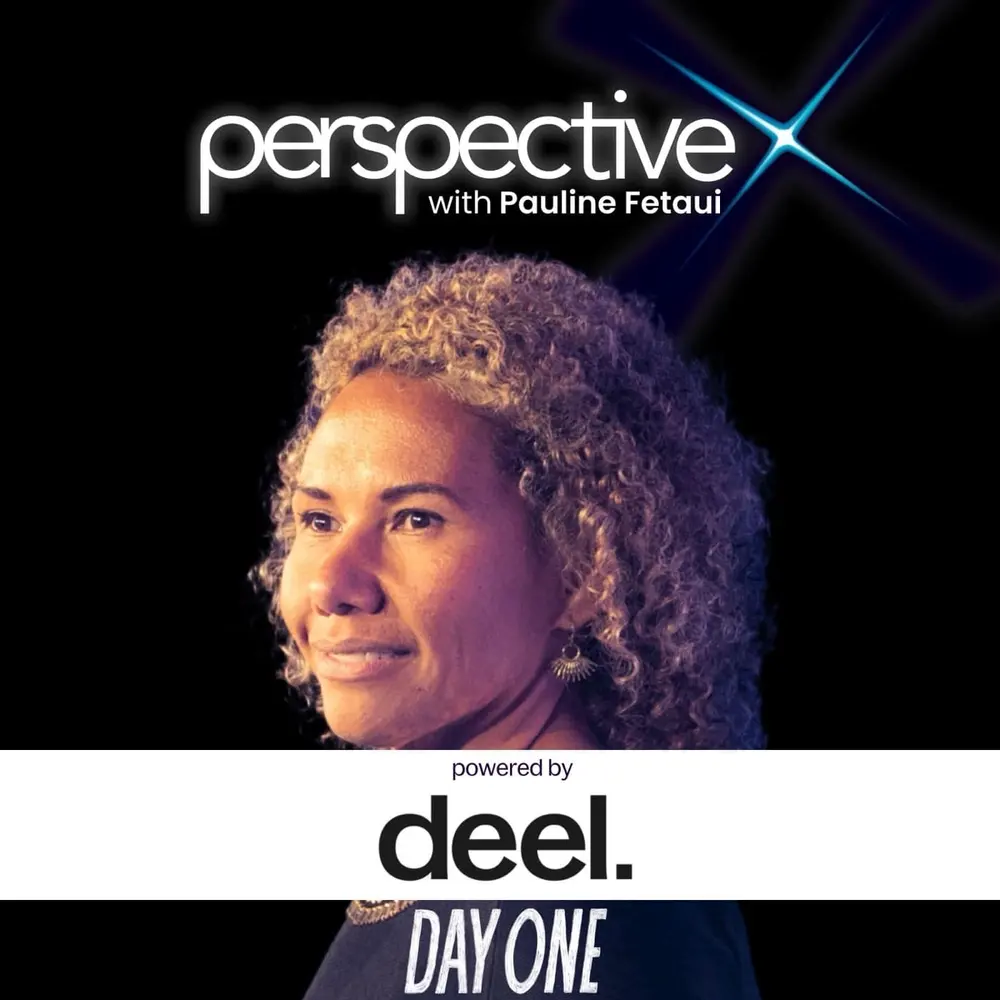 Perspective X with Pauline Fetaui
Presented by Deel
Perspective X with Pauline Fetaui
Presented by Deel 

 ▶
▶ ▶
▶ ▶
▶