Every policy he read had the same clause: more than two marathons back-to-back counts as an "extreme event." He and three friends were about to run 80 in 80 days, and none of them had run one. They went anyway, with nothing covering them.
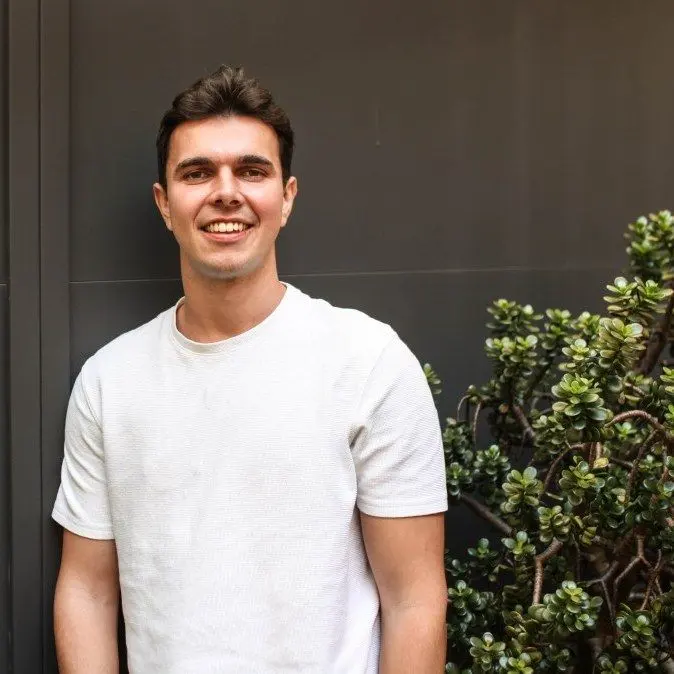
Sean Stuart is the co-founder of Rosella, an AI-native commercial insurance brokerage.
We cover why he thinks "find your life's work" is bad startup advice, how two Australians landed in Dallas with zero meetings booked and door-knocked insurance offices, what VCs consistently get wrong about AI-native service businesses, why a US trampoline park doing $5M in revenue pays $500,000 a year for insurance, and why his highest-ROI growth channel turned out to be mailing people chocolate chip cookies.
Chapters
0:00 Intro 1:14 Schemer And Tinkerer 3:01 Novelty Over Experience 6:11 80 Marathons Begin 7:33 Day 40 Of The Run 10:34 What Is Rosella 12:55 Cold Calling America 15:00 The Bulldog Story 17:07 What We Got Wrong 19:01 What VCs Miss 23:04 Managing People Hard 27:21 The Cookie Strategy 29:55 Moving To America 33:29 Not In Australia Transcript Search or select a timestamp to jump ▾ 0:00 Sean Stuart: Me and my best friends decided to run across America. When we announced we were gonna do that to our family and friends, we hadn't run a single marathon. Day 40, and I was running, and I developed cellulitis and went into septic shock, which means you're a few days away from dying if you don't receive medical treatment. 0:17 Thea Ngo: That's Sean Stewart. He ran it uninsured because no policy on earth would cover a run like this. 0:24 Sean Stuart: I read hundreds of pages of these documents and would find exclusions on every one that said an extreme event is classified is more than 2 marathons. We were doing 80. 0:34 Thea Ngo: The same maze that nearly killed him, thousands of insurers, fine print no one reads, is what every business in the US has to go through in order to get coverage. So Sean built Mozella, an AI-native insurance brokerage company, to do that fighting for them. From a marathon runner who'd never worked a day in insurance, taking on a $200 billion industry, built to say no. 1:02 Sean Stuart: My name's Sean Stewart. I'm the co-founder of Rosella, and this is Founders in Motion. 1:11 Ad: You're listening to a dayone.fm show. 1:13 Thea Ngo: You and Chris met at university about a decade ago, always said you'll build something together, and for years, neither of you knew what it was. So you were in Argentina writing novels, still trading ideas with him over Facebook. Where did that strong desire to build something really come from? 1:34 Sean Stuart: I was the type of person who, when they were like 9, was brainstorming business ideas. And I went through a lot of different iterations and schemes and ventures. I mean, I had a photography business. I did a computer reselling company and just always different things. My co-founder, Chris, he was much more of the, you inventor and the tinkerer. He was trying to build LLMs to detect news bias before ChatGPT. He built a jiu-jitsu belt progression app. And so he was always tinkering, I was always scheming. And then we came together 10 years ago and began the journey of finding what we wanted to dedicate our lives to. 2:19 Thea Ngo: The schemer and the tinkler. What a perfect combination. And I think I resonate with that a lot. I think I grew up selling clothes to people, and then I sold tea, and then I've always played around with like all of these different fun little business ideas. And that's so true, like you always start out thinking about like selling to consumer because naturally you're so used to it. Um, but obviously now you're doing something a little bit different. Um, but okay, so back to that moment, like you're in Argentina, you're writing a novel, which by the way is already a loaded sentence in itself. What was the idea that made you stop writing? 3:01 Sean Stuart: Doing your life's work, being an entrepreneur, and doing something authentic to you, it doesn't mean that the business has to match your experience. It means the business needs to match your disposition. And I think that's really important. And that's something which I suffered through a lot by doing the wrong things because we tried some different things as well along the journey. And so I'll give you like a super practical example. I and my co-founder are inherently very curious people, and I'd say that's one of our biggest driving forces is we love novelty. We love learning about new things. Now, if you started the next B2B SaaS company and your ICP was midsize accounting firms in the Midwest of America, that's gonna be a very boring existence for me because you're doing the same thing every day. You serve the same customer type, And so like, it doesn't matter whether you have experience in that or not. For me, my disposition would mean I'd be very unhappy because I don't like that. Whereas the crazy thing about what we do is we basically service customers across the entire spectrum of the economy. So we have a customer, this is a true story, asbestos removal company in construction demolition as well. One of the most dangerous businesses in America. We have other customers who are truck drivers. And so I didn't know this, but that matches our disposition completely because we get to learn about new things all the time. It's something you can iterate very quickly, which suits who we are as well. We love momentum. We don't like building the next quantum computer where you're not selling anything for 5 years. And so that's my point, which is just, I think it's more important that your business matches your disposition than it matches your experience. And I think the whole life's work is, to me, kind of a bit of bullshit. In terms of your actual question, which I've gone on a very long tangential monologue about, of how did I go from being a fiction writer to starting this business, the answer is that I actually realized I didn't like being a fiction writer. It was a very lonely, isolating journey. And the whole time I was doing it, I was just calling Chris and we were like, what is the next thing we can build? And so we had some experiences in our life where we had a few different ideas of things we wanted to do. The thing that we were both convinced of at the time was that software was saturated. This was before any of the coding agents came out. We just were like, every category has 50 software companies. The next big defining company will not be that. And so we developed a lot of conviction in service businesses. And to give you another kind of kernel of how this happened was when you're starting a business, and again, I want to make it unequivocally clear, we were the type of people who were going to start a company regardless. We were the types of people who didn't believe in life's work and it had to be something from your experience. But we're also looking for problems and things that would be worth solving. And so we bounced a few different things. We looked at a whole range of ideas. But one that really stuck out was 3 or 4 years ago, me and my best friends decided to run across America. And so the challenge was 80 marathons in 80 days. And we started in Florida, Key West, and then ran all the way up to Burlington, Vermont. At the time when we announced we were going to do that to our family and friends, we hadn't run a single marathon. And so crazy outrageous thing to do. It was certainly not our life's work to be runners. We're all very slow and I was unathletic. But we thought that it was possible. And so, we announced that challenge. Part of the thing that terrified our families was travel insurance. As you know, the American healthcare industry is just a behemoth. And if you have one thing, it can be life-ruining, like $200,000 medical bills. And so my job as the failed lawyer was to basically find a travel insurance policy that would cover us. And so I read hundreds of pages of these documents and would find exclusions on everyone that said an extreme event is classified as more than 2 marathons. We were doing 80. And so we basically ran without coverage in the US. And if anything happened to us, like there was no safety net and something did happen. Uh, it happened to me and it was on day 40 and I was running and I developed cellulitis and went into septic shock. Um, which means you're a few days away from dying if you don't receive medical treatment. And so I luckily had, with the help of my mom, um, diagnosing me on the other side of the world. my parents both being doctors, got medical advice for free and managed to source antibiotics and not go into hospital and was okay and just kept running and managed to complete the challenge with my friends pushing me along. And so, I tell you that story. I want to be super clear to everyone listening. The next logical— 8:16 Thea Ngo: I can't believe you kept running after Jim Oving. Like a life-threatening condition. 8:23 Sean Stuart: Anyone, if their 3 best friends are doing something and they're not going to be the one who finishes, will do it. I think you would probably do it too if you were in that situation. 8:33 Thea Ngo: I don't know. I don't think I would put myself in a position to run 80 marathons in 80 days, but never say never, I guess. 8:41 Sean Stuart: You'd be surprised. Maybe you will. 8:43 Thea Ngo: Maybe I will. 8:47 Sean Stuart: But yeah, like the thing, the thing I want to make like super clear to everyone listening is the next logical step was not to start an AI-native commercial insurance brokerage. Like that is not what I did on day 81, being like, hey, this is my life's work. Instead, the story is like you had 2 friends who were going to start a company. It was something innate in them that that was their, what they felt was like the most authentic expression of themselves in the world. And we were trying to find a problem that was worth solving, and it was one that I had felt and had seen. And so that was the beginning of when we started the journey, but it was certainly not linear. And I want to make that so clear, like, these are so messy. So that was our story. 9:31 Thea Ngo: You've had a crazy origin story, and I remember, like, I reached out to you because you had the gigantically crazy origin story as well. And I think one point that you mentioned that I really want to double down on is the idea that life is never linear. People think that there's a clear path to go from A, B, C, Z, D. But usually it's always in the messy moments that you learn a lot about different things you're interested in, different dispositions that you're most drawn to that would make you the happiest, that actually brings you closer to doing something that makes you feel purposeful and content. Yeah. And that journey can feel very iffy, and it can feel like, I don't know, going to Argentina, writing a novel and actually not enjoying it as much, or doing a life-threatening marathon, but then finding a space that you really enjoy working in because you couldn't find the solution for yourself. So maybe before we go into any further, like, for someone that has never heard of Rosella, what do you guys do? 10:41 Sean Stuart: Put super simply, um, we help businesses in America get better value from commercial insurance. Just put it another way, we are a commercial insurance brokerage and we're an AI-native one. So basically we build an AI platform for brokers that then help clients. Um, the simple kind of company to look at is Newfront, They were sold for $1.3 billion. What they did was they hired a lot of brokers and they built their own software platform for them. This was before AI, so this was just a cloud platform. So if you've never heard of a commercial insurance broker, imagine an accountant, a lawyer. It's a professional service here in the US. This is kind of mind-boggling. So I'll give you like a case study. Let's take the local trampoline park in the US. small business, right? Um, maybe doing like $4 or $5 million in revenue. Uh, that business could be paying $500,000 a year in commercial insurance, half a million dollars. And so every single business in the US, um, pretty much pays for commercial insurance. Now, why the broker exists is because there's 2,000 insurance companies. And so in the same process, when I was trying to find travel insurance, I would read all these documents. Imagine how complex it is for businesses. They've got to go to 2,000 different companies. Each company has different contracts. Each company has different prices, and it changes every year. And so because of this reason, 90% of businesses in the US use a broker to buy insurance. It is a $150 billion market of just the brokers. So it is huge. I think in Australia, we oftentimes can't really comprehend. People don't really sue each other in Australia. I think if you go to McDonald's and you get a hot burger that makes your tongue burn, you're not going to sue someone. Whereas in the US, like this is the land of litigation and dreams. And so it happens a lot. 12:49 Thea Ngo: Yeah, I do miss the land of litigation. Everyone does sue everyone. So when you first started on this whole journey, so like you mentioned, you didn't really have a background in insurance before. So I read somewhere that I think you and Chris flew to Dallas, New York, and SF with no meetings booked. So how did you get your foot into like these broker offices and what was the first meeting like? 13:17 Sean Stuart: Yeah, it was pretty wild. I mean, there was many people who shall be unnamed who thought it was the craziest thing they've ever heard. Yeah, we arrived in America with literally zero meetings booked. No one knew we were coming. And what we did was we thought that we could just go door knocking on insurance brokerage offices and different people in the ecosystem. Quickly found out that's super difficult in SF. But we actually managed to meet a lot of the previous wave of companies in the space. So we met with the CPO of Newfront, which is like the biggest company in the space. We met with all the previous competitors who were super kind, generous, and shared a lot of lessons. But we realized that we were going to have to go to Dallas because our thought process was SF is probably like the capital of clueless founders door knocking to ask for advice. And so we thought, let's go somewhere, southern hospitality, they've never seen tech founders before. And so we went to Dallas, we got on a plane, and then we would go to these office parks in Dallas. And what we did was, there would always be a security guard at the front of the building, and then there would just be like hundreds of cubicles and offices. And we would just go to the directory and we would just look for the word insurance or brokerage. And then we would say, hey, like, we're here to meet so-and-so. And then they'd be like, yeah, sure, go up. And then we would just knock on these offices and just walk in. And it was always like a wild— we have a crazy story actually. So, in Dallas one time, we did this where we did this door knocking thing. We opened the door and suddenly there's this like leopard, a taxidermic leopard, like full in like hunting stance just there. And then we look around on the walls and there's like zebras like mounted to the walls. There's a lion that's been shot and this guy's got a gun and it says— Southern hospitality. Yeah, I won't say his name, but it's like his nickname is the Bulldog and he's an insurance broker. And so, he walks in, he's got like a cowboy hat. He sees Chris and I and he's like, gentlemen, like, what are you doing here? And we were just like, we want to talk to you about the business and the industry. And he just sits us down, tells us everything. He's been in the business for like 30 years. His dad built it and then he took over and talks to us about everything. And then after we left, being like, that was quite a strange man, and we Google him. And it turns out that he is, again, I'm not going to name him, but it turns out he is notorious for being a known racist in Dallas. And he's all over the newspapers and like everything he's done. And we were just like, oh my gosh, like we just walked into this man's office completely serendipitously, had no idea. And yeah, he was in like newspaper article after newspaper article. So, wild stories that happened a lot. Not that we met crazy people, but more just we went into a lot of places without knowing anything and met different people of all types of creeds. 16:35 Thea Ngo: No, that's beautiful. I feel like you have to meet a lot of different people in the space to get a feel for everyone that operates there, because not everyone's going to be the same cookie cutter, similar. So you mentioned that you guys, when you guys were starting to look at ideas, the main thing you landed on was that software was super commoditized. And then obviously right now, like in venture capital, AI-powered services have been like all the craze. AI-powered services is really about using AI internally to deliver a service at a fraction of the headcount and costs. So what do you think people get right about it? And what do they get wrong? 17:19 Sean Stuart: I'll start by what we got wrong. And I think a lot of people get wrong is when we were looking at services to disrupt, we made the mistake of looking at industries that didn't have recurring revenue. And I think that is a very big problem in this space, especially, I mean, there's obvious reasons why, but I guess the less obvious is if the models are becoming available to everyone and they're becoming more increasingly commodified and the unit of work in a service business is one-off, then you're gonna have a lot of pricing pressure and it's gonna be really hard to capture value. Whereas if you have something like accounting and it's an ongoing bookkeeping, once the client signs with you and you do a good job of delivering that initial service, it's very high retention. And so the models are your friends because you can just reduce your cost of goods sold, Yeah. And then you can reinvest that into a better customer experience, which is what I think is the best AI-native service businesses. So what we got wrong was thinking that you could go after services where the work wasn't ongoing. I think that was a big mistake. What's more interesting is what do VCs get wrong about investing in AI-native service businesses? And I've heard this from so many VCs, it's kind of comical at this point. They take the mental model of what makes a great software business, which is, let's get the most 2 cracked engineers we can possibly find from Google and Stanford, and then give them a lot of money to play in the AI-native service space. These businesses are people businesses. 19:03 Thea Ngo: Yeah. 19:04 Sean Stuart: They are not, hey, can I develop the best frontier model? And so there is a lot of founders a lot of our competitors in San Francisco where they've raised very large rounds and are incapable of leading and managing teams of people. And really the type of founder that succeeds in this space is one that straddles the ruthless execution of a private equity founder with the optimism and the innovation of a venture-backed one. And it's a very interesting hybrid that I think most people get wrong when they're thinking about what will make a successful company in the space. So that's what I think people get wrong and what we got wrong. In terms of what do they get right, there are these behemoth companies, billion-dollar service businesses that are just as high margin as software companies in many places that are constrained because they can't rebuild their entire company around the software. And we see that with our competitors, they're billion-dollar companies. They have every advantage. They have scale, they have capital, but the thing that holds them back is workforces of thousands of people where they cannot do change management to completely rebuild the company based on what is possible with the models. And our competitors' only competitive advantage, and I think people underestimate that as well. 20:33 Thea Ngo: Yeah. Okay, I have 2 follow-ups from that. So first, when you were talking about services that are non-recurring, what types of services did you look at before as an example? And then secondly, when you think about managing people, I guess, why do you think it's so hard to like manage people or run like a service front people-based business? 21:05 Sean Stuart: Yeah, sure. Um, so on the first question, I mean, I remember reading, um, Sarah Tavel from Benchmark, who is an incredible thinker's essay on service businesses. It probably came out 2 and a half years ago now. Um, and so I read that essay and I remember just systematically thinking about each one that she mentioned. So there was legal, there was immigration law services, there was accounting, there was a bunch of other ones. And I think when we were kind of going through each of those, we were trying to like— our mistake at the time was not understanding ourselves to think about what is the business for our disposition, which I mentioned. Yeah. It doesn't matter what your background is, that's irrelevant. But it's like, would I actually enjoy running this business every day. And at the time, if I had seen the words insurance brokerage, I would've been like, there's no way. But I fundamentally didn't understand what the business is, which is dealing with every business in the US economy, figuring out what the risk is, and trying to help that person to prevent that. And that is really interesting. I think it's the inverse of VC. VCs ask what can go right. Insurance brokerages ask what can go wrong. And all the novelty that VCs love is present in insurance brokerages too. Whereas starting a service business for like franchise accounting, that is not my disposition. And it's not a problem I particularly would be very passionate about. And so that was kind of the process was we were very much just thinking through at a conceptual level about whether it was a good business or not. But I don't think we really thought it through from the disposition side. which we kind of just got lucky with the combination of it was a problem we'd experienced. My co-founder was really good at building things in that space, and then we lucked our way out. 23:04 Thea Ngo: Like, what do you think is so hard about managing a business that's very people-oriented? 23:10 Sean Stuart: In the tech industry, we celebrate companies like Midjourney that get to $5 billion in revenue or something stupid with like 30 employees. And that is almost a symbol of status, is like your revenue per headcount. And so typically the less employees, the better in software. And you have a team of people with very similar backgrounds that typically— 23:37 Thea Ngo: Yeah. 23:37 Sean Stuart: They know what LTV/CAC is, they know who Naval is, there's this shared belief system with everyone in those companies, right? They all understand the industry. They idolize the same people. They understand what venture capital is. And you have a very compact team trying to go after these massive markets. Service businesses are very different. And so for this to be like a multi-billion dollar outcome, we're going to have thousands of employees. And anyone who says, no, we can run this service business with like 5 people, it's all going to be agentic. Like, that, they're not going to win. And so that's one element, is that the number of people required to be successful is just very different in this company's journey. The other one is that it's a very different type of person. And so no one typically wants to go into insurance brokerage. It's not like going to NASA. And so You typically attract a different type of person that doesn't come from like a certain Stanford pedigree. Now, it's not to say that these people aren't brilliant, but they don't come from the same background as people in the tech world are used to. And there's actually a lot of development that you have to do. You have to take someone with an enormous amount of potential and turn them into something. And that process of transformation is really difficult. It's not just like you get top 1% talent, they come in, they get it, they love Aesop, they work hard, they build a massive company. It's you take people who didn't know that they wanted to do that job. They've never, or some of them haven't worked in like a top 1% environment. They haven't realized their potential yet, and they've got to learn a completely different skillset and you've got to teach them to it. And so that is really, really hard. And that's also the IP. And that's also the moat is it's not about software. It's how can you transform people around software and build a great company? And that is the difficult part. 25:42 Thea Ngo: Really curious on the point that like, because you're a service, you're really going up against like the mom-and-pop mortgage brokers or maybe like the tier 1 traditional mortgage brokers. What's fundamentally different about competing against those services versus if you were to compete against another software company. 26:02 Sean Stuart: And we get asked this question all the time by investors, which is like, how do you feel about insert AI company from San Francisco? And the reality is, is that we're going to compete with those businesses less than 0.01% of the time. To your point, like, we are competing with local service businesses. And so it's a very different beast. And really the other thing which I think is going to kill a lot of service companies is go-to-market. That is how you scale these businesses, is you actually need to innovate more in go-to-market than you do in product. And so all of the AI tools that we've built so far have largely been in the go-to-market side today. 26:48 Thea Ngo: Oh, really? 26:50 Sean Stuart: Yeah, like allowing us to have an edge in how we acquire customers, because that is historically the difficult part of a service business. It's, they can be super profitable. Yeah, it's amazing that you can use AI to make it 90% margin, but how do you actually grow? That is what is largely unsolved in this space. So to your specific question of like, how do we compete with local businesses. I'll give some fun examples because I think that might be interesting. So our marketing lead, Will, he discovered that the highest ROI channel is cookies. And so what we do is we basically will reach out to— 27:32 Thea Ngo: Like internet cookies or like actual cookies? 27:35 Sean Stuart: Like actual like chocolate chip cookies. And so we'll reach out to a customer with a phone call, someone that we think we can help based on data. And then we'll call that person, we'll have an interaction, and then after that conversation, we'll send cookies. Now, that sounds so simple. You couldn't put that on the slide of a go-to-market for a VC. But the reality is, is when we do that, our conversion increases like fivefold, and we've closed like $40,000 revenue deals from just a phone call than a cookie. And so when you compete with the local brokerage, their mental model for what works in go-to-market is completely different. So they're stuck in a mindset from 30, 40 years ago where they're like, the only way to attract customers is to be in the community, it's to build relationships. And it's like, yeah, maybe that works, but if we're trying to scale a business to a billion-dollar company, that's not going to work by just being in the community and developing relationships. Like, we need to systematize go-to-market and have edge in doing that. And so, even just something like really amazing filtering of the database on who we contact, and then like systematized touchpoints where cookies get delivered to the office, then a letter, and then something else, has a massive impact on scaling our business. And so, I would say like all those little things, those 1% things you can do are what the local service business is not doing. And that's how we compete in the go-to-market side. 29:17 Thea Ngo: That's super fun. And I'm trying to think like, as a consumer, would I enjoy that? And I think I would enjoy that a lot. I think I had a company send me some merch And while I'm not in love with what they do, I'm just so appreciative of the fact that they send it to my home address. And I still think about it because it's like, what was the company? I can't say. It's in my living room. They gave me a really nice teddy bear. So I always see it now in my living room. I'm like, I really hope they're doing well. Okay, so you grew up in Sydney all your life, and in 2023, you left. So now that I've lived in Australia, I've realised that a lot of Australians want to move overseas to the US to live at some point. What do you know now about making that jump that you wish someone had told you before you did it? 30:18 Sean Stuart: You come to the US and your brain melts. The level, the ceiling just raises so much, and it's something that you can't comprehend when until you've been here. It's not just like the population is 10 times bigger, so the economy is 10 times bigger. It's like 40 times bigger, the economy. And that local service business that you, you just think is a small business is doing like $4 million of free cash flow. And it's like just crazy to truly comprehend the magnitude. I think I didn't understand that before I came here. I mean, it was always very abstract. The other thing Is how hard it is. I mean, you would've dealt with this as well. Just Australia is so comfortable and so nice, and your family and friends are there, and there's an amazing quality of life, and you can even have a viable career in tech. But to leave all of that behind, and honestly, this will be controversial to Americans, in many ways downgrade the quality of life that you have. I think it's just so hard in the beginning, and that's something which I also didn't register how difficult it would be. What about you? What did you find was yours? 31:35 Thea Ngo: So I actually grew up in Vietnam before I moved to the US, so my benchmark is a little bit different. But I have to say, like, Australian living is very comfortable. Like, the apartment I have now in Australia is the nicest apartment I've ever held in my entire life. And I feel like the competition is a lot less. I feel like people don't really try super hard. So if you're just like a smidge of a tryhard, you'll like stand out. Even small things, like I think minimum wage here is super high. So like you can have a very comfortable job and still pays for all the basic necessities. Whereas I feel like in the US, especially like in big cities, like in New York, SF, you can't really live off of like minimum wage or like low salaries. So, yeah, I think in a way, like, and also, like, obviously the beaches and, like, all the subsidies and, like, everything. Oh, healthcare too is a big thing that I had to adjust to because I used to be like, oh, I'm never going to see the doctor. Like, it's going to be so expensive. But now here it's like a cough, go see the GP. Or like, you want a blood test? Just go get a blood test. And I'm like, oh. That's crazy. 32:50 Sean Stuart: Yeah, 100%. 32:53 Thea Ngo: So I think I agree with your point in terms of downgrading your actual lifestyle by moving to America. 32:59 Sean Stuart: And America is great. I also want to say that. I don't want to seem like I'm ungrateful, but I just think it's probably one of the few countries that migrates to America and actually has a worse quality of life. Like, for 90% of other countries, it's probably an upgrade, but for Australians, it's really not. Australia is truly the best place in the world to live, and saying goodbye to that for a dream is both like a beautiful journey but also a very painful one. 33:28 Thea Ngo: Yeah. And do you think Rosella could have been built in Australia? 33:33 Sean Stuart: Uh, no. Um, there's a lot of things to unpack there. Like, do I think you could build a billion-dollar company in Australia? For sure. Do I think our exact business model in Australia? No. There's a lot of industry-specific reasons for that. And so it's like, again, it kind of comes back to our joke about suing someone in a McDonald's. There's a very different cultural attitude to lawsuits in the US, which means that insurance is like a mission-critical thing for every business and they all have it. Yeah. Australian businesses have it, but it's just not to the same extent. It's just not as critical. And so when you talk about building something where there's a genuine pain point, commercial insurance is a genuine pain point for businesses. That trampoline park that I mentioned that spends like second biggest budget expense is insurance. Like that's a massive problem. Whereas in Australia, like it's just not as prevalent. And so less opportunity. So short answer, no. 34:41 Thea Ngo: Well, thank you, Sean, for all your lovely takes, um, and the conversation. 34:47 Sean Stuart: Thank you. That was fun. I appreciate you having me on. 34:51 Thea Ngo: That's a wrap. If you liked this episode, please hit the like and subscribe button. It helps us bring on more awesome guests, level our production, and bring on new series you'll want to watch. And if you want to hear more early stage builder stories, check out our other episodes. Okay, see you next time. No transcript lines match that phrase. Try fewer words.


 ▶
 ▶
 ▶