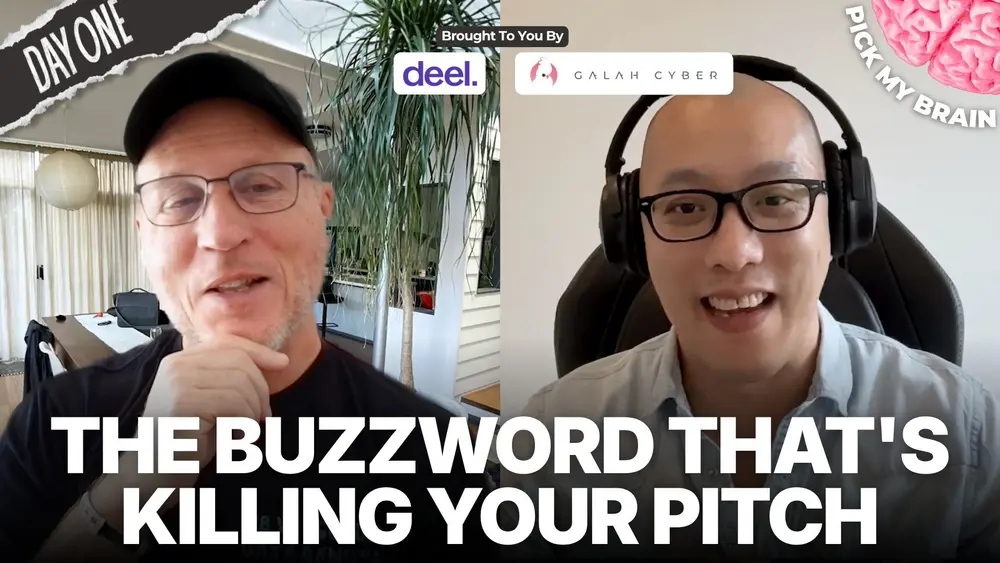
Transcript Synced · select any line to jump ▾ 0:00 Alan Jones: First impression was very hard to shake. But no matter how well we do at the end of the pitch, if the beginning of the pitch wasn't as great as it can be, then it's too late. 0:08 Michelle Chen: That first second when I step onto the stage, like my heart is just pounding. So like I'm trying to like cope with my anxiety while trying to deliver a pitch at the same time. 0:19 Alan Jones: People don't invest in decks, software games, publishers don't license games from decks. They trust people, so they should be focused on you. 0:28 Michelle Chen: Do we make two pitches or do we tailor it to different audiences? 0:36 Alan Jones: Welcome to Pick My Brain, the podcast where we help startup founders hone their pitches to better connect with customers, co-founders, investors, and more. My name's Alan Jones and I'm an ex startup founder myself, but now I'm an angel investor and a founder coach with quite a bit of experience helping startup founders find their way and achieve their goals. But I'd like to acknowledge that this podcast is being recorded on the Gadigal land of the Eora Nation, lands that were never ceded. I pay my respects to the First Nations leaders and the innovators past, present, and emerging. On Pick My Brain, you'll hear real stories from founders as they pitch their startups, tackle the challenges of entrepreneurship, and work on turning their ideas into successful businesses. Each episode, I'll be diving deep to offer insights, advice, and strategies to help founders take their business to the next level. Thanks for joining me. Let's get started. You're listening to a day one.fm show. 1:29 Speaker: Ever sat through security training and thought, non of this helps me ship code? Well, Glasscyber gets it. The foundations of application security course is built for engineers to actually build things. Two days and packed to lessons you can use the minute you're back at your desk. It's relevant and it'll make you better at your job, not just ticker box. Register your interest www.global.com.au slash learn for the 2026 intake. 1:38 Alan Jones: Hands on. It's practical. at GALASIB- That's Galah-Cyber. Learn. We're joined today by Michelle Chen from Mental Jam. Welcome to the show, Michelle. 2:00 Speaker: dot com dot au slash. Thank you for having me. 2:10 Alan Jones: I don't know if you listened to or watched previous episodes of Pick My Brain, but there's two standard questions that I like to ask cameras before we get started. The first standard question is, when you were young, when you were a kid, what did you think you wanted to be when you grew up? 2:27 Michelle Chen: Funnily enough, I thought I wanted to be a fashion designer. And for the longest time, I thought that that was just something I wanted. But later on, I realized it's because that was what my mom wanted to be when she was younger. And I somehow like, just like, you know, attached to it. And even as I got a bit older, I was like, wait, no, this isn't really what I wanted. I was just like, trying to live out my mom's dream. 2:52 Alan Jones: Yeah, I get that. Are you an only child or the eldest child? 2:55 Michelle Chen: I am the middle child, so the people please her. 2:58 Alan Jones: Yeah. The people pleaser. Great. I did the same thing, you know, growing up, my father was a chiropractor and I thought I should become a chiropractor like my father, but I just didn't really have the passion for healing people that he did. And here we are today. My second question is before you became a tech startup founder, what were you doing and what happened to make you pursue mental jam instead of what you were doing before? 3:26 Michelle Chen: So before I started as a tech startup, I was doing my PhD. ⁓ So in my PhD, I was co-creating video games with people about their lived experiences of depression and anxiety. And when I graduated, that's when I realized, like, this is really cool. I want to take it out to the world. And tech startup seems like the way to go. 3:47 Alan Jones: So you weren't done with ⁓ this particular intellectual challenge. You wanted to keep developing it and maybe commercializing it. 3:55 Michelle Chen: Absolutely. 3:57 Alan Jones: Okay, cool. you are ⁓ a member of the catalyzer family, right? Yes. The accelerator program for for migrant entrepreneurs and refugees. How long ago did you go through the catalyzer program? 4:10 Michelle Chen: I think it was sometime last year when I graduated, I was like, okay, cool. I think startups are the way to go. I know nothing about startups. So I was looking for different programs and Catalyzer was the one that came up because I came to Australia as an international student. And what really appealed me about the Catalyzer program is people are also my entrepreneurs and they know the challenges that is even more as an international student, now temporary grad visa holder that Australians may not face. 4:39 Alan Jones: Cool, is it a program you'd recommend? 4:42 Michelle Chen: Absolutely, because like the cohort itself, like some people are a bit more advanced, some people are like just starting out and it's such a good cohort because we all face a lot of similar challenges and even though everybody's doing different things, we learn a lot from one another. 4:58 Alan Jones: Cool. Well, full disclosure for the audience, I'm actually on the board of Catalyzer and been a passionate supporter since the Catalyzer Accelerator program got started. So it's one of many Accelerator programs that I'd recommend, but one in particular relevance to people from a migrant or a refugee background. Thanks for that, Michelle. So we're here today to talk about your pitch for Game Jam. Who have you been pitching to? What kinds of settings? 5:24 Michelle Chen: ⁓ I drew a lot of the startup programs. I recently pitched at the Startup Network as well, and their health and well-being, and right now we're in kind of two stages of pitching, because we're pitching ourselves as a startup to ⁓ startup founders, investors, but we're also pitching ourselves as a game to game publishers, and we have a few pitches coming up when we're going to pitch to some game publishers, and hopefully they'll give us some money. So I guess like... the audience of our pitch is quite different. And we're kind of in that in-between. It's like, how do we tailor? Do we make two pitches or do we tailor it to different audiences? 6:05 Alan Jones: Cool. Okay, so my advice would definitely be to tailor. 6:10 Michelle Chen: Okay. Yeah. Okay. Yeah. 6:13 Alan Jones: So yeah, those two different kinds of audiences are related. They're not entirely dissimilar, but they are different in what they're looking for. Right? So a games publisher is a studio model, you where they identify emerging talent and they try and secure the rights to their intellectual property as affordably as possible. And what they're trying to assess is what do they think is the long-term commercial revenue opportunity out of being the publisher and distributor of this? game, whereas investors are certainly looking to invest in a growing company. But their interest is in, I hold a thousand shares in this company, how much might those thousand shares be worth in say a decade's time? So one of the variables that determines how much each of those shares is worth is how much revenue the company is earning per per annum in 10 years time. But another thing that determines the value of the shares is a rate of increase. in the revenue over time, right? So early stage investors are investing in companies that they believe will not just be more valuable in time, but also are growing faster than someone would expect. So in their games publishing industry in Australia in very recent history, we've had a few really great successes out of the Australian game software industry. And so that kind of establishes a benchmark, a benchmark for growth. So that tells us what great looks like. ⁓ And so you'll be assessed against that. People will be making up their own minds about how rapidly they think you might be able to grow. So with that in mind, it's probably a good idea to have two different kinds of pitch. One for investors, one for games publishers. And then the bad news is there's probably also three different kinds of pitch for each of those two audiences. So that's six total. 8:02 Michelle Chen: Yeah okay. Can you talk a little bit about what those like six are? 8:07 Alan Jones: So it's two of each of three clients. So the first one for investors and for game publishers, we need a teaser deck, something which creates more questions than it answers. So something that says, ⁓ we might be worth having a coffee with, we might be worth having a video call with, we might be worth keeping an eye on. So a teaser deck is designed to be really small, really sharp, really lightweight. So it's an easy attachment. to an email, it's not something that somebody is going to be annoyed with having to download or to page through, you know, 48 slides on a mobile phone. So that's a teaser deck. So both kinds of audiences will want to see those. And those are really good for when you have to do warm or cold outreach, you know, so by warm, mean, you know, kind of, you know, the person that you're reaching out to, but they don't yet know you, right? And you can't get a, you can't get a hot introduction. from somebody else who's a trusted business partner of that person you want to reach to. So warming choices where you know the person you want to reach and you think you know a bit about them. And then a cold introduction is just reaching out to strangers on the internet, which I generally don't recommend. But if you have to do it, a teaser is going to help. So don't try and tell everything about your business. Just try and pick your three strongest, most interesting things. What are the three things that make you stand out most from your competitors who are also raising money to do the similar sort of thing as you. So that's the teaser deck. And then the next kind of deck is the pitch deck. That's probably the one we're going to go through today. And so that is something which ⁓ supports what you say when you're having a meeting with someone, when you're pitching them for investment or for software. So ⁓ a pitch deck by itself doesn't sell an investor or a games publisher on what you need to do. Yeah. but it helps you tell the visual part of the story. Right? So the story is still you, the storyteller, but the deck should help you tell the visual part of the story. So don't get too drawn into PowerPoint or keynote or Cav or whatever you use for your deck tool. Don't be tempted to overthink it and make it more complicated, more dense with information. Because of these early stages, people are trying to establish credibility and trust in what you're saying. And so they want to focus their attention on you. So if there's too much density of information on slides, and if you're telling too much of the story through the slides and not through what you're saying, then that's difficult for the audience to really manage both incoming streams of information at the same time. And they'll lean towards reading the deck, right? And they won't spend a lot of time trying to evaluate who you are, which is never good. People don't invest in decks. Software games publishers don't license games. from decks, they trust people, so they should be focused on you. Think about being Captain James T. Kirk on the deck of the USS Enterprise, right? You are the actor playing the captain of the USS Enterprise. And the set behind you, you know, with the screens and the Klingons and the crew and all that kind of thing, that's just the backdrop for you to tell your story. It's not the story. Nobody watches Star Trek on a streaming service to look at all the cool backdrops. least if they do, they're probably in set design, right? Everybody's watching how the characters tell the story. So a pitch deck should be light and clean and support the visual elements of your story to help you explain what's going on. Then the third kind of deck is what we call a leave behind deck. And both those audiences need that as well. So if you have a lucky enough to have a video call or a coffee with either an investor or a games publisher, they're going to retain hopefully a good part of what you've told them. But once they leave that meeting, that memory will start to fade. And once it's in a couple of other pictures that might be completely gone. So they need something to refer back to, right? And if they're telling somebody else in their office about what you told them in your meeting, they may forget some of that information. They may need to refer back to something. So a leave behind deck is the largest kind of deck. It might have appendices and footnotes and more data and ⁓ more things to read. And that's because you won't actually be there telling the story for them. 12:34 Michelle Chen: Okay, yeah, so that could be the dense one. Yeah. Yes. 12:39 Alan Jones: So that can end up being quite a big file. Give people the opportunity to download it from some kind of cloud service at a time of their choosing, or print it out and give it to them at the end of a meeting with them so that they can take that away. So don't try and attach that to an email. That's just going to box someone's inbox down. 13:00 Michelle Chen: Yeah, around like what are the length of these pitch decks like with the teaser deck like around how many slides with those? 13:08 Alan Jones: PCDeck 3 to 5. pitch deck 10, 10ish, 12ish, 15ish at the most and leave behind deck however much information you have. 13:22 Michelle Chen: Okay, so it can just be like all the info that we have and written in. Because like with pitch decks, because they're like talking to them, then you don't want to have a lot of text heavy things, but the leave behind deck could have those things. 13:39 Alan Jones: Exactly. Would you like to run through your pitch with me? 13:43 Michelle Chen: Yes, please. We are Mental Gem and we co-create video games as a modern remedy for mental health. ⁓ Two in five Australians experience... ⁓ I lost my track. I have like script in mind and every time I see the words, it just goes out of my brain. Let me redo the slide. 14:02 Alan Jones: Was that for a second? Yes. Yeah, cool. That's a really interesting effect and it happens all the time. And the more awkward we are at the beginning, the more likely it is to happen. Right? Because what's written on the deck feels safe and like a safe place for us to go to, you know, because it's something we prepared earlier, so it must be correct. And that happens all the time. in real life pictures, you know, on a stage at the fish boaters or ⁓ tank stream labs or launch vehicle or something, you'll often see people actually turn away from the audience and as you can see on the screen, two in five Australians suffer from mental disorder, right? So that's a terrible thing to do because we are using our body language and our voice and everything that we have to tell a story and saying, never mind me, captain of the USS Enterprise, look at the backdrop. ⁓ That's a really difficult thing to avoid. So when you're 14:55 Michelle Chen: So that's 15:00 Alan Jones: pitching over a video call, be aware of that. So one way to keep your attention off the deck when you're on a video call, because of course it's there all of the time, is to pin. So if you're on something like the Zoom or Teams or Google Meet, it'll allow to focus what's in the center of the screen. And you might want to make that the person that you're pitching to, or the most important person if you're pitching to four or five at a time. and then you can focus on their face rather than what's on your material. In your peripheral vision, you'll be able to see that you're on the correct slide. But if you know your script, you won't be distracted and you won't go to the slide. 15:39 Michelle Chen: That makes a lot of sense. will go and resize my window so that I can see things at the same time. Let me do that. Because a lot of times when you're pitching online, because you're on your slide, you don't actually see the people that you're pitching to. sometimes they would turn off their videos and it becomes a bit awkward. Now I can see both and I feel much better. 15:47 Alan Jones: Right on it. Cool, let's go again. 16:14 Michelle Chen: Mental health is a vital part of our health and wellbeing. However, two in five Australians will experience a mental disorder at some point in their lives and 54 % do not have access to any treatment and it's costing Australia a lot of money. Me and my team, we understand the problem close to our hearts. So hi, I'm Michelle. So I've been a game developer for many years, but my personal experiences with depression and anxiety actually made me quit my job and moved to Australia where I completed a PhD. where I co-created video games with people about their lives experiences of depression and anxiety. And since graduating, I've been pivoting my research into a startup called Mental Jam, where we turn real stories into powerful games. And our new game, Boba Rista, is a soul-soothing mobile game that blends bubble team making with mental hall support through its narrative and gameplay. ⁓ And then pretty slides. ⁓ And we also... ⁓ like run game design workshops with people with lived experiences of mental health struggles to co-create the video games with us by designing the character, contributing the story and shaping the mini games. So some of our unique selling points is we are a really beginner friendly experience that brings mental health experiences to life. And it's about combining that blend of story and gameplay that helps people find what works for them. And it is researched back. all of the projects, game is based on my PhD research and we are really working closely with people with those experiences in the game development process. And we will also have ongoing stories, new characters as we're conducting new workshops. So there'll be a lot of new content for the people to engage with. And each of the characters in the games, they come with their own mini games and their personal challenges. So for example, in this screen, you can see all of the, some of the different characters that we have. For example, we have Bob, who is a platypus who is going through like a midlife crisis and then he went back to uni. So that's me. ⁓ That's character I really relate to. ⁓ And all of the characters have their own minigames that introduce healthy coping tools and kind of reveal like the different ways that the characters are embracing their condition. And this is another character that we have. So her name is Trixie. So she is a quokka. And in this screen, we are showing some of the mini games for Trixie. So she is like a toxically positive quokka, being the happiest animal in the world. ⁓ And her mini game is actually about recognizing and naming difficult emotions. And it's actually encouraging the players that it's okay. You don't have to be happy all the time. It's okay to have different emotions and difficult ones. And it's just really about acknowledging that and really learning to let go of the pressure of always having to be cheerful all the time. And we have another character here. She's Mabel. She is a perfectionist. So she's like a blue tongue lizard. And for her mini game, she's quite a perfectionist and she needs things to be in a certain way. And all of the bubble teas are served in really cute mugs and she accidentally broke one. And being that perfectionist, one of the challenges that she's trying to face is like, Oh, things are broken. It's not perfect anymore. So her puzzle is this puzzle game that's based on the Japanese philosophy of Kintsugi about like repairing broken ceramics with gold, but it's also teaching her about how to embrace the imperfection. So in terms of our market, 70 % of gamers already play video games to nurture their mental health. And the digital mental health market is on the rise with an estimated revenue of $27.56 billion. Highest usage of mental health apps are 18 to 34 year olds, but retention is low unless it's like an engaging or gamified. Our target audience are women and non-binary people aged 18, 15 to 35, especially young adults who are still navigating life challenges and trying to prioritize their self-care. And the access barriers that they face is that 50 to 70 % of them, they actually don't have access to traditional mental health support. And that's due to many reasons like access, costs, wait times, or stigma. And there is a really huge market need for this. ⁓ One in five people have mental health condition and the opportunity that we have is that they're already using their phones. So this is a great opportunity for us to deliver this platform to something that's very accessible that they can quickly pick up. And it's also gamified and it's fun to play. And some of our competitors are like traditional ⁓ mental health apps such as Calm or Headspace. But they usually just focus on giving you like a long list of tools while our game, because we have the story that provides that context. So we're also like sharing people's stories through the characters and introducing these mini games in the context of those characters. And in that way, we're not prescribing players anything. We want them to discover what works for them. for themselves. And here are some of the comparable title sales. ⁓ Comm and Headspace are dominating the market, but there are a lot of new players such as Finch and Quabble and B-Twix, which is also a research-backed app as well. And in terms of our business model, we are going for a freemium model. So ⁓ it's free to download, but we have monetization built into it. through, like they can buy cute mugs, they can customize their boba shaw, they can buy more ingredients in the game. But we're also experimenting with other different monetization strategies, such as subscriptions. For example, we can have some premium features like the ability for them to download a Metal Hall Insights report or having personalized and customizable content. And we'll also have live ops, like we'll continually update the game as we're creating new characters. And we're also looking into having companies sponsor some of the subscriptions and in terms of ads or custom content. In terms of traction, so ⁓ as part of my PhD, I created five video games and we reached 15,000 players through organic traction. And we've also been going to a lot of different game industry events and we've been talking to a lot of customers. I call it blatant self-promotion, so we go on ABC, ⁓ we're here, and we also go to a lot of game events because we really want to connect with our community. And the impact that we want to create is mental health care reimagined. So through cozy and heartfelt games, we are sharing untold stories and reach those often left behind by traditional support. And this is the team, and that's it. 23:14 Alan Jones: Thanks, Michelle. I really appreciate it. That's great. Now, what's the QR code lead to on that last slide? 23:20 Michelle Chen: ⁓ It is a it leads to our link tree so it leads to our our website and our Instagram 23:29 Alan Jones: Okay, cool. And okay, so I have some feedback for you. I'm ⁓ hoping this can help. So you're working from a script. You mentioned the script before. And I feel like you're not actually reading from the script right now. 23:48 Michelle Chen: Not, not so much. Yeah. Yeah. 23:50 Alan Jones: No, okay, yeah, but this is the script that you've memorized, certainly at the beginning. Yeah. The beginning of the script is memorized. you're at a point in learning the script ⁓ where you feel like you can recite it. And the problem with reciting a script is that generally it has way too little emotion in it. ⁓ If you've ever seen a young child go to school and come back having ⁓ memorized a poem, 24:10 Michelle Chen: ⁓ 24:19 Alan Jones: They will stand there in front of their parents, stand at attention, arms rigid, and just like speak like a robot. This is my, so like that's an exaggerated version of where you're at right now in learning the script to go with your story. So what I'd like for you to do is to, is to go back and do even more rehearsal so that you'd get to the point where when someone asks you about your startup, you'll start using bits of your script to answer their questions. Right. And you'll find when you get to that point in rehearsing your script, that you're relaxed and you'll start to add more emotion and dynamism and real personality into the story. Remembering that we set the first impression when we pitch in the first 10 to 15 seconds. And then that first impression was very hard to shake. But no matter how well we do at the end of the pitch, if the beginning of the pitch wasn't as great as it can be, then it's too late. Right. So I want you to really focus on adding more emotion, more warmth, more personality to how you deliver the beginning of the pitch. This is not you reciting a poem that you've learned to your parents. Okay. You also, you stumbled there a little bit at beginning because you just made some changes to the deck. ⁓ It's fine to make changes to our deck. should always do it when, you know, so a startup should always be seeking feedback from its customers, right? In this case, your customers are your audiences when you pitch. So if you feel the need to change your deck, do. But then each time you change your deck, spend an hour in reversal. Otherwise you will stumble like you did this time. Right? So even though you know your script, you're not yet familiar enough with this version of how the deck rolls. 26:01 Michelle Chen: I also have a question because I do get social anxiety. So whenever I pitch in real life, that first second when I step onto the stage, like my heart is just pounding. So like I'm trying to like cope with my anxiety while trying to deliver a pitch at the same time. And it usually gets better as it goes along. But sometimes like in between, I get that feeling come back again. And just like trying to like, ⁓ yeah. What's a good way to cope with that? 26:28 Alan Jones: Yeah, that's very normal and we all face it. So, you know, we can't fix something that we don't understand. So what do you think when you look inside yourself, what is causing the anxiety? What are you anxious about? 26:42 Michelle Chen: ⁓ I'm just anxious around a lot of people really so sometimes when I'm if I go to like a networking event or something when I'm on stage it gets a bit better but like usually when I'm like when there's just a lot of people around ⁓ and also just I guess having that attention on me yeah 27:02 Alan Jones: So I think that's the same for everyone, people with social anxiety and people without social anxiety, feel nervous about being judged, feel nervous about being assessed, feel nervous about someone being silently critical of us. They may not actually show us they think about pitch, but they might be feeling it all the same on the inside. And if it's one person doing it, that's bad enough. But if it's 50 people... that would feel awful. And I think for most of us that's a fear which is ongoing. helpful tool that I can suggest is to step outside yourself for a moment and remember you are the captain of the USS Enterprise and your audience will be judging the performance of the captain of the USS Enterprise, but they won't be judging you. Right? So the version of you that steps onto the stage is the actor playing the role. They won't be judging your acting skills. They will be judging how the character appears. So I find that when I stand up on stage, you know, the character I'm playing is based on me. is, you know, if you're like what I'm trying to portray is the best possible version of me. I don't have to keep it up for the time that I'm on stage, which is usually not very, very long. Right. So I find that when I do that, 28:00 Michelle Chen: Okay 28:23 Alan Jones: If I feel that anxiety coming on, I'm thinking, oh my God, I'm making no sense here. You know, this is probably going terribly. I'm going to regret this later. Um, I try and bring my mind back to the fact, actually they're not judging me. They're judging this, character that I'm trying to create. So maybe you think about that. That separation stand outside yourself. A couple of other things that I think might help much of this material is fine for a leave behind deck. Yes. 28:52 Michelle Chen: Yeah 28:53 Alan Jones: with some information to back up, know, so more research sources on how games can help people, management to health issues, for instance, that could be really helpful on a lead behind deck. And some more information about, you know, the commercial success of some of the other competitors in the market, some total adjustable market, know, near term adjustable market kind of numbers would be helpful on a lead behind deck. for an actual Pitch deck, there are a few slides in this presentation where there's way too much reading. 29:24 Michelle Chen: Mmm, okay, yeah. 29:26 Alan Jones: So when somebody tries to listen to what you're saying and tries to read what's on the slide, they can't easily do both. So usually what will happen is they'll stop comprehending what you're saying and the sound of your voice will just be making it harder for them to read what's on the slides. So you kind of lose both ways. They're not really listening to you anymore and they're also not really reading very well. So what we can do to help them is to bring their attention back to you, the speaker. and reduce the number of words per slide so that if there is something to read, they can skim through it really quickly. So I would recommend a perfect slide might have fewer than 10 words on it, maybe at an absolute maximum 20 or 25. And that's something that most reasonably good readers can skim read in the first couple of seconds of what you're saying, and then they can return their attention to what you're saying. But remember that the pitch deck version of your pitch must be a visual accompaniment to what you're saying, not a replacement for it. So go back through those slides that have too many words and see if you can find ways to make that more efficient. Saying to people, my PhD research is good, but it's not as strong as saying something like the latest mental health research. Right? Because my PhD, It's a small subset and there's probably, you you've probably been inspired by a bunch of other stuff that you had to read in order to do your PhD. Let's think about this as like what you're building solution based on the latest research in the field, not just one PhD paper. 31:11 Michelle Chen: Yeah, yeah, uh-huh. 31:13 Alan Jones: On the character section of the story, maybe we've gone through a bit too many characters there. know, particularly when we're pitching to investors, they might just need one or two. So the one that you closely identify with, that's a nice moment in the story. It's a little personal insight and that's helpful. That helps build trust. And maybe one more would be enough because the pitch of the moment is run just a little bit too long. And there's a couple of other things that I'd like you to squeeze in if you possibly can. 31:36 Michelle Chen: Yeah. Mm-hmm. 31:41 Alan Jones: So one of those would be a team slide. So you talk about we a lot. Sometimes when people say we, when they're startup founder, they mean the world we, you know, I hope that one day there'll be a team. For right now there's me and a couple of people on Fiverr. So that's up to you. But if there are people working on the project with you, ⁓ or if you have advisors or a board or whoever, let's bring some of those people into the story as well. 31:44 Michelle Chen: Yeah. Okay, yeah. 32:11 Alan Jones: And then I think the other thing that could really help is some customer feedback in your video. In all of this kind of work, we need to be able to say to our audience, you know, something along the lines of, don't listen to me, listen to some of our happiest customers. 32:17 Michelle Chen: Yeah. Yeah, because I have customer feedback from all the previous games, but because this one is still developing, like we only have like early feedback from them, but so we weren't sure if we could include those. Like it's still in development. So can we use feedback from the other games? 32:46 Alan Jones: Well, ideally, ⁓ get the game closer to where it is now, ⁓ closer to launching it is now and get people's reaction on video, ideally as they're playing the game, or if not, immediately afterwards. 33:02 Michelle Chen: like we record them and then we include them saying it rather than just putting their quote on the scene. 33:10 Alan Jones: definitely, definitely. Because it's not going to capture the true emotion of what's going on, know? ⁓ The text is just not going to have the same emotional resonance. And this is probably resolving, ⁓ is mental health. And so if it shows promise for people who try the game early stages, video will be a great way ⁓ to express that. 33:36 Michelle Chen: No, that's really good. We'll definitely start doing that. 33:40 Alan Jones: Great. Michelle, thanks so much for appearing on Pick My Brain today. I want to thank you very much and wish you all the best with your journey. 33:49 Michelle Chen: Thank you so much for having me and the feedback has been really valuable. Thank you again. 33:54 Alan Jones: appreciate that a lot. if anybody wants to find out more about Mental Jam, can you give our audience a URL they can go to? 34:04 Michelle Chen: ⁓ Yeah, so just go to hellomentaljam.com or if you want to follow us on TikTok or Instagram is hello.bobarista. 34:13 Alan Jones: Thanks so much, everybody. That was Michelle Chen from Mental Jam. ⁓ Thanks, Michelle. And thanks audience for joining me for this and every episode of Pick My Brains, the advice podcast for every startup founder. Thanks for listening. If you enjoyed this episode, nevermind though, don't forget to like and subscribe nonsense that every podcast host goes on about. Instead, please take a moment to think about someone you know who could use some of the advice we've shared and tell them, tell them they should listen to it. Maybe they'll choose to like and subscribe. That'd be nice, but I don't care. I'm not a lawyer or an accountant and what you've heard today is not intended as financial or legal advice and should always seek that from a qualified professional before making decisions. And I'm not a superhero either, so sometimes don't forget that I'm fallible and very occasionally I might even be wrong. So please let me know when you think I might be so I can get better at this too. Just reach out to me on any of our social channels or email the show at pickmybrain at startupfoundercoach.com. Pickmybrain at startupfoundercoach.com. My Brain podcast is produced, edited and being directly to your ears by the hardworking and understaffed team at Day One, the podcast network for founders, operators and investors. Find out more at dayone.fm. ⁓ Thanks for joining me for this and every episode of Pick My Brains, the advice podcast for every startup founder. Have you been listening to the show and wishing you could ask for a little advice about your startup? Well, here's your chance to do just that. We're trying something new and you can be part of it too. Leave me a voicemail message with a question you'd like answered in a future episode and I'll do my best to give you the best advice I can. Just go to speakpipe.com slash pick my brain and leave me your most pressing question, request or just some feedback and support for the show. go to speakpipe.com slash pick my brain. We'll follow the link in the show notes.



 ▶
▶  ▶
▶  ▶
▶  ▶
▶  ▶
▶  ▶
▶  ▶
▶ ▶
▶ ▶
▶