




Evan Thornley is a serial entrepreneur with decades of experience founding and leading tech startups, including Australia’s first to be listed on the NASDAQ and reach a more than $1 billion valuation. In 1995 Evan Thornley and his wife Tracey Ellery Founded LookSmart, which in 1999 had 500 employees and was the twelfth most visited website worldwide with 10 million users. Since leaving LookSmart Evan has had a diverse career, and is currently Executive Chair of LongView, a company aiming to transform the Australian property landscape. In his conversation with Adam, Evan discusses the highs and lows of his time with LookSmart, and the ways in which the Australian startup ecosystem has changed in the decades since the dot com boom and bust.
Chapters
00:00 Introduction to Day One Podcast
00:11 Overview of Australian Startup Ecosystem
00:29 Guest Introduction: Evan Thornley
00:40 Evan's Current Role at Longview
01:09 Evan's Early Entrepreneurial Days
01:21 First Startup Experience in University
02:06 Starting LookSmart and Insights on Search
03:42 The Internet Boom and Crazy Valuations
04:51 Challenges Post-Bust and Running LookSmart
06:36 The Decision to Leave LookSmart
07:43 Reflections on LookSmart's Journey
09:34 Evolution of the Australian Startup Ecosystem
11:29 The Role of Success in Startup Growth
13:16 Insights on Governance in Startups
15:01 The Impact of Government on Startups
16:32 Heroes in the Australian Startup Ecosystem
18:10 Shoutout to Key Figures: Paul Bassat, Niki Scevak
19:45 The Importance of Social Ventures
21:20 Evan's Vision for Residential Property
23:30 The Future of the Australian Startup Scene
25:40 Closing Remarks and Advice for Founders
26:12 How to Connect with Evan Thornley
Resources
Evan’s Wikipedia page: https://en.wikipedia.org/wiki/Evan_ThornleyLongView: https://longview.com.au/Evan on LinkedIn: https://www.linkedin.com/in/evanthornley/
Transcript
Adam Spencer: Hi, I'm Adam Spencer and welcome to day one, the podcast that spotlights Australian startups, founders, and the organizations that empower Australian entrepreneurship. We go back
Adam Spencer: to the beginning
Adam Spencer: to tell the story of Australia's most inspiring
Adam Spencer: founders and how they
Adam Spencer: built their companies. You're listening to a special interview series as part of a documentary W2D1 is producing about the history of the Australian startup ecosystem.
Adam Spencer: This episode was conducted by guest host, Will Cho.
Will Tjo: Hi everyone. And welcome back to the Australian Startup Series interviews. Our guest today is Evan Thornley. It's so good to have you on the show today, Evan. Thank you. Thanks
Evan Thornley: very much,
Evan Thornley: Will. It's good to be here. To
Will Tjo: start us off, could you just briefly introduce yourself and what you're currently up to these days?
Evan Thornley: I'm Evan Thornley. I'm the, uh, executive chair of Longview, which is a startup in the residential property investment space, um, building a funds management
Evan Thornley: platform for residential property. So that's
Evan Thornley: my 14th
Evan Thornley: startup. Wow. 14. Some of them have worked. Most of them have worked.
Evan Thornley: A few haven't.
Will Tjo: I'm sure there's a lot to unpack here, um, during our interview, but I want to take the audience right back to the beginning. Evan, would you say that you've always been an entrepreneur? Take us back to even university days.
Evan Thornley: Yes, actually. Uh, I, I did my first startup
Evan Thornley: business, uh, when I was a full time
Evan Thornley: law student at Melbourne uni and, uh, I was very involved in student politics.
Evan Thornley: I was president of the student union at the time, and then one of the co founders of the national union of students. This is like, we're talking stone age here. Okay. So 1987. Um, and, uh, and I thought that the student movement should have its own independent income, uh, so that the political fights that always seem to sink the student movement wouldn't be quite so impactful.
Evan Thornley: So I set up the business arm for the student movement and we
Evan Thornley: set up a chain of, uh, computer stores on, on campus. On campus and a whole
Evan Thornley: bunch of other things. So, yeah, so I ended up building a business with about a
Evan Thornley: million million dollars a year of turnover, which was a decent amount in those days, about nine full time stuff.
Evan Thornley: Wow. So yeah, that was age 22. What drew
Will Tjo: you in? Was it just, I guess, problem opportunity identification?
Evan Thornley: Uh, yeah. Well, you don't know what you don't know, right? So you see a problem and something needs to be done about it. So you get about doing it. You know, look, I grew up in a single parent family on, on welfare and,
Evan Thornley: um, mum, mum struggled a fair bit to sort of be on
Evan Thornley: top of things.
Evan Thornley: So I pretty much had to bring myself up. So I was pretty much
Evan Thornley: used to the idea that if you needed, if something needed to be done, you needed to do it yourself because no one else was going to do it for you. So I saw
Evan Thornley: things that I thought needed to be done and so set about doing them. And what
Will Tjo: led to look smart, you know, look smart is wildly famous.
Will Tjo: It's one of the most classic stories in Australian entrepreneurship. You know, one of our first NASDAQ listed companies.
Evan Thornley: Yeah.
Evan Thornley: Yeah. I think the first sort of classic startup that got, got to a NASDAQ listing certainly. And, uh, look, uh, you know, I, I, uh, I was a McKinsey consultant at the time. So I was, you know, uh, a bright young thing, traveling the world, trying to solve the world's biggest business problems with, uh, You know, with a very high end, uh, management consulting firm and, you know, McKinsey, you're very good at understanding the economics of a business and, and quickly getting across the operations of businesses in a lot of different industries.
Evan Thornley: So, uh, taking those analytical skills. I looked at what was happening in the very nascent internet. You know, this is, you know, this is mosaic days, right? And, and it seemed to me that in a world of infinite information, uh, search was going to be the power position. And that, and all this is obvious now, but it wasn't in 1995.
Evan Thornley: Five and that the business model was likely to be direct marketing and tied to what people were searching for. And so that's where I guess, you know, as a McKinsey consultant, you've got to figure out where the money is and where it isn't. That's where I thought the money would be in the internet. And so I thought if I went and did that and it worked out well, then I might be able to do what I really wanted to do, which was to own newspapers.
Evan Thornley: Um, And, uh, sort of be a left wing Rupert Murdoch. Um, so that was the initial motivation. And, uh, six weeks after my twins were born, I left McKinsey and started LookSmart in, uh, yeah, 1995. So ancient history. That's
Evan Thornley: absolutely
Will Tjo: amazing. There's, there's a couple of things that I want to unpack there. Um, the first one is you, you mentioned that you applied your analytical skills, learned from management consulting, and you saw that search was going to be the big thing.
Will Tjo: Um, and obviously advertising revenue was how it was all going to piece together. Although I'm cognizant that there is like a thousand kilometers between, you know, seeing that. And not seeing that, how did you
Evan Thornley: know? Well,
Evan Thornley: it's an interesting question. Uh, I don't want to sound cocky, but I guess over the years I've come to realize that I seem to be one of those people who's pretty good at, um, following the bouncing ball and seeing where it's going to go.
Evan Thornley: What's the old Wayne Gretzky line? Don't skate to where the puck is, skate to where the puck is going to be. I'm not sure what
Evan Thornley: leads you to sort of have that trajectory view of the world rather than a static view of the world, but
Evan Thornley: it's just always been the natural way of seeing things to me. And so. Look, you always go back to first principles.
Evan Thornley: Like I said, in a world of infinite information, search would have to be the power position, right? Like, and, and, and then, well, what's the revenue model going to be? I don't think it's going to be subscriptions. Uh, it's probably going to be advertising. Um, and, and, you know, that, that evolved, right? So, and I always thought it was going to be more direct marketing than advertising per se.
Evan Thornley: Sort of more direct marketing than brand advertising. Because it was so targeted and, you know, it took a few years for us as an industry to really make that happen in terms of search targeted marketing and, you know, keyword driven marketing. But that was a correct kind of analysis. I was doing some work with the direct marketing company at the time, so I probably, to be fair, had that hammer in my hand at some point.
Evan Thornley: But I knew all of the challenges in traditional direct marketing and, you know, direct mail and similar. And it was pretty challenging. Sort of pretty obvious that the interactive world was going to be a much, much better, faster, more malleable, more targetable mechanism for direct marketing than something like direct mail.
Evan Thornley: So you can sort of see that coming. So I guess your brain connects a few dots from different universes together and you form a picture and that. That, I guess, is what happened.
Will Tjo: Yeah. It wasn't something like a black and white formula that you followed to the T. It's just something that you saw a little bit of connection from everywhere.
Will Tjo: And then that's how you knew. Yeah.
Evan Thornley: But look, I think that's,
Evan Thornley: that's where most insight comes from, right? It's the basis of intelligence really is the ability to connect seemingly unconnected data. You know, look for patents and follow trajectories. Yeah. Those are all the sort of generic mental processes I think you go through.
Evan Thornley: Yeah. So the other
Will Tjo: thing that I wanted to ask you, You mentioned like nascent internet, um, and that really piques my interest. What was it like creating your own startup back in 1995? Like in terms of support structures?
Evan Thornley: I mean, let's be clear about where we were, right? I mean, Mosaic arrived and that was the first HTML browser.
Evan Thornley: So prior to that, those of us who were on the internet were on proprietary platforms that were all, you know, Unix based platforms. So the original, you know, CompuServe and stuff like that, where, you know, you were typing Unix command lines into things and trying to find stuff, right? So, you know, I, I remember it clear as a bell, I'd read all about Mosaic, but I hadn't actually seen it.
Evan Thornley: And a friend of mine in the New York office of McKinsey said, Oh, I've got, and then it was renamed Netscape, right? So, um, I've got, I've got Netscape on my browser. I'm sorry. I've got Netscape on my, I've got Netscape on my computer. Do you want to see it? And I said, Oh yeah, I've heard all about this thing.
Evan Thornley: I really want to see it. And he was a British guy. His name was Richard Blue. And, and, you know, he fires up his Netscape 1. 0 browser. And, you know, five seconds later, we're searching for apartments to rent in London. You know, point and click. And I just, the light just went on and I said, wow, this is going to change the world.
Evan Thornley: Like the usability of that point and click interface, you know, HTML interface of the first browser compared to the sort of really clunky, very technically complex environment that online services had been to that date, just. You know, it was a blinding flash for me. And six weeks later I left McKinsey and started the business.
Evan Thornley: So yeah. So I mean, when you say what was, I mean, you know, there was no, there was no internet ecosystem. There weren't, there weren't any internet companies. I mean, Netscape was the first internet company cause they were the first browser. So, um, you know, then you got the first of the directories and search engines starting with Yahoo and gradually that evolved out of the U S and, and obviously there was, there was nothing in Australia.
Evan Thornley: So there was no ecosystem. Could you
Evan Thornley: tell
Will Tjo: me a little bit on your perspective or what was it like at the height of the boom? Yes. Like in terms of, you know, there were crazy valuations everywhere. Everyone was just getting into tech stock as, as long as it had dot com in it, it would be, you know, it would raise
Evan Thornley: millions.
Evan Thornley: Yeah. Look, I, I think I referred to Silicon
Evan Thornley: Valley at the time as the wealthiest insane asylum on earth. You know, uh, you know, there was just money sloshing around in the streets. I thought it was nuts at the time and it was, but you know, the valuations seemed insane, but the great companies, as it turns out, were very good value buying at that point, right?
Evan Thornley: So the valuations
Evan Thornley: weren't insane for the winning
Evan Thornley: companies. They were actually undervalued. I think what it took a long time and it still takes a long time. You still see these fashion trends in the capital markets and in venture capital in particular. It took a long time for people to become more discerning about which companies were actually going to be the winners, which ones had real business models, which ones had credible management teams, you know, which ones had a definable path to victory and some sort of.
Evan Thornley: You know, sustainable competitive advantage. And so it was an understanding market that threw money at everything. And then when the crash happened in 2000, when the tide went out, most of the rubbish went out with it and a smaller number of us survived. And then the truly great companies, you know, went on the, you know, the Amazons and, um, And, and eBay's and then shortly thereafter Google and others, you know, went on to become immensely valuable
Evan Thornley: and, and their,
Evan Thornley: their valuations then look trivial compared to where they are now.
Evan Thornley: So.
Evan Thornley: Yeah.
Will Tjo: What was it like running look smart in the
Evan Thornley: wake of the bust? Oh,
Evan Thornley: look, you know, tough. I mean, we, January the eighth, 2000 I think it was, we
Evan Thornley: sacked 162 people in one
Evan Thornley: day. Wow. That wasn't the happiest day of my life. But as I said to the
Evan Thornley: team at the time, you know, we either lose
Evan Thornley: 162 jobs now, or we
Evan Thornley: lose 600 jobs a few months from
Evan Thornley: now.
Evan Thornley: So , those are our choices. Um. And what was astounding to me was that some of the bigger and best financed and allegedly best run companies didn't take any corrective action in light of what had happened. And so, you know, some of the companies you've never heard of now, like excite at home or web van, you know, I think in both cases, they had 1.
Evan Thornley: 25 billion of capital in the bank, but they were burning it at a quarter of a billion and two. So they had, you know, five quarters of burn left, right? So you would have thought they would have pulled the aircraft up and gone over the mountain, but no, they just flew at full speed straight into it.
Evan Thornley: So sure enough, five quarters later, they both went broke.
Evan Thornley: So, um, while it was
Evan Thornley: fairly obvious, I think to any sensible person that the world had changed, uh, and that you needed to, you know, survive a nuclear winter, um, it was remarkable to me that some people. People who should have known better
Evan Thornley: just sort of were in complete denial. Um, they just wanted the party to continue and, and was sort of unable
Evan Thornley: to comprehend that the world that we had known had changed.
Will Tjo: What was the decision that led to you, um, leaving Looksmart and then your brief stint in politics?
Evan Thornley: Yeah, look, I guess I've done what I'd set out to do and the company was based in the US and it was really a family decision. We wanted our Children to grow up in Australia and it wasn't practical to stay on as CEO of a, you know, NASDAQ listed company.
Evan Thornley: Tech company in California, uh, from Australia, certainly not in those days. So, and to be honest, you know, I'd made more money than I ever imagined. I ever would. And I still had a burning desire to, um, fix the Australian labor party, which in retrospect was, um, one of my more foolhardy, uh, uh, aspirations.
Will Tjo: This next question, I'm cognizant that it could be quite difficult for lack of better term. Um, so feel free to skip it or, or tell me that I'm out of line for asking this.
Evan Thornley: Oh, look, you'll have to do better than that. I used to say in my all hands meetings, you know, there's a, there's a bottle of wine here for the person who asks the first question.
Evan Thornley: And there's another bottle of wine here for the person who asks the most difficult question. You know, it's the difficult questions are the good ones. So far
away.
Will Tjo: Look smart is a search engine. It could have been Google. What
Evan Thornley: went
Evan Thornley: wrong? Oh, look, so many things that I, you know, I think, uh, as a first time entrepreneur, there's many things that you, you, you would have liked to learn from your subsequent life.
Evan Thornley: But look, I think the first thing I would say is, you know, we started out looking at the world as it was in 1995. And there was a split between keyword search and category based directories. And Yahoo was the leading category based directory and things like Alta Vista were the lead. Keyword search engines.
Evan Thornley: And we first set out to build a much better category directory than Yahoo, which we succeeded in doing. But it's also clear that as the volume of information grew, category directory became unwieldy and the keyword search was the only practical way of running things. So, you know, so I think we were playing down the wrong fairway there.
Evan Thornley: Uh, we realized that and therefore morphed into, looking at the revenue streams and how to, and, and became one of the pioneers of, you know, what's effectively Google AdWords as a revenue model, right? So keyword targeted search terms. So us and a company called goto. com with a sort of the two pioneers of that.
Evan Thornley: And then as Google came along, they adopted that revenue model and, and it seems to have worked out. Okay. So, you know, so we had to pivot at that point to make the best of a situation where it was clear we weren't going to be the leading, right? The leading player in search. So we had to sort of pioneer a different approach to the revenue.
Evan Thornley: And then, you know, we went, we didn't have the venture to compete with the big brand building players. So we had to syndicate our product through other people and white label our product to others. And so we build a syndication driven business. So, you know, I, I think we made the right responses to where we were, but you know, the entire world of search, I'll get a bit technical with you for a minute, was driven by.
Evan Thornley: Search algorithms that were driven by proximity and frequency of the search terms in a document, and Google had the profound insight that it was more about the relevance of the document rather than proximity and frequency and, and that using an analogy from academic citation analysis that The real way you find out which documents are relevant is by which other documents linked to them.
Evan Thornley: And so they've built a link, link topology, ranking algorithm. And that of course was a revolution. You know, it was a technical revolution in search and they quite rightly deserve to win at that point. And you know, some of us did try to buy them, but
Evan Thornley: sadly that wasn't the case.
Will Tjo: Thanks for, for sharing that insight.
Will Tjo: I'm interested to hear. So. You've pretty much been in the whole startup ecosystem for the better part of the last two decades. And I'd love to get your insight on how that has changed over the last 20 years. Has it been what you expected it to be more or less?
Evan Thornley: Uh, yeah, well, I think you're right in saying two decades cause the first
Evan Thornley: five or six years we were there, there was no ecosystem.
Evan Thornley: So,
Evan Thornley: so let's start,
Evan Thornley: 2000. Um, we were already a public company by then. Oh, look, I mean, you know, in Australia in particularly, there has, you know, one has developed, you know, I mean, there were, there was really nothing, there was no, even the basic stuff of who are the lawyers who know how to, you know, knock up a stock option plan, you know, where are the venture firms, you know, there was, there was one venture capital firm in Australia in those days, which was a small outfit called Allen and Buckaridge, you know, there were a couple of lawyers or accountants who'd had some experience of stuff in the US.
Evan Thornley: Yeah. Yeah. You know, there were no incubators, there were no serious venture firms. There was, there was none of the, there was nothing here. You know, the, the, the, the entire ecosystem has been created in, in 20 years and, and it's
Evan Thornley: fantastic to say, you
Evan Thornley: know, it's absolutely fantastic to say, and, and at the same time, obviously the technology's advanced to the point where, you know, your capacity to launch.
Evan Thornley: Something online, some consumer application that's going to be exciting and interesting, you know, with relatively off the shelf platform configuration is, you know, it just means the amount of time and the amount of money to actually launch something has, you know, has dropped by an order of magnitude.
Evan Thornley: And so anyone with an idea can get out there and have a crack and quickly, you know, test and learn and see if they've got something or not. Whereas. You know, we had to raise, you know, some millions of dollars just to be able to build something and hope that it would, uh, it would work with no, no precedence and no, nothing to compare to, you know, I mean, you look at your average sort of new SAS platform play in Australia and, you know, you know what all the metrics are that you need to hit, you know, which, which, which players are doing well and badly, you've got a whole ecosystem from, you know, way precede angel through to, uh, you know, post public.
Evan Thornley: Yep. Financing. You've got, you know, lawyers, accountants, headhunters, you know, it's an ecosystem. You know, it's relatively small, even compared to somewhere like Israel, but let alone Silicon Valley. But, uh, but it's a functioning ecosystem. And of course,
Evan Thornley: it's birthed some, you know, some
Evan Thornley: amazing companies, you know, the canvas and Atlassians and after pays and others.
Evan Thornley: Uh, and you know, the previous generation, the, the, you know, seek in
Evan Thornley: particular, I think stand
Evan Thornley: out. Uh, so, you know, Yeah, it's, it's a functioning ecosystem and, and all of that's happened, you know, you know, a relatively short period of time, as you say, in 20 years or all of that's come to pass. And now somebody who is onto something can, you know, have a reasonably clear run through to exploring that and turning it into, uh, into a serious business.
Evan Thornley: Yeah.
Will Tjo: Can you pinpoint a specific year which it all started to, you know, kickstart and, and maybe some
Evan Thornley: catalysts? Oh, look, always the biggest catalyst is success, right? And, and so I'd like to think, you know, when we took the company public, when we took LookSmart public in, in August 99, that was really the first, you know, NASDAQ listing of an Australian tech company, but just before the crash in March, 2000, you know, we had a market cap of 14 billion.
Evan Thornley: Uh, that was real money in those days. I think we were number six on the
Evan Thornley: Australian stock exchange by market
Evan Thornley: value. Um, obviously that drew a lot of interest from a lot of people. And, you know, the next generation came through after us that, you know, the marketplace plays, real estate, car sales, seek, and so then once those were successful and, you know, six, the story I know best, just because Paul was originally my, my lawyer, when we started, we were mates from Melbourne Uni Law School and he was at Arnold Bloch Leibler and, uh, uh, and he did all the early legal work for LookSmart.
Evan Thornley: And then one day he came
Evan Thornley: in and said, Oh, Evan, I'm sorry, I'm leaving
Evan Thornley: the firm. I said, Oh, what are you doing? He said, I'm going to go off and be an internet entrepreneur. I said, Oh, fantastic. What are you going to do? And he pulled it. I still have the, I still have the evidence here. Um, pulled out a business plan for a thing called the spot, which is in fact, what became Sikh.
Evan Thornley: And I looked at it and I said, whew. Taking on Fairfax and the rivers of gold in classifieds, mate, it's a big market, but they're going to be tough to beat. And you know, history tells the tale. They absolutely claimed Fairfax's clocks and built a magnificent company. So I think, you know, I mean, LookSmart was a bit of an anomaly for people, but it's certainly got people's attention.
Evan Thornley: And then when, you know, material success was then replicated by, as I say, the, the, the Sikhs and REAs and car sales. You know, then entrepreneurs had, had role models and believed that it was possible to do this stuff from Australia. Certainly, you know, look smart listing on NASDAQ, I think really helped people believe that we could play globally and the success of the marketplaces in Australia in particular, and you know, the money people aren't far behind.
Evan Thornley: So, you know, uh, you know, our early stage investors made a hundred
Evan Thornley: baggers on the deal, right? So, you know,
Evan Thornley: people notice that. And, um, and many others want to follow, you know, and the, the, the lawyers and, and, and, you know, associated the investment bankers and others, you know, build experience and can then give that experience quicker and easier and cheaper to the next generation.
Evan Thornley: So I think that was the first big turning point was saying the early successes, you know, then I do think that just the evolution of technology and the, the lowering cost of entry, uh, has really helped. Yeah. And then you, you get to a certain critical mass where. There's institutional knowledge, you know, the way people, you know, everybody in the system now can understand what, you know, what's a minimum viable product.
Evan Thornley: When can you establish product market fit? You know, all of the key, you know, all your key. Metrics, particularly in SAS businesses, you know, these become known teachable things, and then you can, you know, you have a sort of mass education that happens in the community and then you have a flourishing
Evan Thornley: of new players and, and, and a sifting out of the success from that.
Evan Thornley: And, uh, I mean, I think the biggest
Evan Thornley: change was really that, you know, entrepreneurs could say that it was possible. And once you believe it's possible, especially when you're young and crazy, then you have a
Evan Thornley: swing. Yeah, I
Will Tjo: love that. It's, in essence, shining a spotlight to past events. Founders because that paved the way for the next one.
Will Tjo: So they should, the spotlight started to, you know, fixate on startups.
Evan Thornley: And look, the other thing that happens, and this is critically important
Evan Thornley: is people that work in those early success stories then know what a successful company looked like and, and off, go off and found their own. And that, you know, that's happened for decades in Silicon Valley.
Evan Thornley: You know, most people don't found their first company out of nowhere. Most people who are good founders actually started in other companies. And, and, you know, we saw, you know, we, we saw a lot of that, you know, Obviously, you know, Martin Hosking was, you know, Martin was, I think, employee number three, it looks Martin really a core part of the founding team.
Evan Thornley: And, you know, then went on with, with Redbubble and his role in Aconex and other things. And, you know, similarly, people came out of SEEK and came out of REA. And, um, so you really then get that second generation that flows. Uh, from that. And then, of course, you get the founders, um, you know, who've made and the early venture investors who've made serious money, uh, in those early startups, uh, then looking for the next
Evan Thornley: generation of founders and the next generation of companies to invest in.
Evan Thornley: Yeah. And it's often with their own, uh, People coming through that they start that. I mean, we used to back, you know, a bunch of our own stuff. I always encourage people if they had a startup, you know, we'd hate to lose them from the company, but you know,
Evan Thornley: we wanted to, we wanted to help them succeed. So we'd often back them in.
Will Tjo: Yeah, absolutely. The flywheel. So they say, right? Yeah. Do you think that we do have a PayPal mafia in Australia? And if so, what company would you say is the PayPal that led to the
Evan Thornley: flywheel? Well, that's a, that's an interesting question. I haven't thought about it in single company terms because there was so few of us, right?
Evan Thornley: Like everyone knew everybody. So, um, I'm not sure it narrowed to a single company per se, you know, I mean, obviously a lot of the sort of, uh, digital marketing folks did come out of looks, but, um, cause we, we pioneered that space. You know, all the marketplace spaces have now, well, famous last words have now been taken up.
Evan Thornley: I'm sure that they haven't, but you know, a lot of people learned about marketplace businesses from the three early, um, the three Amigos in terms of, uh, Seek, REA and car sales. I'm not sure that I'd be interested in other people may have a better vantage point on that question. It's a, it's a, it's an interesting question.
Evan Thornley: I can't think of a single company that sort of had that. Type of impact per se, but I may be missing something really obvious.
Will Tjo: No, I understand your point. And that's fair enough. Um, the next thing that I wanted to ask is a theme that has popped up a couple of times in our conversation so far is the idea of lowering cost to entry.
Will Tjo: You mentioned a couple of minutes ago that, you know, back then it costed millions to test something that had no precedence and you'd have to be crazy to, to go off and do something like that. Yeah. What would you say are, The catalyst that led to this lowering cost of entry. A couple of other guests have mentioned like AWS startups.
Evan Thornley: Yeah, I mean, look, obviously, AWS is part of that. That's certainly part of it. But, but just just the whole, I mean, just dev generally, right? I remember I left McKinsey the same week as my then boss at McKinsey left. And, and he said, uh, I've got bad news. I'm leaving the firm. And I said, Oh, I'm done. I'm, I'm leaving the firm as well.
Evan Thornley: I said, what
Evan Thornley: are you going to do? He said, I'm
Evan Thornley: going to go and build this internet directory. And I said, that's funny. So am I. His name was Charles Connor. His internet directory was, was a local, local business directory. And it ended up being a thing called city search, which. Ultimately got bought by Barry Diller and his people by for a couple of billion dollars.
Evan Thornley: But, um, but one of the funny things Charles said to me when we caught up a few years later and this this will date me, but he said, Hmm, Java great for raising money bad for building websites and you know, everyone was doing their own bespoke development in those days. And, uh, that was necessarily time consuming and expensive.
Evan Thornley: You know, you can really plug and play a lot of modular stuff these days and configure it and get get yourself a working MVP to test the value proposition with customers and obviously AWS and everything associated makes that yeah, you've then got shared infrastructure. So that's that's quicker and easier and cheaper.
Evan Thornley: Yeah.
Will Tjo: I'd love to turn to the ecosystem today. What would you say that there are things that we could still be doing better?
Evan Thornley: Look,
Evan Thornley: I mean, I'm a bit remote from the mainstream of it. I think I've been, funnily enough, still just going off and doing my own things. Um, and so
Evan Thornley: I've got observations
Evan Thornley: and, and I mean, firstly, you know, uh, overwhelmingly, I'm just incredibly excited and proud of where the country's, uh, Got to, and that we have got a viable startup system and, you know, in at minimum Sydney, Melbourne and Brisbane and, and, and great companies come from
Evan Thornley: other places as well.
Evan Thornley: Sending a couple of great companies from Adelaide
Evan Thornley: and elsewhere.
Evan Thornley: But, but I would also say particularly the venture scene. I think it's a bit monochromatic. You know, if you've got a global SaaS platform play,
Evan Thornley: then the venture, the venture folks are all over you. And if you've got the right metrics, they're, they're going to be all over it.
Evan Thornley: And, and that's fantastic. And it's natural, particularly because Australia is a small domestic market. So global players are important and, you know, SaaS models with recurring revenue streams are obviously attractive. But I think that,
Evan Thornley: You know, there's a lot
Evan Thornley: of other ways that great businesses start and a lot of other business models that can work, you know, they're innovative, so you don't have precedent for them.
Evan Thornley: So they're harder to judge. So in a weird way, I think there's a little bit of risk aversion there, or perhaps put another way, there's enough great SaaS platform businesses that why would you go back things that were different to that? So, you know, after pay didn't
Evan Thornley: come out of the venture scene here, right?
Evan Thornley: Because that was a different model. So, you know, I think that, I think that the
Evan Thornley: Australian venture scene does some things really, really well, but perhaps misses out on a broader range of things that would require some first principles analysis to try and determine whether those models were attractive, rather than a sort of more formulaic recitation of, you know, Metrics, which unquestionably are correct and work, uh, you know, in a particular business model.
Will Tjo: Hmm. How about on the flip side of that? What would you say we do better than, say, other geographies? Oh,
Evan Thornley: that's a good question. Um,
Evan Thornley: look, the only three geographies, honestly, that I really know anything about is Silicon Valley, Israel and Australia. So that's pretty tough competition to say, what do we do better than Israel or Silicon Valley?
Evan Thornley: You know, um, um, that that's, that's pretty rarefied air. So, well,
Evan Thornley: I'd say, look,
Evan Thornley: let's compare with say Israel and like, you know, Israel is, you know, At least an order of magnitude more startup intensive than we are, possibly two orders of magnitude. I mean, I think we've put five companies
Evan Thornley: on the Nasdaq four or five in our 20
Evan Thornley: something year history One department of one university in israel put more Tech companies on the NASDAQ in one year than our country has in a lifetime, right?
Evan Thornley: Um, the computer science department at
Evan Thornley: the Technion in, uh, in Haifa did five in one year. So, you
Evan Thornley: know, while what we are doing is, is incredibly exciting and compared to where we were is incredibly heartening. Let's not kid ourselves that we're at the world's leading edge. But the flip side I would say is generally Israeli startups tend to sell out early.
Evan Thornley: And not go on and build great companies. They tend to sell the technology early, take, take the flip and move on. Um, whereas I think, you know, Australia has got a bunch of great companies that have really gone on with it. You know, Atlassian has really gone on with it, you know,
Evan Thornley: and built a great global company.
Evan Thornley: Canva is
Evan Thornley: well on the way to building a great global company. You know, so I
Evan Thornley: think that, I think that we have, uh, Australians have been,
Evan Thornley: have been willing to go all the way in a way that is less common. For example, in Israel, which is otherwise a, you know, much, much more intensive and vibrant startup scene than we have.
Evan Thornley: So I think that that's, um, that's something we've certainly done well.
Will Tjo: Do you have any unpopular opinions, Evan? Something that you believe is true, others aren't on the same page as you?
Evan Thornley: Oh, well, I, I think I would say, uh, what I said about The sort of somewhat one dimensional nature of the Australian venture scene, um, uh, is it certainly would be an unpopular view and in both the unpopular since people don't like it, but also unpopular, probably in the sense that that may not be widely shared.
Evan Thornley: I mean, I'm, I'm always doing completely
Evan Thornley: new stuff that no one else is doing. So sort
Evan Thornley: of by definition, it is that right. So, I mean. I mean, just to talk about what I'm working on at the moment, which nobody else is working on to my knowledge, seriously, which just astonishes me is, you know, residential property is the biggest asset class in the country, right?
Evan Thornley: Not by a little bit. You know, the Australian stock exchange and every company on it is 3. 3 trillion and Australian residential property is 10 trillion. And yet, You know, if you want to buy domestic equities or trade domestic equities or analyze or do anything with domestic equities as an asset class, there is a whole, you know, a whole industry of stockbrokers and analysts and financiers and everything else in domestic equities.
Evan Thornley: And you look at Australian residential property as an asset class, and there is literally nothing. There is literally nothing there. Commercial property, which is one ninth the size is a whole industry with commercial rates and a whole bunch of other things. And so, you know, I'd call that a bit of an oversight.
Evan Thornley: You know, there's more funds in crypto mate than there are in residential property. and exciting as the crypto stuff undoubtedly is, my unpopular view would be that residential property is somewhat more important and
Evan Thornley: a lot less competitive.
Evan Thornley: So, and there's more crushing
Evan Thornley: social needs, quite frankly,
Evan Thornley: you know, the entire Australian housing ecosystem is a disaster.
Evan Thornley: It's the worst country in the developed world to be a tenant. Uh, it's one of the hardest countries in the world to save for a deposit to buy a home. And there is absolutely no one. That's there to help anybody either to buy their own home or to be, you
Evan Thornley: know, a successful just garden variety, mom and dad
Evan Thornley: property investor.
Evan Thornley: So I don't know, that looks like the biggest of blue oceans I've ever seen. And in that sense, it's to use your phrase, an unpopular
Evan Thornley: view. It must be because basically no one else
Evan Thornley: is doing it. There's we're, we're, we're about to launch our first shared equity offering to help Folks get the deposit they need to buy a home.
Evan Thornley: There's a few other terrific startups doing a similar thing. So, so I guess in that particular corner, there's a little bit of action, but that's it. So,
Evan Thornley: you know, hidden in plain sight. Um, so I guess I've always been a bit contrarian. So while everyone I know is going to build global SAS platforms, we're going to focus on, um, on the biggest, play in the country by a factor of three that's hidden in plain sight, which is residential property and fixing the problems that exist in the
Evan Thornley: Australian housing landscape for For
Evan Thornley: tenants and potential purchases and for investors.
Will Tjo: Yeah, this is a little bit of an off tangent question, but how do you make sure that you've struck gold or You're maybe in something that no one else is in in that and maybe you're wrong
Evan Thornley: if that makes
Evan Thornley: sense Oh 100
Evan Thornley: you worry about it every day, right? I mean
Evan Thornley: every contrarian who has any sense worries every day What am I seeing that other people aren't seeing?
Evan Thornley: And anyone who's ever done anything? You new, if they've got any humility left in them, um, does that. So you just keep testing that hypothesis and you keep asking and you keep welcoming hard questions and contrary views and testing what you're working on against that and against the facts. So I think in this particular case, you know, I've talked to just about anyone I can think
Evan Thornley: of in the space
Evan Thornley: over the last five years that we've been working on this and I'm now.
Evan Thornley: pretty comfortable that we're onto something. Um, and, and actually, it's very validating. You know, we started working on shared equity as a critical, you know, affordability tool for young people to buy homes about a year and a half ago. It's been a huge project. And, and lo and behold, as we were doing it, two or three other tech startups have come out, people are starting to get funded.
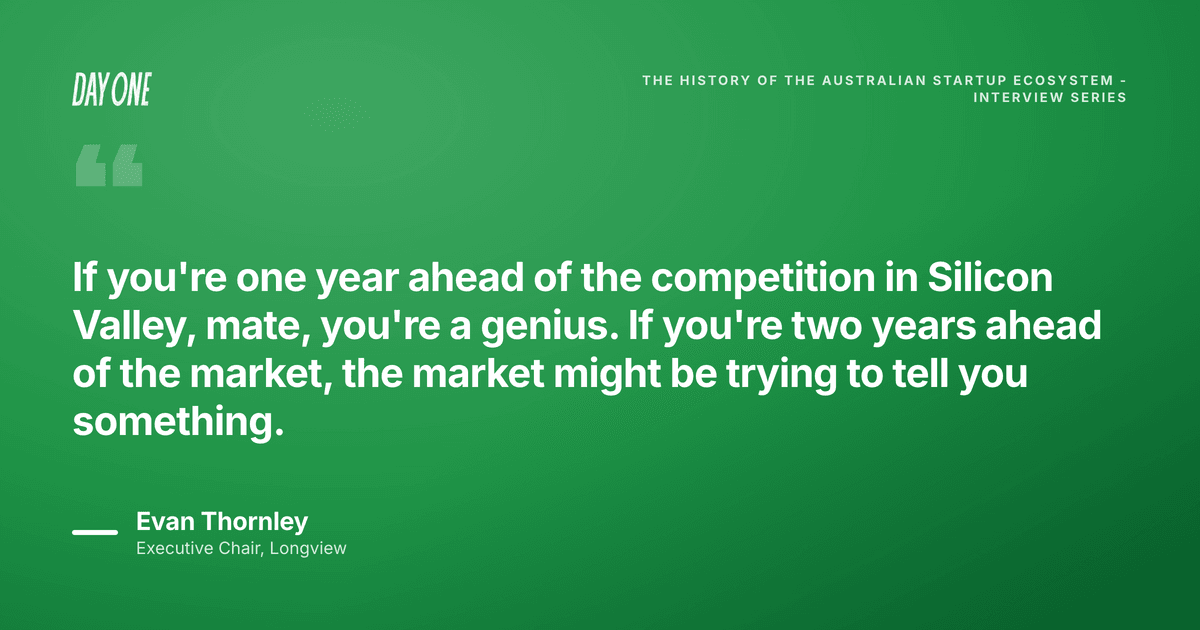
Evan Thornley: Following that model, there's a bunch of government schemes around and soon it'll be flavor of the month. And so, you know, it's always validating to have competition, actually, you know, I remember saying to a fellow I knew in Silicon Valley who said to me, you know, we're two years ahead of the competition.
Evan Thornley: And I said to him, well, if you're one year ahead of the competition, Uh, in Silicon Valley, mate, you're a genius. If you're two years ahead of the market, the market might be trying to tell you something, but ultimately,
Evan Thornley: by definition, you have to be willing to pursue something that you think has
Evan Thornley: underlying fundamentals that support your view.
Evan Thornley: And that the conventional thinking is, is not based in underlying fundamentals. So it's usually based in some misunderstanding or some commonly held, but ultimately abdicated or wrong. worldviews or some other form of, um, sort of mass psychological distraction. And
Evan Thornley: you keep testing those underlying
Evan Thornley: fundamentals.
Evan Thornley: You know, it was like I was talking about, look smart and search. You, you always have to go back to fundamentals rather than fashion trends. So. If you're worried about what other people think and you're wanting to be follow the crowd, then, you know,
Evan Thornley: you will never do anything fundamentally new and interesting.
Evan Thornley: Yeah.
Evan Thornley: That doesn't mean that doing something that no one else is doing makes you smart. It makes you, it should make you extremely cautious and wary and asking yourself the question you just asked me. Every day. And I guess we've been trying to do that. And so far, you know, we're as comfortable as we can be that we're onto something and, and as more competition and, and, you know, the more we've taken the covers off this thing in the last few months and a lot of people seem to be deeply intrigued by why we see the world differently.
Evan Thornley: I'm encouraged by that, but, um, you know, the market will, the market will speak in time and we'll be right
Evan Thornley: or we'll be wrong. And if we're wrong, hopefully we'll see that first
Evan Thornley: and change.
Evan Thornley: Yeah,
Will Tjo: that's a good segue into the next question, which is reflecting on, you know, your, your experience, your wins and your mistakes, what would you tell a new entrepreneur to help them increase their chance of success?
Will Tjo: Is it that be willing to have a crack and test and
Evan Thornley: validate,
Evan Thornley: right? Oh, look, all of that is, is absolutely true. And I still go back to, you know, team is everything. Getting the right founding team and building that team as a team that has the right diversity of experience and mutual respect and has all the basis covered between those first, you know, three to five people is hugely, hugely important.
Evan Thornley: So yes, the idea is obviously important and testing the idea and validating that there are real customers who will pay you money for that is, is, is absolutely essential, but often they won't with your early ideas. But if you've got a good team, That team will, will, you know, take up that data and take up that challenge and keep pivoting until they've found something.
Evan Thornley: So, you know, I'll back a team over an idea all day long. I think my favorite, you know, I used to, uh, probably spend more time with young founders. I guess there were less mentors around. A decade or so ago, so I used to have people every second day come and ask me for help, and I'd always try and make time for them.
Evan Thornley: Thankfully, there are many others that take up that burden now, and I'm back doing my own stuff. But, but the second thing that I always got people to focus on, which was never top of mind for any of them, and this is not so much a key to success, it's a key to avoiding failure. Is that governance matters boards and board structures and board personnel really matters a good board really improves the likelihood that you can take something from good to great, but a bad board.
Evan Thornley: will almost always kill you. And it's just the last thing anyone thinks about in the early stages of a company. But very quickly, the structure of that board and who you put on it and how that board works becomes important. And it inevitably becomes most important in two critical situations, either when something goes wrong, or when things go staggeringly right, right?
Evan Thornley: Um, and dysfunctional boards in either of those situations can kill you. You know, I've seen, you know, the number one reason I've seen startups fail is they run out of runway. But a very close second is problems at the governance level, either disputes between founders, disputes between founders and venture, disputes between venture and venture.
Evan Thornley: Um, and, uh, all of those human elements and the structure and, and, and who's ultimately legally got the power to determine the direction of a company, that stuff really matters. And. It's probably the, the, the one sort of piece of advice I've given almost every entrepreneur I've met, uh, that they've almost never gone yet, yet.
Evan Thornley: No, we thought a lot about that and this is what we've done and this is how it works. And, um, they've always gone, Oh, well, I hadn't really thought about that. And yet the number who come to me and say, Oh, I've got this, we've got this nightmare on my board and, you know, or between us founders or, you know, um, and I think they're the first person who's ever had a problem, you know, in the power structure of the company who gets to call the shots.
Evan Thornley: And yet it happens, you know, all the time. So that's probably the one. Uh, sage piece of advice I'd give everyone. It's not a sexy topic, but it really
Evan Thornley: matters.
Will Tjo: So Evan, as you know, what we're trying to do on this podcast is to document as historically and accurately as possible, the history of our ecosystem, just so that we can look to the future and we're aiming to reach all corners from founders, investors, academics, and policymakers.
Will Tjo: Is there anything that we haven't discussed today? That's always top of mind for you.
Evan Thornley: Oh, look, when you say policymakers, here's the thing. Yeah. And as someone who's been very active in political life, in a range of different forms, as well as in startup life. One of the things I'd say about Australia as a nation and Australia as a polity is that almost every problem we have in this country, the dialogue about what to do about it usually starts with somebody saying the government oughta do this or that.
Evan Thornley: And that includes, you know, how do we build a better startup ecosystem and how do we fix all these things? And, and I would say broadly speaking that. Government is spectacularly irrelevant to 99 percent of this stuff and that we would all profit by wasting less breath on debating what governments ought to do to make us into an innovative economy.
Evan Thornley: It's a peculiarly Australian obsession, uh, which certainly doesn't exist, for example, in, in the U S uh, or for that matter in Israel, although I might say if any government's actually done a good job of, of, of helping. Formulate an ecosystem that probably is the Israeli government, but, but the Australian government will never do anything in that form anyway, regardless of who's in power.
Evan Thornley: So, so I just think it is a massive distraction and, and all the people that have spent years trying to get governments to put money into this and money into that. And I mean, yes, there are a few things that obviously really matter. You know, it's very important that you have a tax system that doesn't, uh, doesn't create cash tax liabilities for non cash rewards in terms of stock options, for example.
Evan Thornley: You know, clearly that stuff's gotta gotta be right. So, you know, that that would be the one thing I would say. And, you know, the tech council and folks doing important things and no doubt will be representing our community on important issues. And it's great that people do that and are of service there.
Evan Thornley: But I just wouldn't get too ambitious about what you're going to get government to change its position on. And even if you did, whether it would have any material impact on the outcome.
Will Tjo: Why is that? On both tangents, why is this a uniquely Australian obsession? And secondly, it seems like, yeah, why should government sort of stay out?
Will Tjo: Well,
Evan Thornley: because government is a slow moving bureaucracy that's, you know, it's an organizational model that's a Weberian bureaucracy from the 1930s. It's a hundred years out of date. So why would you expect something that's working on a model that's a hundred years out of date to be relevant to stuff that's meant to be at the cutting edge?
Evan Thornley: I mean, it's just, it's completely antithetical. It's
Evan Thornley: an organizational form that is the complete antithesis of a startup. In every possible way, uh, structurally, culturally, uh, and in every
Evan Thornley: other way. So it's not
Evan Thornley: because people work in government of bad people or politicians are crooks, or, you know, this party or that party is doing the wrong thing.
Evan Thornley: There's very decent people in public service and, you know, doing the long march through the institutions to try and make the country better. And I commend it. And many of them are friends of mine, but the idea that that organizational model can do anything useful for something that's moving as fast as we're moving.
Evan Thornley: Is just laughable. Yeah, I'm sort of confused as to why people think it would be otherwise. But because our answer to every other problem in this country is the government order. I guess when we get to challenges for startups,
Evan Thornley: we start out
Evan Thornley: with the government order. You know, I'm trying to think of anything material that governments have done in the last 20 years that have really changed the answer.
Evan Thornley: And I'm, I'm struggling.
Will Tjo: How about the national innovation and science agenda introduced by the Turnbull government? Would you say that moved the needle somewhat?
Evan Thornley: Look, you know, I'm not close to the specifics and there may be, um, worthy things that have come out of it. So I don't, and I'm not trying to poo poo these things.
Evan Thornley: So look, I don't know specifically at that level. I mean, look, I recall There was a government scheme, and this is, you know, 10, 000 years ago, okay, in, in, in LookSmart days, uh, and they invested in a whole lot of startups. And one of the, the, what they did was the private equity firm that put early money into LookSmart was sort of, you know, a bit worried about the risk profile.
Evan Thornley: So they laid some of that risk off and took some of the government money in exchange for a portion of their shares. And as it happens of the, I don't know, 30, 40, 50 companies, the government put money into the only one. That made anything was that share in look smart. Fortunately, it was 100 bag. So it actually paid for the entire thing in the company and the scheme come out in front.
Evan Thornley: And I remember being at a dinner in New York when Prime Minister Howard was there. And he sort of pulled me aside and said, well, thanks to you guys. It's not a complete
Evan Thornley: train wreck. And so, you know, even
Evan Thornley: at that time, I was sort of like going, you know, This is probably not the most useful space for governments to be trying to intervene.
Evan Thornley: Uh, so look, look, I thought some of the policy settings in the Turnbull agenda were good and hopefully they've made differences at the margins. And again, the last thing I want to do is criticize the good people who are working hard to try and make sure government policy is as good as it can be. That's important work and it's great that people are willing to do that.
Evan Thornley: To, to put that effort in and, and, and, and make those changes. I'm just saying if you calibrate that as one of the levers of change for our ecosystem, I wouldn't calibrate it very highly. Yeah.
Will Tjo: The last question, Evan, and, and I know that we've mentioned quite a lot of, um, people in organizations already, is who are the, the heroes, um, in the ecosystem that you know or.
Will Tjo: In your personal journey that you'd like
Evan Thornley: to shout out. Oh, look, they're just mates of mine. So, you know, look, Bassett, you know, brother Bassett has been remarkable, right? Because I'm talking about Paul, but, you know, I'm a huge admirer of Andrew's as well. But, you know, Paul's done it twice, right? We, with he and Andrew and Matt, built Seek into a truly great company, you know, a wonderful culture.
Evan Thornley: It's still a wonderful organization. I did a startup a while back, which unfortunately didn't make it, but which Seek backed and I've never worked with a better strategic partner. They were just fantastic. And it was a real credit to them that that company, which is now large and successful, still has such a fabulous culture.
Evan Thornley: But, you know, Paul not only was obviously Central to that magnificent success, but then has gone on to really lead in the venture world through square peg. And so, you know, I think to do that twice is, um, is astonishing and a great credit to him. You know, I think what Nikki Skevak's done and the way they've built Blackbird is, you know, it was fantastic.
Evan Thornley: The way that the, the venture scene has developed, you know, and the, the, the, the Blackbird and Airtree and Square Peg guys, and, uh, you know, Danny Gilligan's a good mate of mine at, at Reinventure, who's one of the people I probably rate the highest that I've ever worked with. And so, you
Evan Thornley: know, they build a real,
Evan Thornley: a real venture community here that's had extraordinary success and they've had extraordinary success because they've helped other entrepreneurs become incredibly successful.
Evan Thornley: So, uh, that, that's the stuff that matters, not, not. Not what governments do, you know, so I think all of those people, uh, heroes, you know, look, I don't know much about Canva, but, um, you know, that, that founding team, um, have done an incredible job and it's really just such a great global platform. Uh, and obviously the Atlassian guys and, and, you know, you talk about.
Evan Thornley: sort of poo pooed government, you know, you want action on climate change. Here's Mike Cannon Brooks from Atlassian, you know, shutting down coal fired power stations by buying the bastards, right? Like that's, that's heroic stuff that should get a shout out for sure. So it's exciting to see people who take their success in the business and continued success.
Evan Thornley: I mean, what a great company. And then, you know, it takes some responsibility to try and really shape the nation and the world on things that matter. And nothing matters more than climate change. So, so look, I'm sure all of those are fairly familiar, uh, heroics. And I don't, I said they're all mates.
Evan Thornley: Obviously, none of those people are not people I personally know. I'm obviously incredibly proud of Martin Hosking and, uh, you know, what he did coming out of, I think learned from a lot of our mistakes, you know, it was done a great job with red bubble and, and, and it was, I think an important part of the total team, you know, that Lee and the guys at Aconex, um, you know, have done really well.
Evan Thornley: So, you know, there's serial entrepreneurship, um, that, uh, at, at the highest level, you know, part of at least three, um, you know, unicorn successes. So you've got to give a big shout out to Martin for that. Um, Yeah, those would be the ones at the top of my mind. But I know there's, uh, there's, there's so many other great companies and great founders out there and, and, and great people, you know, look, I'll, I'll, I'll give a shout out completely separate to this, but again, this is why I like to think.
Evan Thornley: People to think more broadly. I came up with a crazy idea of buying ABC childcare and turning it into a social venture. And I'm, I'm very proud of having done so, but the person who really did the work on that was Michael trail, uh, who'd founded social ventures Australia. And he really did the real work that turned that idea into what is now good start, which is You know, far and away the biggest social venture in the country, the biggest early childhood educator in the world, uh, as a non, you know, as a, as a for purpose venture.
Evan Thornley: Um, so that's the sort of thing and entrepreneurship that I think should be celebrated. And I think Michael's an absolute hero for the work he's done there. And, you know, that's, that's making a difference in, in literally tens and tens of thousands of young developing children's minds, um, at the time that's most important, the year zero to six.
Evan Thornley: So. You know, it's, uh, entrepreneurship matters more broadly than just who's built the next great tech global SaaS platform. Um, worthy and exciting as those also are.
Will Tjo: Evan, it's been so good having you on the show today. Thank you so much for your time. No,
Evan Thornley: thank you. Well, thanks for your interest. And I'm really excited you guys are doing the work now to, um, to get a proper history and, and hopefully for the purpose you've done it, which is to hopefully we can all learn from it and, uh, and set an even better future coming out of it.
Evan Thornley: So good on you for doing the work you and Adam. Thank you.
Will Tjo: Where could the audience go if they wanted to learn more and connect with you?
Evan Thornley: Oh, look, one of the lessons I learned was I thought I was so good after my first success that I tried to do two or three things at once and failed miserably at all of them.
Evan Thornley: So, um, I was humbled back into the idea that maybe I should just do one thing at a time and see if I can at least make that work. So, um, so I'm all in on my current deal, which is Longview, uh, which is, you know, Residential property is a long game. Um, so longview. com. au, uh, you can find me, uh, there evan.
Evan Thornley: thonley at longview. com. au and, um, I'm always happy to talk and, and if I can be helpful to, uh, to founders or others that, uh, that think that, you know, They, they can profit from avoiding the mistakes that I've already made. I'll be happy to share them.
Evan Thornley: I hope you enjoyed that interview. More interviews are on the way. Follow the podcast wherever you're listening right now. Stay tuned for more interviews with many, many more amazing people from the Australian startup ecosystem. Thanks for listening and see you next time.
More Episodes You Might Like
Let's talk
Turn podcasting into pipeline
We help founders, funds and operators build trust, authority and deal flow with a show tailored to their market.
Win better deals and stay top‑of‑mind with founders.
Close more deals and build a category you own.
Reach founders and operators with a show they trust.