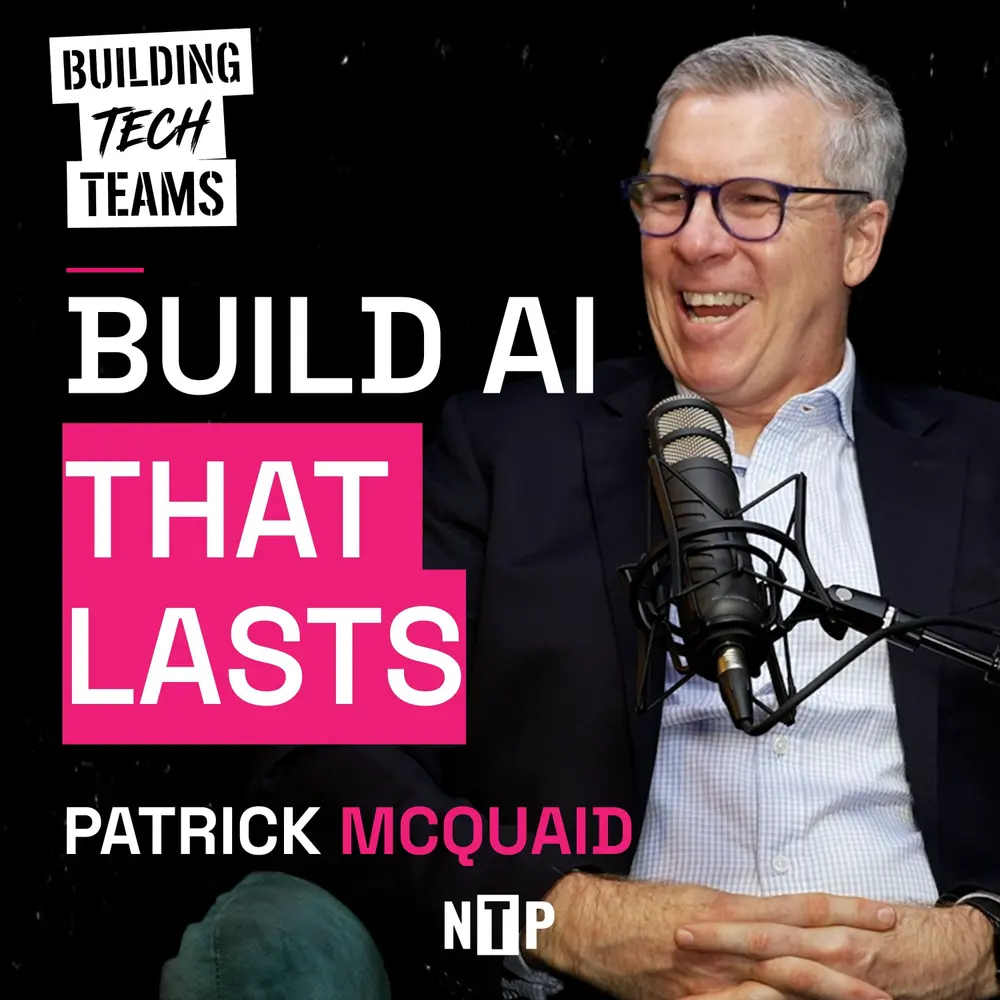
Most organisations are asking which AI model they should use. Patrick McQuaid thinks that is the wrong conversation.
Patrick is Group Head of Data, Analytics & AI at NGM Group. He joins James MacDonald to explain how leaders can build practical AI capability without getting trapped by hype, vendor lock-in or an endless cycle of new tools.
They get into how NGM approaches AI inside a regulated banking environment, where privacy, risk and customer trust make it impossible to turn a weekend prototype straight into production. Patrick explains why teams need both strong foundations and useful short-term wins, why the people closest to the work should own their technology costs, and where generative AI should not be used for decision-making.
The conversation also explores what AI means for technical careers: why Patrick hires for attitude, curiosity and problem-solving over years of experience in technology that has only just emerged, the continuing value of junior engineers, the rise of AI enablement and orchestration roles, and the human skills that stay hard to automate.
About the guest
Patrick McQuaid GAICD is Group Head of Data, Analytics & AI at NGM Group, one of Australia's largest customer-owned banking groups, operating the Greater Bank and Newcastle Permanent brands.
Building Tech Teams is produced by Day One®, trusted partners in the technology space and the team that helped build Blackbird Ventures' Wild Hearts. Sister shows include First Cheque, Oversubscribed and Pick My Brain. Episodes are cross-promoted across the network.
Chapters
0:00 Stop arguing about AI models ▶ 0:46 What this episode covers ▶ 1:15 Meet Patrick McQuaid ▶ 1:38 Leading experts without being the deepest technical expert ▶ 4:37 Deployment, flexibility and avoiding model lock-in ▶ 6:45 Vibe coding versus production inside a regulated bank ▶ 8:30 Shadow AI and choosing enterprise tools ▶ 10:10 Junior engineers and hiring for attitude ▶ 16:15 Who should own AI and token costs? ▶ 19:34 Building, buying or partnering for AI capability ▶ 21:21 Where generative AI does not belong ▶ 25:41 Joining NGM during a major data transformation ▶ 30:17 Building foundations and delivering quick wins ▶ 34:20 Planning in a fast-moving AI market ▶ 35:45 Agentic tools and the value of staying flexible ▶ 37:04 Can specialist software companies defend their advantage? ▶ 39:18 What organisations should and should not build themselves ▶ 41:33 Technology's role in a human business ▶ 49:44 The human skills AI cannot replace ▶ 52:33 What AI could mean for the next generation ▶ 54:33 Remote work, relationships and learning together ▶ 58:35 Cutting through AI FOMO and LinkedIn hype ▶ 1:00:27 The AI advantage for smaller organisations ▶ 1:01:24 Managing legal, financial and reputational risk ▶ 1:06:43 AI sycophancy and why chatbots agree with you ▶ 1:07:57 The skills technology professionals should build now ▶ 1:09:26 AI enablement and orchestration roles ▶ 1:12:46 James's key takeaway ▶ Transcript Search or select a timestamp to jump ▾ 0:00 Patrick McQuaid: If you're arguing about what model to use, you're having the wrong conversation. There's a lot of people out there trying to instill a FOMO approach to this, right? If you're on LinkedIn, they'll be like, oh, you know, you need to do this, you need to do that. You're not gonna get the full benefit of AI unless you do it now. But there's also not, there's a lot of hyperbole. But I would rather have a couple of core people with depth and pair them with people with the right mentality who are just keen to just get in there and learn and soak it up and apply lots of energy and have a go. It's not enough to be right. You actually You've absolutely got to be engaging. You've got to find allies. You've got to build support. You've got to build relationships. One of the core skills in the future that is unassailable by AI is the ability to build relationships and talk to people and communicate. 0:46 James MacDonald: That was Patrick McQuaid. He's head of AI, Data and Analytics at NGM Group. There's so much hype around AI at the moment. Everyone's vibe coding, building proof of concepts. Far less people are actually rolling out AI into enterprise. NGM Group banking environment, highly regulated, and Patrick's talking about how to get AI into production whilst also dealing with risk and privacy. If you're facing the challenge of rolling out AI into your organization, into your company, and doing it safely, this could be the episode for you. Welcome to another episode of Building Tech Teams. On today's episode, we have Patrick McQuaid. He's Group Head of Data, AI, and Analytics at NGM Group. Welcome, Patrick. 1:24 Patrick McQuaid: Thank you, James. Nice to be here. 1:26 James MacDonald: That's a big title, Group Head of Data, AI and Analytics. What set you up? Tell a bit of the audience, like a bit of your background that's led to being in a role as big as this at a bank. 1:38 Patrick McQuaid: Probably started when I was in consulting. I was promoted really quickly at one stage and I realized that I was quite out of my depth from a technical perspective. And up till that point, I'd been a technical leader. And I think I just adapted and realized I was good at managing technical people, leading technical people. And we can get into how I'm good at it, but that's formed a bit of a pattern over my career. And so I've, I've often jumped into new areas. I've only spent 2 or 3 or maybe even 4 or 5 years there, but jumped across areas because I knew going into them, hey, I can grab a bunch of people who know a lot more than me about stuff and make them work well together. 2:23 James MacDonald: Sounds like this will work well on a podcast titled Building Tech Teams. I'm gonna get straight into that part right now. There's a lot of talk about AI at the moment. There's a lot of talk about technology. There's also a lot of talk about the changing nature of roles and how maybe managers might be the roles that are getting squeezed. How important is it for someone in a role like yourself to understand the technical nature of it? How technical do you need to remain to be successful? 2:50 Patrick McQuaid: I don't think I'm very technical, so that's maybe a bias to my answer, although maybe some people might think I am. I think you've got to understand a lot of first principles and fundamentals, but I've never— I lead data teams and I've never really done SQL in production or anything like that, but I know good questions to ask. I know how to prompt people. I know how to— sort of manage people and get experts together, like I said. So a common mode that I use in— or have used for the last 15 years or so— is I ask people, what are the options? And I get the people in a room together and give me the pros and cons, and I ask questions, and that's when the answer falls out. Often, often they don't need me to decide, which is really my ultimate goal. And then if I do decide, I know at least I've got pros and cons. But I not too into the technology, but some of my peers are. So I think you can be both, but I'm saying you don't have to know the tech really deeply. 3:53 James MacDonald: Perfect. But you did mention the knowledge of first principles. 3:56 Patrick McQuaid: Yeah, yeah. I mean, look, I think you've got to ask, one of the things you often try to ask when you're making big decisions is, is this an open, is this a two-way door or a one-way door? reverse this decision later on, or am I making a decision now that locks us in? And those are kind of the first principles I'm talking about. Some of them are not technical, but you also ask about how does this fit in with where we're going from a cloud perspective, for example. So there are technical aspects to that as well. But generally a lot of what I ask is technology agnostic, and I lead in that way sometimes. 4:35 James MacDonald: Because at the end of the day, technology is a tool, right? 4:38 Patrick McQuaid: Yeah, and I think it's especially important in the age of AI, you know, what new models coming out every 3 months. And I actually recently spoke to a group of leaders in Hunter and I sort of said, if you're arguing about what model to use, you're having the wrong conversation. 4:55 James MacDonald: Correct. 4:55 Patrick McQuaid: Because that model will change. 6 months, 9 months, whatever, it'll change. So you've got to ask more about how am I deploying this? What are the pros and cons of the way I'm doing it? What are the things that lock me in versus give me freedom. 5:11 James MacDonald: And I think that freedom one's a big one that a lot of people are overshooting at the moment because being agnostic, whether it be model agnostic, company agnostic, what you're actually tying yourself into, having that question is really important at the moment because as you said, we're talking about token cost changes, we're looking at model changes, some models are gonna be better than others. We're talking about, I think in the future we'll be having more companies look at local models as well just from a cost perspective and also a security side of things. architecting things in the way that gives you flexibility down the track. 5:42 Patrick McQuaid: Absolutely. I mean, I think it's not to say that the technical details are not important. I want to be really clear on that. So I do care about the technical details, but I know that for me to get across the technical details in the amount of detail that would be required to make a good decision, it's impossible. It's a waste of time. Yeah, it's a waste of my time given I've got people on the tools who are experts and whose job it is to be there. My job is to sit above that and to surf across it and to look ahead and look across. person around. So it's important, but it's not my job. 6:15 James MacDonald: Perfect. And I think it's a different role being in an enterprise organization like yourself versus if you're a startup who's building an AI native or a fully agentic platform from— they're 2 different lenses and ways of about going things. And I think if you're in that sort of secondary role, you need to be on top of the tools and learning how to build AI native from the ground up as opposed to, hey, we're a big organization. We've got highly regulated environment. Where can we use AI and data within the org? 6:45 Patrick McQuaid: Yeah, yeah, for sure. I mean, look, I do some vibe coding at home for some personal things, and I have fun with that. I learn, you know, I didn't know Python before I got into, I had to do some stuff at work and I had to learn it. So I actually dispute the fact that vibe coding means you don't need to code, 'cause to troubleshoot it, I had to. But the freedom to use those sorts of tools is not there when you're dealing with people's money, people's personal data, livelihood, vulnerable customers, all these things that mean that what we do has to adhere to a certain level and a certain standard. That means I can't just say, whip something up over a weekend and say that is now in production. It just doesn't work like that. 7:31 James MacDonald: Yeah, I love the fact when I talk to tech leaders that are playing, playing with some tools themselves. It doesn't mean, as you say, you're building something for production, but you've got an understanding of what it's capable of. Is there something that you think is important for, for all your other leaders, the people that are sitting under you, to at least be aware of the different technologies, what's available now, what can be done now? How important is that for you? 7:53 Patrick McQuaid: It's not critical, but I think it is important still. Like, I pushed myself to do it because I'm not usually the sort of person who does that. I don't like to be on a laptop on my— well, If I'm not working, I don't like to be sitting there on a laptop. I like to be spending time with my sons or out there exercising or whatever. But I did feel that particularly in the AI space, it's important to get in and just play with it a little bit and understand what it's good at, what it's not good at. And I learned some really eye-opening things or maybe even just reinforced stuff I'd read. 8:25 James MacDonald: Yeah. 8:25 Patrick McQuaid: Which was— so it's not critical, but I'd say it's important for a fast-moving tech. to play with. 8:31 James MacDonald: You mentioned that you're playing with some tools individually at an individual level. I think a big question that's coming up across enterprise at the moment is tooling and what you can actually give to your team to use. Otherwise you get this shadow IT that goes on. I mean, people are going to be using some form of tools, but if you're locked into a Google environment and everyone's got access to Gemini, but they want to use Claude in their own time, they start putting some company IP in their Claude, personal Claude account. What's your opinion? What's your advice to other people that are starting to deal with or having to have these challenges around shadow AI? 9:05 Patrick McQuaid: Well, for a start, I think you've got to give people some tools, something, right? And so we're a Microsoft shop, so we use Copilot. The good thing about a lot of these enterprise platforms now is they do allow you to choose your own model at the back end if you, if you want to. Now, we have disabled most other models. Because A, we want to protect data. We're not sure some of these things where the data sovereignty is, where the boundary is. And B, we do want to control cost. And some of these other models, you can start to run up token costs and things like that versus the standards where it's all included. So you do need to provide some capability. I have, and our CISO and our CIO have both left it open to use other models should people have the need to. But that's the key point, the need. Lots of people may have a preference, but I don't think there's a lot of need for different models for most corporate use cases. 10:10 James MacDonald: I would agree. 10:12 Patrick McQuaid: Yeah, 10:12 James MacDonald: I would agree. I'm going to go back one. You mentioned your vibe coding. You've learned some Python. You've had to learn some Python to understand the troubleshooting side of things. There's talk of engineers becoming— there's multiple, multiple stories. A, that it's the death of the junior engineer because junior engineering is not needed anymore. Mm-hmm. Secondly, there's other people saying junior engineers now have better tooling and can upskill quicker than any engineers before them. Others are saying senior engineers are now 10x better than what they used to be because they understand those core principles. Then now they've got better tooling, they become even better and faster again. The importance of that core understanding of software engineering or good data practices, how to build a data pipeline, how to understand architecture, how important is that for the people that you're hiring into your team or the successful people that you've seen grow careers? 11:09 Patrick McQuaid: Let me first by starting, the reason I had to learn the code was I discovered it was faster. 11:13 James MacDonald: Yeah, 11:14 Patrick McQuaid: than just— you can probably do it without learning code, but I'll give you the example that prompted me to get into it, which was I was doing this on a Mac. The initial Python-generated code was all for Windows, so the paths were all wrong. It was faster for me to identify and say, wait a second, why is that a forward slash than a backward slash? Than it was to go to the AI and say, why is this wrong? And for it to maybe prompt me and eventually find it out. So there's a, there's a bit of, I'm not scared of code, so I'll look at it. sort of thing. In terms of your broader question though, um, you know, experience is still great, right? Uh, and, and so you always love to get somebody who's experienced. But I think the realities is if we, if we all said we were looking for people with 4 to 5 years of AI engineering experience, the people who've really done it are pretty rare. Um, B, they're probably commanding larger salaries than I can pay in a regional bank, if I'm just brutally honest. And they'll probably be at some of the big locations and we do try and preference Newcastle hiring where we can. So I've taken the approach recently of a bit of experience is great, but I would rather have a couple of core people with depth and pair them with people with the right mentality, which is you know, to be stereotypical, sort of younger people who are just keen to just get in there and learn and soak it up and apply lots of energy and have a go. That mentality, I think, is probably more important in this day than ever before. 12:58 James MacDonald: I agree. And I think it doesn't matter what stage of your career, whether you're a junior or somebody that's mid-senior, that's willing to upskill, willing to dive into the tools and try and find the answer. I think where it ties back to at the end of the day is that problem-solving ability. And I think what you've mentioned there, attitude and problem-solving, I think are the 2 real core fundamentals that if you have them, that you'll go a long way. 13:21 Patrick McQuaid: Yep, absolutely. Yeah. 13:23 James MacDonald: There's a lot of talk at the moment when we— you mentioned engineers just before. There's a lot of talk at the moment and there's some various threads that people are pulling on the death of a junior software engineer. Those roles don't exist anymore. To counteract that, we've got junior software engineers are going to come in better, more equipped, better tooling, learn faster because of the new tooling. And then you've got these seniors that have now got this great tooling, they've got core fundamental understandings, better tools. Now they're, now they're 10x better. How do you go about looking for the people that are, that are going to join your team? Obviously competing for those 10x engineers, AI-native engineers, is going to be very expensive and hard to hire for. 14:04 Patrick McQuaid: I mean, like you said, you know, the reality of finding someone with as much depth of experience as you might say an experienced person should have who is in a regional location coming to work for a regional bank is probably pretty low. We have found some great people and I've actually been really impressed with the talent at NGM since I joined. So the way we try and sort of build that person is we've got people who understand banking. That's a tick. We've got people who understand software engineering in a regulated industry. That's a great tick as well. They might understand the latest tools, but then not a lot of people do. And the space is moving so quickly. So I tend to think that we could bring in people who have the right attitude more than anything else. Hiring for attitude is what I call it. And you might say stereotypically, that's your young, hungry engineers. It could be an experienced person as well who's just decided that they were— not decided, but has never lost that ability to be curious and get in there and have a go. And that's what I'm looking for. So people who can demonstrate, I don't know the answer, but I'll get in, I'll have a go, and by the end of the week I will. And that's really priceless in this fast-moving area. 15:18 James MacDonald: I agree. I agree. Because as you said, tooling's moving so quickly. And to say that you're fully across everything would be, for the vast majority of people, a lie. And things will going to continue to change over the next coming days, weeks, months. So I think that attitude part, curious, that word, I think curiosity, problem solving, those are the sort of core skills on people I'm seeing jump in their careers as well. 15:42 Patrick McQuaid: Yeah, absolutely. 15:43 James MacDonald: You mentioned back before, again, there was another point I wanted to pull out. You mentioned the models and why you're looking at models from a costings perspective as well. I think it might be a standalone role in the future. I know it happened with cloud. many moons ago where everyone was about, we have to be fully cloud native. And then people were seeing their AWS costs or their Azure costs or GCP costs go through the roof and, oh yeah, this is more expensive than on-prem. And then people started to reverse out. How do you see that from— is that something that sits within the data and AI team or is it a finance role responsibility? How do you see that? play out ongoing? And then how have you tackled it at NGM Group? 16:31 Patrick McQuaid: Yeah, look, I'm a big believer, whatever the org model is, I'm a big believer that the team needs to control the cost because you can make the right trade-offs. I think where you get disconnects is when, like we've had in the news recently, there's a management push to token max or something like that. That's crazy. So I think even if it's finance that is the watchdog or some FinOps team in the cloud engineering team, and that's the model we have at NGM, we have a good FinOps team that manages the overall cost. I have from the very start instructed my team to worry about cost or to worry about tracking. Sorry, it's not always about cost because it doesn't come out as cost sometimes, but to worry about tracking and to work with the FinOps team. And, and that's just a matter of oftentimes, depending on what platforms you have, just building the dashboards, building the warning, building the monitoring. But also, and this is why I think it belongs in the team that's using it, you can start to build lead measurements. You can start to realize that these sorts of queries or this sort of thing will lead to this level of cost. You can start, and once you start doing that, you can start to program a bit of perspective in the way your teams use certain tools, the way there's teams that do certain things as well. 17:52 James MacDonald: Do you think we'll have a standalone role as like a token optimization person or a token costing person in the future? 18:00 Patrick McQuaid: I think it'll be, I think it'll be part of somebody's role more than anything else. Probably part of that is because I work with— this is a relatively small organization given other organizations I've worked at. And their role will be not so much to monitor and track it, but to set in place how to monitor and track it and make sure teams are doing it. Because in the end, the accountability should sit with the team, should sit with the leader to justify any cost and to make the trade-offs. 18:33 James MacDonald: So a very smaller business than yours, again, to go about this and being on the front foot would be just looking at setting up some form of reporting dashboards, QA, Lead indicators, alarm bells, I guess, of sorts to give yourself some form of— 18:49 Patrick McQuaid: Yeah, I think you've got to work with your provider to know what tools they have. And so for example, we work with one of our platform providers and they're very helpful because they know if we got burned by cost, it'll actually lead to a whiplash the other way, right? So you've got to work with them to set, I think, at least thresholds. And probably some warnings as well. And then over time, I think you develop the lead indicators yourself. You kind of have to because the provider doesn't know what you're doing until it hits them. So you've got to figure out actually when we do this thing that touches these 4 systems or this much data, that's a big cost one. So let's be careful about that. 19:35 James MacDonald: Enterprises have different challenges as SMBs, but I think one of the bigger questions going around at the moment, hey, we're a business or an organization, we want to do something with AI. Do I grow the skillset internally? Do I hire the skillset externally? Or do I go and use a partner? Or is it a combination? Is there no one right or wrong answer? Can you just talk to me about how you sort of envisage like those 3 parts coming together? 20:01 Patrick McQuaid: I always think it's a combination. I think you're— and again, everyone's situation is different, but my perspective has always been I don't want to rely only on externals. And this is part of— you go back to what we said before about hiring people who are keen to learn. You pair a person who's keen to learn with an expert that you can source maybe beyond the budget you can pay, and all of a sudden you have a really nice combination, hopefully. So I think it is a combination. I would use proper consultants important accelerating partners for when you have a real pinch point that you need to accelerate that's high value. But other than that, I would always try and partner with contractors who understand the things and then have them work with a team with a specific goal of upskilling the team as well. So it is all 3. 20:50 James MacDonald: I believe there are some challenges out there working with an external provider, come and build something flashy, beautiful, works, then agreement ends and then you are left to carry the maintenance of it. And I think there's a lot of conversations or missed conversations at the moment around the ongoing maintenance, QA, performance optimization of AI within organizations. How do you approach that? How do you approach not only a build cost but an ongoing maintenance? How does this play out longer term, that point of view? 21:21 Patrick McQuaid: So I would say in our industry, we're a long— well, we should be a long way. I'm sure there are people who are experimenting who may be further forward than us, but we're a long way away from using generative AI type models or agents in really critical processes. And the reason that is, is because they're critical processes and I cannot afford to have a probabilistic outcome which is vulnerable to model drift or bias. Right now, you know, you will have heard about people saying using models in decisioning, credit decisioning, but almost always those are predictive those are proper deterministic predictive machine learning models from that we've had for 30, 40 years. So, 22:08 James MacDonald: and I think machine— I think that that is the key under the hood for a lot of organizations. It's traditional engineering, machine learning, automations, and that's where the vast majority of benefit is really coming with AI as a, you know, as a flashy tool at the moment, or flashy headlines, so to speak. Which LLMs are actually a much smaller part of the majority of actual AI projects. 22:33 Patrick McQuaid: Yeah, I think it's the case for when you talk about core business processes, core business processes, where generative AI can help with core business processes is usually because your inputs are unstructured. So it helps with interpreting, organizing those sorts of things. A good example is we do some process documentation work. Now you could spend a lot of manpower, person power, getting things in the right format to feed them into a process documentation engine, or you can use an AI. And that's been very successful. Really trivial use case, but very high benefit, very low risk. 23:14 James MacDonald: And I really like that point. That's where a lot of the conversations I've had at enterprise level It is actually using AI for something in a small use case which might seem quite trivial but actually has a lot of benefit to the organization. Because if you're talking about labor costs there, not only are you saving labor costs, but if you're actually reapplying those humans to better tasks or higher value tasks or tasks they actually enjoy, quality of the job for the human gets better, more accuracy with the actual AI. The cost benefit for the organization is phenomenal. And those use cases in enterprise, just because of this sheer volume, actually plays out really significantly, right? 23:52 Patrick McQuaid: Yeah, yeah. And look, I mean, the use cases where you see direct-to-customer or large-scale direct-to-customer, generally retail. I mean, apart from maybe, you know, I know CommBank has a triage agent and things like that, but those, the CommBank example, they are there to help find a human or a, a policy faster. The ones that are generally doing proper generative AI facing customers, they're in the retail space. And the consequences of getting that wrong are usually quite low. Air Canada examples notwithstanding, where, you know, AI agents said somebody was entitled to a refund and they weren't. But, you know, if the wrong color of shoes or the wrong size of shoes or those sorts of of things, they're easily rectified. Financial advice, financial savings, what to do with your money, those sorts of things are far too important to leave it to that at the moment. 24:54 James MacDonald: Yeah. And I think the human in the loop is what we're talking about. 24:57 Patrick McQuaid: Absolutely. And there's various examples of that. You've got human on the loop, you've got expert in the loop and other things like that. But a lot of times it comes down to this is too important. to leave it to chance. Our regulator's also saying that. Our regulator's saying that sampling is no longer enough. You actually have to have more stringent in-the-process controls. And plus, if I can spruik NGM for a second, we're a community bank, right? There's a lot about being in the community, being personal that is core to our brand as well. 25:35 James MacDonald: I agree. NGM Group, you've opened the door. Mate, you started there in a temporary role to start with and you've been there for a little while longer now, but I'd love to understand, you started in a temporary role, what did you see at the start? What was the environment that you walked into? Let's start with what there and then we can expand. 25:56 Patrick McQuaid: I have worked with the CIO before and he knew I was available and this was my area of specialty. And I'm not afraid to travel. I've done it for most of my career. So he asked if I could come and help them out. And I got here and it was a fairly tumultuous time. The data replatforming project was stalling and there were 2 teams that were coming together. So there was a lot of org change in there. And so a big job, complex job, even though the organization's smaller than I'm used to. And what I found when I got here, which actually surprised me, and I must admit, hand on heart, I thought I would find not the level of person that I'm used to dealing with in some of the bigger organizations. And I was arrogant in that respect, and I was wrong. Great people here. And that was the first thing, great people. I also felt like I could make a difference. I felt like that my style was going to work here. And one of the things that everybody likes to know is they're going to add value. And so, you know, within a month, I think, of being here, I could see I was going to add value. I could see great people here that I really liked and a really encouraging environment from the executive as well. And so then, like I said, within a month, 6 weeks, I went to my boss and my other boss and said, I like this place. I'd like to stay and see what I can do here if we can make things work out. 27:35 James MacDonald: Nice. And what does this— it is a big title, Head of Data, AI and Analytics. What is your remit? What's the environment that you've walked into? You gave a bit of a mention of them. What's the end goal? What's that roadmap look like for you? 27:52 Patrick McQuaid: Yeah, so most head of data roles or chief data officer roles, a large part of it is consolidation of data, not just for the point of consolidation, but consolidation of data because that leads to better access, lower cost, and better transparency and less risk, right? So that's really the core of a lot of head of data roles is how do I get it onto one big platform And then how do I expose it to my internal customers for value? So, and that's the project that I walked into that was kind of stalling. I'm really pleased to say we've almost finished that project now. And so there's a lot of data that's been centralized in a really great way. You're never done, absolutely never done. But I could say we've got 60 to 70% of the way there and we're really going to start to add value now. So now we're moving in that project we're moving to a phase of how do I leverage this data better? I'm no longer now just building the foundations. I'm sort of saying, well, who needs what and how do we talk to people about what can we provide them with data? So that's the data side of things. And then very closely related to that is analytics, which in this conversation, just think of as traditional analytics, because once you have your data in a good spot and you have it on a cloud platform, then the thoughts immediately turn to how do I derive value? And that is basically analytics in a lot of cases. 29:20 James MacDonald: How do you manage, and it'd probably be from a business perspective, probably be from a personal perspective as well, I'd be keen to get your understanding, this, the dual nature of A, we can't do anything with AI automation unless the data's in a good spot and we have clean access to quality data. data. Finding that drive balanced with, hey, we have to sort of take 2 steps back to get it in the right spot before we can do anything new or flashy with it. How do you both individually deal with that, but also at a company level deal with that, where we have a drive and a desire to be moving forward and not missing the boat, let's call it, whilst also knowing that to do that we actually have to— can you do both things at once? Do you have to take the step back forward? I'd love to get your opinion on that. 30:07 Patrick McQuaid: And maybe I've been lucky here. I've never had to completely take a step back. And so I've always approached, always in the last 20 years anyway, every executive or leadership role saying, I need a 2-speed approach. I love building foundations and big, scary or big, complex, cool things, but they take time. The organization doesn't have the patience for that long times. So you've got to go, the first speed is build the foundations and look for some big wins, big hairy audacious goals, they used to call them. But also what are the value sort of increments you can do along the way? And we were, now having said that, last year in NGM, we probably focused pretty much on just the big foundation, but we also found ways to add little bits of value along the way, like streaming data to places and things like that. But it was mostly focused on building that, and I'm thankful to the organization they had the patience to do that. But yeah, almost always I think that you have to approach it with 2 speeds. One is find those quick wins, the value drops you can do along the way, while you are building out your platform. 31:28 James MacDonald: I like that advice. I think it's a challenge that a lot of, whether it be a CTO in an SMB type business where data's maybe sitting on that, they don't have a head of data, or even like head of data type roles where you have that challenge. 31:41 Patrick McQuaid: Yeah, well, and look, I'll— big organizations often get this wrong, I think, as well. So I have worked at some orgs where the goal was measured by how much data was in the target platform, and I think that's the wrong measure. I think you should be looking at how much of a business unit's data usage is in the platform. So it does— and the thing, the awful thing is you can have 80% of your data in the platform, but if every business unit only has 70% or 60% or 80% of the data they need, you have no value. So that's another way of looking at it is, you know, pick your target area. Usually it's marketing or customer engagement because that's the fastest value cycle for data a lot of times. And say, how do I get you up and running on my platform as quickly as possible while I'm building out all the foundations and all the things to bring everybody along in the journey? 32:42 James MacDonald: I like that. I like that approach. I think it's a common problem at the moment and something that will be ongoing. And it's very different for enterprise or a traditional organization, that challenge versus building AI native from the ground up. You know, there's a lot of hype at the moment with AI native, and I think if you are building a company from the ground up, significantly different problems and challenges. Also some things that are a lot easier rather than trying to re-architect a solution that's been around for tens of years and you've got tens of thousands, hundreds of thousands, millions of records sitting in there. and then facing that challenge? 33:16 Patrick McQuaid: I do think AI native, and I'm not in an AI native business, but from what I've read and from what I know about AI, there are options available to you. Again, thinking about that 2-speed approach, right? Not all AI usage today, because of the generative AI nature of it, requires big datasets and high-quality datasets. Like I said, our sort of our niche, one of our niche most successful use cases is just processing documents, right? Now you still have to have a bit of hygiene. You have to make sure it processes the right documents and they're in the right place. But there's not a lot of database work and building platform work you have to do to make that a valuable use case. So I do think generative AI opens up some faster value use cases than having to build the traditional big, put all your data in one place so you can run machine learning models across it and learn like that. They're still valuable, absolutely. And that's probably where the big value is. But you can find ways now through the new technology. 34:21 James MacDonald: How far in advance do you build a plan? Obviously you've got bigger, grander visions as well with the journey at NGM Group and you're still quite early on in your journey. How far into the future are we building the end state with As you said, the acknowledgement that things are going to continue to change. 34:39 Patrick McQuaid: Depends what you call a plan. It really is a weasel way of saying it. But I have sort of these milestones or goals that I can see 2+ years out. Detailed delivery, we only do on a quarterly increment at the moment. We do quarterly planning. So I probably am— that means I'm 6 months because my job is to not look at the current quarter, but to look at the next quarter mostly. So we're probably 6 months, but beyond that it does get fuzzy. And so I've got these ideas of these are the things I need to do in the next 2 to 3 years, uh, this is— these are the things we're working on right now, these are the things I'm going to get to next quarter, and then everything else is sort of in the fog. It'll become clearer as I get closer sort of things. 35:24 James MacDonald: I really like that approach. I think, uh, as you said, things are moving quickly and things are changing. And the grand plans of, hey, here's my 10-year vision. Maybe vision's correct for 10 years, like a big overarching vision, but detailed plans, I think a lot of people can get stuck in over-planning, especially with how quickly things are moving. 35:45 Patrick McQuaid: Absolutely. And, you know, I used to be a project manager early in my career. And so, you know, I've done some planning and detailed things like that. But I would say you're better off being quite flexible now, and especially for relatively, well, some middle-sized orgs like us. I think we've got a great advantage if we are open to possibilities. And a good example, if I can do that, is agentic, the agentic wave that hit. When I was at Telstra and we were talking about this, there was a whole lot of complexity you were going to have to build to enable agents to work safely in the org. And then 9 months later, Microsoft, Claude, other areas, or Anthropic came out with fully fledged agent platforms where they're almost, well, they're low-code, no-code. And you're like, wow, I'm so glad we didn't build these crazy hairy layers to enable agents to execute safely. And we can leverage that with from our partners. So staying open to things, like I said before, open doors versus closed doors, committing what you need to in the short term to make things happen, but always keeping your head up and being flexible is key. 37:04 James MacDonald: I like this. I like it a lot. Opens the door to a question. You're obviously not a product-based company, but I think there's a lot of challenge at the moment, at the moment for pure product plays and product startups in particular, where if you build something, you're trying to build a moat around that to make sure you're long-term successful and Anthropic or OpenAI can't just come and build it and roll that out to all their customers, you know, within a day, a week, a month. That's a very real challenge. Like, how do you look at it from that product side of things? Because things are moving quick. I guess you've mentioned it already and probably answered from be flexible and willing to see what's out there and test and try it. I'd just love your opinion on those, that product, and like, how do you look at vendors? 37:44 Patrick McQuaid: It's probably one reason why I'm not in products is because I don't have really good answers, but There are products out there where I'm still curious as to how they're delivering value in this. And look, if I'm honest, so Harvey AI, the legal AI, I've heard various people describe it as just a wrapper around somebody else's LLM, but it's doing really well. And so there's something about being specialist, probably good customer service, good industry knowledge, which benefits you. And I think that is where the value is actually, is knowing your target industry, knowing your target customers means your product builds a moat around itself because of your ability to serve and engage. It'd be my advice. 38:34 James MacDonald: Which is probably no different to the NGM Group, right? 38:36 Patrick McQuaid: Yeah, yeah. I mean, look, and not being a product person, so I don't want to oversimplify, but, you know, yes, the big model companies are going after verticals because that's where they can see you can get layers of value rather than just being a commodity in the back end. So it is interesting, but I, I do think, you know, software bloat is still a real thing. You, you know, Siebel was the Salesforce before Salesforce, and then it lost its way, right? So these big companies, I think, get homogenized and bloated really quickly. So if you're a nimble specialist industry and customer savvy focused product startup, I still think you can create value. 39:18 James MacDonald: For non-software companies like yourself, how far would you go in building your own software to be used internally? You do have a soft— you do have software engineering team internally. You've got really strong capability there. How far would you go? You're not going to rebuild the entire platform, but are there use cases internally for building unique pieces of software unique to your needs? How far would you take that as opposed to using something off the shelf? 39:47 Patrick McQuaid: You know, this is my own opinion, so I don't think it makes a lot of sense to devote a significant amount of your own resource outside of your core competency. And our core competency is not building software. We do a good job and we have great engineers, but they build software in the service of our core competency, which is, you know, our customers and our communities and servicing their needs. So I can't see us devoting the energy and resource to both building and importantly supporting things that are part of core processes. And But the answer is, on the outsides, maybe, and it's just wherever that ring sits. And so you think about things that are non-core, maybe a ticket management system for IT. But even that, I mean, there's a lot of complexity in that in a big enterprise organization. And while it might seem on the surface to be something really easy to build, There are packages out there that do it. 40:59 James MacDonald: And do it well. 40:59 Patrick McQuaid: Yeah. So why would I do that? I think if you've found something that is niche, that is a point of value or a point of difference in your core competency, then that is when I would build it. But banking is from a software and a behind-the-scenes model fairly commoditized. Where the biggest difference is, is in customer service and your ability to service your customer and interact with them and build relationships and deepen those relationships. 41:33 James MacDonald: On that point, how far does technology play a role in that for an organisation like NGM Group? Traditional banks 10 years ago, everyone's got their outlets. You'd walk into a branch, you're spoken to by a human being. Branches across the board for all banks are, you know, limited in numbers these days. Technology plays a bigger part of a customer's interaction with the bank, whether it be through an app, a phone, an agent, a chatbot. How do you look at technology from that side, with customer service obviously being one of the biggest differentiators and value adds for you? 42:09 Patrick McQuaid: Yeah, I mean, I've worked in banking technology since 2008, so I obviously think it's really important, and that's why I'm there. And I do believe that. I think even if you were to go to a model where all of our interactions are human-related, the reality is all the humans need technology to support them as well. Our branch staff, without good tech underneath them, are hampered. And so we're key to the staff-oriented or assisted model, we're key to where most people interact with banking every day, which is their app and their internet as well. So I think technology is a key part. We have to remember we're not— I don't believe there was a mantra going around a while ago in some of the big banks that banking is a technology industry. I don't believe that, but I do believe technology is a core part of the banking value proposition. 43:15 James MacDonald: I agree. I was about to ask you that question because I think you could go at the lesser of the least side, technology's an enabler for banks. At the greater side, banks are essentially technology companies. And there's probably a continuum there between those 2 endpoints that— 43:31 Patrick McQuaid: Yeah. And look, I used to work in, for a while there, I sort of led NAB's customer experience analytics and customer experience insights function. And the really annoying thing is— it's annoying as a technologist. So there's a lot of things about customers evaluate you to the best digital offering out there, not the best banking digital offering, right? So there was a lot of things about we have to be as good as a Netflix or a Google or something like that. And that's sort of true. But when you delve into customer experience insights, People, they might like a new digital interface for a day to a week, and then expectations get leveled there. Moments of truth, moments of impact, and moments where loyalty is built happen almost always where there's a human involved. And it's when a crisis happens and a human helps, or when somebody just gets unexpectedly great service from a human, they feel that way more than if their app surprised them one day. So that is why I think technology is a core part of banking, but banks aren't technology companies in the way that we thought they might have been, you know, go back 5, 10 years ago. 44:50 James MacDonald: I think customer service— there's been a significant fall-off in really quality customer service these days. So when you do get it, you really do notice, you remember that it might be the cafe that remembers your coffee order or delivers it to you by name. It might be if you go to an actual physical shopping centre and the customer service person comes to you to ask if you need help as opposed to sitting and waiting in a line. I think customer service is a real opportunity for differentiation at the moment. 45:21 Patrick McQuaid: Yeah, I totally agree. And from what I understand about NGM, and I'm not as close to the customer as I was, that is still a core differentiator in the way we service the markets here. And, you know, we are making our frontline people better, or helping our frontline people be better through the provision of technology. But that's where the differentiator happens. 45:45 James MacDonald: You've mentioned you're not a product person, so this is going to be slightly left of centre for you. You mentioned Netflix before, and you look at customers and what their experiences are across other apps. From a banking environment, If I think about my app, as long as I can access my data, I can access my money and it's safe, that's my core functionality. That's what I need. Everything over and above that's great. But how do you look at other platforms, whether you look at competitors or you look at a Netflix or somebody else for inspiration on what your online experience looks like? Do you take inspiration from other verticals, other companies? How do you look at that from a product perspective? 46:26 Patrick McQuaid: Yeah, I mean, look, I'll speak to when I was at NAB, when I was part of their digital function and part of their marketing function. Absolutely, you look across industries, you're getting ideas from everywhere. And, and by the way, you can't avoid it because consultants come and try and shove it down your throat anyway. Where I think banking has changed, and this is along the lines of what I said before, we used to think banks were technology companies, same as I feel a lot of bank digital apps used to say, we want to be the place where people stay, and so let's offer lots of services. And I remember being at a bank, and not NAB but another bank, where they were saying, let's, let's expose train schedules as a widget on our app. And I think that's a, a really misguided approach because people don't want to spend time on banking. I mean, they'll do it when they have to, and you want to make it a great experience and frictionless, but it's not where you just go when you've got a second. You know, you go to YouTube or you go to somewhere like that. So I think you've got to be very careful transferring experiences from apps that have a different perspective. And I feel that there were some mistakes made, you know, 10 or so years ago in that vein where the banks thought they had to make their apps really, really sticky and Reality, you want to make it frictionless, you want to make it really good, and you want to try and add value, absolutely. But it's never going to be, oh, I want to spend half my day on my banking app. 47:57 James MacDonald: Yeah, and I think you've mentioned a couple of times, it's knowing who you are, it's knowing who your customer is. So staying in your lane is the way I like to look at it. It's know what you do, do that really well, and if you're doing that, then your customer is going to have great experience. 48:09 Patrick McQuaid: Yep, absolutely. And look, and it's not to say things like advice and insights, potential areas where you can add value. But we used to think about, well, look at how amazing Netflix's recommendation engine is. Well, I can tell you most people don't like Netflix's recommendation engine. Well, not most people, I shouldn't say things like that, but I ignore Netflix's recommendation engine now. 48:34 James MacDonald: Yeah. 48:34 Patrick McQuaid: Because so often it's just, you know, it's filled with the stuff they want to push you onto. So I think, yeah, there's a lot to be learned in the way things have gone the last few years. 48:44 James MacDonald: And we mentioned a lot about technology. A lot of this technology and what you can actually achieve doesn't happen without the people in the door, the people in the building. Obviously, in a regional, you have different challenges. There is a changing nature of roles. There's a lot of hype around the AI engineers and being able to access them. You've talked about hiring for skill and hiring for attitude, curiosity. problem solving. How do you see the nature of technology teams changing going forward? You've mentioned you did some project management before. Project management's changing in nature. Are you seeing just an evolution of roles? Do you think there's anything black and white that we used to do things this way, it won't be like that in the future? Or do you think it's just this AI, AI period in time is just another evolution and we've always been through that? You know, old school infrastructure engineers maybe learned to infrastructure as code and had to learn the code. Is that where we're at? How do you see the changing nature of tech? 49:44 Patrick McQuaid: Yeah, look, I hesitate to say this is like everything else because it is pretty— AI itself, I think, is a more pervasive technology than we've possibly dealt with before, perhaps with the exception of the internet. But I do, you know, I was, you know, go back 2, 3 years ago, I've got young sons, I've got an older son who's 21. I was worried about his future and work and what was he going to do. But I think we've learned more and more that the whole human-in-the-loop concept, there's still a lot of value and a lot of— there's probably a thicker loop than we suspected around AI. Where it's going to land, I'm not sure. But you're always going to have, I think, the need for experts because you've got to find some way to ascertain and verify the AI is delivering the right thing. That comes from experts. You're always going to have the need for storytelling because again, AI is great at doing information and information presentation, but we've all seen AI slop. And everyone's sick of AI-written presentations now. So there is definitely a human element that is needed there. And I do think, you know, stuff we've known about for years, and as a highly technical, data-driven person, one of the things I had to have beaten into me earlier in my career was it's not enough to be right. You've actually got to be engaging. You've got to find allies. You've got to build support. You've got to build relationships. That's still a core skill. So there are 3 areas that I don't think change, and I think there's a lot of value and a lot of space for humans to play in those spaces. Even if we've got somebody, something able to find all the information at the click of a button, there's still those 3 elements which are going to be critical. 51:47 James MacDonald: I completely agree. I talk to my kids about those skill sets. I think communication, the ability to build relationships, those type of things, storytelling, become only more important as we go forward. And I think the more and more we deal with technology day in, day out, the more and more we also have this need and desire for human-to-human connection. And we're seeing that come back as well, right? From the changing nature of role part, again, without having a definite answer, do you think longer term it becomes a positive thing where we just do more of the things we enjoy doing, the more of those higher value tasks, and AI takes away all the repetitive, highly repetitive stuff we don't want to do? Or do you think we get to a point where it's taking out a bunch of white-collar roles and it's a negative for society? 52:33 Patrick McQuaid: Yeah, gosh, that's a bigger question than I think I'm really good at. 52:36 James MacDonald: I don't know if I should have even asked you that. 52:38 Patrick McQuaid: I'm putting you under pressure. I mean, I'm not a Pollyanna about this. I think there's going to be significant upheaval, and I still am worried about what, what do my boys end up doing? And, um, uh, you know, how do they find their place in the world? Because, you know, if I can sort of tangent for a second, I've seen something like this before. You know, back when I was in consulting, early days when I was actually still on the tools, um, the rise of the remote development center happened. And, and not just offshoring, but because before offshoring there was remote development center where we, we had all of our junior coders and our analysts sitting in a room not at the client site because that saved a lot of money. And then we discovered you could also offshore it. And we were worried about, where are the roles in the future going to come from? What are they going to do? How do you grow people who are good at it? It's probably turned out to be quite overblown, but we've been through that. Um, so I think I was very worried about that because I prided myself on being a really good coder, a really good what you'd call engineer now, for a while there. And I was like, how are you going to grow more people like me? That makes me think it's not all doom and gloom. There will be space for people doing higher value work. But is there enough of that work? I don't know. And I think that's what sort of scares me a little bit about what are we looking at in the future. So yeah, I think that's my opinion. I'm just uncertain. But I do know that you can't deal with that uncertainty by ignoring it. You've just got to get in there and have a go and see what you can do and figure out what's happening. 54:33 James MacDonald: Just stay down this Teams route for a little bit. You mentioned the word remote there. How important have you found— there's a big move back to sharing some time in the office. How are you— how have you found the, the team building aspect, growing a team, getting people's storytelling on this as a journey we're on? How have you found that remote versus in the office? You mentioned before the start of your career, you know, the need to bring people together to grow that next generation. Has your opinion changed over time? What's your current experience look like? 55:04 Patrick McQuaid: Um, I don't think my opinion's changed over time actually, because I've been, I've been in roles where I haven't been with my team 100% of the time since 1998. Right. I've had different roles where I've been flying around and teams in different locations, so I can never be 100% with my teams. I don't think 100% remote is great. I prioritise, you know, I come to Newcastle every second week and that's a significant pain sometimes, but I do it because I think it's important to show up and be around and to see people. rather than be a face on the screen. And I think my career, if I was to take, my career suffered during COVID because I couldn't build relationships as easily. It's harder to do it over Zoom. So my advice to anybody thinking about, you know, what does this mean? Do I take 100% remote job? Obviously life stages, other things to factor in, but where possible, I think you should try and get in the office, build relationships. 'Cause we talk about what we said before, right? Yeah. one of the core skills in the future that is unassailable by AI is the ability to build relationships and talk to people and communicate. That is enhanced by in-person, there's no doubt about it. 56:23 James MacDonald: I agree. And I think it goes one step further as well. If you have a look at, you know, a startup or anything like that, or any company, the, the communication, understanding whether it be like internal stakeholders, understanding your customer, that comes down to communication thing. If you can understand what your customer who your customer is, what their problems are, then you can actually build for that. So the communication, like sales and marketing is communication, right? Internal, what product are we going to build? How do we build it well? How do we communicate this internally? Communication. I think that, that skill only becomes more and more important. And as you said, I think it's significantly easier to do in person than fully remote. 57:01 Patrick McQuaid: It's something you should practice too. And It's something I, again, I speak to my sons about. He, uh, you know, my older son, for a long time there led a predominantly online life, right? It's really easy when you're online to only hang out with people who agree with you, or to, if you hang out with people who don't agree with you, to do the perfunctory transactional elements. But getting into an office, working with someone who you don't see eye to eye on everything, and still forging something productive is a real skill that has to be honed and trained, and it's valuable. So 57:36 James MacDonald: yeah, 57:37 Patrick McQuaid: I'd encourage people to do it, 57:37 James MacDonald: especially with, uh, your LLMs at the moment, with how agreeable they are to you. 57:42 Patrick McQuaid: Exactly. Yeah. 57:43 James MacDonald: You know, you're never in the wrong, right? 57:44 Patrick McQuaid: No, exactly. So you want, you want to get into an office, you want to, you want to have that hot flush feeling of disagreeing with somebody but still having to work with them, uh, and, and, and having a good debate but still remaining respectful and those sorts of things, things that just don't happen online in my experience anyway. 58:00 James MacDonald: You've worked at enterprise-level companies, NAB, Telstra, NGM, still mid-sized, mid-sized business. These companies have challenges where they can't just roll out AI across the board. There's boards, there's general managers, CEOs talking about we need to be doing something, we don't want to miss the boat. How do you personally think about it and advice that you would give other organizations to approach an AI journey? 58:26 Patrick McQuaid: Yeah, look, I think first thing to maybe say is there's a lot of people out there trying to instill a FOMO approach to this, right? And so if you're on LinkedIn, they'll be like, oh, you know, you need to do this, you need to do that. You're not going to get the full benefit of AI unless you do it now. And, you know, and some of that's like a lot of these things, there's a kernel of truth to that, but there's also not. There's a lot of hyperbole. So, um, like, I, I'm not a believer in the, uh— there's a theme going around at the moment is you're not going to get the full benefit of AI unless you redesign all your processes around it. I don't think that's true. I think that might be an end state where you can redesign and reimagine some processes with AI, but this, you know, no one has 100% optimized processes, and AI provides a lot of ability to get productivity and efficiency in a different way without redesigning things. And I'll go back to the simple example I had before. And in fact, even doing that, stepping into these things in a light way, learning about them, still doing highly beneficial use cases, but learning about it without trying to break and toss up your whole system is a great way to do it. And then along the way you create the capacity maybe to think about bigger and better things. So that would be one of my first pieces of advice is yes, do start. Don't swallow the whole, I have to redesign my whole company to fit around AI, because I don't think that's true. I think you can get a lot of value from doing it. But I do say get going. And that is a great thing, I think, for smaller enterprises as well, is there's a lot more power in your hands now than maybe you would have been previously. So get going, exploit it, have a look at it, but don't think you have to throw everything up in the air to do it. 60:17 James MacDonald: I think the other benefit for smaller organizations is that nimbleness or ability to do something as long as it's not affecting the end customer significantly or negatively, learn from it if you get it wrong, adapt, iterate, and the speed at which we can adapt and iterate and build right now is quicker than ever before. 60:37 Patrick McQuaid: Exactly. I, I, look, I, I don't think AI is different to a lot of other, uh, technologies in the past. You don't immediately go to the guts of your company and toss it up and down and implement this new technology. You do it in lower-risk areas. You learn, you grow. So those are the key things I think that I would emphasize to people. And I think, um, look, I operate, I have operated most of my career in highly regulated industries, industries where we hold a lot of people's data and a lot of PI, personal information. And so we have to be way more careful about how we do that. 61:15 James MacDonald: The AI journey, there are legal risks, financial risks around this, especially when you're dealing or having any of your customer data accessible by AI. There's even more risk for a highly regulated environment like yourself. How do you advise others on doing something with AI, like you said, get an easy win or a quick win, but also looking at it from a risk framework, an architecture framework, a data privacy framework? How do you tie those 2 things together? 61:50 Patrick McQuaid: Yeah, look, I mean, for a start, I'll say there's some great resources out there now. There's the National AI Center, which is an initiative for the Australian government. Everybody in a small business should go and look at that because it actually lays out some good frameworks and some good risks which will help you. Because what I said before is don't fall for the FOMO, don't fall for the hyperbole, but don't ignore things either. So you take these frameworks and they'll help you think through the risks and then you have to engage with that and decide, Do I have a legal risk here, or is it the same legal risk I've always had? And that's one other thing that I'm a big— I have a big bugbear about, which is some of the risks people are talking about saying, because you use AI, you have a risk of this. No, you've always had that risk. It's just that the AI is the latest way that people sell to you that you've got that risk, and therefore you may need to pay their consulting services. So don't ignore it. Go in with your eyes open, use the resources. But risk is probably— and I've done a— I did a data protection role at Telstra and I did a risk role at Telstra. And most people who know me well, who understood that, laugh at that because I've never been that sort of person. I've always been the forge ahead, slightly break things. Again, acknowledging I live in a regulated industry, so you can't break a lot of things, but really push the boundaries and strive to innovate. But those risk roles gave me a new appreciation that I think is helping me a lot with AI right now, because a lot of AI, I think, is about managing the risk. And so in a smaller company or a medium company, find the areas where you're not exposing or using customer data, find the areas where you have minimal legal risk and deploy there to learn and get the benefits before you go on to the higher risk areas. But you have most of AI, I think, right now in is about how do you manage and think about risk of using AI. 64:13 James MacDonald: For a smaller organization who probably don't have a risk framework, probably as far as they've ever gone is a privacy statement on their website, and maybe they got that templated from somewhere as well. How do organizations like that approach this? Because I think in a bigger organization, highly regulated, you have to do it by you know, you're legally bound to do it anyway. Everyone's got privacy issues and privacy laws they have to abide by, but most SMBs, I think, don't spend a great deal of time actually looking at it, optimizing for it. How do those people, those businesses, tackle that dual nature of wanting to do something and not being left behind whilst also being more cautious in their approach? 65:03 Patrick McQuaid: Well, I mean, and I go back to what I said before. I think something like the National AI Center framework is a good way because they do list the AI risks, the categories that you can think of. But ironically, use AI. You know, even in my space, every now and then I'll go on to our model and say, here's my AI risk framework. Tell me a bit more about it or tell me where it's weak or— 65:30 James MacDonald: Poke some holes in it. 65:30 Patrick McQuaid: Yeah, exactly. So it's a thought partner. Yeah. As well. So anybody can do that. Anybody can use AI. And the great thing is it will find those things for you better than a Google search engine and it'll give you more context. So I would genuinely like if, if you put into your whatever your favorite LLM chat window is and you said, I am thinking of doing this in my industry, what are the risks? It will spit you out a pretty good list of the risks that you can start to consider. 66:03 James MacDonald: And if you give it a more detailed prompt again with, you know, here's what I'm thinking on the back of that, poke some holes again, I think that's a, it's a good approach. And using it as that thinking partner or the sounding board, because I think in a lot of these cases you can be like, oh, go and talk to a lawyer before you do that. And, you know, for a startup or a smaller business as well, they're like, these legal costs are things that, you know, can make and break a business. And maybe if it's just a new feature for them, that they want to pull out for their business, like those cost legal issues, sitting down with a lawyer is probably not worth that trade-off, right? 66:33 Patrick McQuaid: Yeah. Although I will say anytime you get into legal issues, don't rely just on AI. Oh, yeah. Because I mean, there's plenty of instances right now of people being burned by that. So and, you know, this is go back to the point you said before about the whole AI sycophancy sort of problem. These chat engines are mostly designed to make you feel good and also designed to sound authoritative. So they will give you a point of view and opinion which will largely agree with what you have tried to get it to say in the first place. So I think use it as a sounding board, but any time you stray into something to do with the law, always get advice or go to a website, you know, go to, go to the source to double-check. I think more 67:21 James MacDonald: than 67:22 Patrick McQuaid: Oh yeah, 67:22 James MacDonald: I definitely will not be giving out any legal advice on this podcast and I would hope it's not taken that way. 67:28 Patrick McQuaid: But this is, we go back to what we said before, the real advantage for small businesses with AI now is all of a sudden you can have this, this is a really innovative, powerful capability you can get for dollars of usage. And so you can find it. So that's where I would start if you're thinking about it. 67:48 James MacDonald: Nice, mate. So we'll just wrap up. I think you— one of the key takeaways that you've provided for me today for technology professionals is to really lean into those core human skills: problem solving, the right attitude, having that go-getter attitude, willing to take something on, admit when you don't know the answer, but I'll find a way, curiosity. Those are the key skill sets that you would be advising people to sort of lean into for the rest of their careers. Any other takeaways that you would, uh, share with other business owners, technology professionals, in how they're going to attack their career over the next 12 to 18 months? 68:25 Patrick McQuaid: This advice is probably applicable to anybody. I was going to say if you're not a software engineer, but I think anybody, um, learn to use the tools. Um, a lot of AI usage now, and if I think about my own space, right, I've got some data scientists and some engineers, and that's great. Where I am lacking though is I'm lacking an expert who might lead the Copilot charge or Claude or something like that. I think there's no downside to getting into and using the tools and thinking about how do I become an expert in this tool? Because more and more, I think, talk about the Pareto principle, I think 80% of the usage of AI in organizations will be based around tools that are produced by these companies that you can go and learn now. 69:16 James MacDonald: Completely agree. It was going to be the last question, but I completely agree on that. I want to dig onto that tiny bit because I actually believe one of the key roles for the future is going to be what I call an AI orchestrator. And essentially, you don't even need to be an engineer. You can use Claude to build the integrations between them. Back in the days, you needed to be an actual engineer to be, you know, to hit an API these days. And then you need to use make.com or N8N. But now you can just use your code to build these integrations between different systems. And it is that orchestration role of here's the problem within a business, getting a tool off the shelf, which can be quite cheap, and just making sure we've got the right integrations between them to actually make it work and add value to a business. I think that role of an AI orchestrator is going to become more and more important going forward. And I think most companies will have some version of that within their org, and it might sit within a current role or a current subsection of a role. But how do you feel about that non-technical? And I think like you have a look at a role like a BA, like a business analyst or something, their core role is to understand a problem and then map it. Like, it's a— that skill set for someone like that could be invaluable. 70:28 Patrick McQuaid: Yeah, it could be. Um, yeah, I mean, I, I— you'll, you'll see it advertised a little bit now. Now it's AI enablement. 70:34 James MacDonald: Yeah. 70:34 Patrick McQuaid: Is out there. And a lot— some of those roles are more enterprise change. But I think if you had an AI enablement team in your org, and I'm talking big orgs here, you could easily see these roles that are specifically like— there could be an AI orchestrator whose job it is to knit together things using AI. There could be a Copilot guru or a Claude guru who coaches people on how to do prompts better or has workshops with people with a very specific question, right? And they're not that technical, those roles. Those roles are about getting in there and having a go and playing with the tool. Problem solving. Exactly. But problem solving with the tool you've got. So there's a lot of, you know, we have it now in NGM. I'm organizing some workshops with people who are just good at Copilot prompting with teams who want to, who have a very specific problem. You're saying, well, actually what you need is somebody to teach you to prompt better. 71:36 James MacDonald: It's also the reason there's been a significant investment in consultancies to actually enable companies to roll out AI and throw a big open hour. You know, the partnerships with McKinsey and the likes of that, these AI consultancies are just growing because they understand the actual the desire for people to use the tools, but the need to actually roll them out properly and get the value out of them, that need doesn't necessarily need to come from a consultancy if you can build that internally. 72:02 Patrick McQuaid: And they're not highly technical roles, they're just people who've got in there and done it. And that's the key. 72:06 James MacDonald: And I think that just ties in and wraps up what you've talked about today is that attitude part. The attitude and willingness to go in and learn a tool can be super valuable. And I think that will be a role of the future or make people more valuable in their current role going forward. And I appreciate your time today. 72:22 Patrick McQuaid: Thank you. 72:23 James MacDonald: Thank you for the time. I always like to talk about AI, always like to talk about how organizations are actually using it in enterprise. So really excited to continue to follow the NGM journey. 72:33 Patrick McQuaid: Great. Thank you very much. Thanks for the time. 72:35 James MacDonald: My key takeaway from the conversation with Patrick was not even around AI in your enterprise. It's around the human connection. I like to talk about building technology teams and technology careers on this podcast and in my day-to-day job as Managing Director of NTP. What Patrick mentioned around those core personality traits being the success to a technology career, not only now but into the future as the tech roles might change and the tech skills might change— the eagerness, the attitude to be a go-getter, to try to problem solve, fix something even if it breaks or you get it wrong, learn from it, problem solving, communication— that human element, those personality traits which can be taught, are the things that I'd be leaning into if I was a technology professional trying to build out my career. It's an interesting time with AI and how things change, but as much as some things change, some things remain the same. That was my key takeaway, and I think it's really key advice for anyone exploring a career in technology. Hope you enjoyed this episode. This was the Building Tech Teams podcast. We release new episodes every Tuesday. Really keen for feedback on guests you'd like to see, more topics you'd like to see in depth. If you'd love to provide any form of feedback to me, find me on LinkedIn, James McDonald AU. You won't miss me. This episode was produced by Day One. No transcript lines match that phrase. Try fewer words.





 ▶
 ▶
 ▶
 ▶
 ▶
 ▶
 ▶
 ▶
 ▶