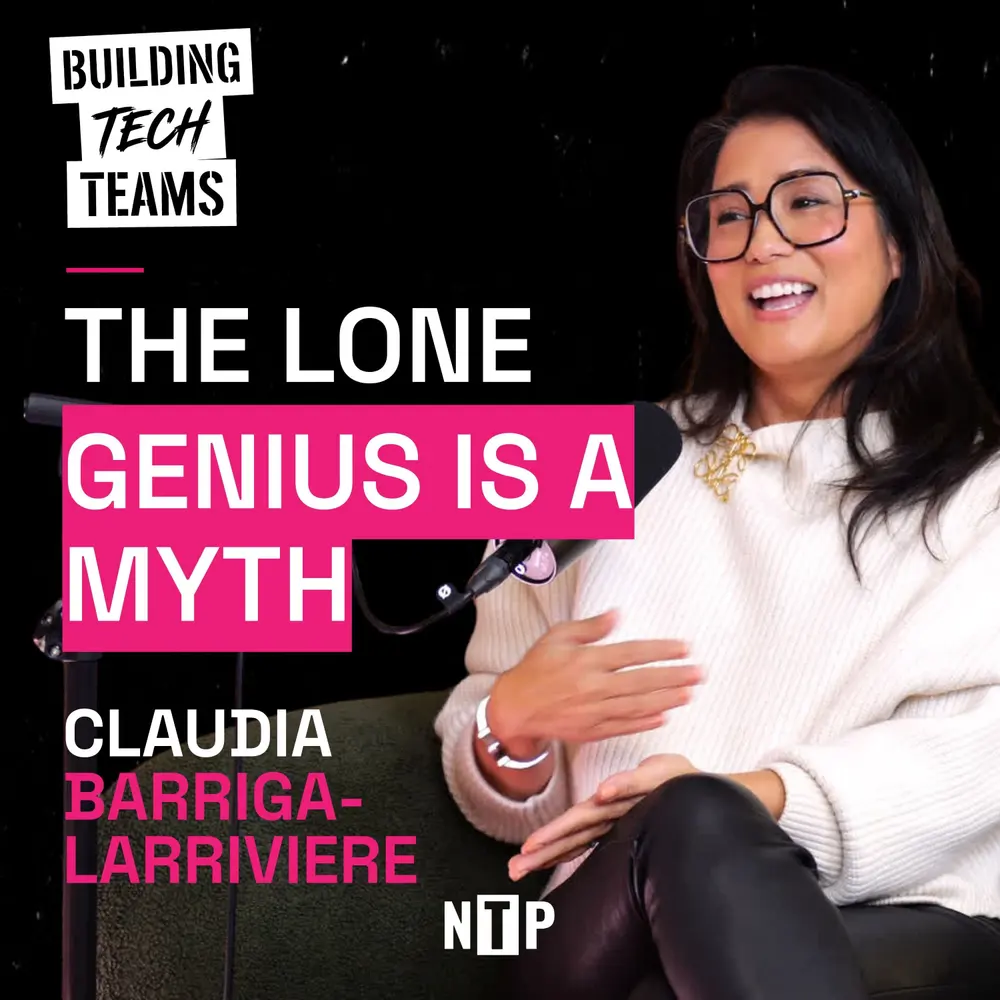
Every great team Claudia Barriga-Larriviere has seen shares one trait: they're comfortable with discomfort. After nearly 20 years building people and culture inside startups and global enterprises, she thinks most of the AI conversation is quietly dodging the hard, human questions.
In this episode of Building Tech Teams, James MacDonald sits down with Claudia — people-and-culture leader and founder of Startup Flamingo — for a practitioner-to-practitioner conversation on how capable people actually build teams. They get into self-awareness as a muscle rather than a gift, why Australia's love of harmony quietly kills direct feedback, and the difference between a genuinely high-performing team and one that's just stressed and running fast off a cliff together.
Then it turns to AI — not as weather to brace for, but as a tool you have to point somewhere. Are your people more productive, or just faster? What do you lose when you automate the uncomfortable parts of the job — the feedback loop, the one-on-one, the human connection — and who is a flattened, agent-run org actually built for? Claudia makes the case that AI should augment an already good team, that you have to build that team first, and that the leaders winning this moment are the ones asking better questions instead of racing to be first.
About the guest
Claudia Barriga-Larriviere is a people-and-culture leader and the founder of Startup Flamingo, with nearly two decades building teams across startups and global enterprises.
Building Tech Teams is produced by Day One®, trusted partners in the technology space and the team that helped build Blackbird Ventures' Wild Hearts. Sister shows include First Cheque, Oversubscribed and Pick My Brain. Episodes are cross-promoted across the network.
Chapters
0:35 The one trait every great team shares: comfortable with discomfort ▶ 1:46 Is self-awareness born or built? Temperament, empathy and psychological safety ▶ 3:28 Why leaders dodge the hard conversation ▶ 3:59 Cutting her teeth on GFC redundancies: directness and an American education ▶ 6:04 Australia's harmony problem vs direct feedback ▶ 6:43 What "high performance" actually means (and what it doesn't) ▶ 7:42 The feedback loops we outsource because they're uncomfortable ▶ 9:17 An Indiana Jones lesson for leaders on protecting the plan ▶ 11:18 Read fiction: storytelling, empathy and depersonalising feedback ▶ 14:35 Praise the person, critique the work — and when to call it out ▶ 16:55 Overconfident founders and the case for yin-and-yang teams ▶ 18:39 Powers of Two: debunking the lone genius ▶ 23:13 Hire for change, not to fit in ▶ 24:20 The maths of a founding team: builder, organiser, learner ▶ 26:41 Glue vs grease: does your team need cohesion or speed? ▶ 28:53 Project or person? The metabolism of a team ▶ 29:47 AI is a tool, not the weather ▶ 33:16 The narrative vs the technology — and the Tickle Me Elmo problem ▶ 41:14 Slow down to speed up: when the market rewards layoffs ▶ 42:32 The CPO's dilemma: more productive, or just faster? ▶ 45:04 When is the risk no longer worth it? (You're paying by the token) ▶ 48:21 Longevity isn't impact: off-ramps and the retention vanity metric ▶ 49:52 Is AI making the manager redundant? ▶ 52:54 The automatic ball thrower: what you lose when you automate connection ▶ 58:31 AI augments a great team — but you have to build that team first ▶ 59:18 Departing advice: play the tape to the end, and be in the business you're in ▶ 1:03:32 Purpose over "who gets there first" — go touch some grass ▶ Resources
Links
Claudia Barriga-Larriviere — Startup Flamingo
James MacDonald — LinkedIn · NTP Talent
Mentioned in this episode
Powers of Two and Lincoln's Melancholy — Joshua Wolf Shenk · Team of Rivals — Doris Kearns Goodwin · The Ten Faces of Innovation — Tom Kelley (IDEO) · The Lean Startup — Eric Ries · How Google Works — Eric Schmidt & Jonathan Rosenberg
Hosted by James MacDonald, Managing Director of NTP Talent.
Transcript Search or select a timestamp to jump ▾ 0:00 Claudia Barriga-Larriviere: And I have this rule of I always praise the individual and critique the work. There's different leaders that take different stances around praising people in public and giving feedback in private. I think there's benefits to either. In order for you to be a really effective member of a team, you have to be either an agent of glue or an agent of grease. I don't know if you've heard about this. So if you're an agent of glue— and this doesn't have to do with care, but glue in terms of cohesion, unity— is there anybody on your team that is worried about, does everybody understand what we're Does everybody have the right information? Are the right people on this, like, not only on this team but in this meeting right now? And the other one is grease, which is an agent of motion. How quickly are we getting there? What is the shortest distance between not doing this and doing this? Great. Or how fast can we get to this goal? And there's this really great creative tension between these 2 things. If your team is very greasy, you should be over-optimizing for glue. If your team is very gluey, you should be over-optimizing for grease. Optimizing for speed. One of the first questions I ask hiring managers, team leads, whatever, is, does your team need to be moving faster? Does your team need to be, you know, cohesive, more cohesive? They have almost never thought about it, but then they have an answer. So that's where you should start hiring. 1:13 James MacDonald: Welcome to another episode of Building Tech Teams. And on today's episode, we're taking a slightly different take. We're talking about building tech teams from the people side of things, and we're talking to somebody that's worked within startups, scaleups, And in enterprise in people functions, Claudia Barriga Lariviere, and she's globally recognized as one of the top 100 HR directors. We talk about the people function. We talk about whilst AI is changing some things within technology and technology teams, many things still stay the same. What are the challenges for technology leaders, leaders in general, and building teams having those difficult conversations? And why these core functions whilst technology changes, trends change, the core function still stays the same. Really interesting take. Claudia has strong opinions. On HR, strong opinions on people functions, and also AI's effect on both technology teams and the more global environment. Hope you enjoy this episode. Welcome to another episode of Building Tech Teams, and on today's episode we have Claudia Barriga Lariviere. 2:11 Claudia Barriga-Larriviere: Perfect. I always want to congratulate people who take the time to say my name. 2:15 James MacDonald: I did a lot of practicing on the street talking out loud by myself before this podcast. I must have looked like a proper weirdo. 2:22 Claudia Barriga-Larriviere: What a way to look like a weirdo. Thank you for doing that for me. Not a problem. 2:25 James MacDonald: Globally recognized HR leader. Thanks for spending the time and coming on the podcast today. 2:30 Claudia Barriga-Larriviere: Pleasure. 2:30 James MacDonald: You've worked in a lot of people teams, a lot of companies from startup level right through to global enterprise-level companies. 2:40 Claudia Barriga-Larriviere: Yes. 2:41 James MacDonald: If we just start, what is one trait that brings all really high quality technology teams across the board? 2:50 Claudia Barriga-Larriviere: I would even go as far to say non-technology teams, such as teams in general, is being comfortable with discomfort. And I think we're going to talk a lot about that today. But like that ability— actually, I would say 2 things. One is like self-awareness, like individual self-awareness of, you know, these are my strengths, these are my weaknesses, and this is how we complement each other. I think that's a really, really key thing at all levels. And at all, like longevities of teams is really interesting. But yeah, that the, the discomfort of being able to have difficult conversations, challenging things, saying, actually, I don't think that's a good idea, or man, I have a better thing that we should do. Those 2 things, I think across all levels that I've seen, and it's not a hard thing to spot from a distance nowadays. So yeah, I would say those 2 things. 3:44 James MacDonald: On that point, self-awareness, easier said than done. 3:48 Claudia Barriga-Larriviere: For sure. 3:49 James MacDonald: Do you think it's something that can be trained? Do you think it's something that people can learn and get better at over time? Do you think it's something that people innately have? How have you seen the people that are best self-aware, have that higher, highest degree of awareness? Is it something that they continually work on? 4:08 Claudia Barriga-Larriviere: I think all of those things, but I think there's a level of temperament, right? So you're born with temperament and then you acquire personality and you have all of these environmental things. I find it really fascinating, the idea of self-awareness as a skill, but also some muscle. So it's something that you can definitely develop. There are people who have this innate quality to it, but also it comes hand in hand with empathy, which is something also we have to develop as babies. There's always like PIJ models about like when and how like kids develop empathy and are iPads good for them or not? And how are we actually sheltering our kids from discomfort? I mean, I'm very childfree. I have a dog who's not feeling well today, which is why I was late today. But this is how we form all of these muscles and this is how we end up with them as adults. Right. And one of the things that is the Venn diagram in there is that like that emotional, emotional intelligence that allows you to actually exercise those things in the real world. So you can have self-awareness but actually not disburse it. 5:17 James MacDonald: Yeah. 5:17 Claudia Barriga-Larriviere: In any way. Right. And being in the right environment to do it, having the right psychological safety to do it, but also having courage to do it is probably even more important than the self-awareness. 5:29 James MacDonald: I think the courage piece you mentioned there ties back into what you mentioned before about having difficult conversations as well. 5:34 Claudia Barriga-Larriviere: Yes. 5:35 James MacDonald: I've been, as a business owner, it's, it's a challenging, you know, you need to do it. It's a very easy thing to put to the side and hope things go away as opposed to really directly having those hard conversations. And it's happened in a lot of the teams I've worked with as well. Again, I think it's a skill that a lot of leaders have to lean into or learn because it, it's not something most people want to take on. 6:00 Claudia Barriga-Larriviere: No. And it's— I mean, I made a career out of having difficult conversations. It's interesting. That's how I got into people and culture work back when I was in advertising. I kind of cut my teeth in during the financial crisis. That's how old I am. This is during the first Obama administration, and I worked in advertising and, and most of my team was made redundant. I remember it being like it was a Tuesday night here when it all happened, and a lot of my team was made redundant, and I got called in by the group. So I work with a huge kind of communications group. It was GPYNR and WPP, and I— the practice leader called me in for HR, and he was like, hey, we can keep you on longer if you can help us have difficult conversations and like effectively let people go because I had a comfort doing it. I largely credit it to one, the psychological safety that I felt as a child just growing up. I'd have really supportive parents who had really high standards for us, but we had a really loving, supporting home. I know that's a privilege and not everybody has that. Yeah, but also you might be able to tell by my accent, I have an American education. There's a lot of directness in an American— an international American education has a lot of like directness. Like you have this hunger for feedback, you have this feedback loops with teachers, and there's like a lot of roads for excellence in those programs. So I've just had that baked in me the whole time. So I've never had to learn it as a skill. I do have a theory about it if you wanna hear it in terms of like why this discomfort is so— 7:46 James MacDonald: Yep. 7:47 Claudia Barriga-Larriviere: It seems unapproachable to a lot of people and it, I think it comes with like self-awareness and all of that. But I think we also have this like permeated culture, um, in Australia. We, we value or seem to at least value harmony above all else. 8:02 James MacDonald: I agree. 8:03 Claudia Barriga-Larriviere: Which I find, again, American education and a Latin American upbringing. It's really interesting. 8:10 James MacDonald: And that's where that direct feedback— people, A, don't like giving it, B, don't like receiving 8:15 Claudia Barriga-Larriviere: it. There's an avoidance to it, like beyond not liking it, right? I don't like eating birth products. I do it all the time. I have to do it. I have an insulin disorder. It's important for me to do it. 8:25 James MacDonald: Right. On that point, you also mentioned just before, yeah, the relationship between that direct feedback and excellence. 8:31 Claudia Barriga-Larriviere: Yes. Yeah. 8:33 James MacDonald: And break that down a little bit further for me because I think you mentioned it there quite loosely, but I think it's, it's a big part of those high-performing cultures. 8:41 Claudia Barriga-Larriviere: Yeah. But also understanding what high performance means, right? So we have all these like vibes of what high performance means. I worked in teams where not only in teams, like in entire companies who are just like, this is a high-performing company and it just means that everyone's stressed out. 8:58 James MacDonald: Yeah. 8:59 Claudia Barriga-Larriviere: I've also worked in very like harmonious companies that are actually high performance, but nobody refers to it like that because no one's running around, right? Yeah. So it's just like understanding, are we all running fast in the same direction, but we're just running off a cliff, you know, at the end of it? So just like understanding that and having a feedback loop and going to a conversation we started having just earlier, it's like the idea of what are we, Happy and comfortable outsourcing is those things that make us uncomfortable. What is it? I mean, my partner is we met we're both startup people, and he used to run these huge teams of customer success and customer happiness. AI, that's the first thing that's gone out the window. Why? Because it's uncomfortable. Why? Because it's a complaints department, right? And we're like, hey, let's grab all of this and take it to places we don't have to see it. Let's put it in the Philippines. Let's put it in Vietnam. Let's put it in wherever it is. And you know, it has to live in this office and it's cheaper, guess what? We would never dream to do that for like a marketing department. Yeah. You wouldn't really dream to do that for the sales department necessarily. You know, those are the people you reward the most. But what is that? That is your feedback loop to the customer. Why are you shortcutting that? Why are you giving that away? Right? And in the same way, and again, I'm biased 'cause I'm a P&C person, we're also really happy to outsource those P&C things. Let's just get a platform that tells us how people feel and what to do about it. Let's get some perks in here. Can we make better sandwiches? Do we have, nice snacks, right? So if you're not comfortable with the discomfort of feedback, constructive feedback, bad feedback, uncomfortable feedback, whatever it is, then how are you going to be comfortable having those conversations with the people who are going to inform the way you should be running your business and the decisions you should be making? Because one, it might be— and going back to the self-awareness— not what you want to hear. 10:51 James MacDonald: Agreed. 10:52 Claudia Barriga-Larriviere: But also it might make you change your plans. And that's a really dangerous thing when you've made a lot of promises, right, to investors, to founders, to whoever it is. And all of a sudden it's like, oh my God, the plan should change. Well, let's protect the plan above all else, right? That's 11:09 James MacDonald: not the information I want to hear. 11:11 Claudia Barriga-Larriviere: That's not information I want to hear. And I, I keep having this conversation with leaders, with like especially first-time leaders around like the idea of like feedback and changing as you go and the discomfort. And I apologize in advance because I use a lot of like analogies in my methodology. I 11:30 James MacDonald: like it. 11:31 Claudia Barriga-Larriviere: But for first-time leaders, particularly leaders who have this like feedback and flexibility, let's call them issues, I always ask them to watch any— and I only recognize the first 3 of the Indiana Jones movies. I don't know how familiar you are with the canon. 11:47 James MacDonald: I've watched Raiders a number of times. 11:50 Claudia Barriga-Larriviere: Perfect movie. 11:51 James MacDonald: Yeah. 11:51 Claudia Barriga-Larriviere: I'm Last Crusade, 'cause it's Harrison Ford and Sean Connery. Forget it. What do you mean? That's how I grew up. Any Indiana Jones movie, he'll go in, has a plan. He's like, these are the Nazis, right? Very clear-cut bad guys. They've done something crazy and we have to fix it. So he summons a bunch of people he trusts, said, we're gonna do this. And then 5 minutes in, it all falls apart. Like literally every movie is that. And then he has to figure out how to pivot. But he has like one, there's one enemy, right? And we have to figure that out and there's a thing to do. And the way that I talk to leaders about it is like Indiana Jones doesn't get flustered about the, let's protect this plan above all else. It's like there's Nazis out there. Yeah. We need to figure that out, right? And they're doing something crazy. Let's stop them from doing that crazy thing or let's fix them doing that crazy thing. Yeah. So there is that focus of like where you are as a leader. If your job is to protect this plan above all else, you're not going to let any of those external things that are getting in the way inform things, surprise you, or even change it for the better. And I think that's a really dangerous thing in how quickly we want things to move. 13:09 James MacDonald: How do you go about coaching people to be better at that if they're leaders out there listening to it? and they're challenged by these situations. 13:18 Claudia Barriga-Larriviere: Yeah. 13:18 James MacDonald: What's your advice for them in improving that skill set? 13:21 Claudia Barriga-Larriviere: I'm just going to sound a little weird, but I would say read. 13:24 James MacDonald: Yeah, 13:25 Claudia Barriga-Larriviere: read a lot. Read fiction. 13:27 James MacDonald: For what reason? 13:28 Claudia Barriga-Larriviere: Because it's important to put yourself in other people's shoes, right? I have read a lot of Russian literature, not by choice, but I have no idea what it feels like to be a Russian housewife and why anybody would, like, end up flinging themselves in front of a train. But I— that's helped me practice putting myself in other people's shoes. Right. There's also these like, and again, like going back to my need for analogy, I think that's how we connect with the world. Like, and not only through fiction, but like through story. I truly believe that's how we're wired. That's how we make change. 14:02 James MacDonald: I think storytelling is actually one of the biggest and greatest skills people can learn. 14:06 Claudia Barriga-Larriviere: I mean, this is how the world turns, right? And this is how changes happen. This is how revolutions ignite. This is how I truly feel that we connect as people. 14:15 James MacDonald: And on a much smaller scale, how startups grow. That's how you attract people to your team. That's how you attract investment. That's how you attract customers. Storytelling's a significant skill. 14:26 Claudia Barriga-Larriviere: That's how you align people. That's how— and again, at the atomic level that we connect, we're pack animals. And that's our, you know, that's our language quite literally. So I would say read. And read with intention. There's also all of these things I use a lot of, like literature, movies, like pop culture and all of that, largely to depersonalize also working with leaders. If you can be like, well, this is what you're doing and this is why it's wrong, this is what the feedback and this is what it is. It can be very confrontational. Again, when you're not comfortable with discomfort, there are people that are just, tell me. 15:02 James MacDonald: Yeah, 15:03 Claudia Barriga-Larriviere: right. And I work with leaders across the world. I remember, I think this was at Sendoh, 'cause we had like the Philippines contingent, we had the American contingent that was fairly new, and then there was the Australian contingent. And when we started putting in all like our feedback program and all of this like performance reviews and all of that, it was a huge difference between how each of these cultures, I mean, obviously at the individual level, but like how these cultures would take into consideration what feedback was, right? Whereas again, my American occasional will be like, actually that doesn't look like, can you do it again? Or can you bring it back to me when it's ready? And then I find myself in, you know, an Australian context often going like, hi, so thank you for giving this to me on time, but I think it needs another pass. Do you mind if I give you feedback? Like, so I now I'm 5 sentences into what should be 3 or 4 words. 15:59 James MacDonald: Yeah. 16:02 Claudia Barriga-Larriviere: There is elements of how do you take the cultural context of it, not only the leadership, but also meeting people where they are. I think storytelling and that analogy piece is really helpful. 16:20 James MacDonald: I think the depersonalization, I think that's what you mentioned there. I think that's probably the most important part because especially with constructive feedback, people can take it personally. And if you can remove that personalization and we're talking about something that happened or a task or something that hasn't gone to plan. 16:36 Claudia Barriga-Larriviere: And I have this rule of I always, I always praise the individual and critique the work. And that has worked really great for me. There's different leaders that take different stances around like praising people in public and, and, you know, giving feedback in private. I think there's benefits to Either. One of the questions that I love asking founders when I start working with them directly is, do you want me to give you— when you say something crazy, so it's not for feedback about everything, but like, if you inevitably— we're all going to say something crazy. Sometimes it can be insensitive, sometimes it can be even not politically correct, whatever it is. Do you want me to call it in? in public, like maybe you say something at an all-hands, or do you want me to save it and bring it up in private in our one-on-one or something? And there's a difference between— and there's no right or wrong. I'm just saying there is a difference between a founder who would say, oh no, no, call it out on time because I want people to use it as a learning opportunity, to a founder that might say, or a CEO who might say, actually, I would like to explore that further later. So maybe let's, you know, keep it between us for now until I get more fluent in it. And either of those are fine, but there is— you have to count on their own self-awareness to understand which one's going to work for them. And I think a lot of leaders in general overestimate their own emotional intelligence often. And again, that's not a bad thing. We're all people, we're all learning, we're in this mortal coil figuring it out. But a lot of them would have gotten a lot of like confirmation bias of like how good they are at culture and all of these things and not necessarily have examined it for themselves. Yeah. 18:16 James MacDonald: Do you think there would be a high percentage of those people as startup founders? Because I think it does take a level of confidence, a level of charisma potentially, but definitely a confidence thing from a startup founder to actually go out and say, I'm going to build something that people are willing to pay for. You have to have a level of self-assurance or confidence. 18:35 Claudia Barriga-Larriviere: Thank goodness for overconfident people. I wouldn't have a job otherwise. Yeah, right. But there is a yin and yang to it, and I'm Really, I'm a huge advocate for balanced teams. I say that 20 times a day. 18:48 James MacDonald: Yeah. 18:49 Claudia Barriga-Larriviere: So there has to be like a yin and yang. There is that over— I wouldn't say confidence, but like just confidence altogether, not even overconfidence to be able to get up in the morning and be like, there isn't this thing, there's going to be this thing. I'm going to be the one that makes it. I don't have that. Like, I just don't have that. That's not in me. I'm a good yin to that yang. So you can, you can definitely develop it. But I think there's also a very deep need for a lot of people to go, actually, I need to be checked on this confidence, or I need to be, need to have a counterbalance in it. Like, there's a lot of theories around like, Do startups do better, or do companies do better with like co-founders rather than founders? Like, please check me on this. It's in the Pollinizer book somewhere. I come from the Pollinizer School of Startups. 19:48 James MacDonald: Yeah, 19:48 Claudia Barriga-Larriviere: I like I owe like my entire methodology of bringing on all of that. And at the time, I think at least for a while while I was there, Phil and Mick only took. startups that had co-founders, or that then they would then find a co-founder for them. Yeah, because there was that balance. So they can't just be just one person going like, this is how it's going to be. And I think that was true, at least while I was there. There is that duality. There's a wonderful book actually called Powers of Two. I don't know if you've ever heard of it. 20:21 James MacDonald: I haven't. I haven't read it. 20:22 Claudia Barriga-Larriviere: My God, it's my favorite book of all time. 20:24 James MacDonald: It'll be on my list. 20:25 Claudia Barriga-Larriviere: Please put it on your list. And it's a really complementary book to like any other, like team building book and all of that. And it's a narrative book, like it's, it's It's very much about partnerships. 20:35 James MacDonald: Perfect. 20:35 Claudia Barriga-Larriviere: But there's this author called Joshua Wolfschenk. He does biographies and he had this— he has a seminal biography about Abraham Lincoln. Again, my American education. I love presidents. I love The West Wing. If anybody has— needs a show to binge watch, he wrote this really in-depth biography about him, about all of his accomplishments. And he found out that for every accomplishment he was in the middle, and he like emancipated enslaved people and did all of these amazing things, including like inventing a whole way of debating and the Lincoln-Douglas debate and all of that. And what Shank did was he mapped out all of this accomplishment. It turns out that every single one of them coincided with Lincoln's bipolar bouts. Sir Tony was undiagnosed bipolar back then. I can't imagine there was a diag— there was no DSM. 21:32 James MacDonald: I don't think so. 21:33 Claudia Barriga-Larriviere: Right. So he was untreated. I remember reading it and he would go into the woods and friends would have to go find him because he might have unalived himself. Like, it was really crazy. Um, like the situation was crazy. So he was like, well, how did he manage to do all of these things like in one lifetime while dealing with all of this stuff? And the reason he could do it is because at each of these inflection points, he had what Joshua Wolfshank calls a creative partner, whether it was his wife. It also turned out to be mentally challenged. I see his vice president. He famously also— fantastic book, Team of Rivals— put together his cabinet as a team of rivals, people who didn't agree with him. 22:14 James MacDonald: Yeah. 22:15 Claudia Barriga-Larriviere: Which also is a really great theory for balanced teams. But it's those creative partnerships. So he started this theory and this methodology about like the most atomic version of creativity and disruption and innovation is a partnership, and it's a partnership that is complementary to each other. So he started writing this other book called Powers of Two, and he like puts them in buckets. It's a fascinating book. The, the like the organizing principle around it is to debunk the idea of a lone genius. The idea there is this— Steve Jobs is this whole thing. No, actually, it's Steve Jobs and Steve Wozniak. You just didn't hear about it, right? Yeah. This common thread that they all— that has across the book, which is really beautiful. I'm in love with the musicians, so this spoke really deeply to me, is the partnership between Paul McCartney and John Lennon, who are wonderful, wonderful on their own, but never as good as they were with each other. And like how those partnerships work and how even conflict and partnership is really, really good. So and whether you find that in a co-founder or you find that in your board or you find it in your partner or in your friendship group, there is a vulnerability that you need to have, like people coming through the cracks. And often that confidence doesn't let those cracks be visible. 23:41 James MacDonald: Yeah, you know, it's not early on. 23:43 Claudia Barriga-Larriviere: It's used as armor. 23:44 James MacDonald: Yeah. 23:45 Claudia Barriga-Larriviere: especially if it's like overconfidence and it kind of hermetically heals, like seals you from finding that partnership and that thing that is going to actually unearth that innovation and disruption or even success and joy just at a very atomic level. Right. Yeah. So yeah, I highly, highly, highly recommend that book. It's such a fascinating read. And then you— because it's a lot of— it's obviously it's a lot of historical things, right? 24:13 James MacDonald: Yeah. Comes back to your storytelling though, right? It's actually getting a point through for actually seeing other people's experiences. 24:18 Claudia Barriga-Larriviere: It's so powerful because it's, you know, you know, a tech, you know, the seminal tech, the origins of Apple, right? And then you have, you know, Balanchine reinvented ballet in New York, and he had to find a very courageous dancer who was willing to break that with him. 24:37 James MacDonald: So for people building their teams. 24:39 Claudia Barriga-Larriviere: Yeah. 24:40 James MacDonald: Whether it be looking for a co-founder or a bigger organization, you mentioned the yin and the yang and finding that, that person. How do we go or how do you go about finding that person that, you know, it's very easy to go and find somebody that looks very similar to you. 24:55 Claudia Barriga-Larriviere: Yeah. 24:55 James MacDonald: Thinks very similar to you. Feels like it'll be easy, whereas quite often it's that person that is willing to challenge you, willing to have that yin to the yang. How do people go about that? How do you coach people around building their teams for that? I know you've mentioned about hiring for change. 25:11 Claudia Barriga-Larriviere: Yeah. 25:11 James MacDonald: Not hiring for somebody that's going to fit in. 25:13 Claudia Barriga-Larriviere: Yes. 25:14 James MacDonald: I'd love you to break that part down a bit because I think it's a real challenge at bigger companies. It's a, it's a challenge for founders trying to find their co-founders, that first hire, which is uber successful to their actual success. 25:28 Claudia Barriga-Larriviere: Yeah. 25:28 James MacDonald: How do you go about that? How do you go about coaching that? 25:30 Claudia Barriga-Larriviere: I mean, I think that comes back to— so I largely come from incubators. So we had to develop a methodology as to like, how do you not only have your like first hire, but it's like, how are you going to— what is the mathematics of your founding team? And when are you ready to actually have a— be in charge of a full person? 25:49 James MacDonald: Yep. 25:49 Claudia Barriga-Larriviere: And it's interesting because again, it depends on like the maturity of the person actually doing it. Right, and how much help you you need. One, I would say you shouldn't do it on your own. Like you should find somebody to help you do it. It doesn't have to be me, but it has to be somebody who understands. I'm constantly talking about like team chemistry, and it's like beyond yin yang, right? There's another fantastic book, *The Ten Faces of Innovation*, by the IDEO guys. They have these like ten archetypes of what makes an amazing team. you're going to have 10 of these, you know, exact different people in it. But there is this really magical alchemy that comes from having different people on the team and different perspectives on it. But the ingredients largely are 3. Mm-hmm. So at any point in a startup or in any team, but in a startup as a, as a human, you know, collective, you should be building. So you should have a builder, an organizer, and a learner. Somebody who's making the thing, somebody who's learning from the market, learning from your users, learning from how the politics works within your industry and sector. 27:02 James MacDonald: That's going to be the person that's probably selling it as well, I imagine. 27:05 Claudia Barriga-Larriviere: Largely, often the person selling it. And then the organizer, so somebody who knows how to run things. And again, that doesn't have to be the person in charge necessarily or the CEO. but somebody who understands politics and process and compliance and all of that. So you're not just, you know, going back to one of the things I think we're now living with the consequences of, like, break things, you know, move fast and break things. It's like unorganized would be like, how about let's break less things, right? How do we navigate the world and still do things and still like comply with the law and like figure all of these things out and all of that? Yeah. And there are ways to find out whether, you know, you have those right elements in the team. The— I think correspondent to what we were talking about in terms of like dynamic partnerships and creative partnerships, there's also a really great precept called the Glue and Grease. It's Harvard Business School idea that you can all Google, but it's a really, really amazing It sounds so simple, but ultimately is such a powerful, just turnkey thing. So in order for you to be a really effective member of a team, you have to be either an agent of glue or an agent of grease. I don't know if you've heard about this, but it is— these are the questions that I always ask. Yeah. So if you're an agent of glue and this doesn't have to do with care, but like glue in terms of like cohesion, right? Unity. Is there anybody on your team that is worried about like this? Does everybody understand where we're going? Does everybody have the right information? Are the right people on this, like not only on this team, but in this meeting right now? 28:47 James MacDonald: Yeah. 28:47 Claudia Barriga-Larriviere: Are we following this up correctly? Like, is our, you know, that type of default setting. And the other one is grease, which is an agent of motion. How quickly are we getting there, right? And it's in charge of being like, what is the shortest distance between not doing this and doing this? Great. What is the resistance between, or how fast can we get to this goal and how do we get? And there's this really great creative tension between these 2 things. If your team is very greasy, you should be over-optimizing for glue. If your team is very gluey, you should be optimizing for speed. Yeah. So one of the first questions I ask hiring managers, team leads, whatever, is does your team need to be moving faster? Does your team need to be you know, cohesive, more cohesive. And they have almost never thought about it. 29:40 James MacDonald: Yeah. 29:41 Claudia Barriga-Larriviere: And then they go and then— but then they have an answer. So that's where you should start hiring. 29:45 James MacDonald: I think it's a really good point on actually challenging a hiring manager or challenging a, a company on what does that— what are you trying to achieve with this next role as opposed to I need another engineer because we've got to build quicker. 30:01 Claudia Barriga-Larriviere: Yeah. And that comes to like, is this a project? 30:04 James MacDonald: Yeah. 30:04 Claudia Barriga-Larriviere: Or is this a person? Right. And there's a difference, right? It's like you're acquiring a person and it's like that's a person's livelihood and hopes and dreams and people are going to have to like be invested in this. And you're also adding— we're going to introduce another word that I use all the time, which is metabolism. You're adding another person into the metabolism of a team and a company. So you're adding somebody else's like motivations and bad days and good days and how they affect other people. So there's more than a list of skills that a person has. It's like, how are they actually going to— and this should be everyone's job description should have this as a header is change this company for the better. 30:48 James MacDonald: Yeah. 30:48 Claudia Barriga-Larriviere: Are they going to do that? If not, hire a contractor, figure out this project, get it out of the way. 30:54 James MacDonald: Very good point. 30:55 Claudia Barriga-Larriviere: Yeah, 30:55 James MacDonald: I'm very interested in the space of AI at the moment, how it's changing some things, and also much remains the same. When you're talking about that, you just mentioned before project or person. 31:07 Claudia Barriga-Larriviere: Yeah, 31:08 James MacDonald: I think AI is allowing people to build a lot quicker at the moment. It's allowing companies to move a lot quicker. How do you actually coach people or actually ask them the right questions to decide at the moment, do you need to be hiring another person? Mm-hmm. Or is this a project and can you outsource it? A lot of people are struggling at the moment with, hey, I don't have AI talent within my team, or we want to build this or we want to move quicker. Do I go to an external agency who might be able to actually do it for me? Do I upskill internally? Do I hire the new person with that skill? They're the 3 ways I think a lot of companies are looking at it. Do you think that AI has changed anything, or do you think it very much is the same on what are we trying to achieve? person project? 31:48 Claudia Barriga-Larriviere: Yeah, I mean, it's an interesting question because there's a lot of levels on it in terms of like what it would depend on, like the size of things, the type of company you're in and all of that. But I don't know, I'm always a very enthusiastic early adopter of technologies. I'm finding it really— and not that I don't use it, I use it quite a bit— just really I'm finding it hard to connect with AI as a, well, we think of the world like this, we should think about the world like this instead. Because it is kind of like, if we think about like how people are talking about AI right now, and I hope I change my mind because it's, people talk about it like it's weather, like it's coming. It's like Hurricane Andrew, everybody get your windows ready. 32:35 James MacDonald: Yeah. 32:35 Claudia Barriga-Larriviere: And I'm like, it could also be Nabi, like the people, there's people who are making decisions to make it seem inevitable. Yeah. Right? We could change it. This— people are making it. This isn't actually weather. But to your question is, should, you know, should we think about it in terms of like, has that changed the way that we would approach a project or hire because there's AI here? I think AI's kind of like email in a way, right? Email changed a lot of things. It accelerated a lot of things. We don't have to write letters. Mm-hmm. We don't have to like, phone calls and all of that. So if we think about it in terms of like it's an instrument, it's 33:13 James MacDonald: a tool. Yeah, 33:14 Claudia Barriga-Larriviere: it's a tool. And rather than it being like an authority or the weather that you have to like get ready for, one, then it becomes like largely dependent on what you're directing that tool to do. Like email, I think it does accelerate things. So for example, you can test— and again, I'm an MVP girl from the Paul Andreessen school of test something before you do something. So it gives you an environment in which you can test the smallest thing to prove your point, which is, you know, the golden rule of MVPs and lean startups. And then you can decide what to do with that information. I think it's useful for that as a tool. 33:53 James MacDonald: Great. 33:54 Claudia Barriga-Larriviere: But I don't think it's the thing that you go, yeah, you shouldn't make it an authority in terms of like helping you decide whether to do the other 3 things. 34:03 James MacDonald: As much as things change, a lot stays the same. That underlying principle is really, do we look at this like a project or are we looking at this as a long-term investment from a people side of things? 34:14 Claudia Barriga-Larriviere: Yeah. 34:14 James MacDonald: What are we trying to achieve longer term? Yeah. 34:16 Claudia Barriga-Larriviere: And it should be part of an education and training and all of that, particularly if we— it's a huge responsibility, right? Because it really has 2 levels, which I'm trying to get also myself educated and trained because I get a lot of these questions a lot. The idea of like it is there's a narrative and then there's the technology. 34:37 James MacDonald: Great. 34:38 Claudia Barriga-Larriviere: Right. So the technology is one thing and it's doing, you know, it has a lot of potential, but it also has attached to it a lot of crazy scary things. Right. We have the data centers and the water pollution, all these things like we should like stop and figure that out. But even on the narrative stuff, there is that, well, this can be quicker with less people and save you money. And then the next question is, to what end? Right? I was having this conversation with somebody the other day and all I could think about is, again, this is how old I am. Back when I was a little kid, there was the frenzy about Tickle Me Elmo. Do you remember that? 35:20 James MacDonald: Yeah. 35:20 Claudia Barriga-Larriviere: And everybody wanted a Tickle Me Elmo. I don't think kids wanted Tickle Me Elmos. I think parents were crazy about the Tickle Me Elmo. And then I remember thinking about it and I was like, if you get a Tickle Me Elmo, I think you would get it. It'll be the novelty if you can tickle it. 35:35 James MacDonald: Yeah. 35:36 Claudia Barriga-Larriviere: And then how do you play with it? Like, how does it, you know, 35:39 James MacDonald: what does that look like? 35:40 Claudia Barriga-Larriviere: Do I play with like my Barbie dream? How, like, how does it live with the rest of my life as a 7, 8-year-old, like, why do— or however old you are, would you want a teko mielma? So I think there is the longevity of it. It's like, if we don't understand why we're getting it, and it's like, what are we going to use it for, and how it lives with the rest of the things that you're doing, then what is the point? I've yet to— I've met a lot of people in my daily life, not only in terms of the work that I do, but in just the life I lead. I have yet to meet anybody who's like, you know, my most treasured possession is my old Tickle Me Elmo from when I was 6 years old. 36:18 James MacDonald: It's the first time I've heard the analogy between Tickle Me Elmo and AI. 36:22 Claudia Barriga-Larriviere: It feels like the hype. 36:23 James MacDonald: Yeah. 36:23 Claudia Barriga-Larriviere: Right? And also the fact that I truly think it's like the parents are really, were really disconnected as to how their children play. 36:31 James MacDonald: I agree. 36:31 Claudia Barriga-Larriviere: And I think there's a lot, not all of them, but there's, I think, a lot of CEOs and leaders that are like, we should get it. And they're disconnected as to how their teams are gonna use it. 36:41 James MacDonald: I think this is the biggest challenge I've seen. I've talked to, plenty of companies every week on— there's a board or a CEO. 36:49 Claudia Barriga-Larriviere: Yeah. 36:49 James MacDonald: Who hears the hype and says, runs it down the, down the chain. What are we doing with AI? We need AI without actually understanding or trying to take that one step back. What is the problem we're trying to solve with this? Yeah, it's a very powerful tool and it's getting more and more powerful. But like, what are we trying to do? Are we just throwing technology at a problem? 37:08 Claudia Barriga-Larriviere: Yeah. 37:08 James MacDonald: Or are we just throwing technology without actually even knowing what the problem is we're trying to solve? 37:13 Claudia Barriga-Larriviere: Yeah. 37:14 James MacDonald: And it's just we need it. We need it. 37:16 Claudia Barriga-Larriviere: We need it. It's interesting. And maybe this comes from like my jaded people and culture. I've been doing this for almost 20 years now and working almost exclusively with like founder CEOs. It does have the same flavor. I remember when I— there's 10 years ago almost exactly, I started at a company with somebody I trusted really a lot. And I mean, I'm just going to tell the full story because I don't think you would mind. And 37:47 James MacDonald: you're good at storytelling. So let's— 37:49 Claudia Barriga-Larriviere: Hopefully. So I started at Blue Chili. It was a startup incubator and they were very— I mean, I do wonder what it would be like now because you can just build anything with AI at the moment, right? So they would make your MVP and get your first investment, help put together your first team. And I was their head of people. I was there for almost 4 years, and my God, was that an education. It was amazing. So Seb and I— Sebastian Eckersley-Maslin was the founder. He and I had at that point been friends for many, many, many years, and they were at that point, you know, ready to have a head of people. They were about 40 or about 40. And I think because we had that shorthand and we had been friends for a long time, So it was really comfortable, like giving me suggestions about like how we should like form PNC. And obviously you want input from the founder, but it was really funny one day. I think it was my first or second week. He dropped this book on my desk, and we used to sit next to each other. You know, it's like how Google runs. And I went, "Thank you." It's not a book that I would pick myself. And it's like, "Well, I just finished it. I think we should do everything that's on this book." Like, okay, you have a time machine. Like, are we just going to be a search engine now? Like, I just don't understand how this translates into like, this is an incubator. Like, there's not consumer product attached to it. Like, how would you— like, what's the translation here? And also, this is written by the people who it's about. So there's not a— there's not going to be a mistake in this book. Like, they've done everything perfectly because they're Google. Right? So I do find that. And then we'll— and then we talked about it and he's like, well, I mean, just read it, see if there's anything useful. And I did. And there was a couple of things that we could take away from it. But ultimately it wasn't the same linear story. We were not going to all of a sudden go back to 1997 and found a search engine, call it Google, and do all of the rest of it. Right. So you just have to like understand the context that you're in. And I think with AI, we're missing that. Like, what is it? One, I have yet to see, and I really, really want somebody to point me to a success story to it. Like, all I keep hearing about is like how people are trying to regress into like the before times. I want to be wrong about it. I, I like to think of myself as a progressive person who wants progress in all directions. Hmm. And I largely joined tech as a sector and as an industry Because I used to think that as an innovation engine, that it was also a progressive, a socially progressive, you know, force. And I still want to think that, but we haven't really connected that to like, okay, we keep hearing the story about like, we better get ready for AI, but ready for it to do what exactly? Is it like kneecapping the economy and getting ready, getting rid of jobs? these entry-level jobs, just like giving people excuses to fire people and like all of these layoffs. Like even we were talking about like the difference between the narrative and the technology. Yeah. Is the technology on its own, it's a little strange, but we could fix that. I'm pretty sure we can. We're really smart people. We've already put somebody on the moon. This other thing can't be that hard. But what is the real narrative around it and what is it that we're trying to run so fast towards or trying to prepare pair against. I think that there's that, like, we haven't figured that out yet, and yet we're running as fast as we can. 41:19 James MacDonald: Yeah, I think there's a dual narrative going on at the moment because I think there is the hype and the fear of missing out. So everyone's running quick and, hey, I need to do it, I'm behind. You wake up every morning, there's a new product, a new company raising billions of dollars, valuations going through the roof. The hype around that and the feeling that if we don't move now, we're going to miss out. And then we've got the the other narrative around we're going to remove everyone's jobs. If you remove people's jobs, you remove their, their reason for life, the meanings around life. And we end up at a spot where we've got universal basic income as our only opportunity. You know, we're running the two narratives at the moment. And I think we're still in this very much sorting out stage. 41:59 Claudia Barriga-Larriviere: It's strange. And I wish we would slow down so that we could speed up. And the slowing down, I think it's hard because there is a lot of the, the most powerful narratives I think are happening at the level that you mentioned, which is that like a CEO handing me a book about can we run the company like this, 42:17 James MacDonald: right, 42:19 Claudia Barriga-Larriviere: is the same of an investor or a board or somebody that's like, AI seems to be the thing that's going to get us our money back. 42:25 James MacDonald: Correct. So at the moment, our valuation is going down because we're currently sitting in SaaS and AI has got higher valuation. So we need to become an AI company. 42:31 Claudia Barriga-Larriviere: Figure it out. 42:32 James MacDonald: Yeah. 42:32 Claudia Barriga-Larriviere: But there's also like, what is the market? Rewarding. And, you know, you see not in every single case, but as somebody who follows the stock market and like has eyes open a bunch of things, um, you know, you see not every time, but many of the times where companies that have, um, that have gone public and they announce layoffs, their stock goes up. That's scary. Like they're celebrating that the market is rewarding destruction, destruction of livelihoods. And it's a strange formulation, right? Which is like, to what end? Again, 43:17 James MacDonald: I agree. 43:18 Claudia Barriga-Larriviere: Yeah. 43:18 James MacDonald: If I dig into that a little bit, if you're in a chief people officer role at the moment and you're sitting within a company, you have a responsibility to the board. Or responsibility to shareholders. AI's come in and affecting roles at the moment. People are becoming more productive within their current role. Maybe you don't need to hire as many people. How do you operate in that type of environment at the moment? Is, is it upskilling of existing team into different roles within their companies? Because the way I look at it, we've got 2 sort of options. You can have a look at some companies that are laying off staff Yeah. To save money. Other companies that are actually doubling down and saying, hey, we've got this new tooling, our team are even more productive than they used to be. Let's hire more of them. 44:02 Claudia Barriga-Larriviere: Yeah. 44:03 James MacDonald: How do you see in there? Because I think there's a lot of CPOs, head of people at the moment that are sitting in these, these roles and are quite challenged. 44:13 Claudia Barriga-Larriviere: I go to a lot of these HR community events and a lot of them are now starting to be about AI, like AI hiring, hiring and AI restructuring and a lot all that stuff. And we hear a lot of horror stories about it. But right now, I think there isn't a cohesive narrative yet, because I don't think there's a cohesive narrative internally with a lot of these companies, because the CFO might think one thing and the CEO thinks something else, and then the board might be really enthusiastic about it. So I think it's early, particularly in Australia, because we tend to adopt things a little bit later. I agree. because there's a lot of companies that haven't necessarily made up their minds and they're kind of testing, is it true that we're productive? And often my question is, are they more productive or are they just faster? And I just don't know if it's the same thing. 45:01 James MacDonald: I completely agree. I completely agree. And I think a lot of companies, the vast majority of companies are still using AI in some form of proof of concept. They're not actually showing an ROI at the moment. They might be doing a, a small product somewhere, but has it really got to production? Is it really affecting The bottom line, is it really affecting customers? What does that actually look like? And the vast, vast majority are still in this figuring things out stage. 45:24 Claudia Barriga-Larriviere: Yeah. And I think those are really smart questions to ask. And again, I don't want to— I'm not an AI skeptic. I'm a skeptic of the people trying to like steamroll past the important questions. That's what makes me crazy, right? One of the last conversations I had with— I'm going to shout out Shai Chaim. He's The CPTO at E-Club at the moment, one of the strongest, most prepared leaders I've ever just like just thought water amazing, amazing brain. We had this like long conversation about like how do we get ready for this? He has. I very rarely felt this aligned with a leader right like right away. I had very little to do with him coming into the organization, so I'm going to take any credit for that. But we were very, very aligned really right away. And he has this maybe the most sophisticated competency matrix I've ever seen because it very specifically separates the growth for individual contributors and the growth for managers. And I very rarely see that in a tech function done as just elegantly and humanely as that. And we were having this conversation about like how do we prepare for this? How are we going to think about it? What are the principles that we're going to think about it? And like, what, what, what would be the levers by which we are going to effect this change? But also the idea is like, when do we really— like, what is the— and this is like what people think about risk a lot. A lot of it is just like recklessness. Yeah. But also like vibes, you know, does this feel dangerous and therefore it's risky and therefore I'm being like a really brave leader. It's like, okay, so when is the risk no longer worth it? So is it when we're paying by token, which is happening now? 47:14 James MacDonald: I completely agree. 47:15 Claudia Barriga-Larriviere: So it's like, when is it— when does it stop being worth even exploring this as an organizing principle by which— and not just like email? 47:24 James MacDonald: Yeah. And if you're running an agent and the agent's tokens cost more than a human being and their equivalent output, 47:32 Claudia Barriga-Larriviere: And also, isn't my favorite definition of a startup is a startup is a human organism that operates in great uncertainty. That's an Eric Ries definition, the Lean Startup guy. So it's like you're just removing the humanity just for the vibes of it. Like, I just, I just don't understand that as an endgame of it, right? But this was a really illuminating conversation that I had with Shai coming from somebody who has had a lot of experience, a very— a lot of permutations of what a tech team and an excellent tech team should be. And one, I love that he was asking questions as opposed to being like, well, this is how it's going to be and this is the rules and this is how we're going to do it and these are the changes that we need to make. Hi, HR lady, go ahead and do it. But it's like, okay, so how do we figure it out and how are people going to feel about it? And like, how do we get the early adopters to it? And how do we give also people permission? And this should— this is conversations happen in every organization, which is the— you might not like separate and apart from AI, all organizations change, right? Particularly a startup. Its entire job is to change and grow. 48:46 James MacDonald: Correct. 48:46 Claudia Barriga-Larriviere: Is there are people who love and thrive in an 8-person organization, who hate being in a 50-person organization, who super hate being in a 200-person organization. And there should be like off-ramps that are, you know, kind and human to those cycles. 49:04 James MacDonald: I completely agree. I've had this conversation in recruitment all the time. Just because you were at a role for 18 months and have moved on doesn't mean it was a bad role. It was the right role for you for that period of time. And sometimes you outgrow it, sometimes you outgrow the company, sometimes the company outgrows you. Just because it's not a 10-year job doesn't mean it's not a success. Yeah, there's a right place and a right time, right company, right size. Right trajectory at the right time, 49:28 Claudia Barriga-Larriviere: and the impact as well. Because I've seen people come in and make a huge impact and build something really great in six months and move on, or three months and move on, because that's what 49:40 James MacDonald: they do. 49:40 Claudia Barriga-Larriviere: They do. They have a big hammer, come in, figure it out, leave. And then there are people who do are around for twenty years doing nothing. 49:49 James MacDonald: Yeah, 49:49 Claudia Barriga-Larriviere: right. I come from advertising. I've seen people be in an industry for forty years and not only do a bad job, but bring the whole industry with them. Yeah. So it— I don't think there's this like— the idea of retention for me is always like having that retention number as like your bragging rights, this vanity metric. Like you just have to understand internally what your metabolism actually is. 50:11 James MacDonald: Yeah. 50:12 Claudia Barriga-Larriviere: As opposed to it's like, are we just keeping people chained to a radiator in this company? Or we made them feel so horrible about themselves that they feel, who else is going to want me? and now you're in an abusive relationship with your workplace. But yeah, there is that, like the idea of like longevity, I don't think has anything to do with impact or contribution. 50:35 James MacDonald: I agree. If we're talking about impact and contribution, you mentioned before individual contributor versus a manager. 50:43 Claudia Barriga-Larriviere: Yeah, 50:44 James MacDonald: I think there's a lot of conversation. Again, we're early days, so things are changing and every organization is doing things differently, but there's a lot of conversation and talk There's a lot of talk around AI flattening organizational structures and there'll be less need for managers. There might be managers of agents or managers of more people. Those people are more productive. That manager title's changing, the manager role's changing. And I know you've got opinions on, is AI making the role of a manager more redundant? Is it making it more challenging? Is it making it easier? I'd love to get your opinion on that because I think there's a lot of people in bigger organizations at the moment. 51:17 Claudia Barriga-Larriviere: Yeah. 51:17 James MacDonald: in that manager title reading a lot of different information out there? 51:21 Claudia Barriga-Larriviere: Yeah, I mean, I think the answer to that question, I think regardless of who you ask, it's going to be a very hypothetical answer. Right. And I think it's going to be a very philosophical answer by definition, because we, as you said, are early days at this like macro level. Right. If we think about AI having been around since technically 2022, but we're really now having it as part of our daily conversation and transformation, whatever, and even earlier than that, right? 51:46 James MacDonald: Yeah, but it's the last 8 months maybe that things have really started to heat up. And I think the model's changed to the point where you can actually see it getting some form of significant output. 51:57 Claudia Barriga-Larriviere: Yeah, I think there's a few layers again to what we can unpack with this question. And a lot of the layers have to do with like human behavior and like the connection and like what the job actually is and how defined it is and how you're rewarded for that job. Like there's all of this stuff and also the type of organization it is. So it's like, okay, so why are you flattening your organization? Is that helpful or is that just saving you money? Right? There's also like, and I should preface this by the fact that I think the people in an organization, particularly people who are leaders and, and maybe even the investors, should be in the business that the business is in. Right? That to say, if the only reason you're doing this is to make money, you're in the finance business, you're not in the hospitality business, in the fintech, but like you're not actually in the business that that company is in. If it's just like for you to extract monetary value, then of course you're not going to think twice if you have to make like a, you know, fundamentally destructive decision, because if it's going to make you money, then that's cute for you. Yeah, but not for anybody else. So and I think on down to like what is the purpose of like flattening an organization and redefining what a manager is and all of that. I have been thinking about this in terms of like, well, how going back to like the analogy part of it is the how do I want to explain it so that we can explore it as leaders? And it made me think of my partner. I spent three weeks in Adelaide, which is where he's from, and we spent New Year's in Goolwa. His best friend has a family summer house there, and they have all these dogs. All the families come together. And have you seen those like automatic, like ball throwers that the dog puts the thing in and it throws the ball? 53:48 James MacDonald: Yeah. 53:49 Claudia Barriga-Larriviere: And we have a dog, we have a little poodle, Charlie, who loves playing with the ball. And when you're working from home, she can be a little eager to play with the ball while you're busy. And whenever we're on a goal, we're like, we should get one of these automatic ball throwers, right? And I guess if we're looking at it from like the automation part of it, which is the AI part of it, and you're in charge of this dog, And every now and then you're gonna need to turn this thing on to give you 10 minutes while you have a conversation or you need focus time and all of that stuff. 54:20 James MacDonald: That's the equivalent of my giving my kids the iPad. 54:23 Claudia Barriga-Larriviere: You know, but if like all you're doing is waking up in the morning and turning that thing on and turning that thing off when the dog goes to sleep, then one, what is the point of having a dog? But also, and going back to why I was late today, I, my dog wasn't feeling well. She's been up all night trying to eat grass and Trying to do all these things. We had a little scary moment this morning where I had to call the vet and like figure some stuff out. She's gonna be fine. She's actually fine. But if I didn't have the relationship that I have with my dog by playing with her and spending time with her and like actually doing that, and instead having this like automation on all the time, one, I wouldn't have been able to answer any of the questions the vet asked me on the phone. It's like, has she been doing this? Blah blah blah blah. The other one is like, I think that I wouldn't have developed. Connection enough for when if I had to make a decision, am I going to spend money and time tomorrow taking her to the vet and doing all these things and probably buying some medication and all of that? I think fundamentally I would make a different decision if I didn't have a connection with this dog, right? And I think it's very similar to what we're trying to figure out with what is the role of a manager. If we are really, really, really good at as people, as humans, to design around discomfort. So we started this conversation. Yeah, right. We are very comfortable outsourcing and automating the things that make us the least comfortable, one of which are that connection piece. So if all you're doing is like whatever the manager equivalent of this ball thrower is, you're going to do it. If it's going to be Actually, I've had this like live conversations the last couple companies that I worked with. And again, not every leader, but the leaders who are prone to do this can now do it faster because they go, okay, so I don't even need to have my one-on-one this week because I already know this. I have a dashboard that tells me that the person has done their task. Like, well, can you— is there any other utility to your one-on-one? Are you going to like develop a, you know, a relationship with this person, understand what their motivation is? understand if they're going through something that they need support with, if they're getting along with the team, if they're participating in it, if they understand what the team goals are. 56:37 James MacDonald: Yeah. If the results are doing really well, but they're about to face burnout, if the results are poor and they're going through a tough time at home. 56:44 Claudia Barriga-Larriviere: Literally anything else other than the thing that you've automated under your dashboard. So I think it's that and, and that idea also that if you're just automating This thing, whether it's through AI or whatever it is. Similar to decisions that had to do with Charlie today, is like if you have to make a difficult decision at some point and you don't have that connection, those decisions are going to be not informed by connection and care and knowledge about this individual that you just automated your relationship with. I would even take it a step further, which is like. What if there was this automated dog thrower to a fake dog, those robot dogs, as opposed to an actual real dog, and the only real thing is the ball? Now we're really in crazy territory, but this is the actual logical conclusion of it, which is like, now we have agents. So 57:36 James MacDonald: you 57:36 Claudia Barriga-Larriviere: don't have to talk to a person. 57:37 James MacDonald: Yeah. 57:38 Claudia Barriga-Larriviere: Right? 57:39 James MacDonald: The point that you made just there is really interesting, is the relationship between the willingness to have a difficult conversation and the willingness to go deep down AI and hire agents as opposed to human beings. Because having a difficult conversation with a human being, obviously challenging. If I don't want to do that, instead of hiring a human, I'm just going to automate more and more and I'll have my AI. I can swear at my AI if I need to because yeah, it's not going to talk back to me or it's going to agree with me. 58:05 Claudia Barriga-Larriviere: Yeah. Have you ever gone into like a bank app or like the economy, whatever it is, and be like, oh, thank God this is a chatbot. 58:14 James MacDonald: Yeah, 58:15 Claudia Barriga-Larriviere: that's never happened to me. I was like, oh no, 58:18 James MacDonald: yes, 58:19 Claudia Barriga-Larriviere: I'd like a person to help me with this, right? 58:22 James MacDonald: Um, 58:23 Claudia Barriga-Larriviere: unless it's like 58:24 James MacDonald: the, the automated response though, where I have to wait for 7 minutes to press 9 and then it goes the 4 layers of that. I will talk to a chatbot over that every day of the week. Well, then I'll talk to a human over the chatbot. 58:35 Claudia Barriga-Larriviere: Yeah, but there is— there's a role for these Right? I think the danger comes when we go like, great, we can eliminate discomfort altogether, and therefore people and connection altogether. And then to again to one end, I feel like I say that about AI seven times. I I don't have a problem with the technology itself. I again, I want progress. If this gets us to a better place, let's figure it out. But let's figure out what that better place actually means and what the consequences. are. 59:07 James MacDonald: And a lot of that would come down to— I think a lot of what you've spoken about is the cohesion of a team and the importance of different personalities with the team, and that creates a great culture. If you add this tool on top, which is super powerful, then you add that to an already great team and you become more powerful again. 59:24 Claudia Barriga-Larriviere: Yeah. And it's understanding that it's like how if this is an augmenting tool, then it should augment great policies and great policy and great processes and a great team. You have to have that first. And I think we're skipping that step, right, of thinking that through and then going like, oh, we have this thing that's going to make us a great team or going to— it's going to make us a great policy. And I don't know that that's necessarily true all the time. 59:50 James MacDonald: If we're going to like departing advice for sitting either as a technology leader or a head of people at the moment and the company's having conversations around AI, You may talk about people becoming more efficient, might talk to job losses. Where do I start? Where do I start as a leader? Where do I start as a head of people? What are the conversations I need to be having internally to set ourselves up so we're attacking this in the right way? 60:13 Claudia Barriga-Larriviere: Yeah. Oh my God. Very big question, James. I don't know if I have a perfect answer. I think it's about keeping asking questions. And I would say, I mean, I give this advice For most things, I think. And when it comes like to, for strategic and structural things, which seems to be what AI wants to be, right? If we're gonna personify it, is let's play the tape to the end. Let's play the whole movie. Like, where do we actually wanna land? Because like right, right now it's the, you know, we're really getting bogged down by the ingredients. Like, what are we actually trying to feed people? Like, what is the, what are we making? Yeah. I think that's one of the things. And also, it's like listen to your people. They're not going to be shy to tell you how they're going to be affected by it. But I think more than anything, I would encourage people just be in the business that you're in. You can't just be there to extract, you know, call it value, but it's like to extract from your workers. One is like we're just like. I don't know. Again, coming back to like the reading and history and understanding, you know, behavior and people and consequences is like, are we just like barreling through like the next French Revolution of like the you know we're living through a cost of living crisis and we're living through all of this like loneliness and pandemics and all of these things and all we want to do is have less human connection. I just don't. I think it's hard for me to square those circles. There is a really, really great opportunity for us to have these internal conversations about the— are we just isolating our people more? Are we making our people resentful? Are we choosing to care about the people who have taken this journey with us, particularly for startups? You know, those people, those organizations that are under 200 people, those are your first believers and those are the ones who are going to carry your story. for better or worse, whatever that is, you know, through, you know, however long that startup journey is going to be, whether they stay in your company or not. Right. Because they're going to be ambassadors to that story whether they're there or not. 62:24 James MacDonald: They'll continue to share the story whether they're inside the walls or not. 62:27 Claudia Barriga-Larriviere: Yeah. And now we have things like Glassdoor. Like there's infinite ways for people to share those stories. Right. So I would say, you know, you have to consider the human In it as a human organization, because again, you can just have like the robot and the ball thrower, and if you want to be that, go ahead. But then you can't complain that there's no economy to hold that, or there's no customers to buy your nonsense. So I think there there is that human responsibility that we're yeah that's falling through the cracks a little bit. I keep, you know, listening to like interviews and things in the news about like these, like the big AI barons at the moment. I'm like, I wish they hadn't dropped out of school. Like, I, I'm very lucky to have had a very privileged education, but it's like the idea of like large part of my communications and journalism degree have been around like ethics and history and human behavior as well as, you know, methodologies and frameworks and all of that. You know, there I think there's a lot of value in the humanities because it's there's a lot of value in being human and having that connectivity. So it's the I think it's our responsibility as leaders to reach out to that and not only share stories but like try to have that being agents of correcting this you know crazy race that we're in and to give it purpose and not just to be. Who gets there first? 64:02 James MacDonald: Yeah, I love it. Purpose, loneliness, ethics. This conversation could have gone on and we might have to do an episode 2 at some point. Why not? For any of the listeners that are interested in talking to you more, finding out more about you, what's the easiest way for them to get in touch with you? 64:16 Claudia Barriga-Larriviere: The easiest way is [email protected] . And yeah, if you think I can help your organization navigate any of these questions, I'll be happy to have a chat. But yeah, I would say go out, touch some grass, connect with people. This is why we're here. 64:33 James MacDonald: Appreciate it. Thanks again for your time today. Pleasure, James. Thank you. Cheers. My best learnings from the conversation with Claudia is we are still so early on in this AI journey. People are still figuring things out. There's no one best way to do everything. But the core people functions, the core team building leadership functions, leadership practices still remain the same. I think people leaning into best practices when it comes to having hard conversations, building culture within the team, actually looking at the type of people you need within your team, whether you're looking for that glue person, you're looking for the greets person, those questions rather than the actual technical capability can be the core and the success in building a strong technology team. Hope you enjoyed the episode. This was the Building Tech Teams podcast. We release new episodes every Tuesday. Really keen for feedback on guests you'd like to see, more topics you'd like to see in depth. If you'd love to provide any form of feedback to me, find me on LinkedIn, James McDonald AU. You won't miss me. This episode was produced by Day One. No transcript lines match that phrase. Try fewer words.





 ▶
 ▶
 ▶
 ▶
 ▶
 ▶
 ▶
 ▶
 ▶