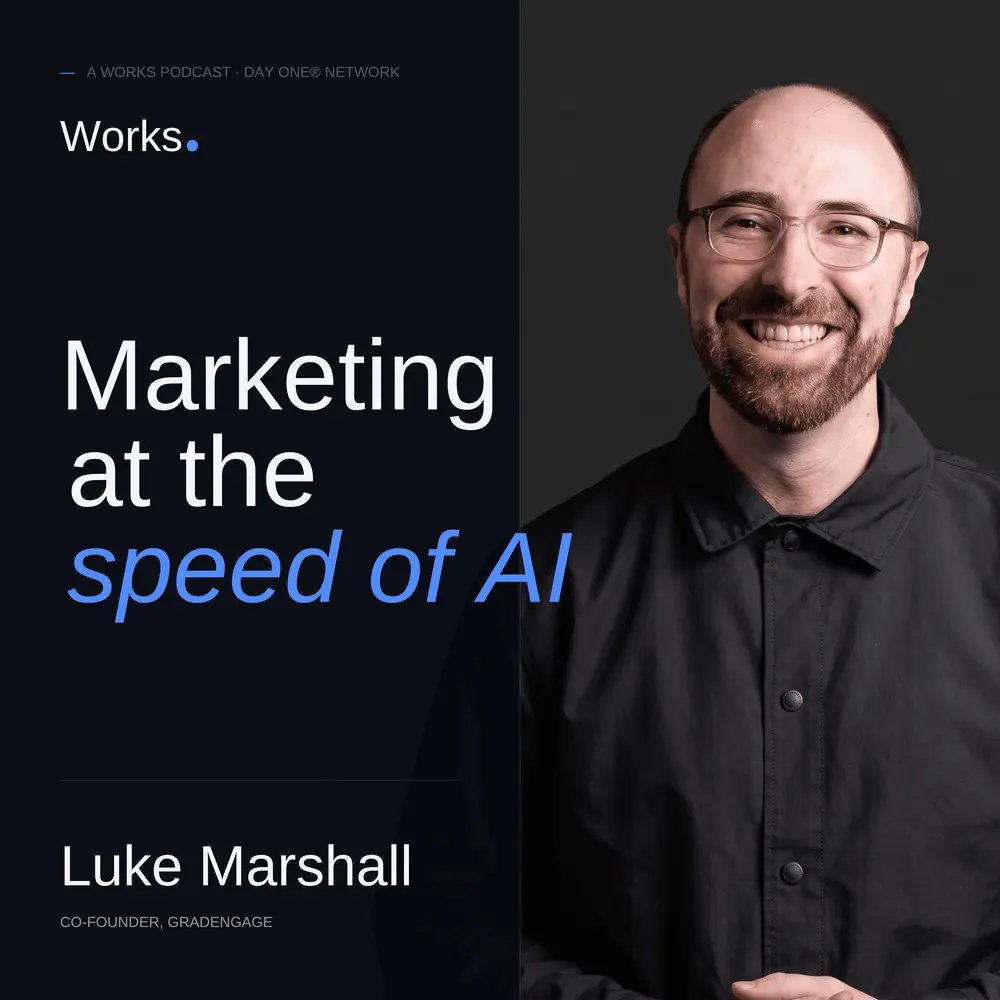
Luke Marshall, CEO at GradEngage runs growth marketing from a single Claude Code instance — hosted on a cloud VM so he can reach it from any device, tied to a running knowledge archive, and extended into everything from lead generation to his own workout tracker.
GradEngage helps companies keep graduate hires warm and prepared in the months between accepting an offer and actually starting the job. Luke, who describes himself as the growth marketing automation lead among his co-founding team, opens his screen to show the system behind it: a landing page and product video rebuilt with Claude Code and shipped to WordPress, and a lead-generation workflow that scrapes public prospect data to auto-generate personalised landing pages and email previews for each target company.
The setup starts with infrastructure. Luke hosts Claude Code on a cloud VM synced to Dropbox, so it's reachable from any device, and pairs it with a skill that finds his latest reference notes without him re-explaining context each time. From there, he walks through a standalone Convex database built to track GradEngage's roughly 6,500-company target market — kept deliberately separate from the CRM so early-stage prospects can be nurtured slowly, without cluttering the pipeline tools the sales team relies on day to day.
Judgement still sits with Luke throughout. He explains why he switches between typing and voice dictation depending on the task, and why he pushed back on a cold pitch offering to run his marketing on full autopilot. That judgement call gets tested directly in the episode's most useful failure: an outreach automation tool re-messaged the same contacts with no response, burning leads before Luke caught it. The fix wasn't more automation — it was less. AI now runs read-only on outbound messaging, tracking open threads for a human to action rather than sending anything itself.
The system extends past work, too. Luke shows a custom workout generator that pushes Claude Code output to his phone and watch, and a from-scratch AI assistant he built for his wife to handle weather, tasks, and a shopping list — settling on a cheaper model to keep it running affordably day to day.
Luke Marshall works in growth and marketing automation at GradEngage.
Chapters
0:00 Cold open: a look at Luke's AI stack 0:55 Meet Luke Marshall and GradEngage 2:34 Rebuilding a landing page and demo video with Claude Code 7:29 Running Claude Code from a cloud VM for lead gen 13:00 A standalone database for the entire target market 17:25 Voice versus typing: planning out loud 19:29 Planning mode and a clarifying-questions skill 22:47 Personal builds: a workout generator and an AI assistant for his wife 27:41 When automated outreach went wrong 31:07 Rapid-fire round 32:00 Where to find Luke and how he sources new ideas Transcript Search or select a timestamp to jump ▾ 0:00 Luke Marshall: Our total addressable market is roughly about 6,500 people, uh, companies globally. 0:04 Zachary King: You have access to it from whenever, wherever. You can summon the beast from wherever you are. 0:09 Luke Marshall: It's just a case of chipping away. 0:11 Zachary King: Tell me about a time when the AI's gone off the reservation. 0:13 Luke Marshall: So I've had kind of burned leads where I've messaged someone 3 times without any, you know, prompt back. That's a bad look. I love custom workouts generated by Claude Code. And so I built an app with, um, a tool, open source tool called WGER. It sends my workouts to my phone. Uh, to my watch. 0:33 Zachary King: I want to get the weekly newsletter from Marshy's Wiki that says, here's the new things that I've added. Uh, and here, and usage, you know, you can put usage on top of that. Operator AI is proudly part of the Day One Podcast Network with more great shows at dayone.fm. Welcome to Operator AI, Luke Marshall, recording attempt number 2. Here we are once again, and this time I've pressed the big red button, which followers of myself on LinkedIn would have seen that I didn't do last time because Luke, who never misses an opportunity for some content, immediately shamed me to all 25,000 people who followed him. Luke, thank you for giving it another go and coming back on, mate. 1:18 Luke Marshall: It's all part of the teaser drip marketing campaign to get as many people as we can. 1:25 Zachary King: I saw a few comments there. People were saying, this is, I'm not falling for this. This is just Marci's marketing spin. I'm not going to fall for that one again. 1:32 Luke Marshall: Yeah. Guilty as charged. But yeah, good to have another go. 1:36 Zachary King: All right. So very excited today to have Marci on board because I have learned just an enormous amount from Marci over the last couple of years since I've gotten to know him. And Marci has built an incredible machine. He's going to give us a little bit of a glimpse of One of the many avenues that he's been doing. If we were going to record all of it, we'd need to be here for days. So he's going to give us a little bit of a peek at something that he has built for one of his projects. I believe it's going to be GradEngage, if I remember from the last recording. 2:05 Luke Marshall: Yeah, that's it, Zac. And see what we can fit within the time range and talk through it. And I guess the benefit is today I'm not at the airport, so I can do it from the home office. 2:18 Zachary King: More time today. Love it. Right. So mate, start to start off with, while you're, while you're pulling up your screen to share that and give us a look, give us a, give us a little intro to what GradEngage is, the actual business, before we see what 2:31 Luke Marshall: you're— Yeah. GradEngage is a platform started by my co-founder, Tim. Essentially, in the world of graduate recruitment, which I accept is fairly niche already, businesses will invest a lot of time, effort, money, budget into recruiting graduates every year. And this could be 5 to 50 people plus. And essentially the bit that we help with is the recruitment marketing during the onboarding process. So when a candidate gets their offer, they won't start for another 6 to 9 months. And we help clients with their content and the automation around that to basically prepare them for entering the workforce. We've got a lot of IP in this area because the founding team, some of them are HR execs. And I guess where I fit in is I'm a growth marketing automation AI nerd and help with all the backend growth and systems around that as well. 3:33 Zachary King: Nice. All right, mate, if you're happy to and show us a look, feel free to fire up that screen of yours. 3:41 Luke Marshall: Cool. And so what you can see here is our web page. This has actually gone through a little bit of an update. I updated it probably about a month ago from WordPress. I don't know if you guys have any experience with WordPress, but I've always found it to be a nightmare with plugin management, updating, and the like. And so one of the things that we updated early on was, you know, we created these new landing pages and Tim is a highly energetic founder and said, hey, could you make the landing page the homepage? Because it's better. And so that's what we did here. 4:23 Zachary King: All of this is— Did you turn your machine at WordPress or is this native we're looking at? 4:28 Luke Marshall: This is, no. So this is actually WordPress. And what we got the AI to do is We built the landing page with the design skills and all via code. And then I said, hey, I haven't done this before. Can we create this in WordPress? What do we need to do? And it updated the theme. And one of the things it did after it did all that is, yep, I've staged it, I've tested it. Here's the theme. Now you can just upload this zip into WordPress. And I said, I don't want that. I don't, I don't want to be able to have to do that manual work. And so we got the backend access from the original developer and said, hey, can you do this bit too to the AI? And it did it. So we're quite happy with it. 5:20 Zachary King: I haven't used WordPress before. So basically you just got it to write custom code in a way that WordPress would be happy with and then had your machine manually Sorry, automatic. Well, now here's one for you. Do we call that manually or automatically these days? Because I'm exactly the same. It's like, you know, whenever, whenever my, my AI tells me, now you just need to upload that. No, I don't. You need to do that. What are we doing here? 5:43 Luke Marshall: Yeah. Yeah. Sometimes. And it's a good point, Zac, because sometimes it's wrong or sometimes it can work out or be directed to work out another way. Another thing that's interesting here, these videos, we actually— this was a recording from our founder, but he said, you know, can we actually get a video done of how GradEngage works? And someone did it with Gemini. And then I'm like, well, let's just, you know, see how it goes. And we grabbed PowerPoint slides from, you know, from the founder and then jazzed it up in GradEngage's look and feel. And you'll notice there's pinks, teals, very much by design because generally graduate recruitment marketing is quite bland. And so we've tried to make it really easy for people to understand, you know, new to the product, what it does. And this video essentially, it may be a few iterations. There's feedback from the founder back and forth. And then, yeah, it sort of does a pretty good— there's some issues there with the the staging, but we're fine. Like we're going at a very fast pace and essentially, you know, iterating. And we didn't even bother with the website for a long time because we were sort of busy, already busy mining leads and sales from the, from the, with the customers and pipeline. And so then, yeah. 7:12 Zachary King: That video AI created as well? 7:15 Luke Marshall: Yeah, 100%. So one of the things I do to make my life easier is I host my main Claude code in a virtual machine, and then it's synced to my Dropbox. And so if I need to get it to interact with files, for example, I'll just— I may as well. 7:34 Zachary King: This is one of the great Marcy hacks, by the way. I love that you were super early on this in terms of setting your machine up directly in the cloud. And the big advantage is you have access to it from whenever, wherever. whatever you're doing via whatever device, you can just summon the beast from wherever you are. It could be in an airport. 7:53 Luke Marshall: Yeah, yeah. And it's like an archive, Zac. So I'm a nerd that sort of archives all my work since 2023 and take fastidious notes simply because I'm forgetful. So, but what I can do is just drop in a— actually, this is a good example. So, you know, my Claude code has access to these weekly notes folder. And it has a skill that says when I drop something in latest weekly notes, it just finds the latest week and then finds the files I'm referencing. And that example in there, we're actually updating the product at the moment. So we've got examples of file stuff from the original product. And I spent this morning planning a bit on what's going on in there for the next build. And so I'll actually show you sort of what the original build is because jumping ahead. But yeah, this is what we use to— we have these landing pages that we designed and create that are custom to the prospect or client we're going after. And you'll note it's very similar to the webpage, but we'll put the client's name in here, the prospect's name in here. And we generate an example version of our products. So this is an onboarding email. This could be anywhere from 3 to 18 onboarding emails depending on the length and before they start. And that's, you know, in someone's inbox when we send it. 9:25 Zachary King: So mate, just to capture that, you are using this for lead generation where you can now instantly spin up a very detailed mockup of what the product would look like. By how do you do that magic? You point it at the website? 9:39 Luke Marshall: Yeah, good question, Zach. So I guess originally we had the founder creating these research docs like, okay, say we're targeting NAB. Here's their social media handles. Here's the recruitment team. Here's their careers website. It's quite manual. And we're like, well, we actually don't need to do it manually. We don't need the founder doing that manually. We created scripts for scraping and finding that information online, some of which is very easy to find. Like, it's very easy to find a careers page. Some of it's harder to find, like recent LinkedIn posts from the recruitment team. And so through a combination of scripts, coding, and then access to tools such as Apify, A-P-I-F-Y. I 10:24 Zachary King: know you're getting Apify credits right now. 10:26 Luke Marshall: Yeah, yeah, mine are getting burned. Like, I've been pounding it. for this new, new, new stage of the project lately. But yeah, and it works exceedingly well. So we were putting together these prototypes manually, like with just prompts and using the information that was searched and then eventually built a template generator. Yeah. 10:49 Zachary King: And that's the process, right? You've got to start the process manually. That's how you build these incredible machines. You build the foundation, you do it once, you point it, you do it bit by bit. And every time you add a little bit more on, another step, do that for me. Here's what I did. Can you do that? 11:05 Luke Marshall: Yeah, I'm sort of quite frustrated by seeing things like this master prompt or one-shot this, and it kind of doesn't make sense. Like with the template generator, we are actually one-shotting things in to generate the landing page and the prototypes, but That took a lot of iterative work to get there. So, 11:32 Zachary King: you know, those clickbaity posts never tell you, here's a one-shot prompt that solved this incredibly complex problem because I spent 9 months working on it and training it and giving it the skills and the templates and the framework. 11:43 Luke Marshall: Yeah, it just doesn't— it's not grounded in reality. So here's some things we're actually doing this morning. You know, Kmart, if you joined as a graduate recruit, this is in Kmart's branding and what to look out for and how to consider things when you're an employee. And then that stuff can be generated in a landing page. So we've got an example here through a partner that we work with, Amberjack. Amberjack's a global sort of graduate consulting house. And so they're a customer of Kmart's customer of these guys. And so we partner with them to bring them templates and say, hey, do you like this? Do you want an example of this? And that works really well. So yeah, the template generator is paired with Claude Code. And I guess the other part that's interesting is we've got API keys because our engineer built the template generator to meet demand. And I said, hey, we want to do this programmatically, like at a large scale. And so The next thing we did was connect it to code with API keys, and that enabled us to sort of really rev it up. 12:58 Zachary King: So that allowed you to hit the ultimate MASHI marketing at the speed of thought. 13:03 Luke Marshall: Yeah. And we've got a pretty well-defined cohort we're going after. Like, you're either English-speaking country and run a graduate recruitment program at a decent scale or not. Like, it's very clear. 13:18 Zachary King: Nice. And that's where your Apify credits are being burned as you get every single one of those on the planet. 13:24 Luke Marshall: Yeah, yeah. So I thought I'd share what we've built here, which is Convex is a very— probably just a more up-to-date version of Supabase. It's a very large-scale database tool that's very friendly with AI and does things very friendly. And so, you know, we've gone after all the recruitment sort of marketing, you know, based on what they do and, you know, fed it into a database. And so our total addressable market is roughly about 6,500 people, companies globally. We've got their details and the like. And now, you know, it's just a case of chipping away and trying to get some on board and getting them on board, you know. 14:14 Zachary King: And so you built that database so that you weren't polluting your CRM or not polluting, but making it busy with leads that aren't relevant. And so you use this external database as the first layer or the first step? 14:27 Luke Marshall: Yeah, almost as like a source of truth. So the reason we start with a, I guess, an overview is the goal will be to convert it slowly over time. But these people don't know us yet. You know, we've got no business sort of contacting them all at once. But what we do want to track over time is we want to be in front of this company at least once per quarter, you know, for as long as it takes to sort of convert this pipeline. And ideally even more, even more frequently they're showing interest. But by putting it in a database instead of a CRM directly, we can start slowly nudging this database. And then if they show interest, they sign up for something, they engage, we can push it to a CRM and obviously touch it with more touchpoints. But doing it this way is super measurable because, you know, like if we convert 5% of that 6,500 over time, we're sailing. Like that is, you know, mission success. 15:25 Zachary King: Yeah, yeah, yeah. 15:27 Luke Marshall: Yeah. And the product is very well defined in terms of product-market fit, solution fit. I went with the founder to essentially a meetup for Australian graduate employers in December last year. I just butchered the pitch. Like, I'm not from this world. I just said, hey, we do this thing where we give an onboarding email for graduates. They're like, oh, I need that, Jimmy, you need this. And I've coached hundreds of startups, Zach, and to have that fit from the customer just right in front of my face without me even trying was like, wow, this is amazing. 16:05 Zachary King: Mate, there's nothing better than when you, when you get that aha reaction when you just show them the product and, uh, and they just go, yes, I need to have that. 16:12 Luke Marshall: Yeah. And, and Tim's, you know, Tim the founder is, is from this world and he was, he was like a piranha in a pool. He's just running around and having a lot of fun, starting a lot of conversations. So yeah, um, Yeah, this is— I told my AI to just give a summary, but a persistent refreshable database of the 8 markets where we're focused on companies, programs, tiers. Obviously some are more valuable than others and then verified contacts and the like. And so one of the interesting things that AI was really adamant about is that it'll probably get worse over time. But UK and Ireland in particular and Canada have pretty strict GDPR or GDPR equivalent guidelines. And so I was very diligent in heeding those and making sure things stayed above board there. But yeah, that's a database that's now sort of active to be able to work with. And I'm really sort of happy with it. 17:09 Ad: You're listening to a Day One FM show. 17:13 Zachary King: If you're watching this thinking, I want this working in my business, well, that's what we do at Worx. Start at workshq.com.au. Right, let's get back to it. So mate, we've got a little bit of your stack so far. We've got Google Cloud, we've got, sorry, Claude sitting on a virtual machine in the cloud somewhere so you can get access to it anywhere. And I saw just then that you were typing to it. Is typing your normal mode or are you more a voice guy? 17:37 Luke Marshall: I flip between both, Zac. Like, I definitely understand the merit in voice being much faster. than typing. And so for small commands like that, I'll still type it out. You know, I'm a writer by— I've been a writer for a very long time. I'm very used to typing things out. But what I've found really good, and I've actually got an example from today— 18:03 Zachary King: I do both as well, but there's 20 years of wiring into my 18:08 Luke Marshall: meat 18:08 Zachary King: time. You know, I talk to it, my hands just jump up. I want to communicate to the machine, it jumps up. And then sometimes I'll catch myself and hotkey into it. Depends how long it is. 18:17 Luke Marshall: Yeah. So I've noticed younger people just straight in. Maybe they haven't got as much wiring on that. 18:23 Zachary King: I don't think my kids will ever learn typing. I think they'll look at it as something primitive that Dad used to do. 18:27 Luke Marshall: Yeah. So this was— but for longer, particularly for planning, I, you know, voice that. I use a tool called Super Whisper. They're all pretty interchangeable at this point. And I talked through what we're trying to do with the product redo. And even with that process, it was pretty fun. I guess that was iterative too because I had it in planning mode on Claude Code, and then it took maybe 5 or 6 cuts of planning mode for me to be happy to be able to pass it then to the engineer. I was like, okay, I can see these things have been put in the document, but I actually need this framing as well. And actually, we need to beef up the design skills here. So use the information I gathered on that. And yeah, I think going through that iterative process, even with the planning, was, was super, super helpful because now I can just pass it to our AI engineer and he'll be able to pick it up and run with it. 19:27 Zachary King: Well, let's unpack that a little bit there. So when you're in planning mode, do you use any specific skills around that? Do you use Grill Me? 19:34 Luke Marshall: Uh, no, I actually haven't heard of Grill Me. Uh, what's that? 19:37 Zachary King: Oh my God, there's something that Marcy isn't using. I love it. Um, so there's a guy, Matt, uh, I forget his last name. I'll put it in the show notes. Prolific guy, puts a lot out. There's a skill called Grill Me, which is very useful for planning mode. We throw it in there and it's just like the beefed up version of, uh, kind of planning mode. It'll just ask you a bunch of questions that it needs to know. And it's very good. I use it in conjunction. Uh, I have a PRD skill. Because I've never been involved in product to that level previously. So I built a PRD skill and I tag it in with GrillMe and away we go. 20:11 Luke Marshall: I can see that being really useful, like in case you miss something in your brief or your product design. 20:17 Zachary King: I'll share that one. Yeah. 20:19 Luke Marshall: Yeah, yeah. One thing that I've noticed with AI is so infinitely complex and variable that everyone's gonna have their own way of doing things. I've probably got a little bit more product direction experience from my startup days and sort of what I've worked on in the past. But yeah, no, that's a great shout. And so yeah, I just in planning mode and Claude Code and just kept reviewing the document and its understanding, well, the way it described what it was going to build until it was in a position I was happy with. There were some key callouts with product that we sort of needed to make sure it hits, design skills being one. And there are a few nuances around this. recruitment marketing world, then I wanted to make sure it included as well. I thought I'd just share— 21:05 Zachary King: Perfect example of, yeah, as you're pulling that up, perfect example of a senior operator with all of your years of experience, knowing what's important in here, giving it the context, but also saying, hey, these are the things you really need to hit. This is graduate recruitment. There are elements of graduate recruitment you need to bear in mind. Here's those. And again, giving it the steering it that way is how you get top-tier results. 21:28 Luke Marshall: 100%. And, uh, I think, yeah, as sophisticated as AI is, and when this is getting filmed, August 2026, where I think senior practitioners in particular have an advantage is being able to direct and, and guide it in a direction that, um, the amount of emphasis to give things and the judgment and decision-making. Like, I'm sure you get a lot of cold pitches as well. It's back and forth thing with the gentleman, um, over the last few weeks who can run my marketing on autopilot. And I'm like, well, I don't want that. Like, I did— the stakes are so high, the accounts I touch are so important that, you know, I don't want you just running that. 22:13 Zachary King: 0.1% of people on the planet who does exactly that. 22:16 Luke Marshall: Yeah, I can see it being really appealing to technical founders and solo technical founders in particular. But, you know, my direction to him was, hey, you know, it's got it wrong and I can understand why it jumped in these directions. because he gave me a full website demo. Like, it was pretty impressive. But I have a portfolio career. Like, the AI will never know, oh, he does this much for the mental health charity and this much recruitment and this much as a consultant. So yeah, it was just— was a miss. Missed the mark a bit. I thought you asked about the stack. And so I just thought I'd show you the laundry list of the stack. So what's up on screen is a wiki that updates every week. Of basically all the things I've built with my virtual machine on Claude Code. Actually, this one's pretty interesting. This is a recent one. 23:03 Zachary King: This is where you've got all of your skills and tools and everything that's plugged in, right? Yeah. 23:08 Luke Marshall: Skills, workflows. 23:10 Zachary King: On our last attempt, I want to get the update. I want to get the weekly newsletter from Marshy's Wiki that says, here's the new things that I've added. And usage, you know, you can put usage on top of that. That would be very interesting reading. 23:23 Luke Marshall: Yeah, well, on the usage, things are dated. So I haven't played with work games since I had the idea in my head in May. It's sort of ranked by— and this one's more recent. I created this last week. So this one is awesome. I can't remember if I was talking to you or someone else about it, but a really bugbear of mine is I love custom workouts generated by Claude Code. And so, but I hate looking at my phone, like it interrupts me while I'm in fitness mode. And so I built an app with an open-source tool called WGER, and it sends my workouts to my phone, to my watch, and then I just click through the workouts as I go. So, you know, the lifts or 24:06 Zachary King: the— Looking at your phone, like what are you looking at? Or is it giving you audio directions? 24:09 Luke Marshall: No, no, it's something that it's just on my watch. So I just tab through my watch as a workout. Which is such a tiny use case, but I love that I can just have that idea and spin it up and it's possible. 24:22 Zachary King: The personalized tools like that, I've got, I've got a, like a longevity project that does all my workouts. It's in there. I haven't quite gone to a native app yet. I've just, uh, mainly because I haven't, I don't want to pay for the Apple license pretty much. So it creates a spreadsheet for me and I look at that and a nice dumb spreadsheet that doesn't distract me. And I just do that every week. 24:43 Luke Marshall: I just follow the instructions and I love it. And then this one I thought I'd share as well. When Hermes and OpenCLAW came out, you know, we tried it with my family and with mixed results. And then when Opus 4.5 in particular and Plus came out, it was like, okay, I think the capability's here now, but it's really expensive. And then with KIMI and OpenRouter and basically having access to the cheapest models now, Chinese models, I built an app for my spouse, Georgia. And yeah, this is her request. Like, she— we're in Melbourne. We need to know the weather and whether it's going to rain every day. What's going on with our boys? What are the tasks today? We don't want to overload ourselves. 25:29 Zachary King: Is this like a daily brief? What are we looking at here? 25:32 Luke Marshall: Yeah, yeah. This is Georgia's app that she It's her personal AI that she just looks at on her phone and does her things. And then she can go and log, put stuff in its memory, reset things. And yeah. 25:50 Zachary King: And so what's this right now? Is this still on Hermes? Where did you end up? 25:53 Luke Marshall: No, this is our own app. So this is on Georgia's website. Like she's got a personal website now that's accessed via a token. And yeah, she accesses it via the phone. And then if there's any changes that are seismic to the app, I just get them on Telegram. So that's probably the last bit of the stack that I'll share. 26:14 Zachary King: Accessing the beast, summoning the demon via like a normal app where it's WhatsApp or Telegram, whatever it is, it was a massive unlock, isn't it? It just really reduces the friction. 26:24 Luke Marshall: So yeah, I don't want to have to do stuff at the computer or have the computer turned on. So yeah, when Georgie wants a change, Georgie would like to be able to view the full shopping list back, asking what fruit and veg is on the list. Currently can add and tick off items, but I can't read the list back to her. So yeah, I just, and then I just say to my assistant, fix this for Georgie. 26:47 Zachary King: Yeah, why can't we do that? Make that so. 26:50 Luke Marshall: It's done. And yeah, I'm the bottleneck here, but while I'm in sort of product creation mode, I want to make sure I'm keeping tabs on what sort of requests she has for future versions of the app. 27:04 Zachary King: Yeah. So good. So that's a standalone app you built, what, with— what's the intelligence on the backend now? 27:09 Luke Marshall: That's being hosted on a subdomain that we have. And then it's controlled by essentially a combination of Claude code, but the coding work for that is done with, I think, Kimmy because it's super cheap. And so, yeah, that's effortless to run now. And Georgia is blown away. Like, she's like, this is what I wanted. I don't care about the tech. I just want it to help me in my life. So 27:39 Zachary King: nice, mate. Tell me, tell me about a time when the AI has gone off the reservation. Have you ever, have you ever had it gone, gone wrong? 27:46 Luke Marshall: Oh, yeah. Yeah, all the time, mate. Nobody's perfect at this. I think where things have gone wrong for me the most is around cold outreach, actually. And there's a tool in cold outreach world called HeyReach. It works fairly well. What I've found, though, is that pushing AI through it too aggressively, things will happen where it won't track last message. And so I've had you know, burned leads where I messaged someone 3 times without any prompt back. And that's, you know, that's a bad look. And so I've salvaged some of them. Like, I'm like, whoops, that was AI. But generally, as a rule of thumb, I'm not letting it run rampant in my LinkedIn inbox. It's more for tracking reads and responses and me manually following up. 28:43 Zachary King: So are you human in the loop at all kind of touchpoints whenever it's going? 28:48 Luke Marshall: I am now. I wouldn't run it purely automatically. automatic. And a tool we've nerded about offline, I love it, is, I may as well show it, Beeper works. 28:58 Zachary King: Your one ring to rule them all for messages. 29:01 Luke Marshall: Yeah, yeah. The Facebook one's currently broken, but for LinkedIn messages, I'm high volume. So yeah, I can sort of run things through pretty quick there. And 29:13 Zachary King: you have Beeper plugged into your, is it plugged into Slack? You got LinkedIn, you got messages, you got WhatsApp? 29:19 Luke Marshall: Yeah, yeah, yeah. So I've got, I got Beeper running on a separate PC because the only way currently I can get it to go stay live. And then what that does is then enable me to track any LinkedIn stuff in particular. It's the main one. So I think it's— I got a little note. Yeah, these are lapsed LinkedIn conversations that it just tracks conversations that started that might need a finish. And I get a heads up about it. So, um, 29:53 Zachary King: that's so good. LinkedIn inbox is just a mess. It's just a hot mess. 29:57 Luke Marshall: Yeah. And then I don't, you know, I haven't been happy with sort of any of the, um, automation solutions for this until Beeper MCP came along because I'm using it just as a read tool. I can track what threads are open and not open, um, in a fairly natural way, which is amazing. 30:16 Zachary King: I've been using browser control for that with Codex, but you've got to give it stipulations because the first couple of, when Claude first dropped browser control, I got pinged a few times on LinkedIn. And mate, you know, for people like us, that's a death sentence. You can't, you just can't risk that, which is why I've always been, you know, traditionally very hesitant on any of the LinkedIn automation tools, using them at all. It's just, it's a very high-risk maneuver. So. 30:40 Luke Marshall: Yeah, yeah. The account's canceled. There goes revenue as a solo operator, like, or a large chunk of it. You need that profile building. But yeah, the read-only capabilities worked really well. And yeah, I haven't done much of the browser control stuff just by virtue of not needing to. I do most things out of code and then directing. But yeah, I can certainly appeal that as well. 31:04 Zachary King: Nice. All right, mate. So thank you. We're going to go into a rapid-fire round. We'll do a couple of short questions. We've answered a few of these already, but we'll get straight into it. Mate, just the first, uh, first response that pops into your head. Don't need to overthink this one. ChatGPT or Claude? 31:21 Luke Marshall: Claude. 31:22 Zachary King: Voice or keyboard? 31:24 Luke Marshall: Both. 31:25 Zachary King: App or terminal? 31:27 Luke Marshall: Oh, terminal. 31:29 Zachary King: Oh, I like it. One shot or conversation? 31:33 Luke Marshall: Planning and conversation. 31:35 Zachary King: Love it. Workflow or agent? 31:37 Luke Marshall: Workflow. 31:39 Zachary King: Human review or YOLO? 31:41 Luke Marshall: Human review. 31:43 Zachary King: Love it. You went in the loop. Mate, thank you so much. This is exactly what Operator AI is supposed to be all about, taking a real problem and seeing real operators build stuff on it. So thank you for sharing. Mate, before we go, let people know where we can find you. 31:58 Luke Marshall: Yeah, I guess 2 main portals. My LinkedIn is, I'm very responsive on there. So just Marshwa on LinkedIn, Luke Marshall. And then I've got a website, lukemarshall.net, which is more for my writing and experiments and have a lot of fun in there as well. 32:13 Zachary King: Nice. And mate, how can we be helpful? 32:16 Luke Marshall: Yeah, feel free to connect, ask questions. Yeah, I think for me, just being an active community member and sharing knowledge and what works and what doesn't has been super helpful in my interaction with you, Zac, and for anyone else nerding out on this. stuff, I'm more than happy to have a chat and swap notes. 32:36 Zachary King: And mate, what's your, um, what's your biggest source of alpha when you're finding out about AI? I think, uh, you're a video guy, you like YouTube if I remember correctly. 32:45 Luke Marshall: Yeah, I, I hoover up the YouTube, um, on long runs, long walks, on long drives, um, just on audio mode. And, uh, I find enough goes in. And then I saw it in, um, uh, a tool called Readwise and Reader, which lets me just, um, review and keep track of all the nuggets that I'm saving. 33:04 Zachary King: It's so amazing at the moment. It's like, hey, this is really good. Throw it at your machine and say, hey, what should we do? What should we pull from here? Is there anything useful that we can figure out? 33:13 Luke Marshall: Yeah, yeah. There's actually a new project I can't talk about yet that— 33:17 Zachary King: More projects. 33:19 Luke Marshall: Yeah, I've been saving snippets around this new industry, an area I don't know as much about, into Reader. And then I said, hey, using these playbooks and things I'm observing, What can we spin up that might have some impact in this space? And so I can tell you a bit more offline. 33:35 Zachary King: Oh, love it. I love it. Well, mate, thank you so much for joining for the second time today on Operator AI. It's definitely— I see a red button here. It looks like we've recorded this one. 33:45 Luke Marshall: Yeah, well done. 33:46 Zachary King: All right, Marcy, thanks a lot, mate. That's Operator AI for this fortnight. Do me one favor. Send this episode to one operator who needs it. That's how shows like this find their people. I'm Zachary King. See you in a fortnight. 34:02 Ad: Hey, thanks so much for listening to this episode. I'm Adam Spencer, the founder of Day One, and I've got a show that I'd love to recommend if you enjoyed this one. An AI workflow never lands in a vacuum. It changes roles, hiring, leadership, and the way a team works together. Building Tech Teams with James McDonald explores those organizational choices with founders, CTOs, engineering leaders, and people leaders. If you enjoy seeing the tool-level detail on Operator AI, Building Tech Teams is the next layer, how to build and lead the people who make that workflow work across a company. Search Building Tech Teams wherever you get your podcasts, or just go to dayone.fm and you'll find the show there. No transcript lines match that phrase. Try fewer words.




 ▶
 ▶
 ▶